
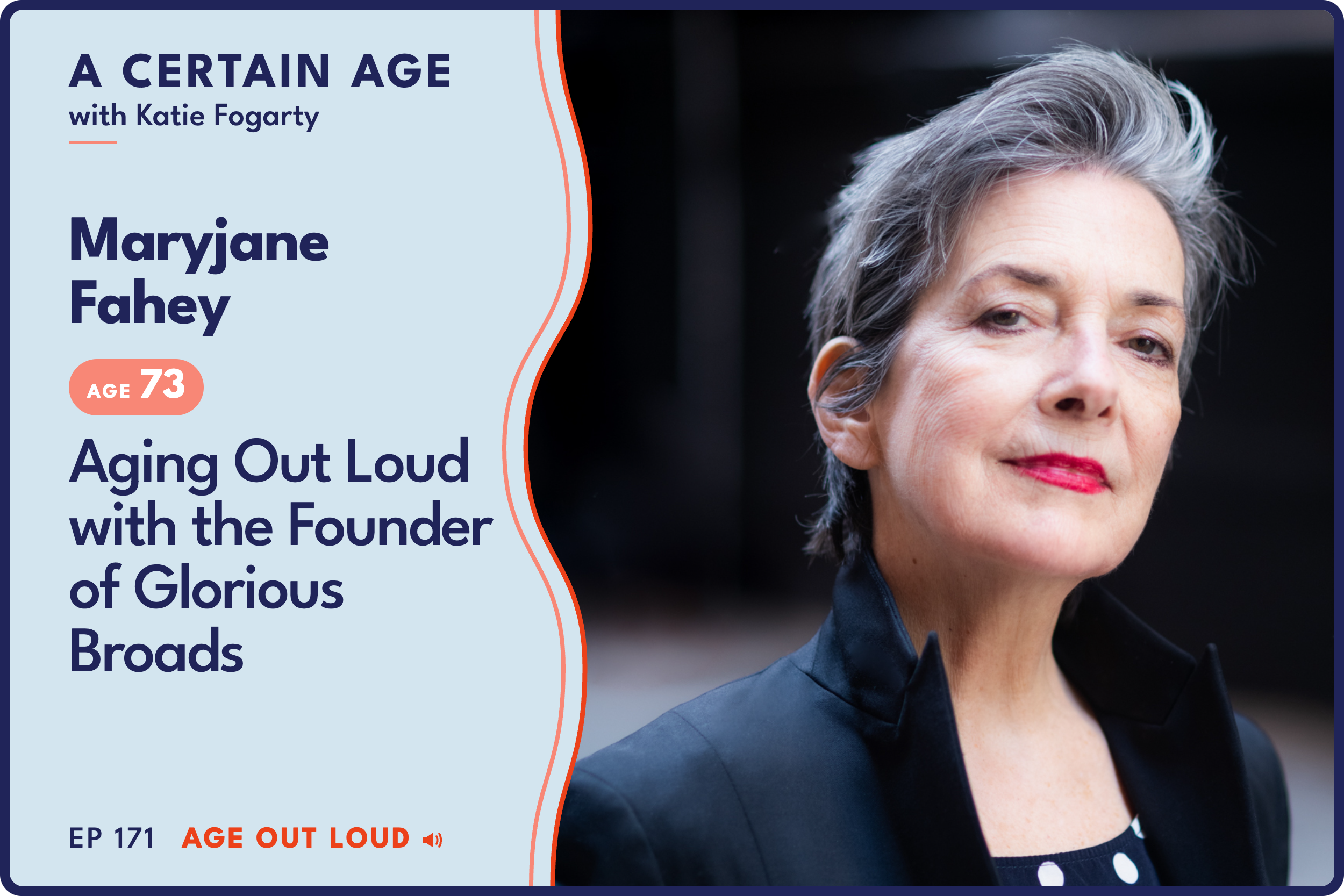
Aging Out Loud with Maryjane Fahey of Glorious Broads
Show Snapshot:
Maryjane Fahey built Glorious Broads into a viral social media following by saying the things most people only think about getting older. She joins Katie to dig into why nobody actually wants to be 20 again, once you've lived long enough to know better.
In this episode:
The real glory of independence and speaking your mind without apology
Reinvention as a midlife default, not a rare exception
Why great sex after 60 deserves more airtime than it gets
The actual work behind self-love, and why it doesn't happen passively
About Maryjane Fahey: Maryjane Fahey is the founder of Glorious Broads, a social media platform for unconventional, uncompromising women over 50. She built her career in print and branding, art directing and launching magazines including Women's Health and Tatler Asia, and later served as launching editor of AARP's Disrupt Aging.
Show Links:
Follow Maryjane:
Quotable:
“I want to show that the woman that's walking the streets could be glorious…I love casting on the streets. And I love that connection—like this woman looks like she has something to say.”
Transcript:
Katie Fogarty 0:03
Welcome to A Certain Age, a show for women who are unafraid to age out loud. I'm your host, Katie Fogarty. Beauties, every Monday I feel like I have the best job in the world. Every Monday, I get to introduce you to a spectacular woman you should know, follow, read, and have on your radar. My guest this week gloriously fits this bill, and then some. She's an OG multi-hyphenate: a creative director, disruptor, editor, and author. Her career spans culture-shifting roles ranging from Creative Director for Women's Health to Content Director of the AARP Disrupt Aging platform. She is also an influencer and content creator, and because she has hundreds and hundreds of thousands of Instagram followers, there is a good chance that many of you are already fans of her work. Please meet Mary Jane Fahey, creator of the kick-ass platform Glorious Broads. Welcome, Mary Jane.
Mary Jane Fahey 0:59
Well, thank you. Great intro.
Katie Fogarty 1:02
I am very excited, but I'm also going to admit I'm a little worried. I'm a little worried we're not going to have enough time to get into everything I want to. I want to explore your serial reinventions, everything that you've learned from interviewing so many hundreds of phenomenal women for Glorious Broads. And I know that you recently were involved in a Cosmo magazine super-viral article about great sex after 60 — we are going to get super fun. So we're going to get into it all. But I want to actually just start with some quick stage-setting. What inspired you to create Glorious Broads?
Mary Jane Fahey 1:37
My mother and my grandmother. But it was not because of who they were, but because of who they might have been if they had grown up differently.
Katie Fogarty 1:47
Now that feels very powerful, and I feel like we have a lot to unpack. So how did they grow up, and what was your experience with them versus how you think they might have blossomed if they were doing it today?
Mary Jane Fahey 2:05
Well, I love them both, and they were powerful within the household, but when their children grew up, they had no idea how to use that energy in the outside world. And as a little kid, I saw that and just said, wait a minute — who's the power figure in this household? It's my mother, not my dad. And why isn't she out there in the world? That really taught me something. My grandmother was the same.
Katie Fogarty 2:31
That's so interesting. And so how did you, as you came of age and sort of moved into adulthood, where did you put your energies before you got to Glorious Broads?
Mary Jane Fahey 2:44
Oh, sure. I was very much a part of the publishing world. I probably redesigned every magazine and newspaper you can think of, truly. I had the good fortune of working with a guy named Roger Black, and there I started with redesigning Esquire magazine. We would redesign magazines, and that really worked for me, because it wasn't only about the look of it, but the content. So at that time, I always thought I could be a writer, but I was too involved and interested and loved the art direction and the look of it. But it was later in life when, frankly, the economy fell and I was competing for jobs for less money than I should have gotten — let's put it this way, the rose wilted — and I started writing. And with that, I then got this great gig at AARP as an art director. My terrific boss over there, Myrna Blythe, saw Glorious Broads because I had started it there as an idea, and she saw my website, and she hired me to be the founding editor of Disrupt Aging. That took real faith from her. She's 80-some years old, and she's still the editor over at AARP. Pretty amazing. Anyway, she took a chance on me, and I grew into the role of being an editor. Having seen how they ran Disrupt Aging and what I wanted to do with Glorious Broads, it was an incredible ladder to walk and to jump from.
Katie Fogarty 4:38
I love how you took these two core talents and interests of yours — the creative direction, visual storytelling, and your new interest in interviewing, writing, and telling a story using the written word — and you've really merged them in Glorious Broads. It's a very visual medium. You've got wonderful photo shoots that you feature on your website and on Instagram. We get to see these people. We get to watch you interview them. We get to hear and see their stories. It's a phenomenally inspiring platform. I want to ask you about your tagline, which is "Sages, Not Saints," which I absolutely love — right? Because, yes, please! These are real women. Not impossible archetypes. We've all had it with impossible measuring sticks. I'm a magazine reader, and women's magazines and pop culture feed us a steady diet of impossible standards. You spotlight real women. Why is this so important?
Mary Jane Fahey 5:47
Oh, I'm tired of — no offense to the ex-models out there, I love and respect them — but the silver ex-model does not interest me. And I think it's a really false hope to give to all of us regular women. I want to show that the woman walking the streets could be glorious, and just maybe a kind of sage. That's probably what we're doing. But I love casting on the streets, and I love the connection — oh, this woman looks like she has something to say. And they're kind of everywhere. So to me, it's the regularity of so many women that I choose to interview that surprise me with their wealth of knowledge and they're always funny. Funny is really important to me. Oh my God.
Katie Fogarty 6:44
First of all, there is just no shortage of amazing women. I say midlife awesomeness is a 24/7 situation. With Glorious Broads, I think you also say there's like a million glorious broads out there — let's connect with them. You talked about sages versus saints. I've had many years of Catholic education. I'm done with being a saint. I am firmly ready to move into my sage era, and I'm maybe ready to move into my broad era too. So you do such a phenomenal job, and when you use the word "glorious" — what do you mean by that? What makes somebody glorious? Maybe that's an easier way of asking.
Mary Jane Fahey 7:33
Well, for me, what makes somebody glorious is an unconventionality — that you rise above what is considered important in this world and set your own standards. To me, that's a glorious broad. I think of really exceptional women in this world, and those are the women I'm drawn to. They're never people who live a so-called regular life. Now, regular can mean someone who's married or someone who's had a long relationship, but independence to me is glorious — that you set your own standards, that you have your own idea of what beauty is and not what somebody else thinks. Look at Diane Arbus and how she looked in the mirror, and she saw what someone else might think is an unusual face, but she viewed herself as having an exceptional face. That, to me, is glorious.
Katie Fogarty 8:42
Yes, she had such a style that came out of every pore, and she presented herself with such confidence. That, I think, is so magnetic and captivating.
Mary Jane Fahey 8:59
I want to add something. Excuse me, but when I was stumped on the name, I was thinking of Lena Horne. Now that, to me, is a glorious woman. I remember being quite young, maybe in my mid-to-late thirties, and it was when she had a Broadway production — just Lena on stage — and she got out there dressed in a long blue gown and said, "I can still gussy up." And she had a laugh about it, and we all laughed with her. And it took her beyond middle age and worked it into power.
Katie Fogarty 9:36
That's exceptional. The image you painted is so striking, and she's such a striking, incredible woman. I want to ask you — do you think that as we age, we become more glorious? Is this something we work up to? We're heading into a break, but when we come back, I want to pick this notion up. Mary Jane, we're back from the break. You talked about Diana Vreeland, you talked about Lena Horne — two women with so much elegance and power who were virtuosos in their careers and fields. Do you feel that being glorious is something that we age into? Is it something we have to begin with? What's your take on that?
Mary Jane Fahey 10:30
Well, there can be exceptions to every rule. Some of the glorious broads I talk to are 41, even 35. But I think you really have to work yourself into it. It's a process. I do feel more glorious this year than I did two years ago, but it is a process of not only working on yourself but understanding life in a larger way. I'm going to get a little Buddha now, but it does have to do with seeing yourself as — in a way — small in this very large life, and knowing that we're all sisters together. I think that takes time to understand. I think when you're young, you just don't get it.
Katie Fogarty 11:14
Mary Jane, how old are you now?
Mary Jane Fahey 11:17
I'm turning 74 in April.
Katie Fogarty 11:21
So 74. I'm 54. We have a 20-year span apart. I agree — I feel more glorious now than I did two years ago. I feel more glorious now than I did at 44. I'm excited to hear from you that this sense of feeling glorious, of feeling expansive in who we are, continues as we progress chronologically. I want to make a quick segue, because I want to ask you about a Cosmo article that you were involved with that I referenced at the top of the show. This was a study based on 3,000 women over 60. It was done in partnership between Cosmo magazine and the Kinsey Institute, and it really examined everything to do with sexuality, ranging from libido to sexual cadence, the number of partners, to sexual fantasies. And I know from reading about this that 75% of women surveyed said they are having better sex with orgasms that are just as good, if not better, than when they were younger. But pop culture does not typically depict women in their 60s, 70s, and 80s having screaming orgasms or even having sex at all. Why do you think culture gets older women so wrong?
Mary Jane Fahey 12:43
Well, I do think that this generation of older women is redefining what it means to be an older woman — and I don't mean because of the cosmetics that are out there, but because the world has changed so much. We're able to be healthier so much longer, and healthier has everything to do with vitality. So I look forward to seeing how women are going to be perceived in the next generation. But for now, we were taught everything wrong. Everything we thought about what it meant to be an older person was wrong. I never thought I would feel this way, and I never thought that my sexuality would be such an awakened part of me on a daily basis. I think we're still in the habit of thinking of grandmas as they were in our great-grandmothers' time, not as the 70-year-olds that exist today — the living, breathing, and sexual women that we are. I think if we brought that into modern terms, we wouldn't think that way. What Cosmo did was a breakthrough issue, and I was very surprised they did it.
Katie Fogarty 14:05
Yeah, it's really incredible. It sort of reinforced something I had learned from a show I recorded probably in my first year. In year one, I had the anthropologist and sex expert Dr. Helen Fisher on the show. She is one of the leading experts on love in our culture, associated with the Kinsey Institute. She talked about the fact that romantic love, attraction, and desire do not fade as we age. It doesn't even fade in long-term relationships, because she had proven that by putting long-term married partners into MRI machines and watching their brains light up with desire for one another — which is such a beautiful image. And when we start to bust some of these age myths, it's so important. It's so important for ourselves, and it's so important for the women and the men coming behind us to know that this important part of your life doesn't go away, right? Yes. So what has surprised you about the reaction to this article? You were in it. You've been interviewed by Cosmo in a video diary they did around it. What has the reaction been like from the people in your own life?
Mary Jane Fahey 15:50
Well, I come from an Irish Catholic family, and there wasn't too much chatting about that within my family — I'm just being honest. But what I loved was the reaction from the younger people in my life. I have a lot of younger friends, and I loved the young women on the shoot. They were so excited about what they saw and also what they learned. I loved their reaction — I think they just saw, "Oh, I have 20, 30, 40 more years of a sexual life in front of me." You're not necessarily going to learn that from your mom, but you are going to learn it from a diverse group of older, vibrant women in front of you. It was a great day of shooting and exchanging. So I'm getting more of a fabulous reaction from my younger friends. From my family, they're a bit embarrassed. That's okay — they've been embarrassed by me for a long time.
Katie Fogarty 16:59
That's okay. They're allowed to be. That's their cross to bear — as we were raised to say.
Mary Jane Fahey 17:07
But oh my God, we're all good friends. But sexuality being embarrassing — that's okay. Yeah, that is okay.
Katie Fogarty 17:13
You just surfaced another theme we've explored on the show: that ageism is not just bad for people who are currently chronologically advanced in years. Ageism is bad for everybody, because it impacts us across generations. So when we put people in these age boxes — saying older people are not sexual, older people can't be relevant and marketable, you can't have older people in your workforce — that is corrosive to younger people as well, because, God willing, they want to get older. And when we limit what, how, and who you can be based on the number of candles on your birthday cake, it's a disservice across generations.
Mary Jane Fahey 18:02
It absolutely is. I want to share with you a funny little story. For Valentine's Day, I wanted to put this little homage up — whether you're with a mate or not, pleasure yourself, enjoy yourself for that night, every night, but especially that night. And I put myself in a skimpy little piece of lingerie. I thought I kicked ass in it. A beautiful young follower — and they write me a lot — put it up and said, "How courageous this older woman is for putting this up." And I had to laugh. I was laughing with my partner this morning. I didn't think it was courageous. I just thought it was sharing. But younger people see older as different. They don't see older as something they're just going to be.
Katie Fogarty 18:54
Well, you're changing that, and I'm hoping I'm changing that too. The more we shift this cultural conversation about what it means to be in these little age boxes, the better.
Mary Jane Fahey 19:06
I love what you said about age boxes, and you're absolutely right.
Katie Fogarty 19:10
So what are some other age myths do you bump up against, maybe in your own daily life or from interviewing all of these women? And when I say "women," I'm using it as a broad phrase, because you interview people who are trans women, cisgender women, female-identifying people from all walks of life — I just want to be clear to all listeners. But you've had numerous interviews. What are some other age myths that you think we all need to be resetting?
Mary Jane Fahey 19:43
Oh, this is a great question. I definitely have an answer for that. I, too, used to put people in boxes — women in boxes. I used to say "my 85-year-old friend" or "my 101-year-old friend." I used to label friends by race. And now they are all in one box. I no longer use those descriptions of age, race, or background. I may learn different things from different people, but they're just my women friends. That was a real liberation for me — no longer to put them in those boxes. It helped me, and certainly helped them.
Katie Fogarty 20:24
Yeah, we have to unpack some of the ageist things that are embedded in our own vocabulary or our own brain. We are products of the environments we're raised in. And sometimes we choose actively to reject that environment or to have new opinions. But I have definitely had to police myself from saying things like, "Oh, that was a senior moment," or "You're so young" — that's also belittling to somebody simply because they have fewer chronological years. So I get it. It's a work in progress. We are all works in progress. That's why we're here. We're doing the work, Mary Jane. We're doing the work.
Mary Jane Fahey 21:14
Absolutely. And even the idea of beauty — I watch myself that when I say someone looks lovely, it's not because they look younger. It's just because they look lovely.
Katie Fogarty 21:28
Yes — they have a glow about them, a radiance. By the way, some of these words are not inherently ageist. You can be radiant and luminous at any age. But sometimes they imply youth. They don't have to if we don't use them that way. So it's up to us to be having a new conversation. You have interviewed so many women. What are some of the big common themes that have emerged? Is every conversation different, or do you find a certain theme about how these women feel in their lives and why they feel glorious?
Mary Jane Fahey 22:15
Well, I would say if there are one or two themes, there is no doubt about the cliché that when they turn 50, they change — and they change in a good way. They usually hit that "don't give a damn" wall, and they become much more liberated and loving themselves more. I would say every woman I've interviewed has said this to me. They've also said they had to work hard to love themselves more, and they do succeed in loving themselves more — even though they have more wrinkles, they may have more difficulty walking or talking, the point is they love themselves more today than they did as that vibrant young woman. And no one — nobody — wants to be 20 anymore.
Katie Fogarty 23:17
Nobody wants to go backwards, although I would not mind having my 20-year-old eyes, because there are some things that change — like the ability to read fine print. So there are definitely things I miss. But for the most part, we wouldn't go backwards for any amount of money. But I will say that's not true of everybody. This tends to be a self-selecting universe of women that I hang out with on the podcast. The guests I invite — the guests that come across my radar — are women who are really reinventing themselves, excited, launching new creative projects, new businesses, new endeavors. They're reimagining their romantic lives, their fitness, a whole host of things. And the women that listen to the show, for the most part, are really open to this. Sometimes I feel like I'm hanging out in a bubble — a bubble of women who are embracing this time of life. But I know this is not true of everybody. I had one very thoughtful listener reach out to me via DM to say that she literally feels like a shell of her former self. And that really hurt me to read. I felt such empathy for her, because I have definitely felt like a shell of myself at different points in my life. We all have highs and lows, and we all have moments where maybe you've lost a job, or — I had postpartum depression after one of my three pregnancies, I did not feel like myself. For any listener right now who feels like being a glorious broad sounds amazing but you're feeling so far from glorious — is there any tactic, tool, or thought you might share?
Mary Jane Fahey 25:21
Yes. I'm happy to share. After menopause, I went through a very, very dark time. There were a couple of deaths in my family, but also menopause did a number on me. I had to work very, very hard at getting in touch with who I was and who I wanted to be. For me, it was at least a couple of months — probably a full year — of meditating more, not watching television as much, leaving a partner who was lovely but not lovely enough for me. I needed to be alone. I needed to do some questioning about my career, which had also really crashed at that time. It took guts, but it also took courage to take the time off and question who I am and what I want. And let me tell you, ladies, it was not a good time. I put in a year, maybe even a year and a half, listening to a lot of Buddha music, and I came out stronger. But it's not an easy path.
Katie Fogarty 26:48
Yeah, I agree. First of all, I appreciate your candor and honesty — that you went through a period of time where you really needed to put the work in to feel good. I think this show offers a lot of tools. I've had so many wonderful experts on the show to help women navigate the challenges of menopause. We've done 40 shows on menopause. Menopause affects every part of your body — your mood, your mind. It really can be such a sea change. So there are tools out there. And I love this idea that you tapped into an intentional pause, that you rethought your relationship, that you put the work in to reconnect with yourself. That's wonderful coaching for anyone who is in a dip right now. But it's also great to hear from people who have come through and emerged on the other side. I put myself into that camp. The very first show I recorded of A Certain Age, I called it "Is Toxic Rage the New Hot Flash?" because I was consumed by volcanic mood swings. It was not pretty to be around, and it didn't feel pretty to be inside my head at times. And I came through on the other side. So any listener who needs it — just know that this too shall pass. That's a mantra I've used, which I will loan to anyone who needs it.
Mary Jane Fahey 28:23
May I add one other thing too?
Katie Fogarty 28:25
Yes, please.
Mary Jane Fahey 28:27
I come from a community of sisters — a bunch of sisters, all good friends. I've lost a few of them. But if I didn't have my community of women friends during that time, I don't know what I would have done. So I'd say, if you're going through something and you have even a small community of friends, reach out. There's a woman I want to mention here. Her name is Yamuna — Y-A-M-U-N-A — and she was a breathing coach. She was teaching us breathwork, and we would get together once every three weeks or so. I would incorporate it daily into my life, and it so shifted my mood swings. A community really matters. Let's reach out to each other.
Katie Fogarty 29:15
That's a perfect note to end on. Midlife — like all parts of life — is more fun with friends. The support of my women friends has buoyed me up at different times and made life more fun and more enjoyable. So yes — prioritize that. Mary Jane, we are moving into our speed round, which is how we close the show. It's just one-to-two-word answers so we can end on a high-energy note. My first question: what quality always makes a broad glorious?
Mary Jane Fahey 29:50
Chutzpah!
Katie Fogarty 29:52
Love it! Love it! Love it! I would love to profile this glorious broad: Chelsea Handler.
Mary Jane Fahey 29:58
Ooh, yes!
Katie Fogarty 30:00
I would be here for that one. All right, when do you feel your most glorious?
Mary Jane Fahey 30:14
Believe it or not, first thing in the morning.
Katie Fogarty 30:16
Ah, I can't get behind that — I am not a morning person — but I love it. I aspire to that. All right, is there a quality or trait you have now that eluded you in your younger years?
Mary Jane Fahey 30:29
Discipline.
Katie Fogarty 30:32
Yes! Okay. A glorious broad is ever-evolving. Do you have a next act in your future?
Mary Jane Fahey 30:38
Playwright!
Katie Fogarty 30:40
Playwright — nice. Come back when you've got plays to talk about! Because I follow you on Instagram, and I spent some time on it recently to prepare for this. And I've been on your gorgeous website. I've heard you say that a glorious broad is an excellent drinking pal. What are you drinking when you're with this pal?
Mary Jane Fahey 31:01
Well, I've changed from vodka martinis to gin martinis. I've changed from an olive to a twist.
Katie Fogarty 31:09
I love it! Finally, your one-word answer to complete the sentence: "As I age, I feel..."
Mary Jane Fahey 31:20
Hopeful.
Katie Fogarty 31:22
I was expecting "glorious," but hopeful is a beautiful note to end on. Thank you so much, Mary Jane. Before we say goodbye, how can our listeners find you and keep following your work and Glorious Broads?
Mary Jane Fahey 31:33
On Instagram and on TikTok, I am @GloriousBroads. On YouTube, it's Glorious Broads. And my website is GloriousBroads.com.
Katie Fogarty 31:45
Phenomenal. I'll put that all into the show notes. I will also link out to the Cosmo article. This wraps A Certain Age, a show for women who are aging without apology. Before you close your podcast app, can I ask you to write a short review over on Apple Podcasts, Spotify, or wherever you listen? Every review helps other women find the show. It's super easy to do — just scroll down to the bottom of the show and follow the prompts. Special thanks to Michael Mancini, who composed and produced our theme music. See you next time, and until then, age boldly, beauties.