
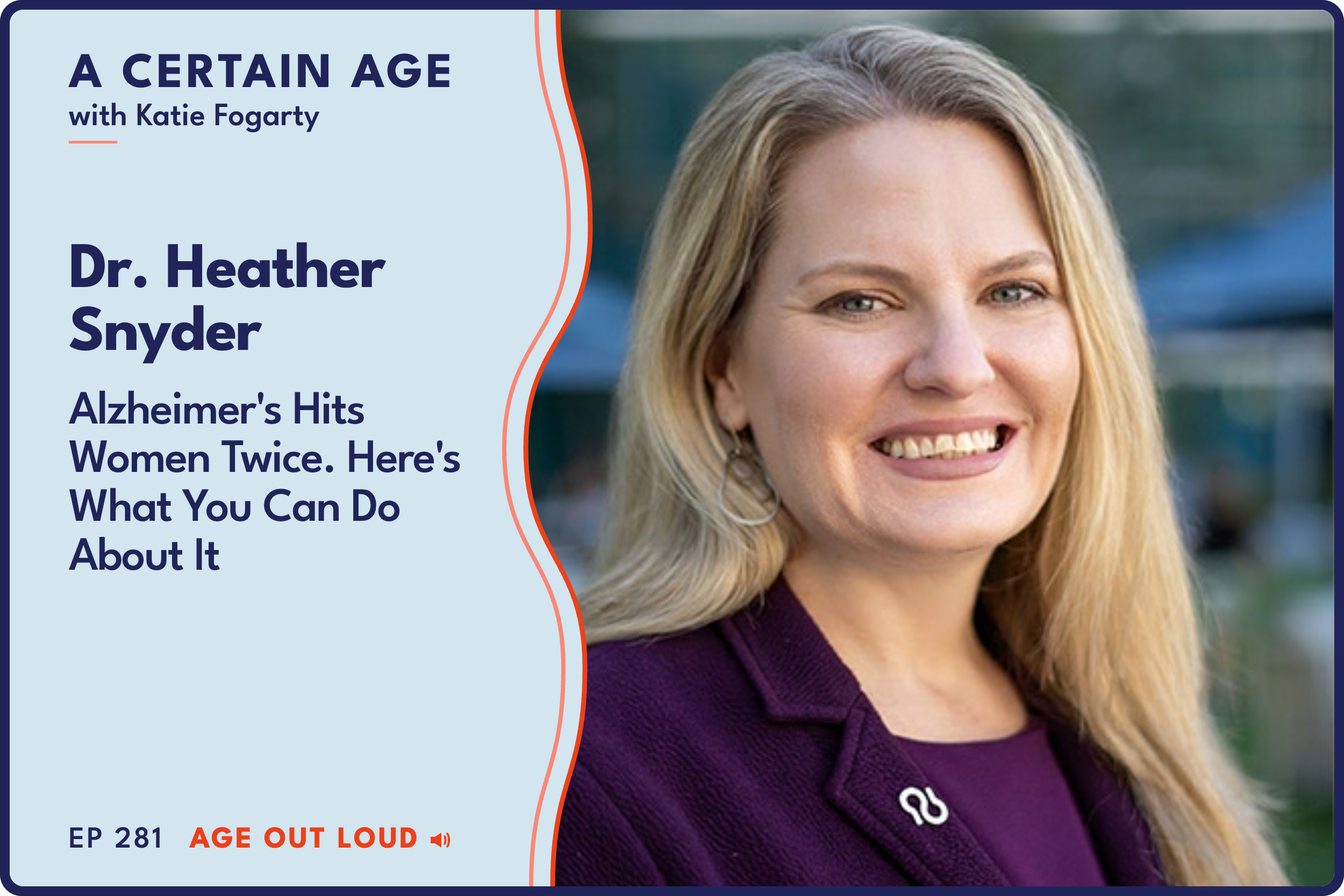
Alzheimer's Hits Women Twice. Here's What You Can Do About It with Dr. Heather Snyder
This episode is sponsored by Strawberry.me. Get 50% off your first coaching session by visiting strawberry.me/katie.
Show Snapshot:
Women are more likely to develop Alzheimer's, and far more likely to spend years caring for someone who has it — two-thirds of dementia caregivers are women, and a quarter of them are still raising their own kids at the same time. Dr. Heather Snyder of the Alzheimer's Association joins Katie to bring real science to a topic most of us avoid talking about until it's already an emergency.
In this episode:
Why women face higher Alzheimer's risk — the biology behind it
What you can do right now to protect your brain
How to get taken seriously by a healthcare system that often dismisses women's symptoms
The real financial and emotional cost of caregiving — and how to prepare
About Dr. Heather Snyder: Dr. Heather Snyder is Senior Vice President of Medical & Scientific Relations at the Alzheimer's Association. Her work brings science and straight talk to why women are more vulnerable to Alzheimer's, and how to protect brain health starting now.
Show Links:
Follow The Alzheimer’s Association:
Quotable:
"There's a common myth, or a common misperception, that Alzheimer's is normal aging — and in fact, that is probably one of the top misconceptions that are out there. There are many people that age without having cognitive impairment, mild cognitive impairment, or dementia."
Transcript:
Katie Fogarty 0:03
Welcome to A Certain Age, a show for women who are unafraid to age out loud. I'm your host, Katie Fogarty. Before we dive into a power-packed show, I want to take a minute to ask a favor. I am looking to boost our Apple Podcasts and Spotify show reviews, so if you've ever learned something on A Certain Age podcast, if you enjoy popping in your AirPods and meeting a fabulous new woman every week, if you've ever nodded your head in agreement or thought to yourself, wow, I never knew that, please let me know in an Apple Podcasts or Spotify review. Reviews help other women find the show.
Now, on to this week's episode. Beauties, here is a statistic that should stop you in your tracks. Women are more likely to develop Alzheimer's and are more likely to spend years caring for someone who has it. One disease, a double whammy. There is no way to sugarcoat these numbers. Two thirds of dementia caregivers are women. One in four is also still raising her own kids at the same time. Look, I get it — nobody wants to think about disease and hard topics, but getting into midlife teaches us we can do hard things. So stick around, because today's show is so critically important for you and the women you love.
Here's the deal. Alzheimer's impacts not just your brain health and overall health, it also creates a tsunami of caregiving needs, which adds up to lost wages, careers put on hold, years — even decades — of unpaid labor, which the Alzheimer's Association estimates will cost $1 trillion by 2050. So today we're asking: why are women so much more vulnerable, both as patients and as caregivers? And what can you do today to protect your brain, your finances, your career, and your well-being for the long haul?
Today's guest is hard at work to give you answers. Dr. Heather Snyder is Senior Vice President of Medical and Scientific Relations at the Alzheimer's Association, where she leads some of the most consequential dementia research happening right now, including a landmark study showing that lifestyle interventions can protect your brain. She's here with real answers, practical tools, a call to action, and genuine hope. I am so ready to get into it all with her today. Welcome to A Certain Age, Dr. Snyder.
Dr. Heather Snyder2:36
Oh, thanks so much for having me. I'm really looking forward to our conversation.
Katie Fogarty2:40
I am as well. This disease has touched my own life. I know it's impacted women who are listening to the show. We have a lot of important ground to cover, including what interventions we can all take to protect our brain health. But I do want to start with some stage setting. The statistics on women's vulnerability to Alzheimer's are truly staggering, both as patients and caregivers. What's driving this disparity? Is it biology, social conditioning, or something else entirely?
Dr. Heather Snyder3:09
I think it's yes — it's all of the above in different ways, and there's a lot of work in my space. I started thinking about and trying to understand why there are more women living with Alzheimer's than men a little over 10 years ago. We brought together a group of experts to ask whether it was simply that women are living longer, and that is why we see more women living with this disease. We came out of that two-day workshop with many more questions than answers, and I think we're still asking some of those questions, but we have come a long way.
There are a lot of differences between men and women throughout all of life that may contribute to their brain's vulnerability or resilience. It could be biology — for instance, women experience different hormonal changes, different immune changes, our vascular systems are different, and all of that is likely contributing to our brain's vulnerability or resilience to disease in later life. But there are also social factors. The level of education, for example — we know that can be protective and helps build resilience. There have been historical differences in educational attainment between males and females.
I have two sons, and I live in a house of men and boys. We think differently — we joke about that a lot, and I'm sure many of you listening do as well. That starts in early childhood development and continues all the way through life. There are also structural differences in our brains between males and females from birth onward, and that may also contribute to the differences we see in Alzheimer's.
Katie Fogarty4:47
I have a daughter myself and two sons, so I absolutely hear you on the differences in how people's brains operate. I love the use of the word resilience — how we can take steps to make our brains more resilient. We're definitely going to get into that, but I do want to ask you one more big-picture stage-setting question before we continue.
I was truly blown away by the numbers I learned while researching this topic about the economic costs of Alzheimer's and caregiving. When families hear that the lifetime cost of dementia care tops $400,000 and that 70% of that falls on them — not covered by insurance — what do you want people to understand about how to start preparing financially before a diagnosis hits? What are some steps we can take to make ourselves less vulnerable financially as we try to navigate what is such an enormously emotional task as caregiving?
Dr. Heather Snyder5:44
I think the first thing is to have those conversations and express your wishes — make sure they're in writing — about whatever those plans should be. It really depends on your unique situation as to whether it makes sense to speak with a financial planner or someone thinking about long-term care insurance, or the different scenarios that are available. There is no one-size-fits-all solution, but it is important to have those conversations and make sure you understand what your partner's or your own wishes may be in that scenario. It's also important to have that conversation with your parents — understand their wishes and what they might want in terms of their own care, should that situation arise within your family.
Katie Fogarty6:31
I think one of the biggest challenges I've experienced personally, as my siblings — I'm the oldest of four — are trying to navigate my mother's Alzheimer's diagnosis. The $405,000 average lifetime estimate — I live in New York City, and I have to say that sounds on the low side, which is insane given that it's already a huge number. What are the resources available at the Alzheimer's Association that help people work through the financial planning and caregiving? I will share quite candidly: it feels very, very overwhelming, even though between my four siblings, two have MBAs, one is a lawyer, and I have a master's degree — and it's still incredibly hard to navigate.
Dr. Heather Snyder7:11
That's always the case, even if you know the science very well. On the caregiving side, there are a lot of different aspects, and when it's your parent or your partner, that changes things too. That's really why the Alzheimer's Association has a presence in communities across the country providing support and resources — whether that's support groups or educational programs, including financial and legal planning, to help people navigate with experts who can speak to different kinds of scenarios and resources.
As you noted, geography matters — the resources in New York City may be very different from those in Chicago, or from what's available in rural Texas. So making sure that the planning and the educational programs are personalized to your geography and situation is something we really try to do.
Katie Fogarty8:07
It's so wonderful that you make those resources available, because truly it is a maze. I want to talk a bit more about what else the Alzheimer's Association is doing. I know there has been a landmark lifestyle study — you're leading research showing that lifestyle interventions can help protect our brain health. I'd like to hear about some of the most powerful evidence-backed changes that my listeners and I can start to make right now. And at what age should we be prioritizing this? I'm 56, and this is on my radar because of my mother, but I have a daughter approaching 30. Help us figure out when to start working on these brain health interventions — for ourselves and for our children.
Dr. Heather Snyder8:46
Maybe I'll answer that question first, and then go into what the science tells us. It's never too late, and it's never too early. There's always something we can do — we can always do a little bit more, we can always take some of those steps that may help our brain health overall. When we think about Alzheimer's or really any disease that causes cognitive impairment, we know these are complex diseases. It's not only our environment or our behaviors that may influence our brain's health — there are a number of factors at play. But what we can do is give our brains a little bit more resilience and protection as we age, and that's what the science tells us.
We have a wealth of science telling us that what's good for your heart is good for your brain. Physical exercise, eating a diet with all the nutritional components that are beneficial for your overall health — low saturated fats, dark leafy vegetables, low sugars — that's important. There have been a number of different dietary approaches: the MIND diet, the DASH diet, the Mediterranean diet, the Nordic diet. All of them draw from different aspects of nutrition, but the commonalities are exactly what I just said: low saturated fats, dark leafy vegetables, and low sugars. Thinking about how to incorporate some of that into your daily life is valuable.
Wear a helmet if you're riding your bike. Wear your seatbelt. If you're smoking, slow it down — or ideally stop — for your overall health and for your brain health. Sleep is huge. As we age, sleep is such an important factor. There are also hormonal changes that happen as we age that may impact our sleep patterns, so making sure we do what we can to get good quality sleep is really important for brain health.
But you asked about a really exciting study that I'm so proud to be a part of. We took all of this science, which has given us hints, and said: I want to know exactly what I can do. I'm at increased risk — maybe I have a family history, as you mentioned. What's that specific recipe or prescription I can incorporate into my daily life? At the Alzheimer's Association, that is the top question we get: my mother, my father, my sister, my brother — what can I do?
So we took the best information science has, built off previous work, and developed a multi-domain intervention that simultaneously targets multiple risk factors — physical exercise, cognitive engagement, social engagement, heart health, and overall nutritional guidance — and put together a specific protocol. We tested it in two different conditions: one where individuals had greater support and structure, and one where they had less. The science told us that less support may still provide some benefit, but those with greater structure — the more intensive engagement — had a measurable benefit on their cognition over two years. That benefit equates to roughly two years of a younger cognitive age. Imagine your brain being two years younger after only a two-year intervention. Now imagine if you're doing this over a longer period of time.
Katie Fogarty12:31
And how can my listeners access this information and this protocol for themselves?
Dr. Heather Snyder12:36
We have a lot of information on our website at alz.org. The name of the study is called US POINTER, and there are resources with links to the specific components of the intervention. Of course, structure was a big component of it, so thinking about how to build in your support and accountability to ensure you stick with it is really important.
The trial reported out not even a year ago, and we've been continuing to analyze the data to understand how to best translate this into the community. We are working with 12 different teams across the country who are taking what was a rigorous clinical trial and figuring out how to make it more available and accessible. That work is in process now, so watch for programs and new resources that will continue to come. For now, there's a wealth of information on our website at alz.org.
Katie Fogarty13:30
Phenomenal. I will make sure to link out to all of those in the show notes, but listeners can also find that on social when I post the show. I would encourage you to follow the Alzheimer's Association on social as well, so you can continue to see their work.
Heather, we're heading into a quick break right now, but when we come back, I want to talk about early warning signs. What should we be paying attention to as we start to experience our own cognitive changes as we age? And I also want to ask you about genetic testing. We'll be back in just a minute.
Heather, we're back from the break. You shared those wonderful interventions that people can find at alz.org, and I plan to link out to all of that in the show notes. But I want to ask you now about early warning signs. I myself, when I went through late-stage perimenopause, started having some brain fog and a little bit of confusion. A lot of that cleared up once I moved firmly into menopause, worked on my sleep, and started using HRT. But a lot of women sometimes chalk up cognitive changes to simply getting older. I want to hear from you: what are the potential red flags that we should take seriously so we can self-monitor? And then, as a second part to this question, I'd love to hear your thinking on genetic testing.
Dr. Heather Snyder14:41
I want to start by saying: good for you for recognizing those signs and really thinking about how to encourage your sleep and make sure you were doing what you needed to do for a good night's sleep. That's important for your brain health, and kudos to you — and I'm sure to many listening — who have done that.
There's a common myth or misconception that Alzheimer's is normal aging. In fact, that is probably one of the top misconceptions out there. It is not. Many people age without developing cognitive impairment, mild cognitive impairment, or dementia. The clinical symptoms are defined by very specific biology that is changing in the brain.
Some of those early signs are not always the same for everybody. I had one gentleman — an executive — tell me that he did a lot of memos and short emails to his team, and he noticed he was having difficulty with word retrieval. That to him was an early warning sign. I had another woman tell me she had made the same breakfast casserole recipe many times, and when she started missing ingredients, that was a sign. So it's not going to be the same thing for everybody.
The Alzheimer's Association has the 10 Warning Signs on our website at alz.org. The best way to think about all of them is: what's a change from something you've done for a long period of time? I do a lot of Excel spreadsheets and math in my head — I can quickly calculate a tip in a restaurant. If that became something I struggled with, that might be a warning sign for me, because it's something I've always been able to do. There are also some people who report depth perception issues — challenges with a curb, or when driving. Again, it's really worth having those conversations with your healthcare provider if you notice consistent changes in things that you've not had difficulty with before.
Katie Fogarty17:14
That is such a great tip. The tip-at-the-restaurant example cracked me up, because I have trouble with that — so I'm delighted that can't be a warning sign for me, because I've had that issue since I learned about tipping. But word retrieval is something that hit home for me, because I talk for a living and have always been very good with words. I did have word retrieval issues at different points — we'd be looking at a spatula and I couldn't remember the word. It's frightening when that happens. I will say it really did subside as I moved through late-stage perimenopause, but it's great to know that everyone has their own internal measuring stick they can use to notice changes for themselves.
Dr. Heather Snyder17:55
Let me just build on what you said, because I think it's a super important point. You're right — it's scary when those things happen or when you notice those changes. But it's really important to have that conversation with your doctor, because it could be a lot of different things. It could be sleep, it could be hormonal changes, it could be a thyroid imbalance or a nutritional imbalance. It may not be something as serious as Alzheimer's. It could be something very treatable and very reversible. That's why having those conversations with our doctors is so important.
Katie Fogarty18:26
Where do you land on genetic testing? We don't need to do an exhaustive dive, but is this something people should consider if they have a family history? Or would you ever see this becoming a blanket policy where everyone should understand their potential genetic risks? Not everyone knows their parents, and not everyone has an open family relationship where these kinds of cognitive changes are discussed. What is your thinking on genetic testing?
Dr. Heather Snyder18:54
This is very much a personal decision. From the Alzheimer's Association's perspective, our job is to make sure people have the resources to be a savvy consumer and make the decisions that are right for them. In Alzheimer's disease, there have been over 100 different genetic variations associated with risk — some that increase risk, and some that actually decrease it. In most cases, we are still working to understand what they are, what they do, and whether they have the same risk profile in larger and more diverse populations. There's a lot still in the research phase.
There is one gene known as Apolipoprotein E4, or APOE4, that has been studied extensively. We all get one copy of our genes from our mother and one from our father. If you have one copy of APOE4, you are at a slightly increased risk. If you have two copies, you are at an even greater risk. But research has shown that risk is not necessarily the same in all populations around the world, so there are still important questions to resolve.
If you are not experiencing symptoms and you make the choice to pursue genetic testing, it's important to understand where you are and are not protected. In the United States, we have something called the Genetic Information Nondiscrimination Act, or GINA, which protects your genetic information from being used in employment decisions and in health insurance. However, we are not protected from long-term care or life insurance. Many life and long-term care insurance applications ask whether you have ever had genetic testing and request that information, so that may impact decisions made downstream — by them or by you. Being a savvy consumer about where and how you are protected, and what you might want to have in place before pursuing testing, is really important.
If you are experiencing symptoms and perhaps have a diagnosis of mild cognitive impairment due to Alzheimer's, genetic testing may now be part of the workup for decision-making around treatment. That is a more recent shift, and it then becomes part of the discussion with your healthcare provider about whether current treatments are appropriate — a risk-benefit discussion.
The main point I would make is that APOE4 is a risk gene, meaning it increases risk, but it does not definitively determine outcome. Many individuals with Alzheimer's do not have APOE4. And there are individuals who carry APOE4 and are living into their hundreds in some ongoing studies without any cognitive issues. There is a lot more than just risk genes at work.
Katie Fogarty21:56
So many factors, and I appreciate your point that it's a very individual decision. Let's talk about something that's a bit more universal for the women listening. If you're born with ovaries, you're going to experience menopause and the exiting of estrogen — that's not optional. So what is the connection between estrogen, menopause, and brain health? I'd love to hear your take on what the current science shows about whether there's a hormonal link to Alzheimer's risk.
Dr. Heather Snyder22:25
We touched on this a bit earlier — trying to understand why more women are living with Alzheimer's than men, and also whether there are differences in the age of diagnosis. Studies suggest that women may have a greater amount of the biological changes in their brain compared to men before clinical symptoms appear, and a big question is whether that's because they're more resilient for a period of time, or whether something else is going on.
A big part of what may be contributing to this is hormonal changes throughout life. Understanding menopause, HRT use, and brain health overall is such an important topic — and a complicated one. Our brains are complicated, and our hormonal system and the changes women go through throughout life are also complicated. Understanding some of those temporal changes and how they might influence something 10 years downstream is a major area of ongoing study.
There have been a few large studies. One large study suggested that a particular hormone replacement therapy may increase vulnerability to cognitive decline. Other studies have not found that to be the case. So there is no clear-cut answer across the board, but this certainly needs to be weighed individually based on a person's overall risk profile and in conversation with their healthcare provider.
We know, for instance, that HRT can help manage menopause-related changes in mood, sleep, and more — and sleep is such an important aspect of brain health as we age. So again, this needs to be balanced within your conversation with your healthcare provider.
There was a really interesting study from a group at Kaiser in Northern California a couple of years ago. Within their database, they had access to life-course data for individuals across their entire time in the medical system. They found a number of associations between a woman's dementia risk and factors such as the number of children she had, her age at first menstrual period, and the duration of her reproductive period — the time from first menstrual period to menopause. If that window was shorter — because of an earlier menopause or a later start — there was a slightly greater risk. Understanding all of that at the individual level is complicated, and it is difficult to translate because my information and yours are not the same. There's so much to take in here.
Katie Fogarty25:40
I'm absolutely fascinated. Women today are at a tipping point in the HRT conversation. There's new science, new guidance. I've seen that unfold over the five years I've been doing this podcast. I'm on the board of Let's Talk Menopause. I'm in a lot of rooms talking about menopause, and women are newly excited about making HRT part of their toolkit — but there's still confusion. I feel like we have better science today than we had even five years ago, or at least it's being better interpreted and disseminated to the general public.
But I also feel like we're at a point where — at 56 — there's not a lot of clarity on what's truly causing this disease, and how to prevent or mitigate it, beyond the lifestyle choices you've identified. I completely agree we need more studies. Can you catch us up? Is that research happening? Can we expect my daughter — who is now 26 — to have a different experience at 46 and 56? Will we have the research we need by then?
Dr. Heather Snyder26:44
There's a lot of really exciting work going on right now. We talk a lot about AI and where it's coming in, but I do think the ability to look at massive data sets and tease out some of these complexities — in ways that would take humans much longer — is something to be genuinely excited about. We have some newer tools that will enable some of that work to happen in the near future. And as we're collecting and inputting data, we're uncovering more and more each year — advancing our understanding a little bit more and changing the landscape.
For example, one group out of the University of Illinois Chicago found that women have better word retrieval overall, and so they may mask their cognitive changes a little longer because they do better on those tests than men throughout life. If word retrieval is part of your diagnostic workup, but women routinely score higher, and you use just one normalization, you may be masking symptoms — not detecting cognitive changes at an early enough stage. So having diagnostic tools that are specific to an individual's baseline — whether they're male or female — is really important.
I think technology is coming into play here. There's a lot of work on biological measures that will allow normalization across populations, and also on the technology side — tools that will say, 'Here's what your baseline was at this age, here's where you are now, and here's what that change means for you specifically.' There's a lot of work going in that direction.
Katie Fogarty28:35
I want to talk about the role of stress in dementia and Alzheimer's — both for caregivers and for patients themselves — because I shared that powerful statistic at the top of the show: women are the caregivers, one in four is still raising their own kids at the same time. I'm in that spot right now. My children are older, but they still need me, and I'm also helping my siblings provide a lot of care for my mom. This is sandwich generation pressure, which we all hear about, but until you're actually in it, you realize it's not a sandwich — it's a vice. A sandwich sounds soft and fluffy, but the needs of life and caregiving can truly squeeze you. What does this pressure do to women's brain health and dementia risk over time? What does the science show, and why should we be prioritizing stress-management solutions?
Dr. Heather Snyder29:28
That's such an important thing to highlight. More than three in five unpaid Alzheimer's caregivers are women, and this is often a spouse or a daughter. We also see that female caregivers spend more time caregiving on average than male caregivers — two and a half times as many women as men will live full time with the person with dementia. As a result, women caregivers may experience higher levels of depression and impaired health overall.
It is very easy for me to say it's important to take care of your own health while providing care for somebody — very difficult to actually navigate in the day to day, and I appreciate that. That's really why one of the resources the Alzheimer's Association provides is a 24-hour, 7-day-a-week helpline that can help families navigate how to balance all of these components: 1-800-272-3900.
Regarding stress itself: there is a lot of evidence to suggest that over a long period of time, stress increases inflammation, and that's not good for your overall health — and can impact brain health as well, particularly as you age. There have been some mixed studies as to whether caregivers are at an increased risk for dementia themselves, whether due to Alzheimer's or another cause. That data is a little less clear, but stress is not good for your overall health and does impact brain health long term.
Katie Fogarty31:27
I love that helpline — that people can reach out in those moments of acute need. Thank you for sharing that. I'll make sure to highlight it in the show notes if listeners didn't catch it. You can find it in the transcript, and of course at alzheimer.org and over at acertainagepod.com.
One of the things that really stood out to me in prepping for this show is that the Alzheimer's Association estimates unpaid caregiving will cost a trillion dollars by 2050 — truly mind-blowing. A caregiver deep in the trenches right now probably can't think about how they can drive policy change, but what would actually move the needle for women? For people who are listening and thinking it's crazy that there's not enough research, not enough funding, and that women are bearing the brunt of this enormous healthcare tragedy unfolding for so many families — what small action could they take that would make a real difference?
Dr. Heather Snyder32:31
I think there are a few things we can all do. One is sharing your story and being a voice — being part of the community of advocates who share locally, at the state level, and at the federal level about the needs in your community and your experience. To become an advocate, you can go to alz.org and sign up. This is a way to let your legislators know what your priorities and needs are. There are a number of different legislative priorities continuing to develop, including thinking about community resources and caregiver support across the board.
Katie Fogarty33:05
Phenomenal — we can all take these small steps to really make a difference. I've seen, even in the menopause space, how signing petitions and making your voice heard does affect change. We saw that with Let's Talk Menopause, which was a big proponent of getting the black box warning label removed from local vaginal estrogen — and it truly made a difference. So for someone thinking that signing a petition doesn't do much: it truly does. Hop on over and make that something you do this afternoon.
I want to switch gears and give women listening a few more active tools they can use in their own lives as they navigate their brain health. You used the word advocate when we were talking about policy change, but I want listeners to be the best advocate they can be for their own personal healthcare needs. I know from creating this show that many women feel dismissed when they raise healthcare concerns with their doctors — whether it's urology, hair loss, menopause symptoms — women often see several practitioners before getting the solutions they need. When a woman raises a cognitive concern with a doctor, what should she specifically be saying or asking for? How can she clearly make her voice heard in a system that doesn't always prioritize women's health, beyond being told, 'Oh, it's all in your head'?
Dr. Heather Snyder34:35
Part of it is asking the question and saying, 'I've noticed this change. This isn't normal for me. I know it isn't normal. How do I understand what might be going on?' There could be a lot of things at play. Typically, a provider may run a blood panel to assess a number of factors. If that comes back normal, you can say, 'Okay, I'd like a follow-up — where do I go from here?' Continuing to ask those questions is really important.
There are a number of resources on our website at alz.org for navigating that conversation with your doctor when you have a cognitive concern, including the 10 Warning Signs and a tool you can complete and take to your appointment — 'here's what I'm noticing.' Sometimes having someone with you who can validate what you're saying is also helpful.
And if you're not heard, there are other healthcare providers you can reach out to. I will note that there's a lot of work going on right now to ensure that healthcare providers have the tools and resources they need to navigate that conversation on their side of the table as well. Connecting with your local Alzheimer's Association chapter and understanding the systems they're working with may also link you to providers who are actively ensuring their staff has those resources.
Katie Fogarty36:10
Yes — so many fantastic pieces of advice, and I love the idea of: don't be afraid to break up with your doctor.
Dr. Heather Snyder36:15
Yes.
Katie Fogarty36:16
Sometimes our doctor serves us really well in one phase of life, but when we enter a new one, we need a new relationship, a new voice, a new sounding board. Women should not be suffering — go in search of doctors who can hear you.
I want to ask you one last question before our time together wraps up. This has been incredible. I feel personally optimistic hearing you share the different tools we can use to self-assess, figure out our cognitive risk, better educate ourselves, and hear about the resources available through your phenomenal organization. I really do want to end on an optimistic note, because this disease is truly terrible — it's called many things, 'the long goodbye,' it's a heartbreak for everyone who intersects with it. Is there something you've come across recently, a new breakthrough, a moment with someone you've met — something that makes you personally feel optimistic about the landscape for Alzheimer's today?
Dr. Heather Snyder37:20
Let me start with the big picture, and then share a very specific conversation. Big picture: there is so much momentum. We have the first two drugs that target and treat Alzheimer's disease in the earlier stages — for people with mild cognitive impairment or mild dementia due to Alzheimer's — helping individuals have more time with their families at those earlier stages. We have a whole lot of new therapies entering the clinical pipeline as well, really targeting a lot of the different biology we know is at work. We have advances in tools for earlier diagnosis, including blood tests that are coming into the mainstream. And we have behavioral interventions — thinking about how we can give individuals the tools to build resilience in their brain, as from the US POINTER trial.
I was somewhere recently, and the daughter of one of the US POINTER participants was there as well. I introduced myself to her, and her mom was with her. The daughter said, 'I just want to thank you for loving my mom so much to move this research forward. She's a changed person, and she has not only taken this knowledge into her own life, but she's given it to us, her children, and to her grandchildren. Thank you for loving my mom.'
That was such a powerful moment for me. For the daughter, I think it was a very spontaneous comment, but for me it has significantly impacted how I think about this work. Anytime I'm talking about the research, anytime I'm talking about the study, I picture her and her face and the impact that the science is having on real people. And we're going to continue that momentum and keep moving it forward.
Katie Fogarty38:59
So beautiful. Thank you so much for all the work you're doing to make a difference for patients, their families, and for the population as a whole. It is so, so needed. As I said, being on the front lines and feeling the impact of this disease firsthand, the work you're doing is remarkable and needed. And personally, Heather, thank you so much for being with me today. I so enjoyed this conversation. I feel smarter, more informed, and more optimistic, and I am truly grateful.
This was a phenomenal conversation, absolutely packed with so much information. I want to make sure you get access to all the studies and programs that Heather referenced, so make sure you hop over to the website, acertainagepod.com, for the show notes. I plan to link out to the 10 Warning Signs of Alzheimer's. I will link out to more information on the US POINTER Lifestyle Program that Heather mentioned several times — this has specific nutrition, physical activity, cognitive engagement, and health monitoring recommendations that can be helpful in your own life. I'm going to dig up more information on that Kaiser Permanente study she referenced as well and put it in the show notes for you.
You can also head directly to the Alzheimer's Association at alz.org, where there is a wealth of resources. Thank you so much for sticking around to the end of this important conversation. I am feeling more optimistic, more informed, and I'm really excited I got to bring this to you. Please feel free to share this with the women in your life — pull them into the conversation, because sharing is caring, and we need to make sure more women have access to this terrific information.
Thanks for sticking around to the end of the show. And as always, special thanks to Michael Mancini, who composed and produced our theme music. See you next time, and until then, age boldly, beauties.