
Better Midlife Health, and Taming Weight Gain + Hormones with Dr. Mary Claire Haver
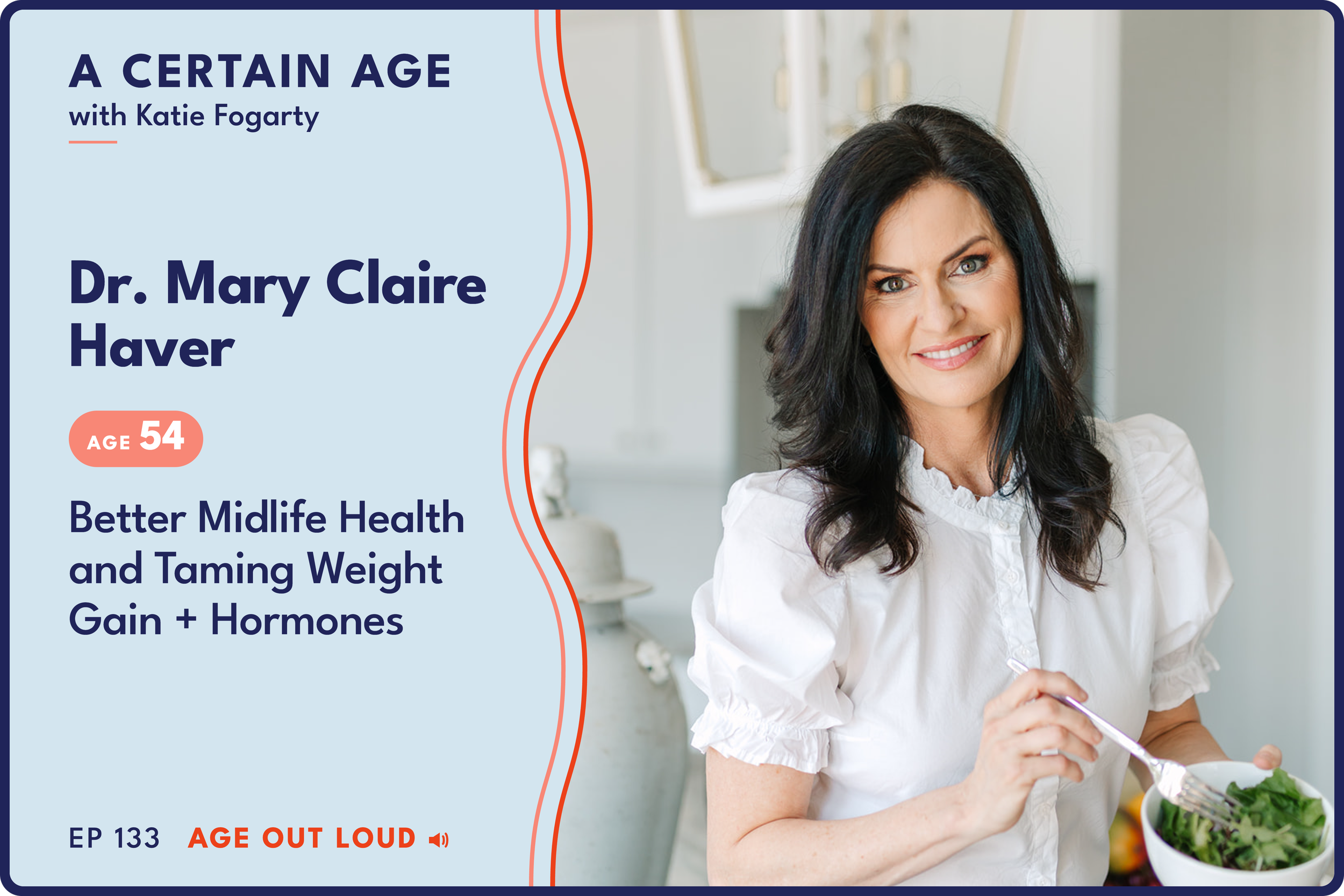
Show Snapshot:
Dr. Mary Claire Haver spent years telling her patients the standard advice: eat less, exercise more. Then she went through menopause herself, and that advice stopped working, even for her. As she puts it, "I'm doing all the things that I have told my patients to do and it's not working." This insight led her to create The Galveston Diet, a nutrition program that has helped nearly 100,000 women manage midlife weight gain and hormonal symptoms. Today, Dr. Haver is one of the country’s leading voices in menopause care and midlife women’s health.
In this episode:
Anti-inflammatory food choices that move the needle in midlife
Rethinking your eating window: what intermittent fasting can offer women in menopause
Why prioritizing macro-nutrient-rich meals beats old-school calorie counting
The real story behind Dr. Haver's own midlife weight gain, and what it taught her
About Dr. Mary Claire Haver: Dr. Mary Claire Haver is a leading voice in menopause care and a board-certified OB-GYN. She is the author of two New York Times bestsellers, “The New Menopause” and “The New Perimenopause,” and founder of The ‘Pause Wellness Clinic and The 'Pause Life, a menopause education and support platform.
Show Links:
Follow Dr. Haver
Dr. Haver’s Books:
The New Menopause: Navigating Your Path Through Hormonal Change with Purpose, Power, and Facts
Quotable:
The only thing we were taught about weight was calories in, calories out. Basically, putting the onus on the patient because she wasn't trying hard enough or she was lazy… it took my own journey of realizing, wait a minute, I'm doing all the things that I have told my patients to do and it's not working for me anymore.
Katie Fogarty [0:03]
Welcome to A Certain Age, a show for women who are unafraid to age out loud. Beauties, navigating menopause is like playing whack-a-mole. Just when you get a handle on your sleep disruptions and vaginal dryness, you learn that every woman in the UK is getting access to hormone replacement therapy over the counter in her local drugstore — and that your favorite pants, the ones you planned to wear to a weekend party, no longer fit. It can feel hard and overwhelming to manage all the menopause things: the latest science, the roller-coaster hormones, your changing body. A Certain Age has twenty-five-plus shows on all the ways menopause can impact your life, and on today's show, we're drilling down on one area. I'm joined today by menopause and nutrition pro Dr. Mary Claire Haver — a wife, mom, physician, and board-certified OB-GYN. Dr. Haver noticed that as her patients aged, she was overwhelmed by the number of complaints and concerns about midlife weight gain during menopause. For years she told her patients to eat less and exercise more. It wasn't until she went through menopause and experienced her own midlife weight gain that she realized this advice did not work, full stop. She created a nutrition, eating, and lifestyle program called The Galveston Diet — a program that prioritizes nutrient-rich, anti-inflammatory foods and intermittent fasting to burn fat and tame hormonal symptoms. Nearly 100,000 women have done this program, and it's now available as a book. Dr. Haver is our guest today, and she is here to give us the down-low on all things Galveston Diet. Welcome, Dr. Haver.
Dr. Mary Claire Haver [1:46]
Hi, thanks for having me.
Katie Fogarty [1:48]
I have toured through this book, and I learned so much. I'm really interested in exploring it all with you. I've been following you on Instagram for a number of months, and I love all the information you share about menopause. I'm really excited to get into the nutrition program and walk through the different components of this eating program. I wanted to share with you first that my most downloaded show on this podcast in 2022 was on reversing midlife weight gain and building fat-burning muscle, because women want information on our changing bodies — but we are also sick and tired of diet culture and body shaming. So I really do want to start with some quick stage-setting. Your book uses the word "diet" in the title, but it's clear from reading it that you're not about restricting and calorie counting. You're advocating for nutrition as a lifestyle for optimizing midlife health, because excessive weight is linked to numerous diseases. I would love to open by hearing your thinking on dieting versus an eating lifestyle, and why you decided to write this book.
Dr. Mary Claire Haver [2:53]
In medicine, when I talk to patients, it's not "Are you on a diet?" It's "What is your diet?" Clinically, a diet is a pattern of eating. Think of it like the Mediterranean diet — no one thinks that's a fad; it's a pattern of eating that people in the Mediterranean region follow and seem to derive health benefits from. When I first developed the program, it was prescriptive — for my patients, for myself, and then for my girlfriends. Then, when I took it to social media, it exploded. So we were happily calling it a diet, and no one really questioned that until we blew up on social media and decided to turn the online program into a book. My own journey — my story, which you touched on a little — is that in medical school and residency, plus my undergrad, which was in geology of all things, I had nothing biomedical in my undergraduate studies except what I was required to take.
Katie Fogarty [4:08]
Talk about a pivot.
Dr. Mary Claire Haver [4:09]
In those twelve years — undergrad, med school, and residency — I had maybe an hour total of nutrition education. Good nutrition was kind of like porn: you knew it when you saw it, but it was never seriously taught to us. So I went with what I thought was nutritious, and the only thing we were taught about weight was calories in, calories out — basically putting the onus on the patient, as if she wasn't trying hard enough or was lazy. There wasn't much evolution in that thinking throughout my education and into my practice. Honestly, I was a terrible menopause doctor. I was a terrible person to counsel someone who was struggling with weight gain — overweight, obesity, and so on. It took my own journey of realizing, "Wait a minute, I'm doing all the things I've told my patients to do, and it's not working for me anymore. There's got to be more than this." I got so interested in nutrition that I went down the research rabbit hole on inflammation and decided to ask: can I get a master's in this? How can I improve my learning from people who actually know what they're doing? I found the culinary medicine program at Tulane University. It's since expanded to multiple universities around the U.S., but at the time it was the birthplace of a program where an advanced healthcare practitioner — a doctor, nurse practitioner, PA, or pharmacist — could go to learn about medical nutrition. It took about eighteen months, and I had to fly to New Orleans and San Antonio for different labs. It really was the catalyst for The Galveston Diet, and for me getting as much knowledge and education as I could so I could be a better physician to my patients at this stage of life.
Katie Fogarty [6:06]
I love this story — I love that you were already a doctor and decided to continue your education. It's fascinating that there's so little nutrition education in med school.
Dr. Mary Claire Haver [6:21]
Exactly.
Katie Fogarty [6:22]
Regular listeners of the show know there's also very little menopause information taught in med school. It makes us wonder who's designing these curriculums. But culinary medicine — can you give us a quick snapshot of what that means and looks like?
Dr. Mary Claire Haver [6:32]
Sure — it sounds kind of funny.
Katie Fogarty [6:34]
No, it sounds very cool.
Dr. Mary Claire Haver [6:35]
So, what is culinary medicine? Dr. Harlan, who runs the program, describes it as "where health meets food." I essentially got the equivalent of the first two years of nutrition science education — my daughter, who's graduating from college in May, is actually majoring in nutrition science, pre-med, so it's been fun having a late-teen, early-twenties person to hold me accountable. On top of that basic nutrition foundation, we added a layer of medicine, and then a third layer — the culinary aspect. The labs we attended were actually held in test kitchens, teaching us cooking techniques we could bring to our patients. It was a way to get a solid grounding in nutrition and then learn cooking techniques that meet people where they are in the kitchen — how to make substantial, practical changes to what they're cooking for their families, how to eat out, what to order at a fast-food restaurant. It was about meeting patients with practical advice, not just handing them a list and saying "go eat healthy," but actually understanding, in the kitchen, how to help them.
Katie Fogarty [8:03]
I'm so excited to explore this, because the book is jam-packed with practical, tactical shopping lists, recipes, and nutritional tables so you can really educate yourself about your choices. We're going to explore all of that in a minute, but I wanted to ask you about some of the health impacts and why we need to be managing our weight and calorie intake in midlife.
Dr. Mary Claire Haver [8:32]
Sure.
Katie Fogarty [8:32]
Setting aside fitting into our skinny jeans — I'd love to hear from you, medically, why this really matters.
Dr. Mary Claire Haver [8:43]
This is part of diet culture, and part of what I fell into for years. I was only moving my body — only exercising — to be thin. Everything I did around my health and nutrition, before I was "woke" to this, was to be thin, and my self-worth — how I judged other people's health, my patients' health — was based on a number on the scale. That's a complete fallacy. Your weight and your BMI are actually not a great measure of your health. When I counsel patients now, it's more about the types of fat we have in our bodies. Subcutaneous fat is the fat we've always known — it's basically a storage facility for energy for times when we don't have access to food. That's how we developed as a species: we needed calories stored somewhere so that in times of famine we had reserves to live off of until we found the next food source. If you carry large amounts, sure, it can raise certain risks, but in and of itself, a few curves are not dangerous. We're all biodiverse — some of us gain weight more in the hips and thighs, in different areas of the body. But in menopause, our body composition begins to change, and we start distributing fat more the way men do — and our health risks shift to look more like a man's. Before that shift, the hormonal changes of perimenopause tend to have women — not all women — gaining weight in the hips and thighs, subcutaneously. It's curves, it's cellulite, it's cosmetically distressing, but it's not that dangerous metabolically. When fat distribution shifts from that area into the intra-abdominal cavity — what's popularly called "belly fat" and medically called visceral fat — that fat is very different. It actually functions as an endocrine organ, releasing cytokines and inflammatory mediators that increase insulin resistance, heart disease, stroke risk — seven of the ten major chronic diseases. That fat is dangerous. In my clinic, I'm fortunate to have a machine that measures that specific type of fat, so I can tell a patient, "This type of fat is elevated in you, and it's increasing your risk of these chronic diseases." Even someone at a normal weight can have what's called sarcopenic obesity — elevated visceral fat despite being a completely normal weight. I diagnose it all the time. They think they're doing great, which again shows that the scale doesn't tell us much, because they actually have elevated risk — versus someone who's been told she's overweight, or even obese, her whole life but is simply muscular. Weight and BMI don't account for those two compartments. Almost all of the current research on nutrition and longevity centers on muscle mass — the more muscle mass you have going into perimenopause and menopause, the healthier you'll be. If I could tell my 25-year-old self one thing about my health, it would be: stop doing so much aerobic activity and switch to muscle-building activity. I did none of that — I didn't lift a single weight in my twenties.
Katie Fogarty [12:22]
I love this — I've taken up weight training myself. I've had a number of guests on the show about this: fitness expert and trainer Amanda Thebe came on to talk about building midlife muscle, and my top-downloaded episode of last year featured Heidi Skolnick, who wrote a book about protein timing and the importance of muscle-building in midlife for longevity. I'll include both of those episodes in the show notes. Mary Claire, we're heading into a quick break, but when we come back, we're going to get into the three pillars of your nutrition program and how we can start implementing them into our own lives.
[ AD BREAK ]
Mary Claire, we're back. I'm so excited — you've gotten me fired up about how we can tackle visceral fat and optimize wellness as we move into the next chapters of our well-being. I want to talk about your book. I know it has three pillars: one, intermittent fasting; two, anti-inflammatory nutrition; and three, fuel refocus, which you describe as the ratio of fats, proteins, and carbs that helps us burn fat as fuel. We're going to dive into each section, but let's start with intermittent fasting. What is it, and why does it work?
Dr. Mary Claire Haver [14:59]
You've probably seen a lot about this in popular culture, both good and bad. When I was researching how to best help my patients at this stage of life — with a focus on lowering visceral fat — I knew I needed to use nutrition to help lower chronic inflammation. When I researched chronic inflammation, I found there isn't a pill or medication at this point that works better than the right nutritional choices. All of the recommendations were to avoid things that spike inflammation and to add in lots of foods that naturally have anti-inflammatory properties — the chemical components in fruits, vegetables, legumes, seeds, and nuts. But for fasting specifically, there was really compelling research done mostly out of the National Institutes of Health. One of my favorite researchers, Dr. Mark Mattson, studied fasting in Alzheimer's and dementia models to see how it affected those diseases — and it dramatically lowered neuroinflammation, insulin levels, and fasting glucose, regardless of what people ate during their eating window. So I preach daily intermittent fasting to my followers, my students, and my patients. It can look different for different people, but The Galveston Diet is more about building sustainable, long-term habits than something super restrictive. Remember, we already fast while we sleep, so adding a few extra hours onto either end of that sleeping window is the most logical and easiest way to successfully fast. We eventually work toward a 16:8 — eating for roughly eight continuous hours and fasting for about sixteen. But you can't just decide tomorrow you're going to fast for sixteen hours if you've never done it before. I counsel people to give themselves about six weeks to ease in — slowly pushing back the evening eating window and pushing out the morning window until it feels comfortable, then adjusting another fifteen minutes at a time. Once you go past an eight-hour eating window, it becomes genuinely hard to get enough nutrition in — people doing all-day or twenty-hour fasts often struggle with that. Not everyone lands on a 16:8; some do 14:10 or 12:12. Really, what works is whatever works for you. The benefits seem to kick in for most people around the twelve-hour mark, so if you can make it to twelve hours, you're already getting benefits.
Katie Fogarty [18:12]
One of the things I really appreciated about this section of the book is that you break it down into these different options — maybe it's 12:12, or ideally 16:8, but you recommend moving your window gradually, half an hour at a time, over about a six-week period, until it feels comfortable. I have a lot of friends who do intermittent fasting — I think of my friend Debbie in particular, who took this on after going through breast cancer treatment as a way to reset her nutrition and overall health. She's kept it up for years and looks and feels amazing. The biggest part is that she feels amazing — she has a lot of energy with this eating program. I've seen it work successfully for women in my own life.
Dr. Mary Claire Haver [19:10]
That's the one pillar people were most afraid of going in, and then they told us it was the easiest part and the one they could fall back on the most.
Katie Fogarty [19:21]
That's so fascinating, because to me, I love waking up with a big sugary coffee, but I guess —
Dr. Mary Claire Haver [19:29]
I was very adamant that I would only have my coffee the way I liked it — with Equal and lots of milk. Learning to enjoy coffee black was the hardest part for me, and it took two weeks.
Katie Fogarty [19:30]
By the way, two weeks is not — I mean, I'm impressed. We could do anything for two weeks, so I might need to try that myself.
Dr. Mary Claire Haver [19:55]
Well, I slowly decreased the amount of additives I was putting in my coffee.
Katie Fogarty [19:59]
That's so smart.
Dr. Mary Claire Haver [20:00]
I didn't just go black on the first day — I started with half a packet and half the milk, kept that up for about a week, and then slowly weaned myself down until it was black. Now I'm sipping black coffee right now. I swore I would never do that — I used to travel with Equal in my purse so I could always have my coffee the way I wanted it. It's funny how your brain tells you something, but you actually can do it.
Katie Fogarty [20:26]
Yep, it's funny — I have three black-coffee drinkers in my house: my husband and my two children. At this point, I'm the only one dumping big packets of white sugar in. I'll see if I can take this on. Your book also talks about anti-inflammatory nutrition, which is another key pillar of your program — maybe this is a good time to move to that. I know white refined sugar is something we need to be moving away from; sugar causes inflammation, as does —
Dr. Mary Claire Haver [20:56]
Excessive sugar.
Katie Fogarty [20:57]
— excessive sugar.
Dr. Mary Claire Haver [20:58]
We don't want it to be restrictive, where people feel they could never have something that's culturally celebratory — a piece of cake, a brownie, a cookie. But when you look at the studies, women who limit their added sugars — sugars added in cooking and processing, not sugars from fruits and vegetables — to less than 25 grams a day consistently have much less visceral and abdominal fat than women who don't. To be clear, when I say sugars, I'm talking about simple carbohydrates added in processing — things God didn't put there — and that includes sugars added to alcohol as well.
Katie Fogarty [21:43]
That's fascinating. One of the things I loved about this book is the quiz that helps you assess your personal inflammation score — you ask about alcohol intake, processed food, red dye, sugar, and also healthy foods like fiber-rich foods, plants, and vegetables. How do we get a perfect score on this quiz, or at least a better grade? Because perfection doesn't exist, but how can we improve our grade on this inflammation test?
Dr. Mary Claire Haver [22:17]
That quiz is based on a nutrition screening protocol from the American Academy of Dietetics. It's a back-of-the-envelope cheat sheet — the actual questionnaire they use is about twenty-five pages long, an extensive recall where you get micro-points for different items. I essentially rounded that up for a few common things people eat, to see how we do. You get positive points for servings of fresh fruit, fresh vegetables, legumes — beans, okra, that type of thing — nuts, and seeds. Some things can be anti-inflammatory in small amounts; the poison is in the dose. Take alcohol, especially wine: it's not the alcohol itself that's healthy, it's the resveratrol in the skin of the grape. But you can undo all of those benefits by having too much. Water is something we need to survive, but if you put someone on an IV of just water with nothing added, they'll die — they'll become hyponatremic. The poison is almost always in the dosage. There are lots of things we can tolerate in small amounts, but it's the consistent pattern of behavior that matters.
Katie Fogarty [23:45]
And we live in a supersize culture.
Dr. Mary Claire Haver [23:47]
Yes.
Katie Fogarty [23:48]
I spent two years after college living in Japan, which really changed the way I think about food and portions. When you come back to America and roll into some of these restaurants, you think, "Who's eating all this?" Everything you're served is supersized.
Dr. Mary Claire Haver [24:03]
Same. I didn't live there for two years, but I took a high school trip to Japan with my daughter. They eat fermented food all day long, and in the U.S., that can be a really anti-inflammatory food because it's rich in probiotics. In the U.S., we rarely eat anything fermented besides yogurt — and even then, most grocery-store yogurt has so much added to it that you lose the benefit, because it becomes pro-inflammatory.
Katie Fogarty [24:33]
Your book has so many useful lists and information tables to help you make food choices, and I was honestly surprised by some of them. There's a table on page 131 that I flagged — it's on fiber-rich foods, and at fifty-three, I felt like I already knew this stuff, but I never would have guessed that a cooked artichoke would top the list with three grams of fiber, while kale, despite still having fiber, ranked lower. That was such useful information — I love both kale and artichokes and I'm happy to eat either, but I didn't have the information I needed to assess which option had more fiber. Can you share what other tables and useful information listeners can expect from the book, and how it's organized?
Dr. Mary Claire Haver [25:30]
The first few chapters are really a primer on menopause. The feedback I've gotten is that I share so many stories of people's menopausal journeys — including changes in body composition and weight, but also other symptoms — and readers feel like they can see themselves in the book, recognizing things we've never really talked about before. Then we launch into nutrition — how we think about it, basic things I learned that I didn't know, like food lists ranking fiber content and the importance of fiber and micronutrients. There's also a quiz: could your symptoms be related to perimenopause? Then we go into the pillars. I talk about fasting, with research articles on why fasting may benefit your health. We cover anti-inflammatory nutrition. And in the final section, the third pillar, we cover micronutrients — for weight gain, that means teaching people about healthier carbohydrate options rather than villainizing all carbs. When we look at sugars, you have to distinguish between added sugars and naturally occurring sugars. We cover micronutrients — magnesium, fiber, omega-3 fatty acids — and their health benefits in menopause, along with what we're most likely to be deficient in, like vitamin D. Then we cover macronutrients — ratios of protein, fat, and carbohydrate, which differ depending on whether someone is focused on weight loss or maintenance. For people who say, "I don't actually have much weight to lose," we add more protein, substitute in more healthy carbohydrates. Finally — when we first started the program, we didn't have meal plans or recipes; people were figuring it out on their own. As we grew, people said, "Just tell me what to eat." So I spent a lot of time explaining the science in the book, because it's not a meal plan that keeps you healthy long term — it's understanding the science, so that when you open the pantry at four in the afternoon and you're craving something, you reach for a handful of nuts instead of a cookie, realizing, "If I choose this, I'll hit my magnesium goal for the day, get a lot of fiber, and get healthy fats that keep me full and my blood sugar stable longer." It's about forming new connections in your brain, rather than just "eat this, not that."
Katie Fogarty [28:14]
Absolutely — you're teaching people to fish, essentially.
Dr. Mary Claire Haver [28:17]
Exactly.
Katie Fogarty [28:17]
You're not handing them a salmon — the book educates you about what you need to do to make the healthy choices that work in your personal life. I want to ask you about magnesium, because I occasionally take it when I'm having trouble sleeping, and I find it really helpful. I didn't realize, until you mentioned it in the book, that pumpkin seeds can be a source of magnesium. Where do you land on the role of supplements, given that you promote nutrient-rich foods as the core of your program?
Dr. Mary Claire Haver [28:54]
That's a great question. Supplements are meant to supplement a healthy diet. In popular culture, people are walking out of doctors' offices with car payments' worth of supplements, in bags and buckets, and bringing them into my office. I ask, "What are you eating?" I do a nutrition questionnaire with every new patient — what is she actually eating — and they come in with two trash bags full of supplements. I tell them we have to start with nutrition first. If you think you're eating healthy but not getting the results you want, let's take the anti-inflammatory nutrition quiz and see where you fall — it might surprise you. Then we track what you eat, as long as it doesn't trigger disordered eating. Spend a couple of weeks eating what you normally consider healthy, track it, and see where you land on magnesium, calcium, vitamin D, and omega-3s — are you even close to what the FDA recommends as baseline levels? About half of women aren't hitting anywhere close — they're getting about half the fiber they should, half the magnesium they should. Then we see if food alone can raise those levels. If, due to intolerances, allergies, or cost, that's not possible after a good-faith effort, then we talk about supplementation.
Katie Fogarty [30:20]
I love that — I'm cracking up about the trash bags. I also saw something funny about someone joking that all those supplements were just creating very expensive urine.
Dr. Mary Claire Haver [30:33]
Yes — I travel with one of those seven-day pill packs, the bigger box, and I tell myself: if I can't fit everything I need into this box, I'm taking too much. I have no scientific basis for that rule — it's just how I limit myself.
Katie Fogarty [30:46]
I love what you shared, because one of my three children has profound food allergies, and it's challenging to get everything you need from the foods you can safely eat. So the role of supplements can be important — thank you for flagging that. Mary Claire, I want to switch gears to fuel refocus, the third big pillar in your book — the right ratio of healthy fats, proteins, and carbs. You've worked with 100,000 women in your coaching programs and learned firsthand that some women aren't getting enough fiber, and many aren't getting enough carbs. What mistakes are too many women making in this area, and how can we optimize fuel refocus in our own lives?
Dr. Mary Claire Haver [31:36]
I think a lot of us — and I was definitely one of them — pay too much attention to labeling. You go to the "healthy" aisle and see "low fat" or "gluten-free" and assume it's healthy. I definitely fell for the fads. What I hope this book does is break down nutrition so people have a better understanding of what they're putting in their bodies and the benefits — and so a woman can let go of the number on the scale as a measure of health. It's one measurement, and not even a very good one. A better one is the waist-to-hip ratio, which is far more predictive.
Katie Fogarty [32:16]
What is that? Tell us about it.
Dr. Mary Claire Haver [32:18]
The waist-to-hip ratio is a back-of-the-envelope measurement for visceral fat. First thing in the morning, when you're at your skinniest — everybody knows that time — you get up, use the bathroom, take off your nightgown, and take two measurements. You'll need a tape measure and probably a calculator; I'm not great at math. It doesn't matter if you measure in inches or centimeters, as long as you're consistent. The first measurement is your waist — the smallest part. If you don't have a defined waist, no problem; just pick your belly button, or any consistent point on your waistline.
Katie Fogarty [33:00]
Do we pull our stomach in to measure this, or stay relaxed?
Dr. Mary Claire Haver [33:03]
Sure, pull it in.
Katie Fogarty [33:04]
Okay, I just want to be clear.
Dr. Mary Claire Haver [33:06]
Pulling in accounts for any bloating you might have.
Katie Fogarty [33:12]
Okay.
Dr. Mary Claire Haver [33:13]
The second measurement is around your hips — the widest part, around the fullest part of your buttocks. Then you divide the waist number by the hip number. If your waist-to-hip ratio is greater than 1.0, you most likely have elevated visceral fat, and that's something to work on. If your ratio is less than 0.7, you probably don't have excessive visceral fat, and your curves aren't a sign of poor health. We have our students track their waist-to-hip ratio throughout the program, more than the scale. We actually advise people not to weigh themselves more than once a week, because of normal day-to-day weight fluctuations from fluid retention.
Katie Fogarty [34:07]
That's such smart advice, and such a great hack — I've never tried this, and I'm doing it first thing tomorrow morning. It's interesting, because to my knowledge none of my doctors have ever walked me through this. It's kind of amazing how many tools and tricks exist that we don't always get from our doctors — we need to take ownership over some of this ourselves. That's been one of my biggest takeaways from doing this podcast: I've learned so much about how to take care of my body that I was never given by the doctors in my life. Thank you for creating a book that makes this so digestible — no pun intended — and breaks it down with genuinely practical, actionable tips. We're nearing the end of our time, but before I let you go, you have a chapter that really caught my eye: making this program stick. Before we move into our speed round, can you share the big idea, or a really tactical tip, for making this an ongoing lifestyle choice?
Dr. Mary Claire Haver [35:24]
If you get a flat tire, don't slash the other three — I'm totally stealing that line. We all have times in our lives where we get off plan; it's just life. Tomorrow, for example, I'm leaving for a two-week trip to Patagonia to go hiking with my husband —
Katie Fogarty [35:46]
Okay, take me with you.
Dr. Mary Claire Haver [35:47]
— and another couple. I'll have zero control over what's served to me — it's a fairly regimented itinerary — so I'm just going to do my best. I'm going to pack a few high-protein snacks to make sure I've got that covered, because we'll be doing huge hikes every day. I'm probably not going to be able to fast, since I'll need more calories than I could fit into an eight-hour window, so I'll likely do a twelve-hour fast instead — and that's fine. I'm not going to beat myself up or go rampant and eat a whole box of cookies. Well, maybe I will, if some are available. When life happens, or you fall back into emotional eating, or hit a trigger — just get up the next day, think about why it happened, and go back to the plan. Don't beat yourself up. One meal, one slip-up, one piece of cake, a glass of wine, whatever — that's not going to reshape your health for the rest of your life. It's your habits. The habits you're building right now are going to define your health for the next twenty years. Think about who you want to be, and where you want to be, in twenty years — not just fitting into a dress for your daughter's wedding. Of course we all have goals like that, but think about what you want to be doing with potential grandchildren, or in retirement. Do you want to be plagued by chronic disease? You can control that — your health, especially what it will look like in twenty years, is controllable. Stop making nutrition about what you're going to look like tomorrow.
Katie Fogarty [37:29]
This is the perfect note to end on, because the choices we make today impact our health in a decade — in five years. I love this notion that our choices can help us live longer, healthier, fitter, happier lives — that's what we're here for. Thank you so much for coming on today and sharing so much about The Galveston Diet. I'll link to everything in the show notes, but I want to close with a speed round, since there's so much in this book we couldn't cover today. I'll ask for one- or two-word answers. Are you ready?
Dr. Mary Claire Haver [38:06]
Go.
Katie Fogarty [38:07]
Let's do it. All right — writing The Galveston Diet was:
Dr. Mary Claire Haver [38:12]
Cathartic.
Katie Fogarty [38:13]
When I first saw The Galveston Diet on the shelves of a bookstore, I felt:
Dr. Mary Claire Haver [38:19]
Tearful — happy.
Katie Fogarty [38:20]
Aw. This anti-inflammatory food is always in my grocery cart:
Dr. Mary Claire Haver [38:26]
Avocados.
Katie Fogarty [38:27]
Surprise — I know this healthy food is good for you, but I just can't get into it:
Dr. Mary Claire Haver [38:32]
Kale.
Katie Fogarty [38:33]
Oh, I love kale. All right — nope, nope, and no; please keep this out of your grocery cart:
Dr. Mary Claire Haver [38:40]
Oh, man. Things with nitrites.
Katie Fogarty [38:47]
Okay.
Dr. Mary Claire Haver [38:48]
And things heavy in added, artificial sugars with no nutritional benefit.
Katie Fogarty [38:57]
Got it — that's probably like potato chips. I'm guessing Pringles fall into that category.
Dr. Mary Claire Haver [39:02]
Oh, god, I love a Pringle, though.
Katie Fogarty [39:03]
I love a Pringle too.
Dr. Mary Claire Haver [39:04]
The salt!
Katie Fogarty [39:04]
We eat them on road trips. I'm a New Yorker, so we don't drive to that many places — I keep my Pringle intake limited. All right — consider adding this supplement to your daily routine:
Dr. Mary Claire Haver [39:17]
Omega-3 fatty acids.
Katie Fogarty [39:18]
Nice. This Galveston Diet recipe is a family favorite in my house:
Dr. Mary Claire Haver [39:23]
The Mary Claire parfait.
Katie Fogarty [39:25]
After my fast is over, I look forward to this favorite Galveston Diet recipe for breakfast:
Dr. Mary Claire Haver [39:32]
I like to break my fast with the Mary Claire parfait.
Katie Fogarty [39:35]
Okay, perfect — I'm going to find that and put it in the show notes. Everything in moderation, I look forward to this treat:
Dr. Mary Claire Haver [39:41]
Alcohol.
Katie Fogarty [39:42]
This next one has nothing to do with diet, but because I follow you on Instagram, I know you always have amazing reading glasses, and I want to know where they're from.
Dr. Mary Claire Haver [39:53]
Hip Optical — they're amazing.
Katie Fogarty [39:56]
I love it. Okay, finally — complete the sentence: as I age, I feel:
Dr. Mary Claire Haver [40:03]
Hopeful.
Katie Fogarty [40:04]
Nice. Thank you so much. Before we say goodbye, how can our listeners keep finding you, learn more about your coaching programs, and find your book, The Galveston Diet?
Dr. Mary Claire Haver [40:12]
Katie Fogarty [40:13]
Perfect — everything's going in the show notes, beauties. This wraps A Certain Age, a show for women who are aging without apology. Before we say goodbye, two things: a quick thank-you to everyone who has taken the time to write an Apple Podcasts review — I see and appreciate you. And come follow the podcast's sister account over on Instagram, @letsageoutloud. The account spotlights even more stories of women making the most of midlife. Have a story you want to share? Head over to @letsageoutloud to submit it — we'd love to feature you. Special thanks to Michael Mancini, who composed and produced our theme music. See you next time, and until then — age boldly, beauties!