
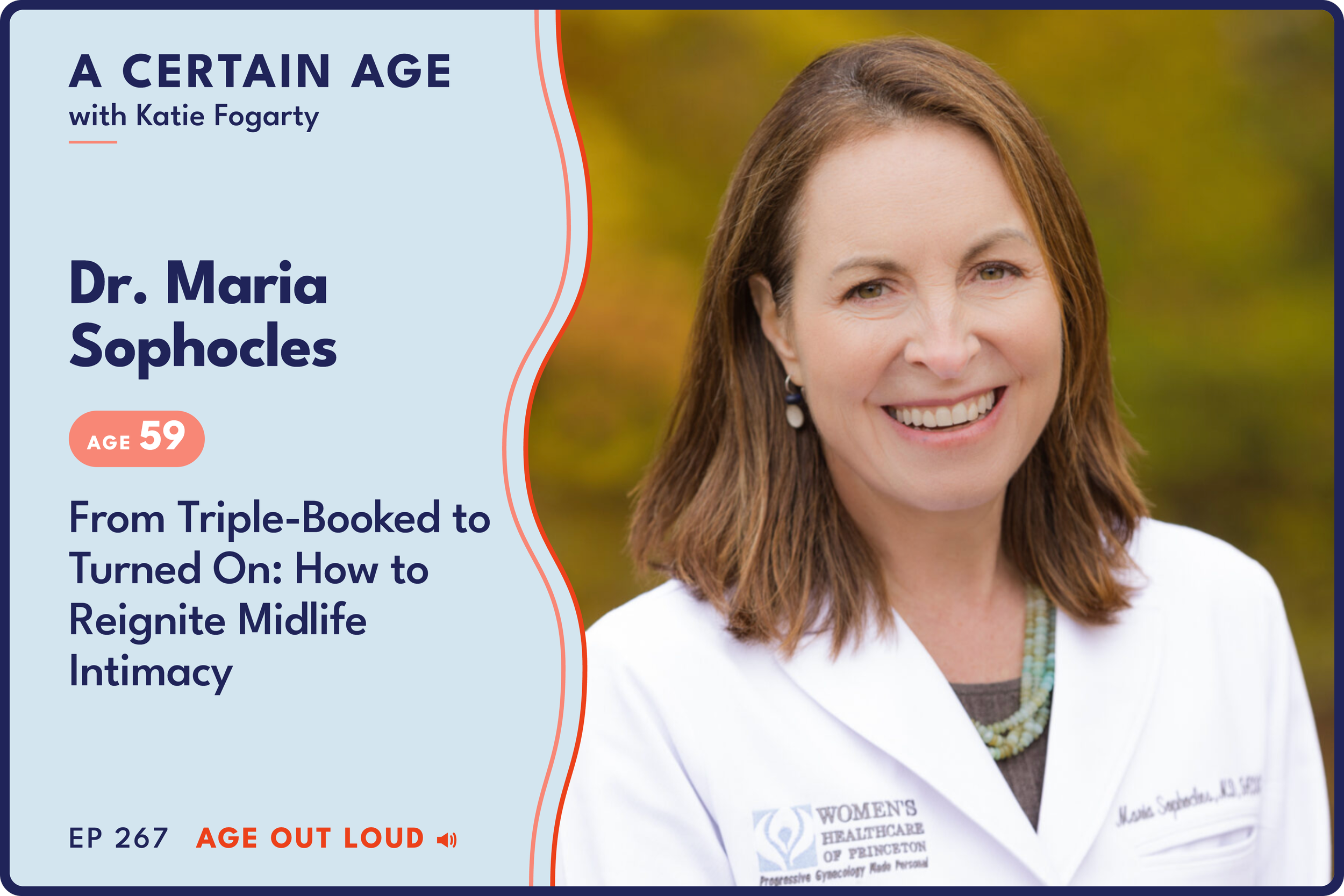
From Triple-Booked to Turned On: How to Reignite Midlife Intimacy with Dr. Maria Sophocles
Show Snapshot:
Midlife women are triple-booked — careers, caregiving, hormonal changes — and your sex life is usually the first thing to get dropped from the schedule. Dr. Maria Sophocles, OB-GYN and author of The Bedroom Gap, has treated tens of thousands of patients over 30 years. She says sexual burnout in midlife is far more common than most women realize, and far more fixable too.
In this episode:
Why midlife sexual burnout happens, and why it's not just "normal aging"
Practical solutions for painful sex and low desire
Tools worth trying: mindfulness, lubricants, erotica, and new sex tech
Gloria Steinem's advice that pushed Dr. Sophocles to finally write this book
About Dr. Maria Sophocles: Dr. Maria Sophocles is an OB-GYN and author of “The Bedroom Gap,” drawing on 30 years and tens of thousands of patients treated. She's a leading voice on midlife sexual health, offering practical, judgment-free solutions — from mindfulness to sex tech — for reigniting desire and preventing painful sex.
Show Links:
Follow Dr. Sophocles:
Dr. Sophocles’ Book:
The Bedroom Gap: Rewrite the Rules and Roles of Sex in Midlife
Dr. Sophocles’ TED Talk:
What happens to sex in midlife? A look at the "bedroom gap"
Other ACA episodes featuring Dr. Sophocles:
What’s the Deal with Testosterone Therapy? And How Does It Impact Libido, Energy and Overall Health?
What’s Your Pleasure? Bridging the Midlife Bedroom Gap with Dr. Maria Sophocles
Want more? Dive into our other shows on Sex + Intimacy here:
Quotable:
“The Bedroom Gap is a lot of explanation about factors—history, patriarchy, culture, physiology. It's a lot of how come, but then it's also how to: how to reclaim pleasure for yourself, how to restart a sex life that's just gone on the back burner.”
Transcript:
Katie Fogarty 0:00
Welcome to A Certain Age, a show for women who are unafraid to age out loud. I'm your host, Katie Fogarty. Beauties, is your sex life taking a backseat to everything else on your plate? If your sex life feels like it's on life support or that your best years in the bedroom are behind you, you have a lot of company. Today we're doing a deep dive into why so many women are struggling sexually, and we're doing that deep dive with one of your favorite guests and mine, Dr. Maria Sophocles. Dr. Sophocles is the author of the brand new book The Bedroom Gap. She returns to A Certain Age to share why midlife women are experiencing sexual burnout at alarming rates, and what we can do about it. With 30 years of clinical experience treating tens of thousands of patients, Dr. Sophocles shares the truth about hormones, medications, body image, pressures and the societal expectations that can derail our sex lives. Whether you're in perimenopause, dealing with libido loss or just want to reclaim intimacy after 40, get ready for a frank talk on supercharging your midlife sex life, and get ready for an unfiltered look at how porn, the patriarchy and the pressures of Instagram perfect bodies can do a number on your everyday sex life. If you want practical tools and supportive guidance to make pleasure, connection and intimacy healthy, fabulous, fun and flirty and to close that midlife bedroom gap once and for all, stick around. We have a terrific conversation ahead. Welcome back to A Certain Age, Dr. Sophocles.
Dr. Maria Sophocles 1:39
Thanks, Katie. It is so great to be back here again. I loved our first go around. So this should be fun.
Katie Fogarty 1:46
It's going to be incredible. You shared so much information when you were on the first time to talk about how menopausal body changes impact our sex life. You came back for a deep dive into testosterone. Those shows are do not miss. I will link out to them in the show notes, but I want to start by making sure that our listeners are all on the same page. Can you help set us straight—define what the bedroom gap actually is, and then I'd love to hear the reason, the moment that made you feel compelled to sit down and write this book.
Dr. Maria Sophocles 2:17
Sure. The bedroom gap is actually a bigger kind of concept than gaps we had heard about, or I had heard about. In my training as a doctor, I learned about an orgasm gap, which is really just that men and women in heterosexual relationships orgasm at different rates, which surprised absolutely nobody. And I thought, okay, I get that. But over my 30 years of taking care of women as a gynecologist, I felt like there was something broader—that the gaps or the differences in expectations sexually or abilities sexually, were partly anatomic and physiological, partly from menopausal changes or erectile dysfunction, but also there were bigger forces shaping who we are as we come into an intimate relationship. And so I guess that's where I came up with the term the bedroom gap: that difference in expectation and ability sexually between partners, most commonly between men and women, and I think most flagrantly different between men and women. But it also exists in same-sex relationships for sure, where one partner might be more sexually averse than another, or might be having sexual dysfunction, or might just be totally wiped out, or tired or distressed or depressed. And so whatever the cause, it's addressing that. And the book is a lot of explanation about those factors—history, patriarchy, culture, physiology. It's a lot of how come, but then it's also how to: how to reclaim pleasure for yourself, how to restart a sex life that's just gone on the back burner. So it's a little of everything.
Katie Fogarty 4:14
When did you realize—was there an aha moment that made you think, I really need this book to be out in the world?
Dr. Maria Sophocles 4:21
It was actually—I was sort of pushed into it by Gloria Steinem in a coat closet in New York. We had both just seen the movie premiere of The Ruth Bader Ginsburg story, the movie called On the Basis of Sex. And at the after party, Gloria Steinem and I both ended up in the coat closet getting our coats together, and just started a very natural conversation about sex and gender and the giant gendered healthcare gap. And she was just livid at the state of affairs that we had a president who was sort of a flagrant philanderer. And she felt that that embodied the just kind of rampant sexism that was invading our bedrooms and that women didn't feel pleasure was really for them. And I agreed and shared my medical expertise and that I had written a book about this, or was in the process of, but, oh, I didn't know if I should bother finishing it. And I remember she just literally looked me in the eye and said, 'Maria, you better write that damn book.' She said, 'Write it like your house is on fire. Write it like people's lives depend upon it, because they do.' And I think I just felt like, if Gloria Steinem feels this topic is so worthwhile, then it really deserves to be written. And before I finished it, I pitched the topic to TED, and they felt that not only was it urgent, but that it was universal. So they accepted it for a TED talk. You know, for that reason, they said, 'Maria, this is not just a doctor talking about a disease. This is you talking about a portion of the world that is being disregarded.' And there's a billion menopausal women out there who, if only 80% have vaginal atrophy, that's 800 million women right now, probably suffering, having painful sex. And so when TED accepted the topic for a TED Talk based upon its universality, and Gloria Steinem did her kind of, damn it, you've got to write this book, I think that's when I really felt like this isn't just something I'm seeing in my office. This is something millions of women are experiencing, and no one's talking about.
Katie Fogarty 6:33
Yeah, it truly is. It's divided into three parts. You do a lot of stage setting. We hear about midlife body changes, and we also talk about the world that we're living in today. In the middle, you talk about desire and pleasure, and what you call the five M's. I'm going to ask you about that a little bit later. And then at the end, there's really practical stuff on tools and tips, on lubes and sex toys, erotica, even sex tech, all the good stuff. We're going to get into it as much as we can. But I want to start with one more kind of stage-setting question. In your book, you're talking about the modern woman, and you describe her as being triple booked, which I was nodding my head in agreement with. Like we're juggling careers or purpose work, whatever that looks like for you. We're juggling caregiving. People are caregiving across different modalities. Sometimes it's kids, sometimes it's aging parents, sometimes it's a sibling, a sick spouse. And we're dealing with hormonal body changes through perimenopause and menopause.
Dr. Maria Sophocles 7:31
I think almost anyone listening is going to be nodding, saying yes. Even if I wanted to have sex, even if I want to have sex, I get in bed and I'm so tired, all I want to do is be by myself, or go to sleep or doom scroll or turn on the TV and binge Netflix or do something for myself, alone with myself. I hear this all the time. I actually get it. I get it. I raised four kids. I built a business. I have aging parents. I get it. So, yeah, we live in a society that prioritizes productivity over pleasure, 100%. We talk a big game. Oh, I'm going snowboarding. I'm gonna go down to the Bahamas for a weekend. I'm gonna go bowling tonight. I'm gonna do this. I'm gonna do that for fun. It's not that we don't have fun in our lives, but we definitely don't prioritize sex as play and as joyful and fun. I think for a lot of couples, it becomes sort of a default—what we do Friday night between 10 and 11. And that takes away spontaneity. That takes away the role of fantasy. That takes away the ability for novelty. That takes away the ability for intimacy without sex. Meaning we've come to think of sex as this, like, sort of series of—I shouldn't say series of unfortunate events.
Katie Fogarty 8:58
I guess it depends upon the kind of sex someone's having, right? Could be.
Dr. Maria Sophocles 9:04
Unfortunate events. But almost this role play, right? Like, let's kiss, cuddle, penetrate, ejaculate, fall asleep, you know? And I think when you make sex like that, it works okay for men, and really, even less okay for women, because again, you lose the ability to just be intimate, to just cuddle, to just feel each other's toes and remember the cute feeling of that, or to do something that you know your partner just loves—a back rub or or stroking someone's hair, or things that when you're dating and courting, you kind of learn, but then you forget in the throes of the crazy, busy life. And I think by reducing a sex life to the motions of sex or what you've seen on TV sex should be, I think you lose so much. You lose the joy. You lose the spontaneity. You lose the novelty. And by the way, novelty, fantasy—these things we know are linked to better dopamine release. And guess what? Dopamine release is a really great thing. It's a really important thing, and it's important for us at any age, even in our 80s. People who release dopamine, who release oxytocin, both of which are released in orgasm, by the way, have less depression. They have less feeling of solitude. And in oxytocin's case, it even facilitates building of muscle mass, which older people really need. So there's all kinds of links, Katie, between staying sexually active and longevity. I know that's not where that question was going, but...
Katie Fogarty 10:42
No, I love it. I love it. And in the book you write, 'Staying sexually active is not just about maintaining intimacy—it's about maintaining yourself.' I'd love for you to riff a little bit on that and what you mean, because I felt like that statement just like punched me in the gut. It was like really powerful.
Dr. Maria Sophocles 11:01
I think when we feel desired, when we feel sexual, it helps us feel sensual, which helps us feel sexy, which helps us maybe take better care of our health, our bodies. And that, in a nutshell, is what longevity is all about. It's self-care. It's taking care of your health. So if being sexually active and pleasured helps you stay more connected to your own body, to your own sense of self, you're more likely to make healthy decisions in other areas of your life. Like, this was a really nice orgasm, which releases oxytocin, which makes me feel happy, which makes me maybe less likely to drink tonight or to binge on the chips and cookies. Or if you're going to do that, at least do it guilt-free, you know? Like, let's just have the cookies and not feel guilty. I mean, I think women need to stop. Just take a deep breath. Not everything has to be perfect. But I think it's just about staying connected to yourself. Taking the time to pleasure yourself, whether by yourself through masturbation or with a partner, is just another way of prioritizing you. And we don't do enough of that. Like you said, Katie, we're triple booked: work, family, menopausal changes. We don't put ourselves first. And I think in the bedroom, we also don't put ourselves first. We put our partner's needs first.
Katie Fogarty 12:25
Okay, so in the book you've got some really interesting statistics, and as I was reading it, I started thinking about some of the realities that I think a lot of listeners are experiencing themselves or they have friends who are experiencing these things. Almost three in four menopausal women report less frequent sex, and like a whopping 58% of women say their sex drive has declined compared to just a third of men. And something like 68% of women between 35 and 60 feel increased body consciousness during sex. So I would love to hear a little bit about why this is happening and what's causing it, and kind of walk us through why so many women are feeling this way and struggling this way.
Dr. Maria Sophocles 13:13
Well, there are a lot of reasons. Some are physiologic. The decline in estrogen and testosterone really change things for women. They change, first of all, our vaginal health, vaginal moisture, elasticity, and that alone is going to make sex uncomfortable and even painful. And without treatment, and most women don't know about treatment, and even if they know about treatment, they're not seeking it out. And you couple that with just not feeling as horny as you did when you were 25. So you have desire decreased because of hormonal changes. You have vaginal dryness and pain with penetration because of hormonal changes. You have energy decreased because if you're perimenopausal and you're bleeding like crazy and iron-deficient, you're tired. If you're postmenopausal and you're having hot flashes and night sweats and insomnia, you're going to be tired. And we know that sleep deprivation is a desire killer. It just removes libido completely. I mean, if you think you're tired, all you want to do is sleep, not have sex. So all those kind of physiologic aspects of perimenopause and menopause, huge. Medications themselves, psychiatric medications, high blood pressure medications, these all decrease libido. So if you're on antidepressants, you probably are less likely to have decreased libido and harder time having an orgasm. So that's a lot of physiology affecting women's libido. But over and above that, Katie, women—here's the other part of it—women in relationships don't feel like their partners are doing enough in the shared labor in the house, and they feel like they come in second to the partner's career all the time. They feel like everything they do is not valued. So now you add to the exhaustion and the hormone deficiency, the imbalance of labor at home, and it's no wonder women are like, 'I'm tired. Leave me alone. I don't want to have sex.' And that's where I think we have to address the relationship dynamics. We have to make sure men—and I hate to say just men, it's anybody, any partner—is doing the dishes, is helping around the house, is not making a mess every minute. You know, is not just, like, making your life harder. Like, if you know Katie comes home on Wednesdays, exhausted from her show, help her. Don't sit on the couch. Or if you want to sit on the couch, sit there together. Build some intimacy, build some connection. I think those relationship pieces are missing.
Katie Fogarty 16:02
I mean, it's true. It's so true. One of the things that I sort of riffed on when I was reading the book is, I think in a lot of relationships, there's this misconception that like the woman's the one who has to drive intimacy and the man is the one who drives sex. And those things aren't necessarily the same. And I think, like, there's a lot to be said for the partner who wants to have sex to also spend more time developing that intimacy and emotional connection outside the bedroom. Because I think that's such a huge part of what makes a woman, you know, her engine running. Like, if I feel connected and valued during the day, I'm much more likely to want to have sex at night.
Dr. Maria Sophocles 16:48
Absolutely. And men need to understand that for women, arousal and desire is not as spontaneous as theirs. That a lot of women, maybe most women in long-term relationships, have what we call responsive desire, meaning they're not walking around thinking, 'Oh, I really want to have sex tonight.' They're walking around thinking, 'I got to get this done, I got to do that.' And it's only when their partner does something—rubs their back, maybe kisses their neck, says something sweet, does the dishes, makes them laugh—that they're like, 'Oh, okay, maybe. Let's see where this goes.' And that's responsive desire. And it's not inferior. It's just different. And I think men—or partners who have spontaneous desire—need to understand that just because your partner doesn't initiate sex doesn't mean they don't want it or don't enjoy it. It just means they need a little warm-up. They need a little foreplay. And I don't just mean genital foreplay. I mean emotional foreplay, like connection, like talking, like asking about their day, like being present.
Katie Fogarty 17:53
One thing that I heard about recently that I want to ask you about is called desire discrepancy. I think that's related to what we're talking about. Can you talk about desire discrepancy and how that impacts relationships?
Dr. Maria Sophocles 18:08
Desire discrepancy is one of the most common sources of conflict in long-term relationships. And it's not about one person being normal and one being abnormal. It's just that in any relationship, there's usually going to be one partner who wants sex more frequently than the other. And that can shift over time, you know? Maybe early in the relationship, the woman has higher desire, and then after kids or menopause, it flips. But the discrepancy itself becomes a problem when the person with higher desire feels rejected and the person with lower desire feels pressured. And that creates this awful cycle where the higher-desire partner keeps initiating and getting rejected, and so they initiate more desperately, which makes the lower-desire partner feel even more pressured and defensive, and so they pull back even more. And it just spirals. So what I tell couples is you've got to talk about it. You've got to normalize that it's okay to have different levels of desire. And you've got to find a middle ground. Maybe that means the higher-desire partner takes care of themselves sometimes through masturbation. Maybe it means the lower-desire partner works on increasing their desire through addressing hormones or stress or relationship issues. Maybe it means you schedule sex, which sounds unromantic, but honestly, it can be helpful because then both partners know it's coming and can prepare mentally and emotionally. The key is to stop making it about right and wrong and start making it about understanding and compromise.
Katie Fogarty 19:45
You talk a lot about the five M's in the book. Can you walk us through what those are?
Dr. Maria Sophocles 19:52
Yes, the five M's are Mind, Meds, Medicine, Movement, and Moisture. And basically, these are the five areas that I think are most important to address if you're trying to improve your sex life, especially in midlife. So Mind is all about stress, anxiety, depression, body image, past trauma. If your mind isn't in the game, your body won't be either. So we have to address mental health and psychological wellbeing. Meds is about medications that can interfere with sexual function—antidepressants, blood pressure meds, even antihistamines. So we need to review your medication list and see if there's anything we can adjust or substitute. Medicine is about treating actual medical conditions that affect sex—vaginal atrophy, painful bladder syndrome, pelvic floor dysfunction. These are treatable, but you have to know about them and seek treatment. Movement is about staying physically active, which improves blood flow, energy, mood, and body image—all of which are important for sex. And finally, Moisture is about lubrication, both natural and supplemental. Because if sex hurts because you're dry, you're not going to want to do it. So addressing all five M's together gives you the best chance of improving your sex life.
Katie Fogarty 21:16
That's such a helpful framework. I want to dive a little bit deeper into a couple of those. Let's talk about medications. What are the most common culprits that you see in your practice that are impacting women's sex lives?
Dr. Maria Sophocles 21:29
The biggest ones are antidepressants, especially SSRIs like Prozac, Zoloft, Lexapro. These are incredibly effective for treating depression and anxiety, but they also commonly cause decreased libido and difficulty reaching orgasm. And then blood pressure medications, particularly beta blockers, can reduce blood flow to the genitals, which makes arousal harder. Birth control pills can lower testosterone, which can lower libido. Antihistamines, even over-the-counter ones like Benadryl, can dry you out, including vaginal dryness. So it's really important to look at everything you're taking and talk to your doctor about whether there are alternatives or adjustments that might help. Like, sometimes switching from one SSRI to another can make a big difference. Or adding Wellbutrin, which is an antidepressant that actually can increase libido. So there are options, but you have to ask.
Katie Fogarty 22:35
What about hormone therapy? I know you're a big proponent of it when it's appropriate. Can you talk about how hormone therapy can help with some of these issues?
Dr. Maria Sophocles 22:46
Hormone therapy can be life-changing for a lot of women. Estrogen therapy, whether systemic or local, can restore vaginal health, improve lubrication, reduce pain with sex. It can also help with energy, mood, sleep—all of which indirectly improve sex. And testosterone therapy, when appropriate, can help with desire and arousal. But I want to be clear: hormone therapy is not a magic bullet. It's not going to fix a bad relationship or erase stress or heal trauma. But if the problem is physiologic—if your vagina is dry and painful, if you're exhausted from hot flashes, if your testosterone is tanked—then hormone therapy can absolutely help. The key is to work with a provider who understands menopause and sexual health and who will listen to you and tailor treatment to your specific needs.
Katie Fogarty 23:46
You mentioned body image earlier, and in the book, you talk about how porn and Instagram and just the media in general have created these unrealistic expectations for what bodies should look like and what sex should look like. Can you talk about that and how it affects women's sexual confidence?
Dr. Maria Sophocles 24:06
Oh my gosh, this is huge. We are bombarded constantly with images of perfect bodies and perfect sex. Porn shows sex that is totally performative and often violent and completely disconnected from intimacy or pleasure, especially female pleasure. And Instagram and social media show us filtered, photoshopped bodies that don't exist in real life. And so women—especially midlife women—look at their own bodies, which are changing, which have stretch marks and cellulite and saggy skin, and they feel like they're not good enough. They feel like they don't deserve pleasure or that their partner won't find them attractive. And so they avoid sex or they have sex with the lights off or they can't relax and be present because they're so in their heads worrying about how they look. And that is a tragedy. Because real bodies—your body, my body—are beautiful and worthy of pleasure. And real sex is messy and awkward and funny and intimate and nothing like what you see in porn. So we have to push back against these unrealistic standards. We have to reclaim our bodies and our sexuality and stop comparing ourselves to impossible images.
Katie Fogarty 25:34
Okay, let's talk solutions. What are some practical things that women can do right now to start closing their own bedroom gap?
Dr. Maria Sophocles 25:46
Great question. So first, get a good lubricant. Seriously, this is non-negotiable. If you're experiencing any dryness, you need lube. I recommend silicone-based lubes for penetrative sex because they last longer and they don't get sticky. And there are great brands out there—Überlube, Pjur, Sliquid. And if you're dealing with significant vaginal atrophy, talk to your doctor about vaginal estrogen. It's safe, it's effective, and it's life-changing. Second, explore your own body. Masturbate. Figure out what feels good. Use a vibrator if that helps. You can't expect your partner to know what you like if you don't know what you like. Third, communicate with your partner. Tell them what you want, what feels good, what doesn't. And listen to them too. Fourth, prioritize intimacy, not just sex. Touch each other. Kiss. Cuddle. Hold hands. Build connection outside the bedroom so that when you do have sex, you feel close and present. Fifth, address the five M's—Mind, Meds, Medicine, Movement, Moisture. Work on your mental health, review your medications, treat any medical conditions, stay active, and use lube. And finally, give yourself permission to prioritize pleasure. This is not selfish. This is self-care.
Katie Fogarty 27:21
Let's talk about sex toys. I feel like there's still a lot of shame or awkwardness around them for some women. What would you say to someone who's curious but hesitant?
Dr. Maria Sophocles 27:34
I would say go for it! Sex toys are amazing. They can help you explore your body, figure out what feels good, and have stronger orgasms. And they can be great for partnered sex too. Like, my favorite toy to recommend is the Magic Wand, which is a vibrator that's super powerful and can help women who have difficulty reaching orgasm. And there are all kinds of other toys—bullet vibes, rabbit vibes, suction toys like the Womanizer or Satisfyer. And they're not just for women who are single or who have dysfunction. They're for anyone who wants to enhance their pleasure. So if you're curious, start simple. Buy something small and discreet. Explore on your own. And if you're comfortable, bring it into the bedroom with your partner. A lot of men actually really enjoy incorporating toys into sex because they like seeing their partner experience pleasure.
Katie Fogarty 28:40
What about erotica? You recommend it in the book. Why is erotica helpful for women?
Dr. Maria Sophocles 28:47
Erotica is great because it engages your mind, which for women is often the most important sex organ. Reading or listening to something sexy can help you get aroused, can help you explore fantasies in a safe way, and can just be a fun way to reconnect with your own sexuality. And there's so much out there now—books, audiobooks, apps. One of my favorites to recommend is the Dipsea app, which has audio erotica specifically designed for women. The stories are well-written, they're diverse, and they focus on female pleasure. So if you're someone who finds it hard to get in the mood, erotica can be a great tool.
Katie Fogarty 29:35
Okay, I want to talk about something that I think is really important but doesn't get talked about enough. And that's the impact of past trauma on women's sexuality. Can you talk about that?
Dr. Maria Sophocles 29:48
Yes, this is so important. Past sexual trauma—whether it's assault, abuse, coercion—can have a profound impact on women's sexuality. It can cause pain with sex, difficulty with arousal, inability to orgasm, avoidance of sex altogether. And the thing is, trauma doesn't always show up right away. Sometimes women have a normal sex life for years, and then something triggers the trauma—maybe a life transition like menopause, or a relationship change, or even just aging and feeling more vulnerable. And suddenly, sex feels unsafe or triggering. So if you have a history of trauma and you're struggling sexually, it's so important to work with a therapist who specializes in sexual trauma. Somatic therapy can be especially helpful because it helps you reconnect with your body in a safe way. And pelvic floor physical therapy can help if you're experiencing pain or tension. The key is to be gentle with yourself and to go at your own pace. Healing is possible, but it takes time and support.
Katie Fogarty 31:08
What about women who are single or not in a relationship? How can they work on their sexual health and wellbeing?
Dr. Maria Sophocles 31:17
Oh, this is a great question. Being single doesn't mean you have to put your sexual health on hold. In fact, I think it's a great opportunity to really get to know your own body and your own pleasure without the pressure or expectations of a partner. So, masturbate. Use toys. Explore fantasies through erotica or even ethical porn. Take care of your physical health—treat vaginal atrophy if you have it, use lube, keep your pelvic floor strong. And stay open to connection, whether that's casual dating or just being intimate with yourself. Your sexuality is yours, and it deserves attention and care, with or without a partner.
Katie Fogarty 32:10
You have a whole section in the book on what you call 'sex tech.' Can you give us some examples of what's out there and how it might be helpful?
Dr. Maria Sophocles 32:22
Oh yes, sex tech is so cool. So there are apps now that can help you track your arousal, your desire, your orgasms. There are virtual reality experiences that can be erotic and immersive. There are even—and this is wild—long-distance sex toys that connect via an app so that partners who are apart can still pleasure each other remotely. Like, one partner controls the toy that the other partner is using, and the toys can sync up based on the rhythm and pressure. It's pretty incredible. And then there are things like pelvic floor trainers that use biofeedback to help you strengthen your pelvic floor, which can improve arousal and orgasm. So there's a lot out there, and I think it's worth exploring if you're curious.
Katie Fogarty 33:21
Wait, wait, wait. Long-distance sex toys? Are you serious? Tell me more about this.
Dr. Maria Sophocles 33:28
Yes! So there are companies like We-Vibe and Lovense that make toys that connect to an app. And one partner can control the other partner's toy from anywhere in the world. So let's say you're in New York and your partner is on a business trip in LA. You can both have these toys, and through the app, you can control each other's toy—the intensity, the rhythm, the pattern. And some of them even have this feature where if one person is using their toy at a certain speed or pressure, it actually feeds back into the other person's toy and mimics that. So it's like you're touching each other even though you're miles apart. It's pretty wild.
Katie Fogarty 34:24
Okay, that's incredible. I had no idea that existed. That's amazing. So we've talked about a lot of practical tools and strategies. But I want to zoom out for a second and talk about the bigger picture. What do you think needs to change culturally for women to feel more empowered sexually?
Dr. Maria Sophocles 34:46
We need to stop treating female sexuality as shameful or as something that exists only to please men. We need to talk openly about pleasure, about desire, about anatomy. We need to teach young girls that their bodies belong to them and that pleasure is their birthright. We need to educate boys and men about female anatomy and about consent and about the fact that sex should be pleasurable for everyone involved. We need to push back against porn culture and unrealistic beauty standards. We need to make sexual health a part of overall health and make it something that doctors are trained to talk about. And we need to support women in prioritizing their own pleasure and not feeling guilty about it. This is a huge cultural shift, but it's necessary.
Katie Fogarty 35:50
Absolutely. Okay, so I want to talk about something that I think is really fun and also really important, which is the idea of novelty and fantasy. You talk about this in the book. Why is novelty important for keeping a sex life alive?
Dr. Maria Sophocles 36:06
Novelty is huge. Our brains are wired to respond to new and exciting things. Novelty increases dopamine, which is the neurotransmitter associated with pleasure and reward. So when you do something new or different in the bedroom, it can make sex more exciting and more pleasurable. And this doesn't have to be crazy or extreme. It can be as simple as having sex in a different room, or at a different time of day, or trying a new position, or using a toy, or reading erotica together. Just something that breaks the routine and makes it feel fresh. And fantasy is part of that. Fantasies are a safe way to explore desires and turn-ons without necessarily acting on them. And sharing fantasies with a partner can be really intimate and can help you both understand what turns each other on.
Katie Fogarty 37:10
What would you say to a woman who feels like, 'It's too late for me. My sex life is over. I'm too old, or my body's too different, or I've been out of the game for too long'?
Dr. Maria Sophocles 37:24
I would say it is never too late. Never. I have patients in their 70s and 80s who are having the best sex of their lives. And I have patients who've been celibate for years who restart their sex lives and find it incredibly fulfilling. Your body might be different than it was at 25, but that doesn't mean it's not capable of pleasure. In fact, a lot of women report that sex gets better as they age because they're more confident, they know what they want, they're less worried about what other people think. So if you're feeling like it's too late, I would encourage you to challenge that belief. Start small. Explore your own body. Talk to your doctor about treating any physical issues. Work on your mental and emotional health. Connect with your partner if you have one. And give yourself permission to prioritize pleasure. You deserve it.
Katie Fogarty 38:37
That is so powerful. Okay, I want to talk about something that I think is a little taboo, but I think it's important. And that's the idea of opening up a relationship or exploring non-monogamy. Do you ever have patients who bring this up?
Dr. Maria Sophocles 38:55
Yes, absolutely. And I think it's important to acknowledge that traditional monogamy doesn't work for everyone. Some couples find that opening up their relationship—whether that's having an open marriage, or swinging, or polyamory—actually strengthens their relationship because it allows both partners to have their needs met and to explore their sexuality in ways that feel authentic. But I always tell people that this is not something you do to fix a broken relationship. You have to have a really strong foundation of trust and communication before you even consider it. And you have to be honest with yourself and your partner about what you want and why. Because if one person is doing it because they feel pressured or because they're trying to save the relationship, it's not going to work. But for some people, it can be a really positive and fulfilling choice.
Katie Fogarty 40:00
What about women who are in relationships where their partner has erectile dysfunction or other sexual health issues? How can they navigate that?
Dr. Maria Sophocles 40:11
This is so common, especially as both partners age. And the first thing I tell women is that sex does not have to be penetrative. There are so many ways to be intimate and to experience pleasure that don't involve a penis. Oral sex, manual stimulation, toys, mutual masturbation—all of these can be incredibly pleasurable. And for men with ED, there are treatments available—medications like Viagra or Cialis, vacuum erection devices, even penile injections or implants. So if your partner is willing to address it, there are options. But if they're not willing, then you have to decide what you want to do. Do you want to stay in the relationship and find other ways to be intimate? Do you want to open the relationship? Do you want to leave? There's no right answer, and it's a deeply personal decision. But you don't have to just accept a sexless relationship if that's not what you want.
Katie Fogarty 41:23
Okay, this is a question that I know a lot of women have, and that's about scheduling sex. Some people think it's totally unromantic and kills spontaneity. Other people think it's practical and necessary. What's your take?
Dr. Maria Sophocles 41:38
I am totally in favor of scheduling sex, especially for busy couples who have kids or demanding careers. Because here's the thing: we schedule everything else in our lives that's important—work meetings, doctor's appointments, workouts, date nights. Why wouldn't we schedule sex? And scheduling it doesn't mean it has to be boring or routine. It just means you're both committing to prioritizing it. And actually, knowing that sex is on the calendar can build anticipation. You can think about it during the day, maybe send each other flirty texts, plan what you want to do. So it can actually enhance the experience, not detract from it. The key is to be flexible. If the scheduled time comes and one of you is exhausted or stressed, you can reschedule. But having that time blocked off sends a message that sex is important and that you're both invested in maintaining your sexual connection.
Katie Fogarty 42:52
I love that. Okay, so we've talked about a lot. Before we wrap up, I want to ask you about something that I think is really fun and maybe a little bit out there. And that's virtual reality sex. You mentioned it briefly. Can you talk more about what that is and how it works?
Dr. Maria Sophocles 43:11
Yes! So virtual reality, or VR, is becoming more accessible and more sophisticated. And there are now VR experiences that are designed to be erotic or sexually immersive. You put on a VR headset, and you're transported into a 3D environment where you can interact with virtual partners or scenarios. And some of these experiences are actually really well done and can be quite arousing. They can be a way to explore fantasies in a safe, private way. And I think as the technology gets better and more affordable, we're going to see more people using it. It's not for everyone, obviously, but if you're curious and open-minded, it's worth checking out.
Katie Fogarty 44:04
That is wild. I feel like we're living in the future. Okay, last question about sex tech. You mentioned Pride and Prejudice earlier. What was that about?
Dr. Maria Sophocles 44:16
Oh, yes! So there's this company called Lioness that makes a vibrator that also collects data about your arousal and orgasm. And they did this study where they had women read different genres of books while using the vibrator, and they measured their arousal levels. And it turned out that classic romance novels like Pride and Prejudice were actually really effective at increasing arousal. So the idea is that if you're someone who has trouble getting in the mood, you could read a sexy book—whether it's Jane Austen or something more explicit—and use a vibrator at the same time, and it can help you get aroused. I think it's brilliant. It combines literature and technology and pleasure in this really fun way.
Katie Fogarty 45:19
Okay, that is amazing. I love that so much. Alright, so we've covered so much ground. Before we wrap up, I want to circle back to something you mentioned at the very beginning, which is the long-distance sex toys that connect via an app. What are those called, and where can people find them?
Dr. Maria Sophocles 45:42
Yes, so there are a few companies that make these. We-Vibe and Lovense are two of the big ones. And you can buy them online—Amazon, the company websites, sex toy retailers like Babeland or Good Vibrations. They're not super cheap, but they're not prohibitively expensive either. And if you're in a long-distance relationship or if you and your partner travel a lot, they can be a really fun way to stay connected.
Katie Fogarty 46:21
Okay, I have to ask. What is the actual name of the toy? Because I'm dying to know.
Dr. Maria Sophocles 46:29
So We-Vibe has one called the Moxie, and Lovense has several—the Lush, the Nora, the Max. And they all work a little differently, but the basic idea is the same. You connect the toy to an app, and your partner can control it remotely. Some of them are designed to be worn during the day—like you can wear them to work or out to dinner, and your partner can surprise you by turning it on. It's kind of naughty and fun.
Katie Fogarty 47:07
Oh my gosh, that's hilarious. I love it. Okay, so the Lovense Lush. That's the one that you can wear during the day?
Dr. Maria Sophocles 47:18
Yes, the Lush is designed to be worn internally, and it has a little tail that sticks out, so it stays in place. And your partner can control it from anywhere in the world through the app. It's pretty wild.
Katie Fogarty 47:33
That is incredible. Okay, the name Lovense Lush—it sounds like it was made up by like a 13-year-old boy, honestly.
Dr. Maria Sophocles 47:42
Guess what? It's not that expensive. It's not that expensive either. I looked up the cost of it because I haven't ever used one myself. But if Katie's in New York and her husband's on a business trip in LA and they just really wish they were together, there are remote controls that will allow each of them to pleasure each other—to make each other's toy work. And if they're using the toy together, the rhythm of the toy will feed back into the other toy across the country. And so if Katie is using her toy at a certain rate or pace or pressure, it actually affects the output of her partner's toy in San Diego.
Katie Fogarty 48:43
Okay, that is totally wild. And it makes me think of that phrase, like there's an app for that. Like there literally is an app for everything.
Dr. Maria Sophocles 48:50
In this case, there's an app and a toy—two toys that go with the app. So, you know, it's sort of phone sex, but for our times.
Katie Fogarty 49:00
Oh my, I learned something on every show, and you have taught me something that I did not see coming, and I'm off to Google it when we're done. That is hysterical. Oh my gosh, I love it.
Dr. Maria Sophocles 49:10
I don't know if Gloria Steinem would have wanted the book to go that far. You know, she was the one that said you've got to write this book, and she's the one that really inspired me to actually put pen to paper and do it. And in her typical fashion, she was hurling four-letter words about the state of affairs, politically, of our country, but also of the fact that sexually, women were still just kind of giving in to the same things their mothers and grandmothers and great-grandmothers were. And she felt like this book might be for people a place and a way to feel hopeful, to reclaim pleasure for themselves.
Katie Fogarty 49:51
So that's like such a great segue. My final question for you, Dr. Sophocles: What is giving you hope? What's giving—I mean, this book gives me hope. It's so packed with science, information, practical guidance, big-picture support, things that will make you think differently about not only your sex life, but the world. But what is your hope about the future of women's sexual health and midlife intimacy?
Dr. Maria Sophocles 50:14
Well, my hope is that sexual health will be considered a pillar of overall health. So when we talk about nutrition and movement and sleep, we also look at sex and sex span—meaning, how long are you sexually active—as a metric for longevity and health span. And we have data to show that. And until medical education systems start putting sex ed into training doctors and PAs and NPs in all specialties to think of sexual health as a proxy for overall health, I think we'll be kind of stuck with clinicians not wanting to talk about it. So we have to change that. And until the general public gets out of their sort of squeamishness, I think we won't move the needle forward. But I'm very hopeful, because, like I said, I just was at JP Morgan in San Francisco, this huge, huge healthcare conference. And there's so much interest and funding, and so many startups, female startups, starting companies to make women's health more progressive, and including that is sexual health. So it's coming. Let's, you know, even if it just moves the needle a little bit forward. Someone said you can't climb a mountain until you move some stones. So let's grab a few pebbles each. Grab your Pride and Prejudice, grab your virtual reality goggles, and let's each start talking. Start talking with friends, with daughters, with sons and partners, and see if we can't close our own bedroom gaps and make the bedroom gaps for the next generation not happen in the first place. That's what I'm hopeful for.
Katie Fogarty 51:47
Yeah, I love it. So everyone needs to start by buying this book and then also buying several for the people in your life that you care about. So Dr. Sophocles, before I say goodbye, though, how can our listeners find you and continue to follow all of your work?
Dr. Maria Sophocles 51:59
Either my website or Instagram or LinkedIn. So on LinkedIn, Maria Sophocles. And on Instagram at Maria Sophocles, MD. .com—that's the website too. MariaSophoclesMD.com. And The Bedroom Gap is out, so it can be ordered pretty much anywhere online or in bookstores. And I think it'll be great. I think people will really, really learn from it. I hope so.
Katie Fogarty 52:26
Thank you so much, Dr. Sophocles. This wraps A Certain Age, a show for women who are aging without apology. Dr. Sophocles is always incredible to spend time with. She shares so much smart, supportive guidance. I learned something every time I talk to her. Do not miss her first two appearances on A Certain Age. She came on to talk about midlife intimacy and how menopausal body changes can intersect with our sex life, our sense of self, our identity. And on show two, she came in to do a dive into testosterone and talk about the role of testosterone in our sex lives, on our libido and our overall health. I will put all of those in the show notes. You can find them over on acertainagepod.com. If you learned something on today's show, if you've learned something from one of the hundreds of doctors that have appeared on the show in the past, or any of the other incredible midlife experts who join me every week, I would love to hear about it in an Apple Podcast or Spotify review. I want to know what's resonating, clicking with you. Reviews help other women find the show. I so appreciate when a listener takes time to write one. Special thanks to Michael Mancini for composing and producing our theme music. See you next time, and until then, age boldly, beauties.
