
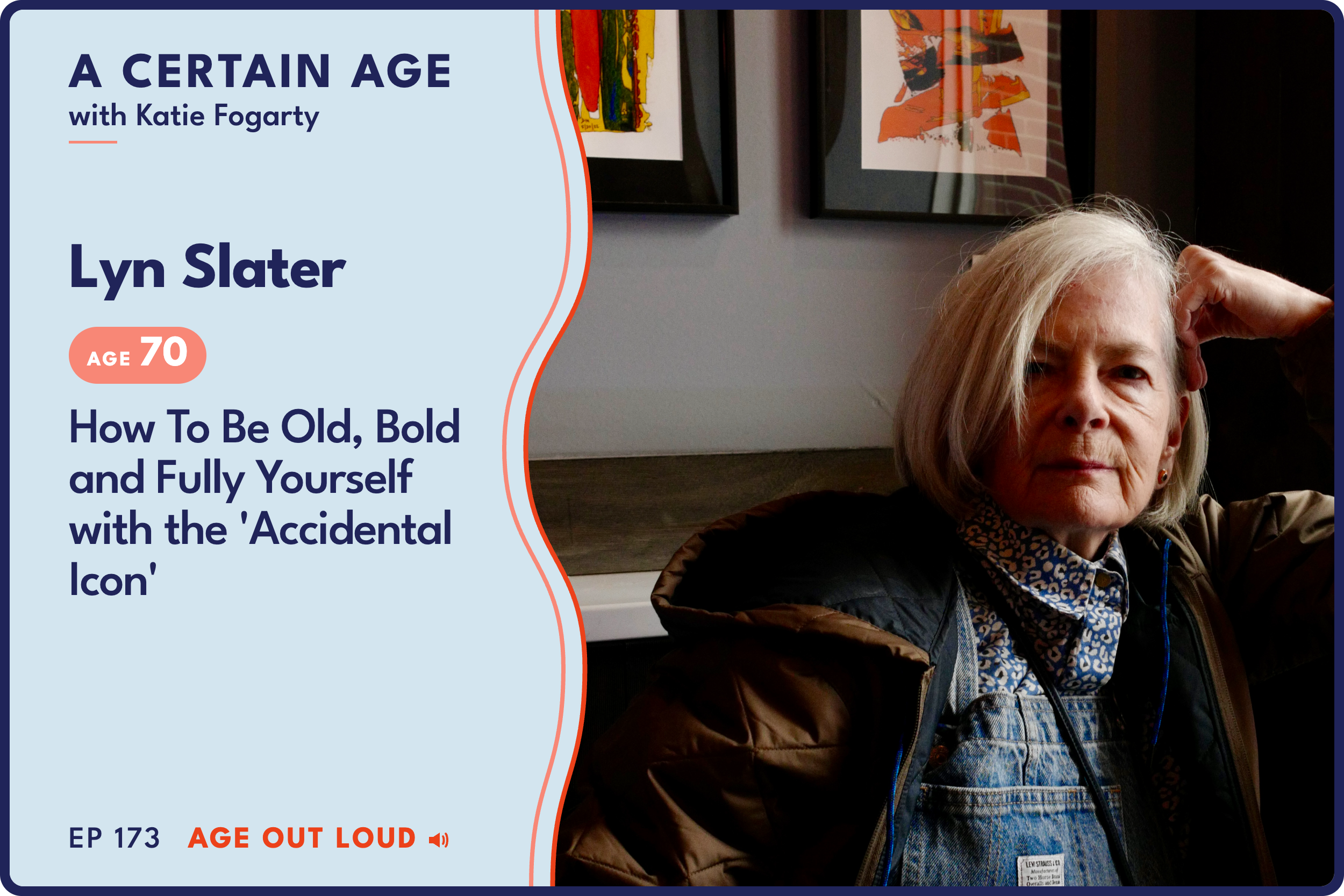
How To Be Old, Bold and Fully Yourself with Accidental Icon's Lyn Slater
Show Snapshot:
At 60, after decades as a social work professor, Lyn Slater started taking classes at a fashion school just for fun, jewelry making, sewing, a course called Building a Vintage Business. Classmates kept telling her she had great style and should start a blog. She did, mostly as an act of self-care with zero expectations. It grew into nearly a million Instagram followers, ad campaigns, and a persona called the Accidental Icon, and eventually into a memoir about why she walked away from all of it.
In this episode:
How a small creative outlet turned into a global fashion phenomenon nobody planned for
The false lens social media creates, and why Lyn eventually stepped back from it
What it means to reinvent yourself and experiment with identity at any age
The transgressive power of aging visibly, and what "how to be old" really means to Lyn
About Lyn Slater: Lyn Slater is the author of “How to Be Old: Lessons in Living Boldly from the Accidental Icon,” one of Elle's Most Anticipated Nonfiction Books. She holds a PhD in Social Welfare and spent decades as a professor at Fordham University before launching her fashion blog, Accidental Icon, at 61, which grew to nearly a million followers.
Show Links:
Follow Lyn:
Lyn’s book:
How to Be Old: Lessons in Living Boldly from the Accidental Icon
Quotable:
I was some ordinary woman on the streets of New York who was wearing interesting clothes. And so that's really how it started. And it was really a pleasure project. It was a creative impulse. It was an act of self care. I had no intention for it to become what it eventually became.
Transcript:
Lyn Slater 0:00
I was like some ordinary woman on the streets of New York who was wearing interesting clothes. And so that's really how it started. It was really a pleasure project. It was a creative impulse. It was an act of self-care, and I had no intention for it to become what it eventually became.
Katie Fogarty 0:30
Welcome to A Certain Age, a show for women who are unafraid to age out loud. I'm your host, Katie Fogarty. Beauties, I have a love-hate relationship with social media — I'm sure you do too. I'm going to spare you all the reasons I think social media is corrosive, divisive, distracting, and focus on what I absolutely love about the medium at its best. Social media is a creative gateway, a free channel for discovery, self-expression, connection. I follow crazy talented pie makers, gardeners, any number of British interior designers. My feed looks like it was styled by the set designer for the last season of The Crown. I also follow incredible women who run age-positive accounts that make me feel seen and supported as I age, that make me excited about the possibility, creativity, and vibrancy that exists in our later years.
My guest today is one of the best reasons to be on Instagram. I'm joined by Lyn Slater, an author and former professor known as the Accidental Icon. You may know her from her eyewear ad for Valentino. You may have seen her on billboards around the world. You may have read her thoughtful blog, seen her in the front row of a fashion show or in Vogue, or you may be eagerly anticipating her riveting memoir, How to Be Old. Get ready to take notes on today's show — we are diving into lessons on living boldly and exploring how to experiment, reinvent, and, of course, how to be old. Welcome, Lyn.
Lyn Slater
Thanks. That's a great intro.
Katie Fogarty 2:13
Well, I am really thrilled. Frequent listeners of the show have heard me say before that one of the best parts of having a podcast is connecting with incredible women, and I absolutely loved your memoir, How to Be Old. It spans a ten-year time period, from when you first launched your blog back in 2014, at the age of 61, to your explosion, right, as a cultural force known as the Accidental Icon. You go through the highs and lows and evolution and eventual distancing that you undergo from the world of influencing — we're going to explore as much as we can. But I would love to have you start by setting the stage. The first chapter of your book is called "Predict the Future by Inventing It." You invented the Accidental Icon. How did you first come to be known by this persona?
Lyn Slater
Well, in 2014, I was working full time as a professor of social work, and being a social worker for 47 years, I had to learn how to deal with some of the really challenging content and experiences, and I had a lifelong habit of stepping out of my professional life and into a world where I began to explore some creative expression that was completely different from what I was doing in my daily life.
At 60, I really started the process. I started to take classes at FIT, a fashion school, because I just had this interest in clothes — not really fashion so much, but clothing, and the power it held to be able to express identity, to experiment with identity, to sort of transgress. And so I took classes in a whole variety of things — jewelry fabrication, sewing — and I took this class called Building a Vintage Business. And all of the students and the professors, whenever I traveled through the school, they would say, "Wow, you have really great style. You should start a blog."
And so I was like, okay, that's easy. I know how to make a website. I know how to write. I like to research. The one thing I had to start doing was having my partner take photos of me in some of my clothes. But that ended up being fun, because my partner was a street photographer, and so the images in the very, very earliest years of my blog were just kind of gritty street scenes. I was like some ordinary woman on the streets of New York who was wearing interesting clothes. And so that's really how it started. It was really a pleasure project. It was a creative impulse. It was an act of self-care, and I had no intention for it to become what it eventually became.
Katie Fogarty
You know, it's so interesting, because I loved that initial chapter of the book where you're talking about this Building a Vintage Business class — you say in that chapter, quote, that you enjoyed it because it treasured oldness, which was something you connected to. And so you were sharing street style photography, your incredible style, your incredible fashion sense, but there was an explosion of interest in you that went beyond simply the clothes, and your age played some kind of role in that. How did you see that link?
Lyn Slater
What was really interesting is that for me, this project had nothing to do with my age, and that's actually how I generated the hashtag Age Is Not a Variable.
Lyn Slater 6:30
I was a woman who happened to be a certain age, but I was just expressing myself in a creative way, and I did not have the intention to say, "Oh, look at me, I'm finding a new way to be old." Actually, society and the media made it about my age.
Katie Fogarty
Yeah, that's so interesting. Because you also say — by the way, my copy of your book right now looks like a porcupine, because it's studded with all of these post-it notes of things that I flagged — this book was so enjoyable. But you say in one of these chapters, quote, "I am calmly demanding my right to self-creation on my own terms. I couldn't care less if you like me or not, want me or not. I appear unafraid of being old. This is a breath of fresh air for those of all ages, seeking the freedom to self-create in a world defined by standards of youth and beauty." And I think we're in such an interesting moment in time, because we're really in the rise of the anti-aging movement, right? But yet somehow it still feels transgressive to reject societal beauty norms. And part of the reason the media focused in on you is that it just felt outrageous and disruptive to be somebody who was self-creating, expressing herself in a society that says, "Oh, after a certain age you are invisible, we don't pay attention." Why do you think that is? What's your take?
I have a lot of thoughts, but you're here as the guest — I want to hear your thoughts.
Lyn Slater
I think it's very interesting, because for me, my experience with how society thought about age really changed over time. And in looking back, I think when I first started, in those early years before I became very well known, is when I was really being transgressive, because at that point there were no older women who appeared in fashion, and I think Joan Didion in a Celine ad and me in a Valentino eyewear ad were sort of the first older women who were featured in fashion magazines in an advertisement from a very big brand.
Yeah, it's so fascinating. And I think initially, the narrative told about me was, "Oh, look at this interesting woman — she's a professor of social work, and at the age of 61 she decided to reinvent herself," and that was a story that I could live with.
Lyn Slater 9:24
Over time, that story changed, and I became promoted in the media as somebody who was living an exemplar of how every woman should be living an older life, and there was no mention of the privilege that I had in being able to sort of be the Accidental Icon, and that this was not an image of age that is available to everyone.
Katie Fogarty
Let's pick that up after the break.
Katie Fogarty 10:00
I think that was one of the really most fascinating parts of the book that you raised. We're heading into a quick break — we'll be right back. Lyn, we're back from the break. When we headed into it, you talked about the fact that you were held up as this exemplar of aging, of self-creation, sort of modeled as a measuring stick in our culture. Women are held to impossible standards, impossible measuring sticks, regularly. And you share in the book that you started to bristle against this measuring stick, and you had this sort of epiphany about how you were unwittingly falling into the trap of being that stick. Can you expand upon that?
Lyn Slater
Yeah, and I think over time — and I think initially from a good impulse — we started to really push this idea of sort of active, idealized aging, because there had been such pervasive and profound ageism and negative representations. And so I think what has happened now is that, like a lot of these other movements, we've gone a bit too far. And so what happens now is that we have these two polarized views of aging.
Lyn Slater 11:30
On one hand, we have the decline narrative, where you are full of needs — medical, mental health, caregiving — and you are a huge burden on society, robbing the prosperity of younger generations. But then on the other hand, now you have this very idealized, ageless, super-fit, looking young, highly resourced, "you can do anything you want" person and representation of age. And the truth is that for most of us — and I'm putting myself there — the truth of getting older is in between those two polarizations, and both polarizations exist in opposition to each other.
Katie Fogarty 12:31
It's so interesting. I've had the same experience myself, a little bit, launching this podcast — it's for women who are unafraid to age out loud. I wear an "age out loud" sweater on the podcast cover art. I stand for being age-positive and embracing this time. And I've heard from listeners, over the three years I've been doing this show, that I've unwittingly made some people feel bad, because I've had people reach out to me and ask, "Do you always feel positive about aging?" And I know behind that question is a sense of sadness that they don't, or that maybe they're not measuring up. And the answer, of course, is no, I don't. I'm human. I don't always feel great. I'd like to be able to read the fine print. I'm worried about my parents. I'm worried about my own mental health as I age, and I'm worried about my memory. We don't all exist — things exist in a grayscale area, and I know that you really grapple with that. So what role, if any, did this play in your decision to step back to a degree from the work you had been doing? Because you're very clear in the book that you are Lyn Slater, known as the Accidental Icon, but the Accidental Icon is sort of a persona that you have adopted, or that was given to you, and that sometimes you play or inhabit, like an article of clothing you can put on and take off. When did you start to take off the Accidental Icon persona more, and hang it up in the closet to revisit periodically, when needed?
Lyn Slater
I think the year before the pandemic,
Lyn Slater 14:06
I was miserable, even though I was traveling all over the world, making more money than I ever made in my entire career as a social worker — far more, which is a little bit of a commentary on what we value. But I was so unhappy, and I started to — interestingly enough — the first book proposal I wrote was kind of saying, "Okay, I'm a boomer, but I have millennial burnout," the way that Anne Helen Petersen wrote about it, and it really did tell the truth of how I was feeling at that time. And I
Lyn Slater 15:00
started to read a lot of books, like How to Do Nothing, by Jenny Odell, and other authors — younger women who were writing about the impact of social media and living in this hyper-productive, super-consumerist kind of way. And so I began to slowly understand what I had gotten myself into, and I was really starting to change right before the pandemic, trying to go back and remember what I loved about fashion when I started writing the blog. And then the pandemic hit, and that just stopped everything. And when you are addicted, as I was, to living a life online — which, by the way, I think the other thing that really contributed was I read Accidental Icon all the time. I did Accidental Icon until 2019.
Lyn Slater 16:09
I was still working as a full-time professor of social work and doing social work things. And so I think in 2019,
Lyn Slater 16:19
I made a decision to retire and just do Accidental Icon. And as I was writing the memoir, I realized that that really was the beginning of me really losing myself and becoming this digital creature,
Lyn Slater 16:39
very disembodied from my real life and my real self. And as long as I was being a professor and a social worker, I had one foot firmly in real life. And so the pandemic made me stop — stop scrolling, stop rushing. I had time to reflect, and I returned to writing on my blog, which I had gotten away from when I became an Instagram creature.
Lyn Slater 17:16
And so I started to write more on my blog. I started to be more vulnerable. I started to talk about how I was feeling, my loss, my sadness, and I even started to change what I did on Instagram, which was — I started to do a lot more of what I call mini-blogging,
Lyn Slater 17:39
where my captions became longer and were really like little pieces of writing, and I found a lot of women relating to the things I was saying. And as the quarantine was ending, my partner and I decided that we needed to change our life and reconnect to important values. And so we moved outside of the city, to be closer to my mother, my daughter, my grandchildren, and my son-in-law, and to really live a sustainable life. And we bought an old 1912 fixer-upper, which we're working on ourselves — everything in it, except for the appliances, is recycled and secondhand.
Katie Fogarty
And you've returned to vintage?
Lyn Slater
Yes, I've returned to vintage and consignment in everything I'm wearing, doing, and designing.
Katie Fogarty
Yeah, I love that, because this intergenerational inheritance is a through-line of your book. You open it by saying that
Katie Fogarty 19:06
you dedicate the book to your mother, who taught you how fun it is to be a belligerent woman. And then in one of your later chapters, you resurface this notion of belligerence, and you talk about intergenerational belligerence, and how you are in a long line of women who are independent and have a freedom of self-expression. I love this notion of intergenerational belligerence. What do we owe the women — and the men, I have two young sons — what do we owe the generation that's coming behind us, chronologically?
Lyn Slater
Yes. And it's so interesting that you say that, because I've had some interviews recently by younger women — women in their 30s. And I follow a lot of writers, younger women who are
Lyn Slater 20:00
really asking hard questions about their own lives. They're really talking about motherhood in very honest, truthful, and sometimes brutal ways. And during one interview, a young woman was asking me questions like, "Do you think about dying every day?"
Lyn Slater 20:28
And it made me realize that as these younger women are asking harder questions about the life they're living now, they're coming up with harder questions for older women. They want us to tell our truth. They're saying, "Tell us the truth here about what it's like."
Katie Fogarty
So how would you answer that, Lyn? How would you answer that question?
Lyn Slater
I would say that there are parts of being old that are wonderful, and there are parts that are difficult, and that a lot of it has to do with genetics, your social positionality — race, class, gender, sexuality — just all of these societal structures that create your challenges and opportunities. And within that, our work really needs to be
Lyn Slater 21:32
how do we respond to these challenges in ways that are creative and life-giving, without denying that they are going to come, and that they exist.
Katie Fogarty
Yeah, absolutely. You just outlined for us some of the various factors that shape how we live and move about this planet — our race, our education, the physical body that we inhabit. But also, I talk a lot about culture on this show, because I have a lot of listeners who, on paper, might have everything you think you need — a good education, they come from affluent backgrounds, they have whatever you might think are the "right" physical appearances. And I know that sometimes people feel a sense of constraint, that they are limited in some way, and some of it is the messaging that gets pushed upon us.
Lyn Slater
Yes, it's easier to make changes when you have the deck stacked in your favor. That's always been the case throughout the course of human history. But sometimes we need to get out of our own way.
Katie Fogarty
Oh, and I hear that a lot. And
Katie Fogarty 22:40
we started this conversation the way you started your book — by talking about the epiphany you had by taking your Building a Vintage Business class, when you were encouraged to take your style and your innate interest in writing and clothes and create a blog. In that class, the professor shared a phrase with you that I noted down, because I thought it was amazing — I was like, I should embroider that on a pillow if I could embroider — which is, "There are several routes to the same destination." It really jumped off the page to me, because getting to midlife has firmly taught me that when I was younger, I was under the misimpression that there was one particular route you had to be on. But as you age, you learn that's not true — you can diverge, and loop, and double back, and take all these different new avenues. For a listener who's sitting here thinking, "I would love to be taking a different route," what one or two pieces of advice might you give them?
Lyn Slater 23:44
Well, I think what I've always done
Lyn Slater 23:47
is put myself into a situation without knowing necessarily, or without being attached to a particular outcome, that is going to teach me something new, or give me an experience I never had before.
Lyn Slater 24:10
And I think the danger is being super goal-oriented — and again, it's a balance, because I really believe people need to be goal-oriented when they're young, about how they want to be old. But when it comes to self-creation and expression, for me, throughout my entire life, I would put myself outside into
Lyn Slater 24:42
an arena I was completely unfamiliar with. So, for example, I've taken classes in improv, and that came back into my life in multiple ways I was unaware of. For example, knowing how to do
Lyn Slater 25:00
improv made me a really good clinician, because when you're working with people in that way, you never know what's going to come into the room, so you have to be very good at thinking on your feet. Same thing as a professor — it enabled me to improvise this sort of alter ego, Accidental Icon. So even if it's not giving you a concrete idea at first, it will just become part of you if you let it metabolize and see what it can turn into
Lyn Slater 25:45
when you return back to your everyday life.
Katie Fogarty
Yeah, I adore that notion, and I've had the same experience. You don't have to know how a story is going to end to get started. And I launched this podcast for fun, and I had no expectation that I'd be doing 170
Katie Fogarty 26:01
shows, and that I'd have listeners around the world — that wasn't even on my vision board. And yeah, you can get started and see where things take you. And not everything pans out. I've started other things that never gelled in quite the same way, but that doesn't mean I haven't taken something from them. And by the way, I've done improv too, and it's so fun.
Lyn Slater
So it is so fun. And I think what you're really talking about is also sort of why being old is like any other time of your life, in this way — there are some things you can plan for, but there are always going to be things you cannot. And if you go back and revisit every decade of your life, there were always things you planned for and always things you could not, but you ended up figuring out how to deal with them, and you moved forward. And I think that's really the same for aging, right? There are things you should plan for and can plan for that are in your control, but there are many things that are going to happen, just like any other time in life, that are just going to come uninvited. And so how you respond, how you think about it, and how you feel about it, is in your control.
Katie Fogarty
100%. I absolutely love that, Lyn. Before you move on to the speed round — because we're nearing the end of our time together — I wanted to ask you about one last aspect of your book. You already mentioned that you moved into what you said was a 1912 house — your "new old house" — and you and your partner are maintaining, renovating, patching, and doing what you have to do, because I'm also in an old house, which I love. This is also the period of time when the book is really being birthed into the world. I know it's coming out soon, and you say, quote: "Sometime during this past year, I've really accepted I'm old and feel no shame, no despair about it. In fact, I decide to inhabit this new version of me as completely as I do my house, in the vintage clothes that hang upstairs in my closet room. I decide to keep saying I'm old, over and over, until it loses all its pejorative connotations." So what did this idea of actively throwing your arms around the notion of old and old age — you call your book How to Be Old — deliver for you, and why did you embrace it this way?
Lyn Slater
Well, I think some of it comes from — there are other groups that have reappropriated language that other people have used about them, and so it's kind of my way of reclaiming my narrative about how to be old, that I felt was sort of hijacked from me by the way society decided to position me,
Lyn Slater 29:15
and it's really reclaiming and embracing, and not fearing the fact that I am old, and that I want to live, and because I am old, that living every moment of my life
Lyn Slater 29:38
in a very rich and
Lyn Slater 29:41
meaningful way is even more important to me now. But it really is reclaiming my identity, and really saying, this is who I am today.
Katie Fogarty
Thank you. Thank you. I love that.
Katie Fogarty 29:58
All right, we're at the
Katie Fogarty 30:00
time of our speed round. This is just one- to two-word notes, or little thoughts, to end on a high-energy note. So let's do this. Okay — writing How to Be Old was
Lyn Slater 30:12
Cathartic, painful, exhilarating.
Katie Fogarty
Nice. We barely talked about fashion — who is a designer that you never get tired of wearing?
Lyn Slater
Yohji Yamamoto.
Katie Fogarty
What article of clothing makes you feel most like yourself today?
Lyn Slater
My 1980s Gap vintage overalls.
Katie Fogarty
Nice. Is there an article of clothing that you're saving for your granddaughter?
Lyn Slater 30:41
A beautiful — a beautiful silk kimono that my grandmother gave to me.
Katie Fogarty 30:48
Curiosity, trying new things, is a theme of the book. What is the last new thing you tried on for size? And I don't mean clothing.
Lyn Slater 30:58
Being on Riverside, and
Lyn Slater 31:02
doing podcasts.
Katie Fogarty
I love it, I love it. There's always new things to learn.
Lyn Slater
Yes, exactly, and there's always new ways to express ourselves. Fashion, clothing, is one form. You've written a book, which is another. Is there another medium you're thinking about exploring next?
Well, I have to say I have really been enjoying, more than anything else — and it's most likely because of women like you who are running them — the conversations I've been having on podcasts. So I prefer to be a perennial guest instead of running one myself. But having conversations really feels important to me, as compared to just throwing up visual images.
Katie Fogarty
I want to share one last quote from your book, and I was smiling when you said "conversations," because I knew I was going to share this. You say, quote, "Sometimes a conversation can be the greatest adventure of your life." Creating this podcast has been that for me. Thank you for today's conversation and for being part of the adventure. Okay, this is my last question, and I'm sorry our time is coming to an end. Your one-word answer to complete the sentence: As I age, I feel
Lyn Slater 32:27
Privileged.
Katie Fogarty
Nice, nice. This has been so much fun, Lyn. Before I say my final goodbye — where can my listeners keep following you and find your work and writing?
Lyn Slater
I think I'm going to be living on Substack for the long haul, and slowly saying goodbye to social media.
Katie Fogarty
Well, we are going to miss you there, but we will love hanging out with you on Substack. Thank you so much.
Lyn Slater
Thank you, Katie.
Katie Fogarty 32:58
This wraps A Certain Age, a show for women who are aging without apology. And before I say goodbye, a quick update: we are going to add a new show segment to close every show — I'll be answering questions submitted by you, so feel free to send your questions my way. You can DM me on Instagram or email me at katie@acertainagepod.com.
Katie Fogarty 33:20
Special thanks to Michael Mancini, who composed and produced our theme music. See you next time, and until then — age boldly, beauties.
