
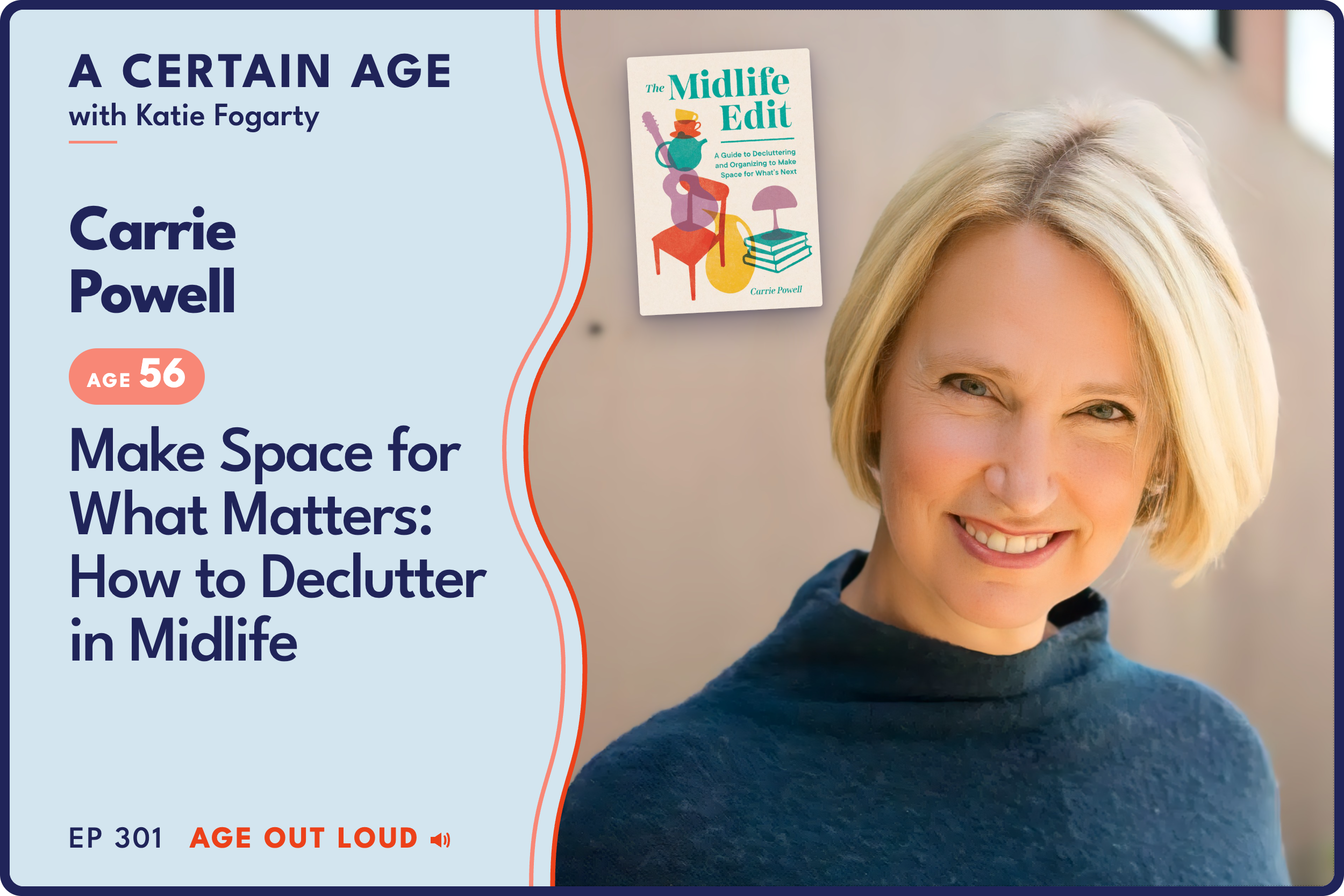
Show Snapshot:
Midlife is the clutter trifecta: your stuff, your kids’ stuff, and now your parents’ stuff. The basement is still full of your kids’ things, your parents’ boxes keep landing in your living room, and your own closets haven’t gotten any emptier. Professional organizer Carrie Powell, author of The Midlife Edit, has a guilt-free way to clear it all out.
In this episode:
How to keep the memories without keeping all the memorabilia
How to declutter around a spouse who won’t budge
How to help a parent sort and let go without steamrolling them
A holiday trick that clears out the extras while you decorate and celebrate
About Carrie Powell: Carrie Powell is the author of “The Midlife Edit,” a decluttering guide for midlife and beyond that was praised by Publishers Weekly. A professional organizer, she is the founder of Method Seattle and spent nearly 30 years as a merchandising executive at Nordstrom.
Show Links:
Follow Carrie:
Carrie’s Book:
The Midlife Edit: A Guide to Decluttering and Organizing to Make Space for What's Next
Mentioned on the show:
Quotable:
We have so much stuff in midlife, and if you try to tackle it in a weekend or a month, you’re going to flame out.
Transcript:
Katie Fogarty 00:03
Welcome to A Certain Age, a show for women who are unafraid to age out loud. I'm your host, Katie Fogarty.
Beauties, my dad recently handed me a dusty pink paper heart Valentine I made for him about 47 years ago. My first thought: that is so, so sweet. My second: where the heck is the trash can?
We all know we need to edit, edit, edit, to embrace the life-changing magic of tidying up. But midlife is where decluttering and organizing get really hard. A whole lifetime of letters, photos, and souvenirs. It's other people's stuff.
My guest today, Carrie Powell, a home organizer, calls this life stage the trifecta of clutter: your own stuff, what your kids left behind, and a new stream coming in from your parents. Add a spouse who won't part with the thing, and Grandma's silver that somehow ended up in your dining room. Clutter is sneaky like that.
Carrie has been there. After 30 years in fashion merchandising at Nordstrom, she retired at 50 and needed a home office. Her only spot was a basement room that had become the family dumping ground. She cleared it out and, in doing so, launched a whole new career. She's a professional organizer, a decluttering coach, and the author of The Midlife Edit. Her big idea: stop purging, start curating, because honoring your past does not mean keeping all of it.
Today: what to do when you know you need to let go but can't. How to sort a 10-pound photo album without looking at every picture. How to handle everyone else's stuff, your spouse's included. How to keep the memory without the memorabilia. Plus, a holiday trick that turns decorating into decluttering. Ready to free your closets, your clutter, and your mind? Stick around. We have a show for you.
Welcome to A Certain Age, Carrie.
Carrie Powell 02:00
Thank you. I'm so glad to be here.
Katie Fogarty 02:02
Well, this is such a hot and important topic. I had to do a massive decluttering in my own life about 14 months ago, when my husband and I downsized our family home of 20 years and moved into a two-bedroom, two-and-a-half-closet apartment in New York City. So I know how hard this is. I know that my friends and the people in my life want this information. People ask me all the time how I did it. You are a pro, and you're going to outline some things every listener needs.
I love something you say about clutter. You call it sneaky, which it is. What was the moment you realized how much was hiding in your own house?
Carrie Powell 02:39
Well, it's funny. I have always been a naturally organized person, and even in the crazy years of child rearing, I would de-stress by cleaning out a closet. So on the surface, when you walk into my home, it feels decluttered. It doesn't feel like there are decades of stuff lurking around and causing me issues. But what I discovered, when I had to repurpose a space and realized I wanted to actually use it, was that I had way more than I realized.
And it's funny, because that was one of the first realizations I had when I started this organizing business. People would want to get straight to the organizing, and they'd tell me decluttering wasn't really that important. Then that was one of the first realizations they'd have: they had way more stuff than they thought.
So that was my aha moment. Oh wow, I'm an organized person, but there's a lot of stuff here that has been accumulating in a sneaky fashion over the many years, those two decades of child rearing, and now I need to address it.
Katie Fogarty 03:56
Yeah, it's such an important distinction. You can be organized and still have clutter, just a volume problem. I learned that when I opened up my kitchen drawer and found about 50 water bottles. I thought, wait a minute, there are only five people living here! And they all had a place. They had their own entire drawer, but it was just way, way too many of them.
So I think this is an epiphany a lot of people go through in midlife. Either they're downsizing, like I did, and all of a sudden truly need to get rid of some stuff, or they're helping an aging parent move. My mom moved to an assisted living facility, and I had to help my father move to a new apartment. All of a sudden you're dealing with your aging parents' items and stuff. So decluttering and organizing in midlife looks totally different from when you were wrangling all the Legos when your kids were young.
Carrie Powell 04:46
We are perfectly situated in this generational situation right now, where we have our own clutter, the things that have accumulated over the past three decades or so. We have the things our kids have left behind as they leave the nest. And we have a new stream of incoming clutter, which is the stuff coming from our parents, whether they're downsizing and passing things down, or they've passed away and you have to go clean out their home. So it's this unique situation, the trifecta of clutter happening in this specific phase of life, and I think that's what makes it so overwhelming for so many people.
Katie Fogarty 05:28
Yeah, the incoming clutter. I can literally picture my father walking through my front door with one of those banker's boxes of papers and handing them to me. It was Valentines, stuff I made him in third grade, and I thought, none of us need to own this, you know?
Carrie Powell 05:44
It's—
Katie Fogarty 05:44
Like, talk about incoming clutter. And there's all the things. I know all my listeners have these issues as well. We're going to get into some of your strategies and tactics. I can talk about this topic all day long, so I'm so excited for this conversation.
I spent some time on your social media, which has wonderful tips, tricks, and tools galore, and we're going to put that in the show notes. But on social, something jumped out at me. You said, "For the sake of your mental health, please know there's a difference between honoring our past and being held hostage by it."
Carrie Powell 06:18
Instead of thinking about decluttering as purging, think of it as curating. I would say that's the common feeling people have: "I can't get rid of this, it was my mom's," or "I can't get rid of this because I've had it for 20 years," or "I can't get rid of this because it's an artifact from my kid's childhood." And that's not necessarily true. You can curate and keep some things from those eras, but keeping everything is going to make it hard for you to appreciate the things that really do matter.
So think about prioritization and what the most important things are. What I recommend is keeping things you can use in your daily life, and keeping things you have room to display that will make you smile every time you walk by them. If it's something that's going to be buried in a box in the back of a closet for another 20 years, then why are you saving it?
Katie Fogarty 07:16
What are some of the practical tools you might offer our listener who's thinking, "Yeah, I want to curate, but it feels overwhelming"?
Carrie Powell 07:25
When it feels overwhelming, that usually means the first step is too big. So the first thing I would say is to break the process down and take a small piece. If you're looking at all these boxes of memorabilia sitting in your basement, for instance, take just one box, go through that box, and prioritize: these are the things I know I want to keep.
Another tip is to take an inside-out approach. Instead of going through each piece and asking, "Am I going to keep this? Am I not?", which brings on decision fatigue pretty quickly when you have a lot of things, scan through whatever's in the box, the room, or the closet and think, "What are the absolutes I know I want to keep?"
This is especially helpful with something like an old photo album. You think, "God, the album is 10 pounds, it takes up so much space, and I know I don't need everything in it." You don't need to go through and look at every picture. You can scan through and grab a few, thinking, "I'm going to keep about 10," and just grab the most meaningful ones. Don't even bother scrutinizing every single item. That's going to save you time, it's going to save you mental energy, and it's going to leave you with what is most important.
Katie Fogarty 08:57
I'm sitting here thinking, wow, that's so hard to do, but it's absolutely great advice. I found myself waylaid by memories in the photo albums, looking at every picture, and it took a lot of time. So this idea that you can have a stack of photos, pick four that you love, and the rest don't need to be examined is so freeing, and such a useful time hack.
Carrie, we're heading into a quick break. When we come back, I want to talk about one of your hilarious Instagram posts: "Nine Decluttering Truths You Probably Don't Want to Hear in Midlife." Number five really spoke to me. We'll be back in just a minute.
[Ad break]
We're back from the break. When we went into it, we were talking about the hilarious Instagram post I loved on your social media, "Nine Decluttering Truths You Probably Don't Want to Hear in Midlife." I'm going to link out to the entire post in the show notes because it's perfect. But number five really spoke to me. It said: all that stuff you've lovingly saved for your kids, they don't want it. And I was like, yeah! When my dad showed up with the dusty pink heart I made 47 years ago, I thought, "That's so sweet." And then, "I can't keep this pink piece of paper. What are we doing with all this stuff?"
How do we have conversations, both with ourselves and with our kids, so that no one feels guilty, and we don't all wind up drowning in a mountain of stuff that, truthfully, nobody wants?
Carrie Powell 10:25
So I think the first thing is to recognize the two different categories of things that end up in your house that are, quote, "for your kids." The first is the things from their early childhood, when they were born. Maybe you made them a baby book. You've got their blankets, their come-home-from-the-hospital outfit, their rattles, their first pair of shoes, et cetera. That's all stuff they don't remember. That's stuff you remember, and that you "saved for them." But it's really your memories.
Then, maybe in late elementary school, but definitely in middle and high school, they have the things they've accumulated themselves: souvenirs from trips, things they picked out when they started earning money and buying their own stuff. These are things that are important to them. So those are two separate categories, and it's really important to recognize that.
Maybe there's one box, and not too big a box, of memorabilia that you saved for them, and then one box of the stuff that is meaningful to them. And obviously, you're going to communicate and collaborate with them on what is important.
In my own experience, I was super surprised at what my kids did not care about. I thought they were going to have way more attachment to the things they accumulated growing up than they actually did, and I think that speaks to different generations' relationships to things. I'm a Gen Xer, and things weren't as overproduced in a global economy as they are now. They took longer to get. It took money to earn and buy them, and we just had more attachment to the things we accumulated.
Katie Fogarty 12:11
Carrie, we had 13 cable channels growing up, so—
Carrie Powell 12:14
Exactly, exactly.
Katie Fogarty 12:16
We were used to operating with very few things.
Carrie Powell 12:20
If you think about the things you've lovingly saved for your kids, and maybe you get your feelings hurt when they tell you they don't want them and they're not meaningful to them, don't get your feelings hurt. It really is this generational divide. It is not a reflection of how much they love you, and it is not a reflection of how good their childhood was or wasn't.
Katie Fogarty 12:44
Such smart advice. I also love your notion of one box: one box for you, the parent, to put a few treasured items in from childhood or babyhood or whatever speaks to you, and then one box for your kids. When we left our house, I probably wouldn't like the size of my box, Carrie, because it was quite large. But I gave the kids these gigantic bins from Target or Home Depot, these massive bins, and I said, "We are going to store these. You each get one. Put whatever you want in here." In went a treasured stuffed animal and a few other items. And then I found myself sticking some stuff in that the kids were willing to throw away, because I was like, "Wait a minute! I think you might want to know your—"
Carrie Powell 13:29
"Support for Mom."
Katie Fogarty 13:30
Exactly! Mom is over here like, "Are you sure? I think we should include that in your time capsule that you're going to open when you're 30, in your own house, thinking, 'Why do I have this stuff?'"
But I think this idea of putting aside those few boxes, the one box, the big box, whatever size box you pick, just gives you this freedom. I felt so much freedom, and I know my kids did too, from all the stuff and all the decisions. Because when you empty a house, when you empty a bedroom, there's just a lot of volume.
Carrie Powell 13:59
One other thing I wanted to point out is that at the time we were making decisions to save this stuff, just think about how crazy life was when you were trying to raise a family. You don't know, when the art project comes home, whether this is going to be the genius piece that's going to live on and be passed down, and so you just save. You end up saving more than you need. And just because you saved it, and it was important to save at one time, does not automatically mean it's important to keep forever.
Katie Fogarty 14:34
I'm like you. I like to be organized. I like to purge. I still wound up after 20 years in the house with too much stuff. But I was pretty good, or so I thought, about moving things out the door. I would frequently send the kids' artwork to grandparents. And my husband's grandmother, at one point, when she was in the Swedish death cleaning phase of her life, where she was just trying to empty the—
Carrie Powell 14:56
Not only did she try, she—
Katie Fogarty 14:58
—succeeded. She mailed this stuff back. I was like, "Wait a minute! I sent this to you 10 years ago. I never expected to see this finger painting again. What is this doing here? Out the door with you!"
So the kids' stuff is very funny, and I do feel like we get to manage some of it. I'm 57. You get to 57, and you're able to manage some of the kids' things. But the harder stuff, I think, is sometimes dealing with a spouse or partner who doesn't have the same kind of curation gene that you might have or aspire to. How do we work with a spouse who doesn't want to part with things? You've worked with numerous clients. What do you see that works, and what do you see that backfires that we might really want to avoid?
Carrie Powell 15:45
The chapter on this topic in the book is called "The Long Game," and that's because what I've learned in my own life and with clients is that you can't make somebody do something they don't want to do.
Katie Fogarty 16:03
Wait, Carrie, you can't? No, I know, I know.
Carrie Powell 16:06
Shocker, shocker.
Katie Fogarty 16:08
Oh my God, I'm holding out hope that—
Carrie Powell 16:11
People are like, "Give me the magic silver bullet solution to this problem." Well, there isn't one, I'm sad to say. The reason I called it the long game is that you want to start with your own stuff. You're not getting into your husband's home office. You're not getting into your parents' memorabilia. First of all, you start with things that are either in your purview or in common, non-emotional places in the home that are less of a minefield. You don't even necessarily need them to participate, but you share your experience as you go along. Hopefully, if you're making progress, especially in the case of a spouse, they're going to be able to feel the difference in the home as you go.
Now, having said that, it doesn't always work either, and there are some deep-seated psychological factors that play into why people have a hard time letting go of things. There could have been childhood trauma. There could have been scarcity. There are all kinds of reasons it's hard for people to let go. So the second thing I would recommend is digging a little deeper, especially if it's your spouse or your parent. Presumably you know these people quite well. Think about what may be driving the feelings behind it, instead of the surface-level "He's a pain in the butt and he just refuses to get rid of anything." Think about why that might be, and that might help guide you in leading him to a place where he's able to help you with this decluttering project.
And the third piece of advice: in my experience, 98% of the time it works to bring in a professional, somebody like me, an objective third party. I do this for a living, I've worked with hundreds of people, and I've worked specifically in situations where one person is gung-ho and the other is reluctant. It's very effective to have this buffer zone of a third person who really knows how to do this and how to lead the reluctant person to water, so to speak.
Katie Fogarty 18:40
Yeah, it's relationship preservation.
Carrie Powell 18:42
Exactly.
Katie Fogarty 18:43
It makes me think of how my husband and I didn't teach our kids to drive. They went to driver's ed. We helped them, we supported them, we helped them practice a little bit. But you want to preserve your relationship with your teen by having a professional be the one to tell them they're driving too fast. So I think it makes so much sense to work with a third party.
Number nine on your list of decluttering truths for midlife, which I referenced earlier, also really spoke to me, because I've been living it over the last year or so. If you don't declutter at 55, 75 is going to be so, so much harder. And I know this to be true. My mom was not able to do the emptying of her apartment, so my siblings and I had to do it. It was an enormous job. It took all summer. And then we had to help my father with his stuff so he could move to his own new apartment. So I encourage anyone listening who's thinking, "I really feel like I need to get ahead of this," the answer is yes, you do, because I didn't want to put my kids through what we had to go through managing all this stuff.
I'll share that it was hard. And I learned a lot about my dad when we were packing up his apartment. He'd be standing there holding something, and he would look at me and say, "I don't know what to do with this." He actually meant, "Katie, will you take this out of my hand and throw it away for me, because I can't?" And I was like, "I know exactly what to do with that." He just couldn't do it. So we want to make sure we're setting our kids up for success by managing some of our own stuff.
Talk to us about this: if our parent has said, "Help me with my own decluttering, help me move through this," what do you think works so we don't show up like we're steamrolling them?
Carrie Powell 20:32
I think you need to reframe it in your own mind. You're not going over there to help them clean out their house or get rid of their memories. You're going there to spend some quality time with them and to learn the things that are important to them now. It may seem obvious, or beside the point, but it's an important reframe. And I guarantee what you'll find as you do the work with them is that you really are getting quality time out of it. You're learning things about their past and about your childhood, and you're also gleaning little nuggets about what's going to be important to them for the rest of the time they have left to live. If you approach it as "I'm going to go spend quality time with my parent," then that's what you're going to get out of it, and you're going to accomplish the decluttering at the same time.
The other thing I would say, to your point about doing this now while you're 55 because at 75 it's going to be a lot harder: you have to remember that your energy level for this kind of work is at a much better place than your parents'. All this emotional work that we're doing with decluttering is really draining for somebody who's older. Don't go over there for a weekend and expect them to be engaged and going through all this stuff with you the entire time. They're going to flame out, I guarantee it. Instead, take an approach of a little bit at a time.
Katie Fogarty 22:15
I agree with you. Helping my dad with decluttering was joyful in many ways. I got to see pictures of my grandmother that I had never seen. He surfaced some photos of myself when I was young that I had never seen, because they'd wound up in an envelope in his belongings instead of the family album. So there was a great chance for discovery and reminiscing and a lot of joy around it.
But I think the memorabilia is hard. I watched my dad struggle with it. I struggle with it myself. I'm sentimental. I like to hang on to certain things, even though I've got a lot of rigor around passing snow boots down to other children in the neighborhood. When my kids were young, I moved stuff along. But for me, the memorabilia is tricky. It's the letters, the souvenirs, the photos.
You say that Gen X and Boomers got handed the worst photo project ever, right? It's like a terrible group project, because we've got printed photos, floppy disks, CDs, memory cards, phones, the cloud. We lived through every transition. Our memories are scattered everywhere. Where do we even start?
Carrie Powell 23:20
With photos and media specifically, gathering everything together is the first step. You want to identify the prints. Oh, there are prints in boxes. There are photo albums. Here are some VHS tapes from the early camcorder days. See what you're dealing with. With all that old legacy media, there are services and companies that will digitize it for you. The one I use is Legacy Box. You put all your media in a box, send it off to them, and they get it back to you digitally. They'll put it on a thumb drive for you if you want. In my opinion, the ultimate goal is to get the photos scanned so you can have everything together in an organized digital master photo library, and that's where you can really enjoy all those memories.
Katie Fogarty 24:20
You share something wonderful where you talk about memory keeper books. This is actually for items in your home. It could be your grandmother's vase that you have such memories of seeing on her kitchen counter, but you don't want it in your own home. You can take a picture of it and then keep it either in a physical book or even a digital album that lives on your phone. Walk us through that idea.
Carrie Powell 24:44
That's actually one of the tactics I have for people who are super sentimental and have a hard time getting rid of anything, even if they know it's something they're not going to use or display. It's very easy now, in the age we're in, with our phones, to snap a photo. But the step people often forget is to create an album on your phone where you can put those photos. Otherwise they'll just be lost in your camera roll, and you won't go back and visit them.
Katie Fogarty 25:19
Carrie, there's also this beautiful Instagram account that I follow, based on an actual business called Heirloomist. I have not taken advantage of it yet, but I keep wanting to. This woman actually creates art for you. You would send her maybe a dozen of your father's favorite ties, and she arranges them, photographs them in these beautiful art photos, and then frames it and sends it to you. Maybe it's all the covers of your grandmother's favorite cookbooks, and she photographs them to create one single art piece that you can display. It's beautiful. I've seen her do Matchbox cars for kids or Lego figurines.
Carrie Powell 26:01
That's amazing.
Katie Fogarty 26:03
It's truly beautiful, and you're creating these—
Carrie Powell 26:06
Make sure you put that in the show notes.
Katie Fogarty 26:07
I will put that in the show notes. It's funny, I have a couple of gift ideas that I'm not going to share out loud right now, because who knows who in the family is listening. But I keep thinking I want to do this for people, because there are certain items with such sentimental value that can't live in your space, yet there are other ways of celebrating them. So I love that idea.
Okay, Carrie, I want to switch gears for a little bit. We're doing this show as we're entering the holiday season. Holidays come with a lot of... we're not going to use the C word for clutter, we're going to say curation. There's a lot of stuff: the holiday plates, the decor, the decorations, the ornaments, et cetera, et cetera, et cetera. Give us some of your best holiday curation-slash-decluttering tips.
Carrie Powell 26:54
Well, the biggest one I would say is that you have a tremendous opportunity, when you're decorating for the holidays, to declutter. We all know the scenario: you're decorating the tree, you're putting out all the knickknacks and things that make your home feel like the holidays, and when you're done, there are things left over that you didn't put out. Ask yourself: When was the last time I put it out? Why didn't I put it out this time? Do I really need to keep it? And then it's really easy. You have it out anyway. You can gather it all, put it in a box, and run it to donation.
Katie Fogarty 27:35
We've got to get rid of some of that holiday decor that clutters things up. We also wound up with a lot of gifts when we moved into our apartment 14 months ago. I said it very nicely to my family, but I said, "I'm not accepting anything besides books or things we can eat, because I just spent six months getting rid of stuff and I am not taking new things in." And it was great. I did get books, and my sister gave me two beautiful bottles of wine for my birthday that I wouldn't have bought myself. These are gifts you can consume and use, and they don't languish on your shelf unused. So that's a little gifting hack I pass along.
What do we do with all the stuff people give us when we don't want it?
Carrie Powell 28:16
It's the sentiment of somebody giving you the gift, and you can appreciate the person and the relationship. If you're not going to use it, it's okay to either (a) regift it or (b) donate it. You don't have to keep it just because somebody gave it to you. It doesn't mean you're a horrible person, and it doesn't mean you don't care about your friend or whoever gave you the gift.
I think what you did is great: giving people an idea that you're in this decluttering state of mind, that you've been working on this, and that these are the types of things you'd be interested in getting, whether it's experiential things or consumable things. The other category I like to recommend is upgrades: a nicer version of something you have that could replace what you have. I believe we've been through so much in midlife that we deserve some upgrades in our lives. But anyway, gently broadcasting that to anybody who's going to be giving you a gift is a smart play, so you won't have to decide what to do with it afterward.
Katie Fogarty 29:24
Yeah, the midlife upgrade. We're definitely here for that. And experiences. Several years ago, I said to the kids, "I'm no longer giving you things that require wrapping." So my husband and I do this: the family trip announcement comes out at Christmas, and there are some stocking stuffers related to it.
Carrie Powell 29:50
Oh, nice!
Katie Fogarty 29:51
When we went to Costa Rica, everyone got new flip-flops and some funky sunblock and a few other things. There are little stocking stuffers, and enough that it feels like you're unwrapping a little something. But it's not boxes and boxes of stuff nobody needs. We don't need all this stuff, and that's what I think getting to midlife teaches us.
Carrie, one of the things I really loved about spending time with your materials, and this book is so... and by the way, books are always a good idea. We always want more books on our bookshelf. We can pass them to friends to enrich other people's lives when we're done with them. Carrie's book is adorable. It's small, it's compact, it's eminently giftable. It's actually very funny and fun to read, too.
Having spent time with your marvelous book and your social media, I've learned that one of your taglines is "Make space for the things that matter," which I absolutely love. The things that matter are connection, community, peace of mind. Clutter can impact your peace. Clutter can impact your sense of calm.
You recently shared on social media that you were diagnosed with breast cancer, that you've been navigating that diagnosis, and that you've been in treatment. If you're willing, I would love to hear a little bit about this experience you're going through. What has it taught you about editing, about being intentional, about what to keep and what to let go of, and what really matters?
Carrie Powell 31:04
It's been quite a journey so far, and I still have a lot left in front of me. But it was interesting. I had a massive pulmonary embolism two days after my mastectomy surgery that put me in the ICU for 10 days, and I really had an epiphany while I was in the hospital. I didn't have any of my stuff. I love to be surrounded by my things. I'm a sentimental person. Definitely not a minimalist. And I realized it didn't really matter if I never saw that stuff again. The important things were the people and the relationships in my life.
I was super lucky to have this wonderful community near and far: my local friends and family, and friends and family spread out all over the country and, frankly, the globe. Spending my time and energy on those relationships, nurturing them and communicating, is really what I want to do going forward. And once I got home, sure, it was nice to be around my stuff. But what I realized in the hospital is that it didn't really matter if I never saw it again.
Katie Fogarty 32:30
Listeners of the show know that I've been helping my mom with her cognitive decline and her move to assisted living, and it's very clarifying. You want to spend time with the people who matter to you. Having too much stuff keeps you busy, and I just got sick of managing all the things that needed to be managed. I want to focus my time and energy on other things. And it sounds like you do, too.
I'm sorry about that tough time, and I'm wishing you all good things as you continue to navigate this, and as you continue to help others find the time and space and peace to manage the things that are most important to them.
Carrie, this has been such a pleasure today. Any last editing, decluttering, or curation tip to share before we say goodbye?
Carrie Powell 33:19
I would just say keep your efforts small and consistent. That's how you're going to make the best progress. We have so much stuff in midlife, and if you try to tackle it in a weekend or a month, you're going to flame out. So small, consistent efforts are the way to go.
Katie Fogarty 33:36
Wise words from Carrie. And my word to the wise, beauties, is to go put The Midlife Edit into your cart. It's a delightful book, and it'll get you where you want to go next. Carrie, thank you so much for being with me today.
Carrie Powell 33:47
Thanks, Katie. It was so much fun.
Katie Fogarty 33:50
That's Carrie Powell, author of The Midlife Edit. Her big takeaway: keep your efforts small and consistent. One box. One shelf. Ten photos from that 10-pound album. And remember, honoring your past does not mean keeping all of it.
Know somebody helping a parent pack up, living with a spouse who won't budge, or sitting on 20 years of kid art? Send her this episode before the holiday decorating starts. Links to Carrie's book, her Instagram, and Heirloomist are in the show notes.
If you love this show, if you learned from this show, follow A Certain Age and leave a review. Reviews help A Certain Age podcast grow. I read and appreciate every one. Special thanks to Michael Mancini, who composed and produced our theme music. See you next week, and until then, age boldly, beauties.
