
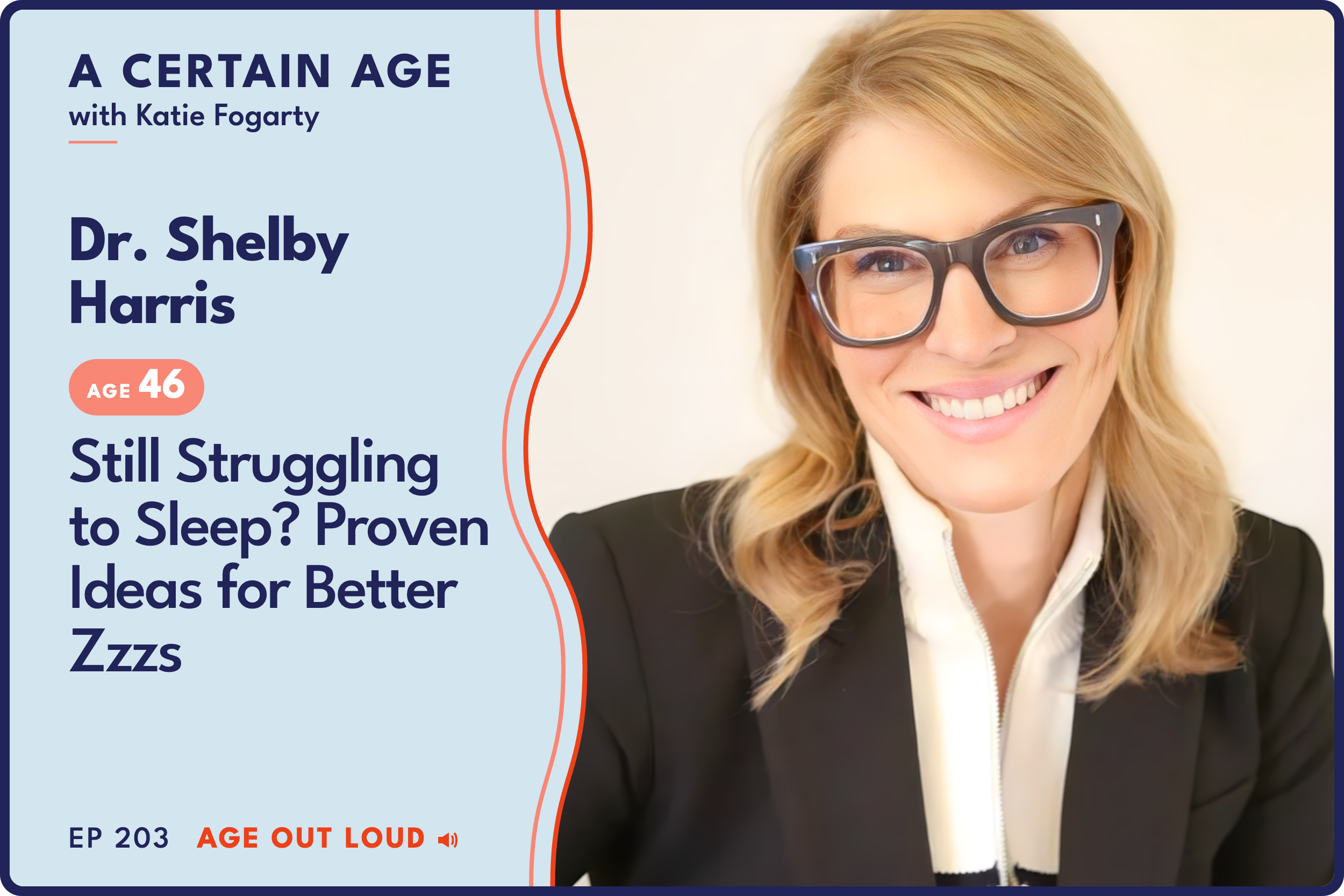
Still Struggling to Sleep? Sleep Doc Dr. Shelby Harris Has Proven Ideas for Better Zzzs
Show Snapshot:
Falling asleep is one problem. Staying asleep is a whole different one. Return guest Dr. Shelby Harris, sleep specialist, is back to break down both, along with why midlife makes each of them harder to solve on your own.
In this episode:
Evidence-based treatments for insomnia that actually hold up
How menopause specifically disrupts sleep, beyond just hot flashes
The surprising link between midlife sleep issues and sleep apnea
Simple, doable strategies for waking up genuinely rested
About Dr. Shelby Harris: Dr. Shelby Harris is a board-certified sleep medicine specialist and clinical psychologist, and author of “The Women's Guide to Overcoming Insomnia.” A returning guest on A Certain Age (her third appearance), she's a go-to authority on how midlife changes — from erratic wake times to hormonal shifts — quietly sabotage sleep, and what to actually do about it.
Show Links:
Follow Dr. Harris:
Follow Dr. Harris:
The Women's Guide to Overcoming Insomnia: Get a Good Night's Sleep Without Relying on Medication
Quotable:
I really do feel strongly that sleep is something that everyone deserves. Everyone deserves a good night's sleep. So it's thinking about, how can we work towards improving sleep for people talking about it in a way that is realistic for most people, that is also not going to break the bank.
Transcript:
Dr. Shelby Harris 0:00
And I really do feel strongly that sleep is something everyone deserves — everyone deserves a good night's sleep. So it's about thinking through how we can work to improve sleep for people, talking about it in a way that's realistic for most people and that also won't break the bank.
Katie Fogarty 0:20
Welcome to A Certain Age, a show for women who are unafraid to age out loud. Beauties, when was the last time you got a fabulous night's sleep and woke up feeling refreshed and ready for the day? Sleep is the midlife holy grail — elusive, hard to pin down, and incredibly valuable. A good night's sleep makes you feel more like yourself: more patient with your spouse and teens, more productive at work and in life. But sleep is also critically important for your health, your brain, your mood and mindset, and your overall well-being. So I have great news — listening to today's show might be the easiest thing you do this week to improve your overall health. I am delighted to welcome sleep expert Dr. Shelby Harris back to A Certain Age for a second guest appearance. Dr. Harris has helped countless people of all ages improve their sleep. She has a long list of credentials — she ran the behavioral sleep medicine program at a major hospital center in New York City. She is the author of The Women's Guide to Overcoming Insomnia, and she is a regular media expert on outlets like The Today Show and more. She joins me today to talk about insomnia — why we can't fall asleep or stay asleep — evidence-based treatments to sleep better, plus the impact of menopause on sleep and its surprising link to sleep apnea. We are going to learn so many new tools. I am already excited about getting into bed tonight. Welcome, Dr. Harris.
Dr. Shelby Harris 2:05
Thank you so much for having me, Katie. It's a pleasure to be here again.
Katie Fogarty 2:08
I'm very excited because this is a topic that's so important to so many women. Every time I reach out to listeners to ask what they'd like me to talk about next, sleep is always on that list, so I'm really excited you're back. You are highly in demand — I see you on The Today Show, Good Morning America. You're busy because everybody wants a good night's sleep.
Dr. Shelby Harris 2:32
Yeah.
Katie Fogarty 2:33
We all want to be better rested, but it's challenging, especially for midlife women, as our hormones fluctuate and impact our ability to fall and stay asleep. I want to start by asking: if midlife sleep disruptions are so common — if so many women are experiencing this — is there ever a time when we need to hit the panic button and see a sleep specialist, or should we begin with a DIY approach and work on our sleep routine at home?
Dr. Shelby Harris 3:00
I'm one of those people who likes to start with DIY. So we're talking about sleep hygiene, right? Limiting alcohol within three hours of bed, limiting caffeine within eight to 12 hours of bed, finding a wind-down time — that sort of stuff. Consistency with your sleep-wake schedule. I'm a fan of doing that stuff consistently for about two weeks, and if you notice absolutely no gains in your sleep — and I'm actually a fan of tracking your sleep, not necessarily with sleep trackers, we can talk about that — but write it down. I have one on my website. You can go to the National Sleep Foundation; there are sleep diaries that are just paper and pencil. Print it out, fill it out by hand, just a guesstimate so you're not looking at the clock at night. Track your sleep for those two weeks while you make those changes, and if there's no change, or very little change, then definitely see a sleep specialist, a sleep doctor. The other thing is that if you're falling asleep a lot during the day, if you can't keep your eyes open, if you notice you're thrashing a lot in your sleep, you're snoring a lot — sleep hygiene isn't going to fix that stuff. So then you don't have to wait as long to go see a specialist.
Katie Fogarty 4:11
Okay, and if somebody's thinking to themselves, "I'm in that category, I know I need a specialist," where do you recommend finding one? And once you connect with that doctor, what does it look like?
Dr. Shelby Harris 4:23
There are different levels of what we're looking for. When you're talking about sleep specialists — if you're talking about wanting to potentially have a sleep study — a sleep study isn't right off the bat indicated for just insomnia, so trouble falling asleep, staying asleep, or waking early. We don't usually do a sleep study off the bat, because all it does is show us that you were sitting there awake. It doesn't really tell us anything we don't already know.
Katie Fogarty 4:49
I can tell you this at 3 a.m. — I'm up, right?
Dr. Shelby Harris 4:51
Right. I can't tell you how often I hear people say they should have a sleep study — why? That's the first thing. But if there's any snoring, if you've tried a lot of treatments for insomnia and nothing's worked, if you're thrashing in your sleep, talking a lot in your sleep, grinding your teeth a lot in your sleep, then you do want to see an MD who is well versed, ideally, in sleep disorders. You can go to the American Academy of Sleep Medicine — they have referrals there. You can find MDs for sleep disorders pretty easily, and you just want to make sure they're board certified in sleep medicine. Now, if you're looking for insomnia treatment specifically, or something like behavioral sleep medicine — which is my area of specialty, treating insomnia, chronic nightmares, circadian rhythm issues like night-owl or early-bird patterns, jet lag, shift work — then you can go to the Society of Behavioral Sleep Medicine. You'll find a lot of PhDs like myself, and social workers who have taken extensive training in behavioral sleep medicine. We don't necessarily use medication, and we do evidence-based treatments. So that's one place to look. If you're looking for the gold standard, someone who's been trained really well, look for a DBSM, like myself — that's a board certification; they've had about 1,000 hours of training and passed an exam. They know their stuff. Otherwise, look for people on that website — it's a good place to start. When you call them, ask what kind of training they've had, what kind of supervision they've had, how many patients they've treated who are like you. You're the advocate, you're the consumer, essentially. Ask those questions, because unless someone is board certified, it's hard to know if they took a week-long training, a weekend training, or have legitimately had more training in it.
Katie Fogarty 6:45
Great advice — check the credentials, understand why you're there, and make sure that specialist can deliver on your unique needs.
Dr. Shelby Harris 6:54
Exactly.
Katie Fogarty 6:55
You are an expert in CBT to treat sleep disorders, an expert in insomnia. What are some evidence-based, science-backed methods that you recommend we can use at home, if that's our starting point — if we're not going the specialist route right off the bat? How do you get a patient or client started?
Dr. Shelby Harris 7:14
If you have occasional insomnia, or even entrenched insomnia that's been there for weeks or years, and you've tried sleep hygiene but it's not doing enough — but you don't necessarily feel like you can or want to see a specialist just yet — there are great apps out there, like CBT-i Coach, which is through the VA in the U.S. There are books, like mine — my book is a CBT for insomnia treatment workbook. There are other books out there, like Quiet Your Mind and Get to Sleep by Colleen Carney and Rachel Manber, who are good friends of mine — that book is fantastic. So you can try books, you can try apps, and if that's not enough, I do recommend people go see a specialist. Sometimes people just want it personalized to them, to have that accountability and have someone tailor it to their own circumstances. The other thing to think about is if you're on a lot of medications already for sleep issues and you're trying to get off them, or you're not sleeping well on those medications, or there's significant depression or anxiety getting in the way of you doing these things on your own, or there are a lot of medical issues going on — then it might be better to see someone individually.
Katie Fogarty 8:28
That makes a lot of sense. So let's talk about what insomnia is as a starting point, because I've had a couple of conversations about sleep — one with you, and I've had other sleep doctors on the show, including a doctor from New York named Janet Kennedy.
Dr. Shelby Harris 8:28
Yes, I know her well.
Katie Fogarty 8:28
Yeah, she's terrific. You both really educated me on the fact that this mythical eight hours of solid Z's isn't necessarily reality, and it made me feel a little bit better, because when I wake up in the middle of the night I used to panic — like, "Oh my god, I'm doing it wrong" — and now I realize that sometimes this is natural. So for women who are sitting here thinking, "I don't feel entirely well rested," or "my brain is racing," what should we be expecting, and what kind of standard should we hold ourselves to?
Dr. Shelby Harris 9:15
Right — what does normal sleep look like? So the way I always think about sleep needs is — I can't remember who said this initially — but it's like shoe size. There's a wide variety of shoe sizes, but we all tend to congregate around the same few sizes, within a range. I like to think of sleep need the same way: eight is in the middle. For most people it's between seven and nine, but some people are fine with less than seven, even six. Some people need more, like nine or 10. Eight is really the number people cite because it's easy to report — it's in the middle, that's it. So how do you know the amount of sleep you're getting is appropriate? It's really about quality and how you're feeling during the day. Are you feeling well rested and refreshed to go about your day? Now, does that mean you should have energy all day long? That's unrealistic for many people — if I put my head down at 1 o'clock every day, I'd easily take a nap. There are dips throughout the day that are totally normal; that's why countries have siestas. So it's fine to feel dips here and there, but if you feel consistently tired throughout the day, if you feel like you need multiple naps or even a nap every day and can't get through the day without one, if the sleep you're having doesn't feel restorative enough to do the things you need to do — that's problematic. So the first thing is: how do you feel during the day? Also keep in mind, it's not about perfection every single day. You could have a really good night of sleep and still feel tired the next day. It's really about five nights a week and five days a week. If you're content with your sleep five nights a week, and you're feeling okay five days a week, then you're good to go. And what does content with your sleep at night look like? Generally, no trouble falling asleep, waking up in the middle of the night, or waking up too early. If you're having trouble three or more nights a week — where it's taking you more than half an hour to fall asleep, or you're up for more than half an hour in the middle of the night — then you might want to start thinking, "Okay, if this is happening three or more nights a week, I might be having some insomnia." So it's not about perfection, it's about progress. How are you doing five nights a week? That's the goal we're looking for.
Katie Fogarty 11:36
Yeah — getting to midlife teaches us that perfection is an illusion, but—
Dr. Shelby Harris 11:42
It's the enemy of good.
Katie Fogarty 11:43
It's the enemy of good, the enemy of progress, the enemy of peace of mind — all that good stuff, Dr. Harris. We're heading into a quick break, but when we come back, I want to talk about feeling content at night and those 3 a.m. wake-ups, which I know from talking to women in my life are a real issue. We'll be back in just a minute.
[ Ad Break ]
Katie Fogarty 11:43
We're back from the break. Before we went into it, you gave us a really clear sense of what we should be expecting and hoping for, and perfection is not on the menu. But oftentimes women are up in the middle of the night struggling, and it can feel really upsetting to have your mind racing, to start worrying about how you're going to get out of bed the next day and perform at work and with your family. So for women who are sitting here thinking, "I am sick and tired of these 3 a.m. wake-ups," how do you recommend they start handling those?
Dr. Shelby Harris 12:40
There are a number of reasons this can happen, so the first thing I always think about is why it's happening. Are you waking up at 3 a.m. because you have to use the bathroom? If you have to use the bathroom multiple times a night, even twice or more, and you're in your 40s, you might want to have that looked into. It could be hot flashes. It could be a busy brain. It could be not even a hot flash, but just waking up warmer than usual because you have too many comforters or your room isn't cool enough. The busy brain is a big one — not being able to let it go. But one thing I do caution people about is that it's normal to wake up at night. Everyone wakes up four to six times a night; they just don't realize it every time. When you go to sleep, you move through stages — stage one, stage two, stage three, which is the deepest, and then REM — and then you have an awakening. That whole cycle is a sleep cycle. After that awakening, you fall right back asleep and start another cycle. A sleep cycle is generally around 90 minutes; it varies from person to person, but that's the general range. So a lot of times, if you always wake up at about the same time, it's very possible you're just waking up after a sleep cycle has finished — and then you look at the clock and reinforce it, because you get annoyed that you woke up at the same time, and you turn it into a problem. Sometimes just reframing it as, "Oh, I think I just finished a sleep cycle," and being okay with that — letting go of the frustration — can actually help you fall back asleep faster, because you're normalizing something that could just be happening. If you are waking up because of a hot flash, urination, a busy brain, that sort of thing, I also ask people to think about how many hours they're spending in bed at night. A lot of times we go to bed earlier, or try to sleep in, hoping that's going to be the night we get more sleep. I actually encourage people — and I talk about this in my book — this is one of the tenets of CBT for insomnia — to limit the time you're spending in bed. Because if you do that routinely, in a systematic way, it actually deepens your sleep, so you wake up but fall right back asleep, bypassing that busy brain. The last thing I always recommend, especially for people with a busy brain in the middle of the night, is to work on meditation. There's been a huge amount of research over the past 10 years on mindfulness-based treatments for insomnia. People often use sleep apps at night to try to hypnotize themselves to sleep — that's not mindfulness meditation. Practice it during the day, five or 10 minutes, and the more you practice over time, the better you get at letting go of busy thoughts. So in the middle of the night, after a month or so, you'll be able to let go of those thoughts more easily and fall back asleep faster.
Katie Fogarty 15:39
That's absolutely fascinating — this notion of tapping into mindfulness versus trying to force yourself to fall asleep, which I think we've all experienced: desperately willing yourself to sleep versus calming your mind and letting it come. I also love what you shared about rolling over, looking at the clock at three or four a.m., and instead of thinking, "Oh my god, here we go again," just observing it — "I'm awake at three, I'm awake at four, my cycle ended" — and being more relaxed about it. I can see how that power of observing and reframing, which I've heard from other guests on the show talk about, even applies to hot flashes — instead of panicking about having one, if you simply observe, "Oh, I'm having a hot flash," it's been shown that you move through it more quickly because you're not resisting it.
Dr. Shelby Harris 16:35
Exactly.
Katie Fogarty 16:36
And I think it's so fascinating that we can apply the same principles to our sleep. I actually use this reframing — observing — sometimes when I'm feeling angry or upset about something, instead of making myself feel bad about it. I just observe that I'm having that emotion, and it does seem to minimize it in some way. So I love that you've offered that as a tool.
Dr. Shelby Harris 16:59
Great.
Katie Fogarty 17:00
You mentioned something I wanted to ask you about — sleep temperature. Sometimes we're under a gazillion blankets. Is there an optimal sleep temperature, or are there other hacks and tools we may not be aware of that can help improve our ability to sleep better?
Dr. Shelby Harris 17:20
Yeah, and there are a lot of people out there who say 67 degrees Fahrenheit is the ideal — very specific. What gets missed a lot in that kind of simplified reporting is that different parts of the country, 67 degrees feels different depending on the humidity in the air. So it's really about keeping it cool somewhere, ideally in the 60s Fahrenheit. People always ask what I keep my house at — I keep it at 68. I'm actually pretty cold at 68 degrees at the beginning of the night; I run cold in general, so I'm usually walking around with a sweatshirt and lots of clothes on while everyone else is warm, but I fall asleep fine that way. I actually wear socks so that I'm comfortable, and it helps release some of the heat from my body — even though I don't realize it's there, it helps. It's called passive body cooling. By putting socks on, you're helping cool off your core temperature, making you cooler throughout the night. So when I wake up in the middle of the night, I'm usually a little warm because I have socks on, so I take them off, and then I sleep totally fine because I kept it cooler at the beginning of the night. If you're someone with a significant other who has a different internal thermostat, two different comforters is a really easy option — most people don't even think to do that. It's not pretty, but you can put a big coverlet over it and make it look like one. Different weights of comforters work well. Then you can look at cooling sheets, cooling technology — even things like these new mattresses and mattress pads, like Eight Sleep, ChiliSleep's Ooler, and BedJet. There's a whole range of these products that work through an app; essentially there are little tubes with water in them — you'd never know they're there, they're so thin — and the water in the mattress pad cools down or warms up the mattress throughout the night. There's a unit under the bed, and you can set it from your phone; it'll be warmer at the beginning of the night, then drop to be cooler throughout the night to enhance that body cooling, and warm back up in the morning. You can even set two different sides — one for your bed partner, one for yourself — if you have different temperature preferences. Some people really swear by it.
Katie Fogarty 19:35
That is so fascinating, and it's absolutely cracking me up — as you were describing it, I literally thought, "Oh, there's an app for that." There's an app for absolutely everything. I love that you brought this up, because one of my questions, which I intended to ask a little later, was about partnered sleep versus solo sleep. Do people sleep in their own beds? Is it better to handle your own sleep needs? How do you work with a partner? Do you ever recommend sleeping apart? It's fascinating to learn about these tools you can use to share a bed with someone who likes it warmer or cooler than you.
Dr. Shelby Harris 20:14
There are so many ways to think about partnered sleep — it's about figuring out what's getting in the way. Is it just temperature? If so, these products are fairly expensive, so that's something to keep in mind. I often have patients start with different mattresses — or, if one person moves a lot in their sleep, you can do two twin extra-long mattresses pushed together with a mattress joiner in the middle, which works really well for a lot of people. I have a friend who texted me that she started doing this and it changed their sleep. Two different comforters can also be an option. If those aren't enough, then you can think about temperature — the Ooler, BedJet, Eight Sleep, all of those. But if it's about different sleep schedules — one person's more of a night owl, the other an early bird, or you have different work schedules, or one person's on call — then sleeping apart, even a few nights a week, might be better. Snoring is the most common issue I hear about; if there's a lot of snoring keeping people up, then that person may need to be evaluated. If they don't want to get evaluated, or nothing seems to be working, then maybe sleeping apart is better. There are different gradations to consider — it doesn't have to be all or nothing. But continuing to do the same thing and having one person not get enough sleep just causes more resentment and more problems down the road. We actually find that sleeping apart can be better for the relationship — research shows it can strengthen the relationship, because you have more emotional reserves, you're not angry at each other, and it brings people closer together.
Katie Fogarty 22:04
So many great tips there, and I would add one—
Dr. Shelby Harris 22:07
Yeah,
Katie Fogarty 22:08
I'm the partner who thrashes — I'll just admit it, I'm no fun to share a bed with. My husband and I aren't especially tall, but we upgraded to a giant king-size bed so I can be far over on one edge, thrashing, without keeping him up, and it's been a game changer.
Dr. Shelby Harris 22:26
I'm so glad. Yeah, it's really about being creative and thinking outside the box.
Katie Fogarty 22:30
Yeah, so if you have the room, consider getting that big bed so you can do whatever you need to do on your section of it. I love all of these ideas. I want to switch gears for a minute, because I had the opportunity to hear you speak a couple of years ago, and you were on a panel about menopause and its impact on sleep. I think most people listening to this show can agree that hitting midlife changed the way they sleep — the quality of the sleep they're getting. I'd love to hear your take on what happens in midlife with hormones, and particularly, I was surprised to learn about the connection to sleep apnea. Maybe we can start by defining what sleep apnea is, and talking about why it's sometimes underdiagnosed in midlife women.
Dr. Shelby Harris 23:18
Oh yeah — first of all, there are different types of sleep apnea; I want to clear that up, because everyone thinks sleep apnea is just one thing. The most common version people talk about is obstructive sleep apnea. What happens is, when you fall asleep at night — or before you fall asleep — the muscles in your airway are taut, so you're breathing fine, air is getting through, no problem. Once you fall asleep, things start to loosen. A lot of the time, in menopause, that's due to hormonal changes. It can also be due to weight gain, but it doesn't have to be — I can't tell you how many women I've seen over the years, at various stages of life, who are as thin as can be and have sleep apnea just because of menopause, or because of the way their airway or jawline was naturally built. So once you start to fall asleep, your airway starts to loosen, and you begin to hear some kind of snoring — the airway loosening creates restriction in the airflow. When an apnea happens — or a hypopnea, which is a partial obstruction, versus an apnea, which is a full cessation of breathing — your brain has a natural, built-in mechanism that says, "We're not getting oxygen, we must wake up." So you wake up, usually pretty quickly, and most people have little or no recollection of it happening. Everything tightens up again, you can breathe fine, you fall right back asleep, it loosens up again, and it happens again. Even a mild case is five to 15 apneas per hour — so multiple times a night, that's happening, and it can really be problematic. Think about how much that lack of oxygen is going to impact your day. And often, once someone wakes up from an apnea, they can't fall back asleep — so now you've got insomnia on top of it.
Katie Fogarty 25:30
It sounds absolutely awful.
Dr. Shelby Harris 25:34
It's not fun. But most people have no idea it's happening.
Katie Fogarty 25:37
And how do you get diagnosed for this? If you don't realize it's happening, is it because you're waking up extremely fatigued? Is that how you find out?
Dr. Shelby Harris 25:47
That's a great question. There are a number of symptoms — some more unusual than you'd think. One is that you're having to urinate more at night. That can be due to a lot of things, including perimenopause and menopause, but a lot of times apnea puts strain on your kidneys, so you might wake up more to urinate. We also see people wake up with headaches or migraines in the morning — possibly because you're not getting enough oxygen throughout the night. We'll see more heartburn or GERD at night. You might wake up feeling like you're dragging, with more sleepiness throughout the day. Women often report feeling more tired, not necessarily sleepy. Women often report feeling somewhat more depressed, with less energy to do the things they want to do — and they get misdiagnosed with depression when no one even asks, "Do you snore? Do you have pauses in your breathing?" It doesn't have to be loud, overt snoring — it can be very subtle. So if you're noticing any of these symptoms, or that your sleep feels non-restorative, you might want to talk to your doctor about getting a sleep study.
Katie Fogarty 26:58
That's such great advice, and these are things I know a lot of women experience — depression, fatigue, brain fog — that are part and parcel with hormonal changes, and it's important to chase down exactly why these things are happening. There are different solutions — sometimes it's HRT, sometimes it's a sleep issue they're not even aware of. I think a lot of times women have a very high tolerance for suffering and just soldier through instead of addressing these things. And I think we can all agree that when we have a great night's sleep — clocking three to five awesome nights a week — everything is better, and it's so important for your overall health.
Katie Fogarty 27:47
Dr. Harris, I want to ask you something, because I follow you on Instagram — we've been connected since you were first a guest on the show in 2021. I saw a post recently about sleep and socioeconomic status, which really caught my eye. I'd love for you to expand on that and talk about the different factors.
Dr. Shelby Harris 28:10
One of my biggest frustrations in the world of sleep wellness — I won't say sleep medicine, because sleep medicine, the MDs and PhDs, have been very slow to move into the wellness space — I'm one of the few people who talks about that overlap. It's usually very apnea, insomnia — that kind of world. In sleep wellness, my question is: how can we optimize our sleep, not necessarily in the context of disorders? One of my biggest frustrations is that people online are often giving advice that requires an elaborate hour- or two-hour wake-up routine — you need to view sunlight at certain angles, you need to wear expensive blue-blocking glasses at night, you need fancy supplements and all this stuff. Much of it doesn't have a lot of research behind it to begin with, and even talking about these expensive bed-cooling devices, it's really cost prohibitive for the average person. I feel strongly that sleep is something everyone deserves — everyone deserves a good night's sleep. So it's about thinking through how we can work to improve sleep for people in a way that's realistic and won't break the bank. Most people don't need these fancy things to sleep better. There are treatments and things you can do that don't cost thousands of dollars, and that's really what we mean by sleep equity in sleep medicine and sleep wellness — these recommendations need to work across the board for everyone.
Katie Fogarty 29:49
So what would be an inexpensive, easy, hyper-accessible action that any one of us could take that you really believe helps improve the quality of our sleep?
Dr. Shelby Harris 30:02
Picking the same wake time seven days a week, as often as you can, is really huge. If you can keep a consistent wake time, that is gold for many people. It doesn't work for everyone, and it's not going to fix entrenched insomnia on its own, but it really does help people fall asleep a bit better and stay asleep a bit more — that wake time sets everything else in motion. It's one of the best things you can do. The other thing I really recommend, which doesn't work immediately, is meditation — I mentioned it earlier. You don't need fancy apps or a fancy phone, or any guide, to help with meditation. I started doing five minutes a day, and that's still what I do. I started doing it before smartphones and apps existed. I look out my window every morning while it's still light out, and I observe and describe what's on the trees for five minutes. When my mind starts to wander — "Oh my gosh, there's ice on the leaves, are they going to cancel school today?" — I say, "Nope, not now," and bring myself back to observing and describing what I see. Something like that can help soften the brain, set the day on a better tone, at least in the morning, and then at night, when you wake up and your brain is busy, you're better able to let go of it. So meditation is something I recommend — if you can't find five minutes, start with one or two. Do what you can.
Katie Fogarty 31:31
Both of these recommendations are free—
Dr. Shelby Harris 31:34
Yep,
Katie Fogarty 31:35
—and relatively simple to do, as long as you consistently commit to it — setting that alarm for the same time every day, and incorporating small moments of meditation into your life. Thank you so much — I love hearing both of these ideas, and I love that anyone can do them. As you pointed out, it doesn't need to be expensive or complicated to be effective. Dr. Harris, we're heading into our speed round, because our time is coming to a close, in part because I know you have patients waiting for you, and I'm so grateful you found time to be with us today to share all these tips and tools and ideas, because I know how much listeners need this advice. So let's move into our speed round so you can get on with your day and your patients. Okay — one- to two-word answers. Are you ready?
Dr. Shelby Harris 32:22
Okay.
Katie Fogarty 32:22
All right, so we talked about alarms — is it an alarm clock or a phone alarm?
Dr. Shelby Harris 32:28
Alarm clock.
Katie Fogarty 32:29
TV in the bedroom — yes or no?
Dr. Shelby Harris 32:32
I'm okay with it, but I don't watch it routinely.
Katie Fogarty 32:35
Okay, nice. How about this one — eye mask, yes or no?
Dr. Shelby Harris 32:40
We're talking about for me?
Katie Fogarty 32:42
Or for anyone.
Dr. Shelby Harris 32:43
For anyone — oh, so, TV in the bedroom I'd say no for most people. Eye mask, yeah, if you want.
Katie Fogarty 32:48
I love an eye mask. Okay — is there a magic pillow type, memory foam, down, buckwheat, or does it just depend on personal preference?
Dr. Shelby Harris 32:58
Personal preference.
Katie Fogarty 32:59
Weighted blanket — are they worth the hype?
Dr. Shelby Harris 33:02
Not necessarily.
Katie Fogarty 33:05
Okay, I feel like there's a qualifier in there — you'll come back another time and talk about weighted blankets.
Dr. Shelby Harris 33:11
A lot of these...
Katie Fogarty 33:13
We talked about best sleep temperature, so I'm not going to ask that. Consider adding this step or action to your wind-down routine—
Dr. Shelby Harris 33:22
That's a hard one — dimming the lights.
Katie Fogarty 33:25
Ooh, I like that. Okay, how about this one — this one's going to be a lot easier. Your one-word answer to complete this sentence: as I age, I feel—
Dr. Shelby Harris 33:35
Empowered.
Katie Fogarty 33:36
Nice. Thank you so much for coming on the show and sharing your expertise. Before we say goodbye, how can our listeners find you and keep following your work and all of your great sleep tips?
Dr. Shelby Harris 33:48
Oh, thank you. You can find me on Instagram — it's @sleepdocshelby. I do a weekly Q&A there. You can go to my website, drshelbyharris.com, and there's my book, like you mentioned, The Women's Guide to Overcoming Insomnia. So there are a lot of ways to get more from me.
Katie Fogarty 34:08
Fantastic! I'm going to put all of that in the show notes. Thank you, Dr. Harris.
Dr. Shelby Harris 34:12
Thank you, Katie, for having me.
Katie Fogarty 34:14
This wraps A Certain Age — a show for women who are aging without apology — and what a fantastic show this was. I learned so much, and if you did too, I would love it if you could rate and review the show on Apple Podcasts. Share what you took away from the episode, and don't gatekeep — if you learned something today, your girlfriends are going to love it too. You can share a link to the episode in your text thread. Special thanks to Michael Mancini, who composed and produced our theme music. See you next time, and until then — sleep soundly, beauties.
