
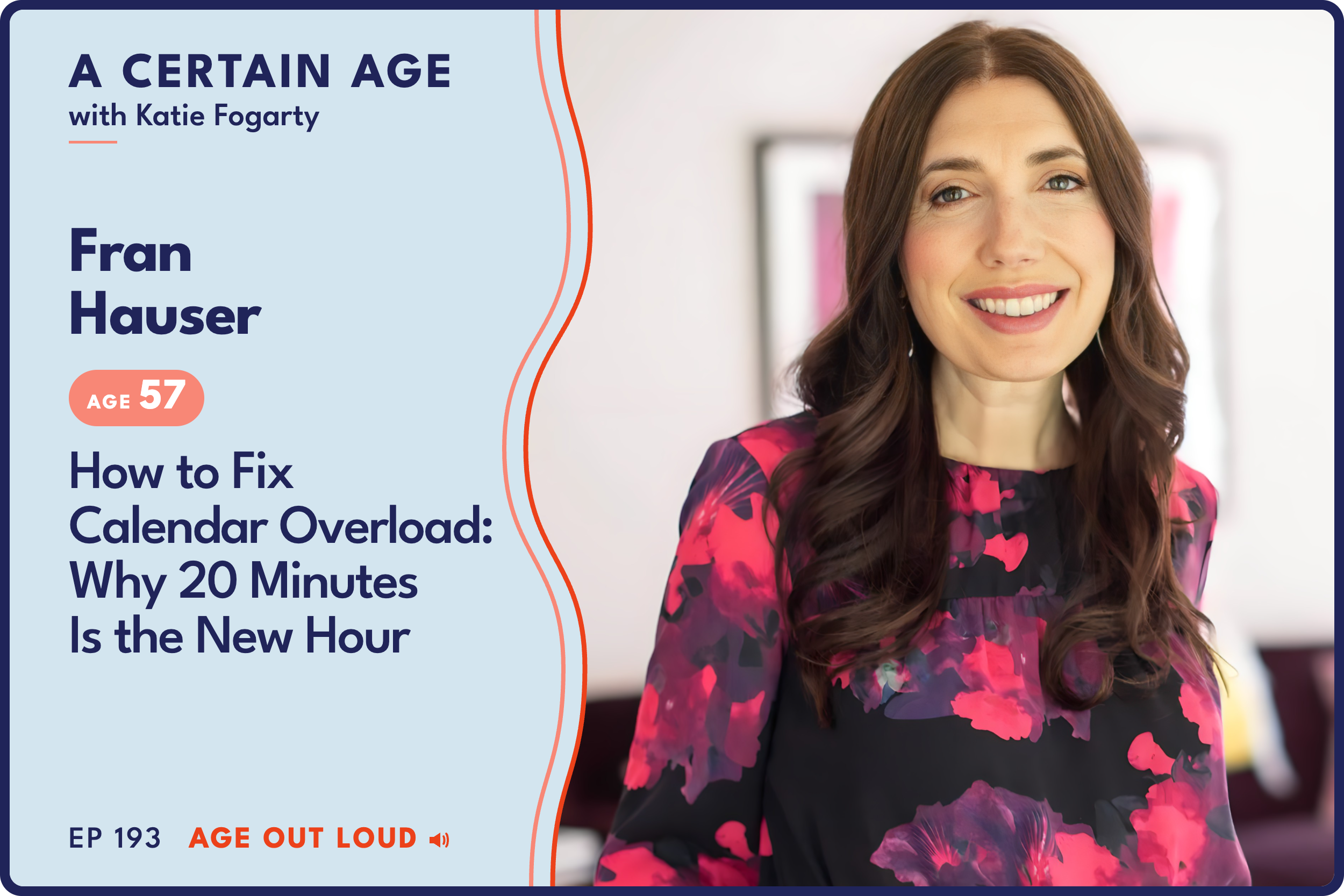
How to Fix Calendar Overload: Why 20 Minutes Is the New Hour with Fran Hauser
This episode is brought to you by Alloy Health — get $20 OFF your first order of M4 Skincare at MyAlloy.com with code KATIE.
Show Snapshot:
A packed calendar doesn't always mean you're getting the right things done. Fran Hauser, author of 20 Minutes Is the New Hour, owner of Bedford Books, and former Time Inc. digital president, breaks down how to actually reclaim your time instead of just filling more of it.
In this episode:
The four sneaky habits quietly hijacking your calendar
How a "to-don't" list makes saying no so much easier
Why messy action beats waiting until you feel ready
The one Friday habit that frees up your entire week ahead
About Fran Hauser: Fran Hauser is the USA Today bestselling author of “Twenty Minutes Is the New Hour,” a guide to reclaiming time from the "4 P's" — people-pleasing, perfectionism, procrastination, and padding. A former Time Inc. digital president and owner of Bedford Books, she's a leading voice on careers and women's leadership.
Show Links:
Follow Fran:
Fran’s book:
Twenty Minutes Is the New Hour: The Ambitious Woman's Guide to Doing Less and Achieving More
Quotable:
"Chronos is clock time. It's the calendar. It's the 24 hours in a day. It's our to-do list. It's all the stuff that we do. Whereas Kairos is more about the quality of the time that we spend. It's really about being present. It's getting into that flow state, and the whole goal of the book is to help women spend less time in Chronos and more time in Kairos."
Transcript:
Katie Fogarty [00:00]
Welcome to A Certain Age, a show for women who are unafraid to age out loud. I’m your host, Katie Fogarty. Beauties, busy is not the same as productive. My guest today says most of us are cramming our days with to-do lists, tasks, endless meetings, and a quest to stay afloat and feel productive. And somehow, despite our relentless paddling, we move further away from what matters. Sound familiar? Fran Hauser knows this territory cold, and not just professionally.
She’s a mom of two, an author, a public speaker, a podcaster, and she runs an independent bookstore, Bedford Books. So she is living the juggle, not just studying it. She’s also the author of multiple books, including the bestseller The Myth of the Nice Girl. She’s a former media executive—she was the digital president at Time Inc.—so she knows a thing or two about crammed calendars and endless meetings. But here’s the thing: women carry a different kind of time load. It’s not always visible on a calendar, but it’s deeply felt. The anticipating, the smoothing things over, the mental load nobody sees. Today’s conversation is about creating more time and space for you and for the work that matters most to you.
Her newest book, 20 Minutes Is the New Hour, is out to prove you can do less and still get further, with a 20-minute formula for life’s endless to-dos, a messy action mindset, and one weekly habit that gives you your calendar space back. Truly, you will never look at your calendar or a clock the same way again. Welcome to A Certain Age, Fran.
Fran Hauser [01:34]
Hi, Katie. I’m so happy to be here. Thank you for having me.
Katie Fogarty [01:37]
I am so excited to be hosting you on the podcast. I got to spend time in your beautiful bookstore, Bedford Books, when you hosted us for Midlife Private Parts, the essay collection I contributed an essay to last year. It’s such a treat to be able to now showcase and spotlight your latest book. I’ve read them all. And I am at a stage in my life where I am so wildly busy, which I know is the B word. When I saw your headline, “20 Minutes Is the New Hour,” I was like, I need this book in my life.
So the whole premise of the book is really to shift how we think about and relate to time. Your book title does a great job of describing it. It’s a guide to doing less so we can achieve more. And I want to kick off with a little stage setting. Let’s throw it back to ancient Greece, right? Because the Greeks had two overarching concepts for how we measure time: Kairos and Kronos. You learned about these two concepts, and it dramatically changed how you spend your days. Can we start by having you explain these concepts and how they changed your life?
Fran Hauser [02:44]
Yes. I actually became kind of obsessed with these two concepts when I was doing research for the book. Kronos is clock time. It’s the calendar, the 24 hours in a day, our to-do list, all the stuff that we do. Whereas Kairos is more about the quality of the time that we spend. It’s really about being present, getting into that flow state. The whole goal of the book is to help women spend less time in Kronos and more time in Kairos.
For me, it’s been really interesting looking at these two concepts, because I think high-achieving, successful women have been conditioned to believe that it’s all about mastering Kronos—how much can we get done, juggling all the things. I believe that success really comes from spending more time in Kairos, because that’s when we do our best work. That’s when we have the time to go deep into a project that can make a meaningful impact. Or it might just be time where we’re resting, or walking, or having a cup of coffee. And, Katie, those moments when you give yourself that time, all of a sudden you have a light-bulb moment, or an unlock, if you’re feeling stuck. So that’s the whole goal of the book: less time in Kronos, more time in Kairos.
Katie Fogarty [04:43]
We definitely want to get to that unlock. Absolutely. You also introduced another great concept early in the book, which you called passive productivity. And, Fran, when I saw that phrase, I was like, I am all in. I want more of that in my life. Walk us through this idea.
Fran Hauser [04:56]
Yes. So passive productivity is really when you’re not trying to do anything. It may be that you’re going for a walk, or having coffee with a friend. It’s during those periods that you have these incredible ideas. For example, when I was writing this book, I might get to a part where I was feeling stuck and didn’t know if there was a story I could use to illustrate the concept, or what I could introduce in the chapter to make it even more compelling. Sometimes I would just take a step away from the computer and go for a walk, or exercise, or even take a shower. And then it’s like, boom, okay, that’s how I’m going to handle it. So the idea is just being more passive, not trying so hard, but you can still have some pretty great outcomes and be productive during those periods.
Katie Fogarty [06:19]
I need to shower with a notebook, because I feel like I have some of my best ideas in the shower. I also have incredible ideas and insights when I’m in a hot yoga class, because that is sort of entering the state of really emptying your mind. It’s such a hard 60 or 90 minutes to get through. You really have to quiet your brain and focus. And then all of a sudden it starts to populate with these ideas, these connections, these insights that are not happening when I’m sitting at the computer, grinding away.
Fran Hauser [06:52]
Yeah, that’s right. My friend was telling me the other day that there’s actually a product you can buy—a whiteboard for the shower. It’s a really small whiteboard. I don’t know what it’s called. I’ve been meaning to Google it. If you find it, let me know.
Katie Fogarty [07:03]
Oh my gosh, I am off to Google that. That is hysterical. I’m going to send you the link. And listeners, by the way, if I find that, I’m definitely popping it into the show notes. That’s hilarious, because it’s so true. I have insights all the time. I solve world problems when I’m showering, and then I get out and it evaporates with the steam.
Fran, let’s talk about the framework of your book, because I was hooked so quickly. You have this framework called the Four Ps, which is—let me get my notes here—padding, perfectionism, people pleasing, and procrastination. When I skimmed through these, I was like, I am all in on this book, because I have struggled with all four of these. So I would love it if you could give our listeners a quick overview of each, and then I’d like to explore each in a little more depth.
Fran Hauser [08:02]
Yeah, definitely. So, perfectionism is when you’re in that mode of polishing and tweaking because you want to get it just right. We waste so much time, and if you think about where you could be spending that time instead, there’s an opportunity cost that comes with it. People pleasing is saying yes even when you don’t have the bandwidth. Procrastinating is putting off the hard things, and when we procrastinate, it’s its own time drain, because the thing you need to do is still sucking up space in your brain. And padding is when we give ourselves too much time to get something done and we end up filling that time with unnecessary tasks.
Those are the four Ps. It was really important to me, Katie, that I name them and go deeper into each one. I want to take a second on this: there’s a positive side to each of them, but when they start interfering with your relationship with time, it’s important to take a step back and check in with yourself. So those are the four Ps.
Katie Fogarty [09:27]
I think it’s important just to identify them and know that they exist, because once you do, you will see them everywhere. For me, time padding was the biggest aha, the biggest unlock. You shared that we are really dictated by a clock that we inherited from millennia ago—the calendar, the 24-hour day, the hourglass you turn over for an hour—and everything is programmed to be an hour. You look at your Google Calendar, you look at your Zoom meetings. This is the default: a meeting is an hour. And when you give something an hour, you tend to use the whole hour. Walk us through when you had this epiphany that 20 minutes could be the new hour in your own life.
Fran Hauser [10:15]
Well, this is interesting, actually, because when I wrote the book proposal, padding was not a part of it. It was just three Ps. Then we got the publishing deal in September of 2024, and the following month, in October, an opportunity presented itself for me to open a bookstore in my hometown. I ended up deciding to do it. And then I realized, wow, I really need to be open for the holidays, because that’s when so much of your sales for the year happen. That gave me eight weeks to open this bookstore, and it typically takes six to nine months.
It was through that process—because I got it done; it opened December 12th—that I realized, wow, if I had given myself six months, I would have filled it with unnecessary tasks. I would have been more prone to people pleasing and perfectionism and procrastination, just because I had the time. Because I only had eight weeks, it forced clarity. I had to be really clear about what was going to be included in the opening and what wasn’t. For example, I decided I’m not going to launch with e-commerce. I’m not going to launch with events. I’m not going to have a relationship with every single major publisher. Instead, I’m going to go through a wholesaler for my opening inventory. It was forced clarity and intention because I only had eight weeks.
That’s when I realized I needed to add this to the book, and I decided to call it padding, which I think is a good label. It’s a really important one. And then I remembered that back when I was at Time Inc., I decided to shift from one-hour meetings to 20-minute meetings. It’s the same concept, whether it’s shortening the meeting or allocating less time for a project. It’s all about giving yourself a concentrated timeline so that you can really focus on the things that matter the most.
Katie Fogarty [12:46]
In the book, you talk about when you made that shift with your eight direct reports. You were spending eight hours a week just meeting with them. When you moved it down to 20 minutes, you still got the same stuff done. They just came in laser-focused with their one, two, three sharp questions, got your input and feedback, and walked out the door, and you gained five hours in your week.
I love that the bookstore is threaded throughout the book. I love indie bookstores, and yours is so beautiful. It was fun to learn how it took shape and blossomed and how it informed your thinking, because you share that you could have agonized over the bookstore logo, but instead you had a very quick meeting with your designer and said, “I want three options.” You got three, made minor tweaks, and were off to the races. I was laughing because I have spent a lot of time agonizing over things like a printed business card. And you think, that’s so dumb. If you could get all that time back and apply it to other things, give yourself fewer choices sometimes, and really commit to that 20-minute meeting, that accelerated timeframe, you can still move the ball forward with a lot less agony.
Fran Hauser [14:02]
Yeah, and I love the logo example, because I know if I had had more time, I probably would have asked for more iterations of the logo. And the logo’s great. I love the logo.
Katie Fogarty [14:13]
The logo is great. I’m going to pop that into the show notes, too, so people can go—or everyone should actually go follow Bedford Books on Instagram, because you can see it there as well. Fran, we’re heading into a quick break, but when we come back, I want to talk about something that I know a lot of people struggle with, including myself: procrastination. We’ll be back in just a minute.
[AD BREAK]
Katie Fogarty [14:35]
Friends, we’re back from the break. When we went into it, we were talking about time padding, which for me was the biggest aha unlock of the book. But you also talk about other things we struggle with, like procrastination and perfectionism. Let’s tackle procrastination, because this is something I still struggle with, even though I’m somebody who loves a calendar and to-do lists. I try to move through things, but I will sometimes procrastinate and have trouble doing the things I’m really reluctant to do. You make several cases in the book that this is very common and that people often put off doing the hard things. What did writing this book teach you about procrastination?
Fran Hauser [15:14]
I think the biggest thing it taught me is that when I find myself in that mode, I ask myself, what am I afraid of? Because it’s typically fear-driven for me if I’m putting something off. It might be that I don’t have all the knowledge I need to move forward. If that’s the case, what’s one action I can take to gain the knowledge? Maybe it’s calling a friend who’s an expert in the space and asking for their thoughts. I really believe, Katie, that if you can come up with just one action, one step just to get things started, you can build momentum. And again, you can give yourself a short period of time for that one step.
But really, it’s going back to: What am I afraid of here? Why am I putting this off? And what’s one thing I can do to just get started? I find that really helpful when I’m in that mode.
Katie Fogarty [16:26]
It’s interesting that you use the words “afraid” and “fear,” because I do think procrastination is often linked to the other P that you identified, which is perfectionism, where we want whatever we’re doing to be perfect. I think perfectionism shows up in different ways, but sometimes it’s linked to this fear of not doing it well. So we keep at it, and keep at it, trying to hone it and make it the shiniest, best object. You talk about perfectionism in your own life and how it played out at different points throughout your career. What has your own experience with perfectionism taught you about how you manage your time?
Fran Hauser [17:08]
Yeah, when I go back to my corporate career—I spent many, many years in corporate—especially earlier on, I often found myself wanting to do things perfectly, whether it was the quarterly report I was putting together for my manager, or a product spec, or a project plan. I would agonize and overpolish, even focus on the font I was using, all of those things. There was one moment when I was at Time Inc. where I had to get this report in to senior management, and my manager said to me, “Fran, I know you love things to be perfect, but we really need to get this report in. They’re waiting for it.”
When he said that, it really affected me. It got me thinking, that’s interesting that he used that word. What is good enough? What if I got this report to a point where it really is about substance over form? Am I giving senior management the information they need so that they can make decisions? It’s not so much about the way it looks; it’s more about the content. That was a big shift for me. This whole notion of substance over form was something I started using while I was in corporate, and then even into my startup investing phase, and as an author and a speaker. It became a bit of a mantra for me, because I started thinking about what’s important to the person I’m giving this report to, or pitching this to. What is important for them to hear? I think that was a big unlock for me, Katie, for sure.
Katie Fogarty [19:15]
I think “done is better than perfect” is something I also grew into, honestly, as I got older. For me, at least, part of it was achieving comfort in the spheres I was operating in. I used to do even more corporate workshops than I do today, and I would be nervous sometimes. You’d be going into Google, and it’s 50 senior leaders. Google has a reputation for excellence. I would walk into that room, and believe me, I would have spent so many hours on the presentation, the deck, making it look insanely good, because it was a bit of a crutch. It allowed me to feel more confident walking into that room. But eventually I walked into enough rooms that I realized, I know what I’m doing. It doesn’t need to be the best image.
I think it depends on the circumstance you’re in. If you’re walking into an operating room, we’re going for excellence and perfection. But for so many of us, to your point about substance over form, it’s the confidence that comes from doing it again and again, which at least allowed me to release some perfectionism. Do you find in your own life that the aging process played any role in your ability to release some of these things, the procrastination and perfectionism you had earlier in your career?
Fran Hauser [20:40]
For sure. I feel like at this point I’ve proven what I’m capable of, and there’s a lot of confidence that comes from that. And boy, do I wish I could go back to the earlier part of my career and apply some of this wisdom. But yes, for sure, Katie, I think it’s the aging process and just the experience. When you do something over and over and over again, you’re building that muscle, and you’re seeing the impact you have. I also feel so much more comfortable trusting my gut and going with my intuition, because it’s informed by experience and wisdom, versus earlier on in my career.
Katie Fogarty [21:33]
Absolutely. We draw on everything from our past to make us who we are today. Let’s talk about people pleasing now, the fourth P in the book. This is something that will probably speak to a lot of my listeners, and to a lot of people who read this book. It’s something I’ve struggled with in the past and, if I’m being totally honest, sometimes today. You want to be able to say yes to people, you want to be liked, you want to avoid hard and challenging conversations—although I’ve gotten much better at all of these things.
But you talk in the book about how people pleasing is linked to time management, because of boundary setting. When we are consistently saying yes to other people, we are by default saying no to ourselves. Time is finite. There’s that joke about how we all have the same hours in the day as Beyoncé, which is not true, because Beyoncé is not doing PowerPoint decks and sorting socks. She’s probably not grocery shopping or driving carpool for the soccer team. Although maybe she is, because she seems like a very involved mom. But when we have a finite amount of time, we need boundaries in order to protect it.
You talk in the book about how you got better at setting boundaries, and you share examples, too. The book is sprinkled with stories from women like Candace Nelson of Sprinkles—there’s a great segue—and Gina Pell, who has also been a guest on the podcast. In the section on boundary setting, Gina talks about how she dislikes group texts and she’s willing to leave them. She’s willing to say, “This is sucking up a lot of my phone time.” We’ve all been on the receiving end of thousands of emails, and sometimes it’s hard to say no. What’s a lesson you learned from somebody you interviewed in the book that helped you create better boundaries in your own life?
Fran Hauser [23:32]
Well, I loved the advice Gina Pell gave about preemptively saying no. I don’t know if you remember that part, Katie.
Katie Fogarty [23:42]
No, tell me. Tell me.
Fran Hauser [24:03]
I had never heard of this before. The example she used was giving a donation to a charitable organization. Sometimes she will say, “Consider this a one-time gift.” What that does is prevent the organization from going back and asking again. It’s her way of preemptively saying no, which is very interesting. She’s getting ahead of it. Isn’t that smart? You could apply that to all sorts of things.
Katie Fogarty [24:19]
Right. It’s so smart. Like, I’m happy to volunteer this Saturday, but do not expect to see me again next weekend.
Fran Hauser [24:32]
Exactly. Or, “I’m happy to do the PTA thing this year, but I know I’m not going to be able to in the future, because I’ll be very busy focusing on XYZ project. But for this year, I’d love to participate.” So I really love this idea of preemptively saying no. That was a new thing I learned while writing the book. Look, this is one of the great things about writing these kinds of books: you go in with your own lived experience, but then you interview these amazing people and you learn even more. That was one of them.
The other big one, Katie, is a tool I’ve used for so many years, and it’s been so helpful when it comes to people pleasing: my to-don’t list. This is the list of things I’ve decided I’m not going to spend time and energy on. The example I always love to use is that right now, I’m not taking on any new board roles. It makes it really easy to say no when somebody asks me to join a board, because I can say, “I’ve decided that for this year I’m not taking on new board seats.” It’s not personal. It’s a strategic decision I’ve made about where I’m placing my time and energy.
The to-don’t list is always on my bulletin board. When I’m reviewing my calendar for the week ahead, I’m always looking for alignment between my calendar and my priorities, but I’m also making sure that things on my to-don’t list don’t sneak their way onto my calendar. So that’s another tool I’ve found super helpful.
Katie Fogarty [26:19]
It’s such a genius hack, too, because there’s so much fatigue around decision making. If you’ve made the decision once—maybe once a year—these are the things I’m not doing, then every time that ask comes up, you’ve already decided. You don’t even have to evaluate. You say, “I wish I could say yes, but my priorities this year don’t allow me to have time for that.” It’s maybe a smart way to start the year, or people could do it on their birthdays. Pick a date that works for you, but think about your to-don’t list in advance. I love that, and I haven’t done it yet, so that’s on my list.
Something else I really loved in the book is what you call a messy action mindset. Fran, your book is full of not only great tips and great stories and very cool women, but also really sticky language. I love the messy action mindset as an antidote to procrastination and perfectionism. I would love for you to walk our listeners through what you consider a messy action mindset to be, and how you use it in practice in your own life.
Fran Hauser [27:25]
So, Katie, have you read that book by Anne Lamott, Bird by Bird? It was ages ago.
Katie Fogarty [27:30]
Yes, but honestly, ages ago. And since then I’ve been through perimenopause and menopause, and I forget a lot. So please, remind me.
Fran Hauser [27:35]
Oh my gosh. Well, it’s one of my favorite books. It’s a book for writers, and she writes about this concept called the “shitty first draft.” To me, that is the perfect example of a messy action mindset. When you’re feeling stuck and you don’t know how to get started, you just start. It might be a very rough draft. It might be that you take the next 20 or 30 minutes and create a rough outline. Maybe it’s making the call before you’re 100% ready, whether it’s a sales call or a pitch. It could also be that you’re in a meeting or in a room with other people and you raise your hand and speak up before you’re fully ready.
These are all examples of a messy action mindset. It’s being really comfortable with not having everything fully thought through and being able to make meaningful progress just by starting. It’s a mindset that really helps me when I’m in analysis paralysis, or when I’m ruminating. It’s just: What’s one thing I can do right now to get started and gain some momentum?
Katie Fogarty [29:14]
I think of it as a form of permission. You’re giving yourself permission to just try, and maybe not have it executed brilliantly, or maybe not even see it through to completion. Sometimes I don’t want to start things that I can’t complete, which is insane, because they’re never going to get completed if I don’t start them. So it’s that step-by-step approach.
You also explore this notion of permission in the book, saying that women should give themselves permission to not do it all. For a lot of women—we touched on this at the beginning—we were raised through education and a more formal work world where you were expected to bring home the bacon and fry it up in a pan, like the Enjoli woman. You gave yourself permission to choose a new path at some point. Where did that permission come from for you? Was it an inner calling? Was it a particular aha moment? Did something happen where you said, I’m doing it all differently?
Fran Hauser [30:15]
Yeah, it was actually after I left corporate to go out on my own. I was startup investing and working on my first book. I remember the moment. I was going into the city, working at The Wing. Do you remember The Wing?
Katie Fogarty [30:37]
Yes, I too remember The Wing.
Fran Hauser [31:01]
I know. So I was working at The Wing, and whenever I would go into the city—maybe a couple of days a week—I would stack meetings back to back to back to back all day, because I wanted to optimize every minute I was there. I was so exhausted at the end of those days, and then I’d be taking the train back up to Bedford, and instead of resting or reading, I would be doing more work on my laptop. I’d be going through the inbox, doing the permission slips for the kids, doing my nonprofit stuff. I was so exhausted by the time I got home. My kids were really little; they were already asleep. I wasn’t even seeing them.
I remember talking to my friend Patricia Karpas, from AOL. I met Patricia at AOL. She’s one of my dearest friends, and she hosts a podcast called Untangle. She said, “Fran, you have to listen to this episode.” I can’t remember who the episode was with, but I was going for a walk and listening, and her guest said, “I realized that I had become addicted to achievement.” She went on to talk about the impact that had on her life and how it was really harmful to her physical health and to her relationships with people she really loved. I remember I was walking and it stopped me in my tracks. I started thinking, this is going to be me if I don’t stop.
I really related to this whole idea of being addicted to achievement. It struck a chord with me, and I realized I was in that cycle myself. I didn’t want to burn out. I really felt like I was on a path to burning out. That was the moment I felt, I have to give myself permission to not do it all, and to build in more time for rest, and more time where I could really be present for my kids. This was probably 14 years ago at this point.
Katie Fogarty [33:08]
What a powerful epiphany, and it set you off on this whole new path, which is marvelous. You opened your bookstore a year ago. You’ve written books and done other things during those 14 years, but it’s amazing how that conversation, that podcast, transformed your life in this way and set you off on a new path.
So a question for you. As an independent bookstore owner, as somebody with two kids in junior high and high school, you do have a lot on your plate. I know you’ve really rethought how you calendar your time, and you’re able to move forward much more effectively and efficiently because of the parameters you outlined so beautifully in this book. But the reality is you do have a lot on your plate. Has owning a small business made the 20-minute mindset harder to practice, or has it actually honed and strengthened your mindset around how you use your time, because you do have a lot going on?
Fran Hauser [34:08]
Yeah, the bookstore—it’s really interesting. It’s definitely the latter. It’s honed and strengthened the way I use my time, because as a bookstore owner, there are so many demands on my time. There are a lot of books, a lot of authors, a lot of local organizations that would like me to donate XYZ. Whether it’s an author asking me to carry their book or host an event at the store, there are a lot of asks, Katie. There are so many more asks on my time than in any other chapter of my career. So setting up frameworks and parameters and boundaries is more important than ever.
I am literally living 20 Minutes Is the New Hour. I’m living the principles in this book every single day at the store, or even when I’m working on bookstore stuff from home. Even with my team, I find myself saying all the time, “20 minutes is the new hour.” Actually, I’ll give you an example, because this just happened recently. You may remember when you were at the bookstore that we have this beautiful pottery store right next door.
Katie Fogarty [35:34]
Yes, gorgeous.
Fran Hauser [35:34]
Right, and we open up to each other. You can walk up a couple of little steps and you’re in the pottery space. The owner of the pottery store came to me and said she was thinking about making some changes, maybe downsizing, or just thinking about different things. My initial reaction was, should I take over the space? Then I started thinking about all that would entail: the furniture and fixtures, a new layout, all the books I’d have to order, painting, all of it. And then I thought, you know what? What if I ask her if we could share the space? That way the layout stays the same, the beautiful tables and shelves she has stay the same, and I can just move in coffee table books, cookbooks, and gift books that will look gorgeous alongside the pottery.
That’s what we decided to do. That’s the perfect example of 20 minutes is the new hour. I spent a morning moving books over, and it created more retail space for me and expanded my event space. When we do events now, people can use both spaces and flow between them. It’s been incredible. It’s only been a few weeks, but it’s made such a huge impact. I think that’s a great example of how I’m always asking myself, how can I make this simpler? Because we over-engineer and we overdo. The other thing I realized is that when we’re uncertain—
Katie Fogarty [37:15]
It’s such a great question to ask yourself, honestly. How can I make this simpler?
Fran Hauser [37:30]
—or when we’re feeling anxiety, our brain actually encourages us to make things more complex. In a weird way, complexity gives the illusion of certainty, if that makes sense. If I create this big project plan that’s color-coded and has 40 line items, it’s like I’m minimizing risk and getting ahead of every single thing that could go wrong. But when I find myself doing that, I take a step back and ask, how can I simplify this? This is too hard. I’m over-engineering, I’m overdoing. The bookstore example is a great one, where it was a few hours and we got it done.
Katie Fogarty [38:19]
Kudos to you for also recognizing that just because the opportunity is there doesn’t mean I need to take it. Is this going to help what I’m trying to do? Part of what I’m trying to do is have some balance, and have some life, and have some time for the Kairos, where you’re letting your brain do different things. Just because something is bigger, better, and shinier doesn’t mean you need to accept it. And I love that you were able to come up with a fresh way of saying, how can I make this simpler? Partnering with one another—such a perfect example of what you were sharing. I love that story.
So, Fran, before I let you go, you’ve already shared a great question that I’m going to think about all week long, and hopefully my menopausal brain will retain it: How can I make this simpler? As a mantra to move through things, that is a phenomenal piece of advice. What is another tactical, actionable piece of advice you would share with our listeners, maybe a weekly practice that helps create space on your calendar?
Fran Hauser [39:19]
Yeah. I dedicated the last chapter of the book, a short chapter, to a week-ahead planning practice that I do every Friday. I’ve been doing this for years and I love it. I find it so helpful. The book goes into a lot more detail, but to give you an overview: on Fridays, I look at my calendar for the coming week, and I look for alignment with my priorities. I look at my meetings, Katie, and I ask myself: Do I really need to be in this meeting? What value am I going to contribute? Am I unclear about the purpose of the meeting? If I am, I should ask the person what the purpose is, and what the best way is for me to contribute.
Are there ways to make meetings shorter? If I see a bunch of one-hour meetings, maybe there’s a way to shorten them. If I see a bunch of events on my calendar, especially evening events, that’s a big red flag, because I really try to do only one or two evening events during the week. Is there a way I can graciously opt out? The whole goal is to free up pockets of time on my calendar. That comes from really looking at everything on my calendar, looking for alignment with my priorities, making sure stuff on my to-don’t list didn’t creep in, and freeing up as much time as possible. It’s such an incredible exercise, because I always end up freeing up some time.
Katie Fogarty [41:15]
So many phenomenal ideas, and this conversation has been packed with them, too. Listeners, the book is 20 Minutes Is the New Hour: The Ambitious Woman’s Guide to Doing Less and Achieving More. Fran, thank you so much for being with me today.
Fran Hauser [41:29]
Katie, thank you for having me. I loved it.
