
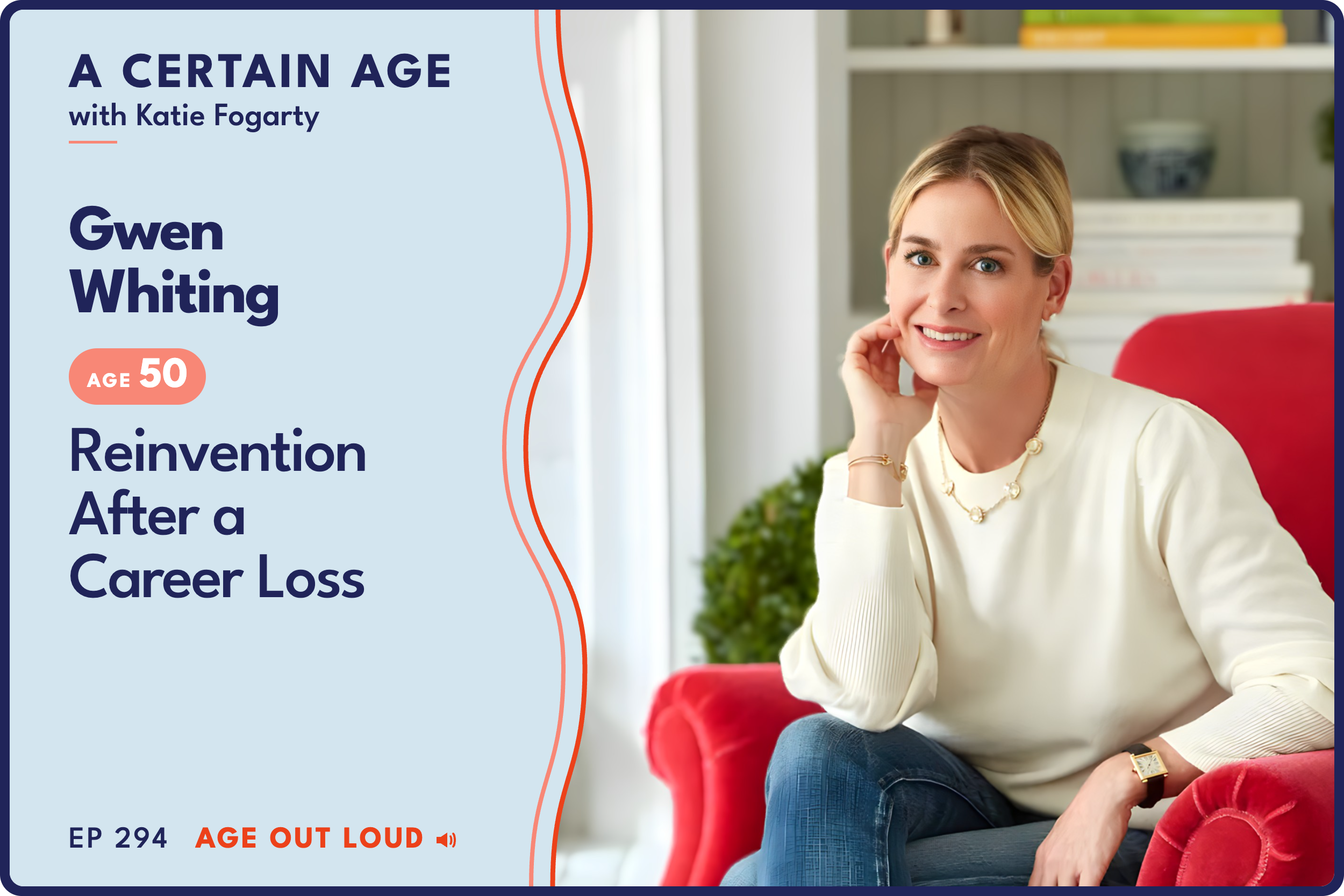
Reinvention After a Career Loss with The Laundress Founder Gwen Whiting
This episode is brought to you by Alloy Health — get $20 OFF your first order of M4 Skincare at MyAlloy.com with code KATIE.
Show Snapshot:
Careers can end in ways nobody plans for, sometimes in public and without warning. Rebuilding afterward takes patience, courage, and a willingness to sit in the unknown. Gwen Whiting, co-founder of The Laundress (sold to Unilever for a reported $100 million), watched a massive recall of her brand make national headlines while an NDA kept her from answering the customers flooding her DMs. Now she's back with The Fill Club, an aromatherapy-infused cleaning line.
In this episode:
Why Gwen refused to rush her next chapter
How to sit with the uncomfortable in-between stage after a major loss
How to push back on the boxes other people put you in
What it takes to rebuild your confidence after a very public setback
About Gwen Whiting: Gwen Whiting is the founder of The Fill, a private members cleaning community and collection of sustainable home care products launched in 2024. She previously co-founded The Laundress, a bootstrapped laundry and home cleaning brand she grew over 17 years before its acquisition by Unilever in 2019.
Show Links:
Follow Gwen:
Gwen’s Substack:
Quotable:
My company was my full, full, full identity. It's the only email address I had. It was my full life, and so it was so painful. I got an amazing coach to help guide me along the journey, because I really needed to sit in that uncomfortable space and separate me from Gwen at The Laundress, and you can only do that with time.
Transcript:
Katie Fogarty [00:03]
Welcome to A Certain Age, a show for women who are unafraid to age out loud. I’m your host, Katie Fogarty.
Beauties, there’s a heartache that doesn’t really have a name. It’s watching something you built and loved get reshaped by somebody else until you barely recognize it. It could be a work project that got reassigned, or a house that you loved, gutted by the next owner. Many of us have felt a small version of that grief.
Today’s guest lived that heartache at the most extreme scale possible, and then was legally barred from saying a word about it for five years. Meet Gwen Whiting, co-founder of The Laundress, the brand that offered us a fresh take on laundry care, making it thoughtful, intentional, even luxurious. After Cornell and a career at Ralph Lauren, Gwen built The Laundress from a side hustle into a brand that global conglomerate Unilever paid a reported $100 million for. Then she was gagged by an NDA as Unilever led a massive product recall and PR fallout, while her own customers flooded her DMs, yet she legally couldn’t answer them.
Today, Gwen takes us behind the headlines: what it’s like to build a mega brand, to grieve a business in public while gagged in private, and how, five years later, she rebuilt smaller, smarter, and entirely on her own terms with her new venture, The Fill Club.
If you’ve ever sold something, birthed something, or watched something you cared about slip out of your hands, this one’s your master class in resilience and reinvention. Welcome to A Certain Age, Gwen.
Gwen Whiting [01:45]
Thank you so much. That was quite the introduction.
Katie Fogarty [01:48]
I have so enjoyed learning about your story. It’s truly riveting from start to finish. We have so much to explore today. As I shared in the opening, you’re best known for creating the fine fragrance, premium brand, The Laundress, and you sold it for an eye-watering sum. But you also had an earlier career at Ralph Lauren, first in women’s design, then home. I have read that you call your time with Ralph your real graduate degree. So to start, I’d like to rewind and learn how that training helped you create your own category-defining business.
Gwen Whiting [02:23]
Yes, it was really important and impactful for my career and my life. It’s like the School of Ralph. It’s a cult brand and a cult community, and you’re in your own University of Ralph. That was my dream job. I actually was fortunate to have my first internship with Ralph Lauren in high school. It was my senior year, and we had to do a senior project in order to graduate. My English teacher knew my ambitions, and there was another younger, newer teacher in the department whose fiancé worked for Ralph Lauren, and that’s how I got my first foot in the door, which then led to many summer internships. And when I was ready to graduate from Cornell, that was my end-all, be-all. I applied for the first job that came out and was open, and it was in women’s design.
This is something I speak about often to students and young people figuring out their path. The idea of getting your foot in the door is definitely something, but it’s also a bad thing to get your foot in the door in the wrong position, one you’re not well suited for. That was my situation. I took a job in women’s design, in scarves and prints, and I wasn’t qualified. That was not my skill set. So I got there and I was trying to get out to a different position from the day I walked in the door, which, looking back, is a horrifying thing to be doing. That’s a terrible career move.
But eventually, I left on great terms. I moved to London. I came back with an open door, and I ended up working in London at Ralph Lauren when they were opening their store and met the team that was part of Creative, Polo Home, store development, and home. That brought me into that world, changing focus from apparel to interiors, and I was able to leverage my textile skill set. So I had skills to apply, but in a new realm, in home. That was very exciting for me because I was qualified, and yet I was in an environment where I was learning a whole new medium. I didn’t know home design,
Katie Fogarty [04:48]
and you really just followed the threads of your curiosity into it. I love this. What great advice to give a young student: it’s important to get your foot in the door, but you can be in the wrong door sometimes.
Gwen Whiting [05:01]
You can be in the wrong door, and it’s a terrible thing to accept a job and try to be in the next department, the next door, the next day. That’s bad protocol. But that goes with being young, and you don’t know any better. You get identified very quickly, and this happens especially in fashion, where if you take a job in footwear, then you become an accessories designer, and then you lose your ability to go back to apparel. People like to put you in a box really quickly.
Katie Fogarty [05:33]
People like to put you in a box in so many industries. It’s amazing. It sounds like the skill set you acquired in certain categories in fashion really did put you in a lane, and I think anyone listening to this conversation has had people try to define their lane for them. So once you arrived in home and realized, “This is the fit for me,” when did you have your aha moment that you needed to create your own brand? Did it happen quickly? How much longer were you at Ralph in home?
Gwen Whiting [06:02]
I graduated in ’98. I got into home in 2000, and I started working on The Laundress in 2002. And that aha moment is one that I shared with my boss, the best boss I’ve ever had. We were driving around in a Lincoln Town Car, as you did in the aughts, and I shared my idea, and he’s like, “Gwen, that’s brilliant! It sounds like The Laundress.” So not only did he support my idea, he also named it.
Katie Fogarty [06:32]
Yeah, I love that. I love that.
Gwen Whiting [06:34]
And a couple of weeks later, I came back to my desk after a long weekend, and he had photocopied and taped up a page from the Learning Annex on how to start your own laundromat, and that was—
Katie Fogarty [06:47]
This is the best boss.
Gwen Whiting [06:48]
Yes, and this is really important, because it taught me how to be a good boss. He said, “Do you need me to pay for your class?” It was not only that he found me this class, but fundamentally he believed in me, and he believed that my idea was worth pursuing. That was really the message that I got from him.
Katie Fogarty [07:10]
What powerful support! Incredible. And so, how did you have the epiphany that there was this white space in the laundry and home care space? I mean, you created something that didn’t exist. Yes, we had cleaning products for our clothes, but not in the way that you shaped and built them.
Gwen Whiting [07:27]
Right. The market was Tide, Woolite, and dry cleaning, none of which were formulated for cashmere or for my white stains. The first T-shirt I bought at Barneys that wasn’t in a three-pack was like $50 for a white T-shirt. I couldn’t quite—
Katie Fogarty [07:45]
You could have saved me hundreds of dollars over the years. Every woman listening is probably like, “I’ve had that white shirt.”
Gwen Whiting [07:51]
Yes, yes. It doesn’t stay—
Katie Fogarty [07:53]
white for long.
Gwen Whiting [07:54]
The first pair of jeans that I bought that were $100, these were investments, and they needed to last. I couldn’t mess around with Tide. This wasn’t going to work out for me. And notably, I also launched a cleaning brand without a washing machine. I was laundering at my fluff-and-fold around the corner. I lived in a fifth-floor walk-up in the West Village. And fun fact, I never had a washing machine in New York City until my last apartment, which was two or three years ago.
Katie Fogarty [08:24]
This is the most amazing fact that you’ve shared. I can’t believe you created this revolutionary laundering brand. This is astonishing. So how did you get the rest of us to be enrolled? I mean, you couldn’t have been reaching simply people who had fifth-floor walk-ups and didn’t have—no. I mean, the brand is a small market. It’s only a New York City market. Maybe they do that in San Francisco, but—
Gwen Whiting [08:46]
Well, the core of the brand was that it was meant for everyone. If you had the luxury of a laundry room or a basement or just a machine, amazing. But you could also have this incredible experience if someone else is using your bottle at the fluff-and-fold around the corner, or you’re hand washing in your sink. The Laundress was designed to work anywhere, in any cleaning circumstances. That also helped the brand become international, because it was designed for any environment in any place. But back to the core: these grocery brands were not inspiring. They were not formulated for specific or finer fabric care. The mentality was one wash for all. And as the years went on and I was exposed to the industry—I mean, the head of R&D at Tide spoke at a conference I was at one year, and he said, “Our goal is to have perceived clean and perceived freshness.”
Katie Fogarty [09:50]
Oh my gosh! Wait a minute. Let’s roll back. Let’s drill down on “perceived.”
Gwen Whiting [09:55]
They’re like, “So what’s most important is the aroma hitting you when you open up the drum.” And I was like, “Okay, this is not my goal.” Like, the—
Katie Fogarty [10:07]
Bar is pretty low. Yeah—
Gwen Whiting [10:08]
Bar is low, pal. Bar is low. And I’m also in the room, by the way, of a sea of very uninspiring men in chinos and non-iron dress shirts. That’s the landscape of people making our CPG brands for us, just so that visual is embedded in everyone’s mind. That man is dictating our home care.
Katie Fogarty [10:32]
You spotted a huge white space in the market. So what came next? I mean, you grew this to the size that Unilever, one of the largest CPG companies on the planet, acquired it. So talk us through that moment. When did the brand take off and become poised for sale?
Gwen Whiting [10:50]
Yeah, it was truly literally one bottle at a time, one load at a time, for 16 years. I went to market in 2004, which, to remind everyone what 2004 looked like: Amazon was still selling books. There was one Whole Foods still in Texas. This better-for-you concept didn’t exist. It was the very introduction of the term “organic” in food. So it was literally one bottle at a time, and people understood. The easiest path to adoption was wool, cashmere, and delicates. People understood: “Okay, here I can use this to not dry clean.” The global growth of the brand followed that. But it was 16 years bootstrapped, living hand to mouth, literally credit card to credit card.
The financial crisis, 2008 and 2009, when all of our independent retailers were closing domestically, we were able to stay afloat with our international businesses, which were growing and unaffected by our distress, and by really leaning in on our direct-to-consumer business, which wasn’t a term at that time, by the way: e-commerce, website dot com, whatever you called it, online shopping. We were able to really leverage our community online and highlight and explain that we’re saving money by not dry cleaning. We’re saving money by taking care of our items.
The thing that was really frustrating was that the brand was perceived as being for fancy people and fancy clothes. When people talk about the brand, they’re like, “Oh, this is for Prada or whatever.” The reality is that our consumers weren’t wearing Prada. These were people who cared about their items, whether it was Ann Taylor or J.Crew or whatever. It didn’t matter what brand. This was a belonging that someone really cared about, and they cared about their homes. They cared about their clothes. In all 17 years of running the business, I never had one product return or complaint about smell or performance or quality. So it was fulfilling to be making people happy and seeing results, just literally one bottle at a time, one customer, one country, and growing organically. But it was a very painful climb.
Katie Fogarty [13:32]
One bottle at a time to the sale of $100 million is a lot of blood, sweat, tears, and loads of laundry done. A lot of loads of laundry done. You were carrying that laundry basket for a long time.
[AD BREAK]
Katie Fogarty (continued)
Gwen, we’re back from the break. Before it, we talked about the grit it took to really build this business, one bottle at a time, one customer at a time, to become a household name, to achieve the level of scale that made you attractive to Unilever. Many listeners would probably feel like this was the end of the story: you’ve summited the peak, you’ve sold the business to Unilever. For listeners who don’t know what happened next, loop us in on what happened when Unilever was in charge of your brand.
Gwen Whiting [14:15]
So I’m going to go back a minute, if I may. Selling is—nothing’s clean.
Katie Fogarty [14:24]
Even with your skills. Exactly.
Gwen Whiting [14:28]
I didn’t build this business—again, this was 2002. There was no term of entrepreneur and founder and exit and getting rich. That wasn’t the playbook. That playbook wasn’t written, so that wasn’t the goal. The goal was, “Oh, I’m going to make this stuff in my arts-and-crafts capacity, my full-strength capacity. But of course, there will need to be a big brand to take it away. The big brand is the one that will be able to really run it and get it into all the households that it deserved to be in.” That was truly my mentality, given my capacity limits.
The other thing was, it was 17 years, very long, hand to mouth. It was not healthy. I had a very toxic business partnership, so I was at a literal breaking point. I had to get out of this business arrangement, so the sale and the exit was perfect timing. And I also naively believed all of the marketing collateral that Unilever pretends that they are: “We love females. We love sustainability. We love B Corps. We love, love, love all of the things.” However, at the same time, I love my brand. I love my company. I loved what I did, but I couldn’t think about all those things. I was just moving one foot forward for 17 years and just getting to the finish line.
So, fast-forward: I sold in January 2019, and I’m thinking I’m sending my baby to Harvard. That this was the best company and the outcome was amazing. I had a two-year contract to stay on, and very quickly I was like, “Oh no, this is very disorganized.” After that ink dried, everyone disappeared, basically. So I stayed on and fought for my brand and my people, all of my people in the office and in the factories and abroad, all my international business partners. I fought for everybody for two years, which is exhausting. But I was like mama bear, you know, I’m full mama bear mode.
Anyhow, two years fighting, it ends, and within a year of me leaving—not being invited back either, which we’ll get to; nobody wants the female founder hanging around, they like the male founders to hang around, but they don’t like the females to hang around—Unilever completely imploded the brand. It was around Thanksgiving. They sent a notification on Instagram citing some quality control problems, and then they proceeded to do a full brand recall. I wasn’t there, but it was reported: it was like 8 million units recalled.
Katie Fogarty [17:46]
And what was the recall based on?
Gwen Whiting [17:48]
It was based on a potential bacteria concern. I know that there was never any bacteria found anywhere, so I know that.
Katie Fogarty [18:00]
So this must have been so incredibly traumatic. You had run this company for 17 years, as you said. You never even had one customer come back and ask anything—
Gwen Whiting [18:09]
Exactly.
Katie Fogarty [18:10]
Now you were making national news, where there was a massive recall. Oh my god—
Gwen Whiting [18:14]
National! It was a news alert from The New York Times. I mean, this is the cruel thing: I was never headlined in any news, yet this was on top of Good Morning America. It was the banner headline on The New York Times daily newsletter. It was the top news item, and arrogant and useless Unilever just thought, “Oh, this happens all the time. No one cares. Move on.” They didn’t realize that they were dealing with a completely cult brand. People do care tremendously, and this made front-page news.
Katie Fogarty [18:51]
And you were not with the company at this time. You had left.
Gwen Whiting [18:54]
It was just complete gross mismanagement. No one was in charge. There was no proper handoff on anything. I was never asked to hand off my relationships and my know-how to anyone. They just said, “We got it,” and put some unqualified man in my all-female team who came from ice cream.
Katie Fogarty [19:14]
Okay, and that didn’t work well, clearly. I don’t mean to minimize this, because this is such a—you sent your baby to Harvard, and all of a sudden you were watching things circle the drain, and you were under an NDA at this time, so you weren’t able to communicate with your customers.
Gwen Whiting [19:31]
It was horrifying to sit there and not reply and ignore. And clearly, if that was me writing to someone, that’s just not who I am. I answered every single email for 20 years and told people how to wash things and fundamentally care. So for me to ghost someone is horrible in itself. But on the receiving end, you’re like, “Oh, she got paid. She doesn’t care.” It’s like, you had no—
Katie Fogarty [20:01]
You couldn’t control the narrative.
Gwen Whiting [20:03]
At all. And that’s just not me. But I couldn’t speak on behalf of the brand. I couldn’t say anything. It wasn’t my place.
Katie Fogarty [20:12]
You are in a remarkably small echelon of women who’ve successfully sold businesses, because less than 1% of all businesses sold are women owned, and the number of women who get the exit probably don’t even get the exit that they want. So in some ways, you’re in this very unique position. Yet you had this experience, which was so dislocating afterwards: to see your brand run into the ground and then to be silenced for five years before your NDA expired and you were allowed to give voice to your experience. What did the five years of not being able to talk openly about this teach you about resilience and grit? I’m sure there were some very dark days where you wished you could have been telling people what was happening behind the scenes.
Gwen Whiting [20:59]
Yes, it was dark, and it was horrible. But I just had to. I had many legal consults to go over all of my agreements. I was like, “Can I just say this?” And they’re like, “No.” “Can I just say this?” “No.” “Can I just write this letter?” “No.” But it was like, “You can say whatever you want when it expires,” and I was like, “Okay, I can say whatever I want.”
I’m very serious about not only telling my story, but I am also fearless to share my story and to speak about corporate responsibility, and that’s not only corporate from the acquirer, but also from the VC, the private equity. These are brands. These are people. These are consumers. This is real. You should be responsible. And if you just buy a brand and trash it, that’s not acceptable. That’s not okay.
But what I also feel responsible for is telling the story of all the women that I’ve met and spoken to who can’t tell their stories. They’re either NDA’d, or they need another job, and if they actually share their real story, they feel that will prohibit them from being able to get a successful position somewhere else. And there’s just power plays, economic plays, logistic plays, legal plays. So I know so many stories of women and brands that people would recognize that had really dark stories, where they got completely taken advantage of by private equity or by a buyer, or horrible stories that severely impacted their economics negatively. I feel that it empowers me even more to be such an advocate for everybody and to really understand the reality of businesses and the economics, and taking outside investment, and all of these things.
What that brings me back to is the narrative of this entrepreneur grow-quick scheme, which is basically smoke and mirrors. It’s completely a facade. The founders in those scenarios are the ones that are not winning in those outcomes, and I want to reframe that: a profitable small business is where it’s at. And small—I’m not being demeaning of small—but a profitable, growing, sustainable business should be what’s celebrated,
Katie Fogarty [23:44]
rather than the sexy headlines about the big investment. And it’s interesting that you’ve been able to connect with all these other female founders who’ve had the same experience. I know at one point in a press piece I read, you said that during these five years of NDA you had to sit there with a dirty sock in your mouth. You weren’t able to pull that sock out and tell people what was really going on. But you’re using your platform now to advocate for women who are still being silenced in this.
I want to switch gears for a little bit, because you just said something that really hopped out at me about how building a small, sustainable business is something that should be celebrated. That’s exactly what you’re in the process of doing right now. In 2024, you had a conversation with your father that reoriented you back into entrepreneurship, and you’ve launched something called The Fill Club. I would love for you to fill our listeners in—no pun intended—on what that is.
Gwen Whiting [24:36]
Yeah. My dad was in the hospital. He was on his end-of-life journey, and I don’t even know if he would ever remember saying this to me. But he didn’t say, “Go make detergent,” because he would never tell me what to do. He said, “I’m out of detergent. What are you going to do about it, Gwen?” I was like, “Okay, Dad.” He’s never once asked me to send him product in my entire life, and here I am. The business is gone. We’re literally living off of the cases that I bought in 2019, and he’s telling me he’s out of detergent. I just felt like it was a sign from above, that I felt more connected to than I was in those moments, and I was like, “Oh gosh, okay, here it is.”
And I was really struggling for all those years. I didn’t want to make detergent again. To go back and start another cleaning brand just felt so depressing. “Oh, great! I have to clean up someone else’s mess.” My mentality when I sold was that I didn’t even care if I had a non-compete for laundry. I never wanted to make it again. I didn’t have to. I made the best brand. My work was done. My work was done. I could move on and do new things. So the idea that I actually had more work to do here, and to clean up someone else’s mess, was super depressing. There’s so much dude talk of, “We’ll just buy back your brand for $1” kind of thing, and I was like, “I don’t want that brand.” A, that’s me 20 years ago. But B, I don’t want that mess. That’s not my problem. I’m a birther. I’m a creator. I can create a new brand. For 20 years, my cleaning community depended on my products.
Katie Fogarty [26:37]
And how big do you feel your community was when you sold the brand to Unilever? I mean, you had a retail shop. You were global. You had a virtual [community] for 17 years.
Gwen Whiting [26:47]
Stores all over the world. I had a huge contingent in Japan and China and Hong Kong. I mean, I was at Café Margot in Paris, and someone recognized my hands from the photos and the washing videos. They were in Paris visiting. They recognized my hands in the café, and they were from Mexico City.
Katie Fogarty [27:08]
That’s wild.
Gwen Whiting [27:09]
Yeah, I was with my best friend from college. She’s like, “That was wild.”
Katie Fogarty [27:16]
Oh my gosh, oh my gosh. So there was a hunger for this product. Well, first of all, there was a hunger for this product because you created it and grew it to the scale that it was acquired by this big company. So you recognized that, and you were also getting DMs from your customers saying, “Where did our Laundress go? Now what?”
Gwen Whiting [27:31]
Yeah, yeah. So—
Katie Fogarty [27:32]
What came next?
Gwen Whiting [27:34]
I was like, “Okay, fine, let’s do it.” So I called all of my old partners, my manufacturing partners, and I was like, “Am I insane? Am I insane? Am I insane?” And the universal response was, “I’ll do whatever you need.” That’s what happens when you have amazing relationships and you treat people well and you have a partnership and you work together. Everyone was more than thrilled to work with me again, even though I was very clear that this was not going to be a giant company again. This was going to be very small, as small as I could possibly keep it.
But I still have, every day, huge ideas and huge business ideas, and I’m assuming your audience will resonate with some of this: while I have enormous ideas and such a creative plethora of things I want other people to do, I have so much scar tissue. So I felt that starting the Fill was almost like training wheels. It’s like, okay, let’s see, because I can do this so easily, and it’s second nature to me. And it was a bit of a challenge. If I can do this well, then maybe this will be the ramp to the next bigger thing.
Katie Fogarty [28:52]
Loop our listeners in. What is The Fill Club?
Gwen Whiting [28:55]
And I’m not selling it very well, am I? Anyhow—
Katie Fogarty [28:59]
That’s okay. I’m here to help. We’re going to get you—
Gwen Whiting [29:01]
The Fill Club is my twenty-years-later cleaning brand. All of the incredible formulas that I made originally, but improved. There was a lot of room for improvement. A lot of ingredients are available now that weren’t available back in the day. So it’s an improved formula, a better-for-you formula, and everything is formulated with aromatherapy.
It was funny, because when I started building the Fill, I had a collection of scents that I loved, and I was in yoga class, and this is where I have all my best ideas, in my hot yoga class, and I was like, “What am I doing? I don’t even like fragrance. I don’t wear perfume. I don’t even want to smell anything anymore.” And I came home. I called my perfumer, and I was like, “I gotta switch gears. I’m sorry. Back to the beginning: I want everything essential oil and aromatherapy based.” And I wrote the profiles of what I wanted each product to emulate. I wanted my wool scent to be warm and comforting and grounding, and to have a detergent day and a detergent night. The day is uplifting and energizing, and the night is grounding and relaxing.
Katie Fogarty [30:34]
And what are some of the essential oils that go into Day and then into Night?
Gwen Whiting [30:39]
Very large blends. It’s not a super basic, “Oh, it’s just lavender and whatever.” There are 13 oils in them, so they’re really complex. They’re really complex.
Katie Fogarty [30:53]
Well, I’ve been using Night, by the way, and I’ve got a beautiful bag of Night. And I will share with you—it’s funny you said hot yoga, because that’s my jam. I do hot yoga several times a week, and I also get my best ideas in hot yoga, or many of them. And I also calm the fuck down in that class. It does two things: you ideate and you meditate. But with hot yoga, you come out a little sticky, or a lot sticky. And I love using Night to wash my clothes because—I don’t know if that’s what you’re doing with it—but it refreshes them in ways that I think regular laundry doesn’t.
Gwen Whiting [31:29]
Yes, it does. It’s just a different orientation. It’s not whether it’s synthetic fragrance or fine fragrance. It’s just a very different, very natural sort of sensory experience. So there’s amyris, basil, chamomile, eucalyptus, fir needle, galbanum, orange, patchouli, petitgrain, sandalwood, vetiver, and ylang-ylang.
Katie Fogarty [31:53]
It’s delightful, and I think it smells phenomenal. This is something that you’re positioning as, yes, a cleaning brand, but also a wellness lifestyle aromatherapy brand.
Gwen Whiting [32:03]
The Laundress was a very eco-forward brand when that wasn’t top of mind for people at the time. Caring for your clothes and caring for your home is truly an extension of your personal wellness, and I cannot stress how head-banging it is. I mean, literally, I was at a wellness retreat in Italy in March, and these older ladies from LA were at the table talking about their organic this and the product that and da da da da, and then they asked me what I did, and they’re like, “Oh, we use Tide.” And I was like, “Ladies, you’re at this wellness retreat, and you don’t care that 99% of your life you spend in your laundry.” This is unfathomable to me. There’s still this idea that if it’s out of sight, out of mind, then you don’t care. I think the huge shift happened through the pandemic, where people started having more appreciation of what was in their homes. But there’s still a huge contingent of people who don’t do their own laundry and don’t clean their countertops, and therefore think they’re immune to what is being used, and that is not the case. You put your underwear on, you sleep in your sheets. You should care what you’re using on those.
Katie Fogarty [33:39]
You’ve also brought a very unique offering to market with the way that you’re bringing these products to customers. Walk us through how The Fill Club works.
Gwen Whiting [33:48]
Yes, so it is a private members community. It is the most exclusive, inclusive community anyone can join. There’s a membership, there’s a free trial, and the opening membership is $40 per year. It is not a subscription, so you’re not sent products. You only buy what you want.
From when I started to now, there’s a very different CPG playbook. You raise money, you throw money at the internet, you pay for people’s eyeballs, blah, blah, blah. That’s the new playbook. I don’t adhere to that playbook. I also don’t think that playbook works, and I’m certainly not going to throw money at Meta to outspend Unilever for my name. That’s not going to work. I also wanted to challenge: Is it possible to be a role model for other people? Is it possible to succeed as a membership, as a smaller buying community? I also refer to this as quiet commerce, because the last thing I wanted was to bombard people’s emails and send all of this marketing information and all the things. So if you’re a member, you’re only going to get two emails from me a month, and I want those emails to be meaningful, purposeful, or interesting.
Because The Fill Club is small, I am able to have this intimate community, and I offer a cleaning concierge, so people text me, they email, they call, and I’m able to give this one-on-one cleaning attention and correspondence. And people are shocked when they call the 800 number and I answer.
Katie Fogarty [35:35]
Oh my gosh! I mean, first of all, people are shocked when anyone answers an 800 number. So to get the founder and the queen of cleaning must be such an amazing treat. And I also love what you said about quiet commerce, right? People still need to buy things, but we don’t want to be marketed to too consistently. To create a space where there’s expertise and community and questions and responsiveness, and where there can be sales, is so revolutionary. Are there other models like that, or are there other companies behaving in this way?
Gwen Whiting [36:07]
I don’t. Not that I know of. I’d love to learn, because I would support them. I do know some friends who have small businesses that are [unclear]. So yes, but for me, the last thing I’m going to do is put a chatbot in. The whole point is that I want to be with my community, super hands-on, available, accessible, and this really is a legitimate community.
Katie Fogarty [36:28]
Well, that’s the beauty of reinvention. As you already did it once, you’re building something in a new and different way. And this is maybe a great time to ask you this last question that I have. You had, in some ways, a forced five-year break. You exited Unilever. You had time when you couldn’t talk. You were probably building the Fill Club part of this and ready to go public on day one after that NDA—
Gwen Whiting [36:48]
At the end, yeah.
Katie Fogarty [36:50]
At the end, you were. But what was it like, after years of relentless work to build a brand day in and day out, to have this forced break?
Gwen Whiting [37:01]
I mean, it was so hard, but it also timed with 2020, and so I was in a time of pain when everybody else was as well. Everybody was struggling, but I was also struggling with the end of my brand and the end of my job, and the end of, like, having a place to go. My identity was my full, full, full identity. It’s the only email address I had. It just was my full life, and so it was so painful. But luckily, I got an amazing coach. I call her my therapist, but that’s really not what she is. She helped guide me along the journey, because I really needed to sit in that uncomfortable space and separate me from Gwen at The Laundress, and you can only do that with time and space, and not just filling the calendar and saying yes and jumping into the next thing or doing something new right away. It’s like jumping from one boyfriend to the next boyfriend. It’s usually not going to work out. I needed to sit with this really uncomfortable space and just have the time and force myself to do different things. Luckily, I was able to travel a lot, so that fulfilled a lot of my creative energy and time and just personal fulfillment. But it was very uncomfortable and it was very hard.
And also, back to our opening sentences about being put in a box: no one understood—even my own family. I hit a wall when they were all saying, “So, are you retired now?” And I was like, “Can I just have a minute, please? Why do you need to put a label on me and say you’re either working or you’re retired?” It was just like, no one’s comfortable if you’re not contained in a box.
Katie Fogarty [39:12]
I know humans are meaning-making machines. They love to make meaning and assign and categorize and sort and label just to move through the world, and that can be very challenging when you’re in this—
Gwen Whiting [39:26]
Yeah.
Katie Fogarty [39:26]
new liminal space that you must move through to emerge.
Gwen Whiting [39:31]
And this is the one time I wish I had children, only because I would have been able to say, “I’m going to spend time with my children now.” No one would challenge you on that.
Katie Fogarty [39:43]
This is like every male politician who’s voted off the island because he was caught with a mistress. He’s like, “Oh, I’m prioritizing my family now.” Yeah, exactly. But I’m not allowed to say that because I don’t have to. Like, I guess I’m going to focus on my husband now. Oh my gosh!
What advice would you give to other women? Because everyone struggles. Listeners should know that I had the pleasure of meeting Gwen in her beautiful living room in her New York City apartment. We got connected by a former A Certain Age podcast guest, Amy Shoenthal, who was recently on the show talking about her wonderful book, The Setback Cycle. That book is about navigating setbacks, big and small, building resilience, and coming through on the other side. It’s such a universal message, because we all experience setbacks, large and small. You had a very large, big, public, New York Times–headlining setback, but many of us go through things like job loss, divorce, diagnoses that we didn’t see coming. Getting to the north side of 40 is to experience something hard and challenging. What is a piece of advice you could hand another woman that you feel makes a difference?
Gwen Whiting [40:57]
I think just sticking to your guns and fighting the boxes that people want to put you in, and not caving to that. And while it’s frustrating and infuriating, people generally need time to sort it out and digest and separate and figure it out. So much of that really can only get done with time and doing the work that you have to do, the inner work.
Katie Fogarty [41:28]
I truly appreciate what you said about time being one of the secret sauces in the toolbox. I think we live in a culture of instant gratification, and people expect things to go quickly. They want to see resolution. They want to see completion. They want to know that you’re okay, that you’ve made a decision, that they can understand it. And we have to push back against that sometimes when we’re going through this, and give ourselves the gift of time to really get where we need to be.
Gwen Whiting [41:56]
It is space, and it is on your terms, and doing the work so that you can intentionally be in the right direction going forward. And we only have so much time.
Katie Fogarty [42:09]
Gwen, thank you so much for being with me today. I really appreciated your candor and your vulnerability. It was so inspiring to learn more about what you built over the years and how you continued to rebuild after The Laundress chapter closed and The Fill Club chapter began. Before I say goodbye, though, I want to make sure our listeners know where to learn more about The Fill Club and what you’re up to.
Gwen Whiting [42:30]
Yes, thank you. So it’s thefillclub.com. The other thing is, in October, I launched a Substack called The Laundry List, and the new chapter is also about continuing to push myself out of my comfort zone and doing things that are hard. Writing and putting things out into the universe is that. So I’m really working hard and enjoying doing that on The Laundry List. I share much more personal things than I usually do. And I’m on Instagram at Gwen L. Whiting.
Katie Fogarty [43:06]
Phenomenal! I’ll put that all in the show notes. And I always love a good Substack read. I’m excited to have The Laundry List now on my radar. Gwen, thank you so much for being with me today.
Gwen Whiting [43:14]
Thank you, thank you so much.
Katie Fogarty [43:16]
Beauties, the thing about Gwen’s story that I can’t stop thinking about: she didn’t get a clean ending. She got a gag order, a front-page recall she had no part in causing, and five years of watching from the outside while people assumed she just didn’t care. And what she did with all of that wasn’t to wait for permission to move on. She did the inner work. She let herself sit in the uncomfortable in-between, and when she was ready, she rebuilt smaller, sharper, and entirely on her own terms. Many of us do this too.
If you take one thing from this conversation, let it be Gwen’s line about fighting the boxes people try to put you in, whether that’s founder, retired, or anything else that anyone’s decided you should be. You get to write the next chapter. Nobody else gets a vote.
You can find Gwen at The Fill Club, her aromatherapy-infused cleaning line, linked in our show notes. And if this episode hit home, send it to a friend who’s rebuilding something of her own right now. She probably needs to hear this today. Thanks for sticking around to the end of the show, and as always, special thanks to Michael Mancini, who produced our theme music. See you next time, and until then, keep on aging boldly, beauties.
