
How to Speak Up for Menopause Care in Your Doctor's Office and Your State Capitol with Jennifer Weiss-Wolf
This episode is brought to you by Alloy Health — get $20 OFF your first order at MyAlloy.com with code KATIE.
Show Snapshot:
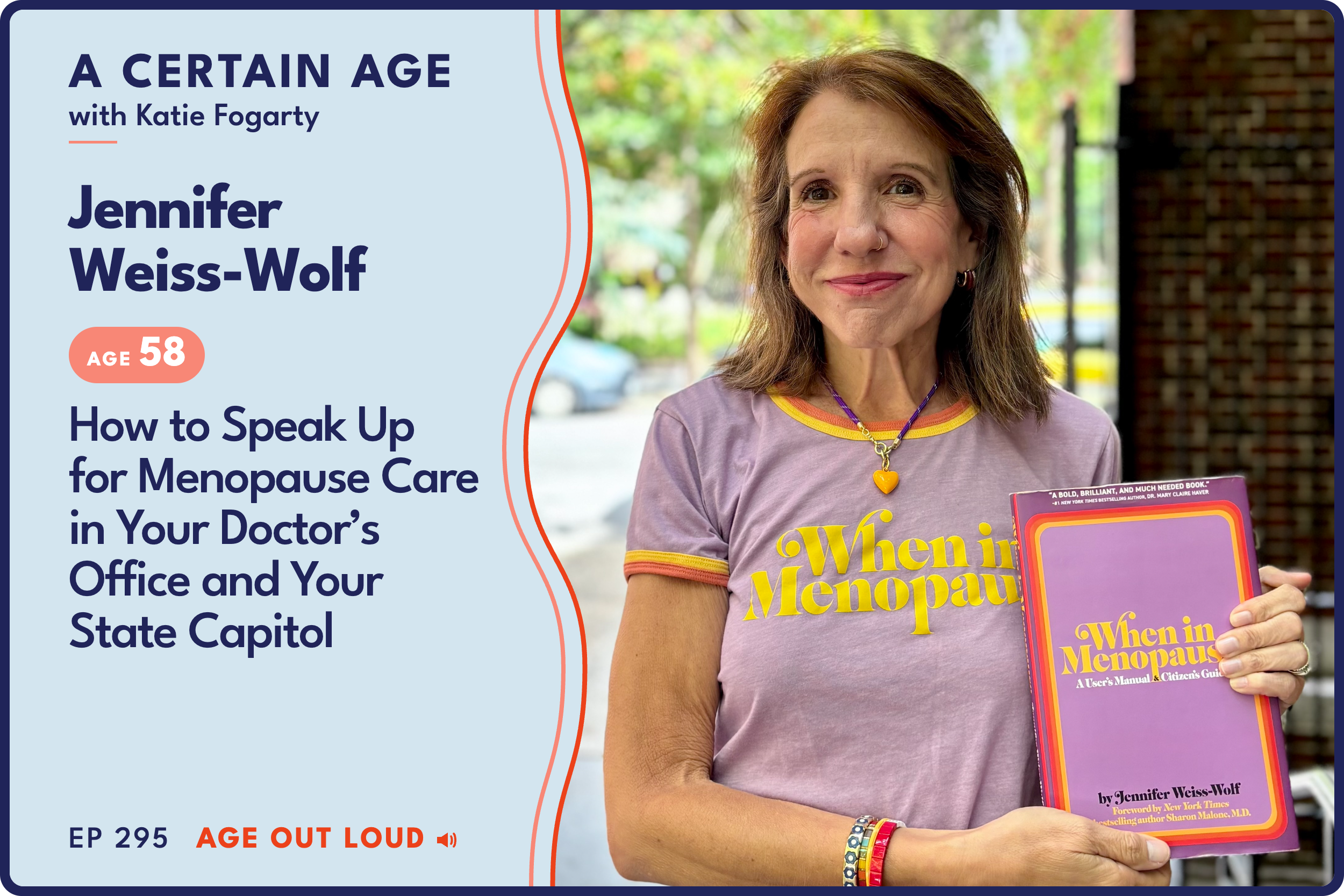
Getting good menopause care can feel like a fight you're expected to win alone. It doesn't have to be that way. Return guest Jennifer Weiss-Wolf, attorney, Ms. Magazine executive, and author of Periods Gone Public and the new When in Menopause, breaks advocacy into three spheres: speaking up for yourself, standing up with others, and shaping the policies that will change care for the next generation.
In this episode:
How to advocate for yourself in the doctor's office, the shopping aisle, online, and with family
Ways to start the menopause conversation with friends, whether it's your book club, your PTA, or your gym
What's changing in the workplace, and why raising menopause with HR has policy implications worth understanding
How to get involved in reform, from state houses to the Capitol, plus the history behind why policies look the way they do
About Jennifer Weiss-Wolf: Jennifer Weiss-Wolf is the executive director of the Birnbaum Women's Leadership Center at NYU Law and leads partnerships and strategy at Ms. magazine. She is the author of When in Menopause: A User's Manual and Citizen's Guide and Periods Gone Public: Taking a Stand for Menstrual Equity. A lawyer and policy advocate, she has presented on menstruation, menopause, and the law at the White House and before Congress.
Show Links:
Follow Jen:
Jen’s book:
Quotable:
"The book is written for everybody who has read all of those other menopause books. It's for people… who now realize that whatever care they were denied or disregarded for wasn't just about them and their doctor. It is systemic. It is part of the way the system has been set up to fail. And it's for everybody who wants to be part of forging a better future."
Transcript:
Katie Fogarty 00:03
Welcome to A Certain Age, a show for women who are unafraid to age out loud. I’m your host, Katie Fogarty. Beauties, six years ago, when I started the show, menopause felt like a whisper. Now it’s more like a roar. Menopause is everywhere. We’re seeing it on the New York Times bestseller list, making headline news, and taking over store shelves at places like Ulta Beauty and beyond. We’ve even seen the first menopause unicorn, with Midi Health hitting a billion-dollar valuation. And yet many of us are still standing in a doctor’s office, a pharmacy aisle, or even our own bedrooms, googling our symptoms at midnight, wondering how to get help and who to trust. That gap between all the noise and knowing what to actually do is where today’s guest lives.
Jennifer Weiss-Wolf is an attorney and an executive at Ms. Magazine. She’s also executive director of NYU Law’s Birnbaum Women’s Leadership Center, and she has a long history as an advocate in women’s reproductive health. Maria Shriver has called her an architect of change. Her new book, When in Menopause, is out now, with a foreword by one of your favorite guests and mine, the wonderful Dr. Sharon Malone. Jen’s book moves a reader from knowing your body better, to learning how to advocate for yourself, to learning how to advocate for each other, and to finally giving women the menopause care they need and deserve. If you’re wondering what’s on the horizon for the menopause landscape, this show is your guidebook. This show is your blueprint.
Welcome back to A Certain Age, Jen. It is so wonderful to have you back. We always have such incredible and rich conversations when you come on the show, and I’m very excited about this one.
As you know, I’ve been doing the show for six years now, and in that time we’ve seen dozens of menopause books published, which is terrific. We’re happy they’re here. There are memoirs, medical guides, doctors’ playbooks. Your book is different, however, and it offers something for everyone. It’s got a menopause glossary. It’s a history lesson. It’s a true look at culture and media, the zeitgeist. It’s a policy playbook and a call to action, all in one book. With so many menopause books already out there on the market, who did you write this book for, and who is your ideal reader?
Jennifer Weiss-Wolf 02:27
Okay, first, thank you so much for that amazing summary. You really tapped into every single aspect of the entire universe of menopause, which gives me so much excitement.
The book is written for, honestly, everybody who has read all of those other menopause books. It’s for people whose own issues or challenges have been solved by reading books, by doctors, by engaging in social media discussions, and who now realize that whatever care they were denied or disregarded for wasn’t just about them and their doctor. It is systemic. It is part of the way the system has been set up to fail. And it’s for everybody who wants to be part of forging a better future.
Katie Fogarty 03:15
Yeah, we’ve seen so many changes in the menopause landscape since you became active in this space, since I launched the show, and since many of these early books arrived. You open this particular book with a story about your own entry into menopause, which coincided with the groundswell of more information, resources, and attention to menopause in our larger culture. I would love it if you could share a little about what you went through, when you recognized you were in menopause yourself, and when you recognized that we were at a tipping point in how people were talking about menopause in the larger culture, because these two strands really came together for you in 2020.
Jennifer Weiss-Wolf 03:58
Yeah, it’s true. So, a little bit of background on me. My focus as a lawyer, advocate, and writer for the past decade and more has been on menstruation in the law, and it’s created almost an alter ego for me. It’s really brought Technicolor to my life, and I love the work so much.
For menopause, I often hear from fellow advocates, physicians, and leaders in the space that a lot of what drew them here was their own experience of how insufficient the system was. Their problems weren’t solved. People couldn’t answer their questions. They were denied care. My story is a little different. I’m prone to say I had a rather uneventful menopause. I don’t actually think that’s true. I think I just didn’t know enough to understand or ask while it was happening. But it ended, or started, whichever way you want to call it, with a bang.
My last period was right when the pandemic started. I remember it very clearly because it’s almost like a punchline-type story. It was messy. It was embarrassing. I hadn’t known, obviously, that it was my last period or about to be. But that was in February of 2020. The pandemic and our lockdown hit shortly thereafter, and even as I was navigating those early months and things about my physicality were standing out to me, I did not identify them as anything related to menopause. I just assumed they were all the different stressors of living through a lockdown.
But by the end of that year, I was talking to a friend about it. My period hadn’t come back, and when we were discussing it, she agreed with my assessment that this might be menopause. Because she was also somebody involved in period advocacy, she asked me what the landscape was for menopause policy, and I answered that I didn’t know. I hadn’t even thought about it. And she said, “I would think you would want to know.” Those were fighting words. I was like, “Wow, I would think I would want to know too.” And so began this next exploration.
I will admit that menopause was exciting to me at the moment, not because it was in the headlines and everybody was talking about it, but because it truly harkened back to getting my period for the first time. I was excited to learn about something new. I was excited to be in the company of a whole new cohort of people and women, so I really did want to roll up my sleeves and understand the public policy landscape. That is the very distinct vision, or interest, that I bring. And there you go. I was very lucky that from 2021 on there were a lot of people, I think more quietly toiling in the space, who were building companies, developing platforms for sharing information, and creating community around menopause, and I was pretty lucky to arrive at the right time and meet so many of the right people.
Katie Fogarty 06:56
Yeah, there’s such an incredible array of women and male allies who are active in this industry, and the landscape has shifted so dramatically. We’re going to talk in a few minutes about where we started, where it is now, and where you hope to see it going. But first, I want to ask you a little more concretely about the book.
On the surface, this is a book about advocacy. But sometimes, when people hear that, they think advocacy equals policy. This is really about being an advocate in three different ways. Can you walk our listeners through how you shaped the book?
Jennifer Weiss-Wolf 07:26
Sure. It’s true that “advocate” is a title and phrase that comes really naturally to me, but I know that for my family and friends, their eyes glaze over at the thought of talking about public policy. Or, even worse, they think it’s going to be toxic. They think it’s going to make them enemies. They think partisanship is the only thing that matters. So I really wanted to fully unpack the idea of advocacy.
The book divides advocacy into three different spheres. The first is the very personal, and I am a full proponent of the adage that the personal is political. But really, what does it mean to advocate for oneself? That could be in the doctor’s office, in the shopping aisle, navigating the internet, or engaging with family members.
The second thread is advocating for each other. What does it look like to create community around menopause? With whom do you talk about it, and why? Is it something you want to raise with friends in book club, at your PTA, in your gym? I tell the stories of people who are doing just that, and there are a lot of really practical how-to tips, because they were so generous in sharing those stories and the strategies they’ve used in advocating for each other. We also explore the workplace, and that’s a good point for me to say that all of these, whether it’s personal, the workplace, or community, have a policy implication. Nothing that happens in our society and our culture happens in a vacuum. So I’m very clear to point those implications out as we go, even if it’s how to organize something with your book club. The workplace is one where, on the one hand, it feels like we’re seeing a lot of talk about workplace benefits and accommodations, and why it’s a great idea to raise this with HR or your employer. I dive into a lot of the policy implications of doing so, because it’s not always clear what is going to be the most beneficial. So, workplace is part of the community story.
Then the third piece of the book, and where maybe most people think I’m going when I say advocacy, and where I hope they’ll really want to graduate to, is what it looks like to advocate for the future. That means reforms being pursued by legislators and lawmakers, whether in state houses or in the Capitol. That chapter also tells a lot of history about why our policies have been the way they are, how they can stand to change, where they are headed, and how readers can get involved.
Katie Fogarty 10:14
Yeah, the book concludes on an optimistic note. A lot of ground has been taken, there’s a lot of groundswell, and it gives the reader a real reason to be optimistic.
Let’s start, though, with the personal. You share that your own menopause was relatively uneventful, with the exception of this sort of cinematic experience that you chronicle in the book, which readers are going to have to buy the book to learn about. But you do share that many women in your own life had very eventful intersections with menopause. You open with a line about your blood boiling over at the way your friends have been treated. You tell stories: Beth’s GSM is misdiagnosed to the point that she winds up in the ER. Kim gets turned away by an OB/GYN. Anna bounces between specialists for a year. I have heard all of these stories from women who’ve come on the show. I’ve heard from doctors on this show that their patients have experienced all of these things, and I’ve heard it from women in my own life.
If a listener recognizes herself in one of those stories right now, what’s the first thing she should do to become a different advocate for herself at her next appointment?
Jennifer Weiss-Wolf 11:22
It’s really interesting, because I have worked with so many doctors, especially, who I think are quite deft at reporting out how patients can come in better equipped. From there, we know all the good—
Katie Fogarty 11:34
We know all the good doctors, but not every doctor is a good doctor. I just heard a story this week from a friend, so yeah.
Jennifer Weiss-Wolf 11:41
My perspective is a little different. It’s one thing for a doctor to say it; it’s another thing to really have that fire and gumption and capacity to do it when your life is going a million miles an hour in every direction. So I really boil it down to how best to speak up for yourself when you head into the doctor’s office: little things, even about the time of day that you go, and things you can do in advance to just make it easier.
One of the things I’ve read about, thought a lot about, and have practiced in my own life now with my doctors is, yes, following the checklist: making sure I write down, and am able to very clearly state, the symptoms that are bothering me the most, in priority order. But then think about them in a more three-dimensional way and express to your doctor how they’re affecting you. It’s not just that you’re having night sweats or insomnia; it’s that your inability to sleep is actually diminishing your ability to be effective in your daily life, whether that’s at work or parenting or whatever else you need to get done. So really think, in a humane and therefore action-focused way, about what it is you want your doctor to hear. A lot of doctors focus on—I don’t know how to say it quite right—how they think about their practice. This is the flip side: a set of suggestions on how to think of yourself as your own number one advocate, who tells your story.
Katie Fogarty 13:15
Yeah, it’s a patient-centric approach, and I thought it was such a smart reframe of the symptoms checklist, because I’ve heard that from a lot of doctors. I think it’s wonderful to walk into your appointment with a list of what you’re actually experiencing. But you help the reader take it a step further and say, “Listen, I can’t sleep, and here’s why it really matters.” That helps the doctor better understand the level of challenge you’re dealing with, and it helps them see you as a human who is suffering because sleep interferes with your ability to function at work or to be patient with your children. So that was incredibly smart advice.
Jennifer Weiss-Wolf 13:53
Interestingly, I think it’s become exponentially more important with the explosion of discourse about menopause. One of the things I include, in the stories, are people who’ve been disregarded by their doctors because the doctors assume they just heard something on the internet and must be coming in with their heads full of misguided ideas. That has happened to me in the doctor’s office, where, when I’ve raised something, they’ve said, “I know everybody’s coming in saying they all saw the same video on Instagram.” So I feel it’s even more important to have that fully three-dimensional ability to communicate about yourself, for a doctor who now might be a little extra cynical or jaded because they think menopause is a little too much everywhere.
Katie Fogarty 14:44
Communication is so key, and this book is full of practical prompts and ideas. We’re heading into a quick break right now, but, Jen, when we come back, I want to talk about how we can communicate with our partners about the symptoms we’re having. You feature a very hilarious international celebrity in the book, and we’re going to get into that story when we’re back from the break.
[AD BREAK]
Katie Fogarty
We’re back from the break. Jen, when we went into it, you shared some terrific ideas for communicating more effectively with your doctor and being the advocate you want to be in that exam room, because you are your own primary care physician. Your actual doctors are your support team, so you need to be able to tell people what it is that you need. You offer so much practical advice in the book about how to enroll all the people around you in your healthcare: how to talk to employers, doctors, families, your spouse.
You use Rod Stewart as an example of a partner who shows up for his spouse in a certain way. You say he Googled and Googled and Googled. He wanted to understand everything his wife, Penny Lancaster, was going through. What made you include this story in the book, and what did he do right that you think all partners should think about?
Jennifer Weiss-Wolf 15:52
Okay, I love that you pulled Rod Stewart, of all things, up to the surface. I do hope Rod is listening.
Katie Fogarty 16:00
Hi, Rod.
Jennifer Weiss-Wolf 16:01
Hey, Rod. I’m fascinated, endlessly, by the intersections of politics, pop culture, and policy. They all affect each other. Policy never happens in a vacuum. As we said at the top, the personal is always political. So there’s never anything better to me than a good pop culture figure or pop star who offers some true wisdom, and Rod Stewart just did. I found a whole series of articles and commentary by him about what it felt like to go through menopause with his wife. He makes a very funny joke that he hadn’t experienced it before because none of his marriages had lasted that long, or he was married to people who were not on the age spectrum where menopause would have emerged. So—
Katie Fogarty 16:47
Hilarious. He was ticking through all his wives. He’s like, “She left at 26. I never got there.”
Jennifer Weiss-Wolf 16:53
His sense of humor made me really want to hear more about what motivated his depth of support for his wife’s truly difficult experience, so much so that they became public advocates for menopause research and care in the UK.
I think a lot in this book about generational perspectives, too, and about stories that really tie to—I’m going to say Gen X here. I realize that could be inflammatory at this point. I know there are some generational wars, or discord, going on about who’s really spurring the menopause moment, millennials or Gen X. I’m a very proud Gen X-er, so we’ll start there. I was really seeking out examples I thought Gen X people would relate to, and I felt I hit the jackpot with Rod Stewart, who turned out to be not only a really thoughtful, supportive husband and spouse but also someone who described how much he valued the communication with his wife, and how her explaining, to some extent, the inexplicable made him want to support her even more. It created a ton of great fodder for advice.
I am not a therapist. I am probably not somebody equipped to give lots of familial advice, which is why I turned to pop culture for that section, to point to the ways we’ve seen menopause reflected, whether it’s fictional on screen, real life with celebrities, or interesting fiction and memoir. All of that spoke deeply to me.
Katie Fogarty 18:26
One of the things I thought was most fascinating about this book was its look at media, pop culture, and the zeitgeist. I think there’s a bit of a misimpression out in the, I don’t know, menosphere, that all of a sudden everyone’s focused on menopause, finally, right? Like nobody was ever talking about it before. I think we could definitely argue that we are at a tipping point in our current era, where there is going to be real change, real velocity, and a real spotlight that hadn’t existed before. But your book shows plenty of evidence that menopause was being talked about in culture and media dating back to 1972, with an All in the Family episode about Edith going through “the change.” You also talk about Gail Sheehy’s decades-old book The Silent Passage. I’ve heard of her, but I hadn’t heard of that book.
Why do you think this generational misunderstanding keeps happening, that we’ve discovered menopause and it didn’t exist before? And what did those past references to menopause not do to create a better information highway for us to be on today? Why did we have to reinvent it?
Jennifer Weiss-Wolf 19:40
That is a great question, and I’m really obsessed with this, too. I did a lot of digging into old media coverage, not just TV shows and sitcoms but media coverage on menopause from the 1960s on. One of the most fascinating pieces I found was an op-ed written in 1992 in the New York Times called “Mighty Menopause.” I promise readers, if you were to read it now and nobody told you when it was written, you would think it was written yesterday.
In 1992, there was a sea change in political representation and leadership. Women won seats in Congress in great waves, and it was the Boomer women ascending in politics, in particular, who created an entire new moment for menopause that led to the Women’s Health Initiative. So that is one example of where menopause was celebrity-drenched. Lauren Hutton was the spokesperson for menopause, right? Leaders in politics were talking about it. There were a couple of decades of experience with menopause hormone therapy, enough for there to be a lot of assumptions and a desire to know more about the benefits and potential risks of hormone treatment. That was a really, really vital time.
But you started with the All in the Family episode, and I do a whole walk through the decades of the history of menopause on TV. There’s also a sensibility that menopause has always been just a punchline on TV: somebody having a hot flash, everybody mocking them, and ha ha, isn’t that funny? But actually, and I welcome you to come binge-watch with popcorn with me, because that’s what I did, I watched a lot of TV and discovered there were so many great hints and little Easter eggs planted about what people really thought about menopause, based on how it was reflected on TV.
The All in the Family episode is a great one because people often point to it. It won Emmy Awards. It was the first time menopause was on prime-time TV. It was very classic Edith and Archie screeching at each other and all the usual gimmicks. But what’s really important to see in that episode is how casually and openly they talk about hormone treatment. It is assumed that’s what Edith should do. Gloria, the hip, liberal daughter, brings her the prescription and tells her it’s perfectly fine to take it. Everybody treats it as the norm. Could you imagine that now? We do not see MHT on TV. We do not talk about it without still carrying all of the clouds of the WHI and the fears that were stoked about it. But there it was in 1972, on TV, as a very common prescription.
It was immediately followed by another Norman Lear gem, Maude, which I knew was a spinoff of All in the Family, but I didn’t realize she was Edith’s cousin. Maude does a lot of groundbreaking things on TV, including having an abortion after finding herself pregnant in her late 40s, and talking about menopause. These things are quite radical. They’re very Norman Lear, in his ability and willingness to push the boundaries. But anyone who thinks we’re nailing menopause representation right now should really invest themselves in 70s TV.
Katie Fogarty 23:17
So what would you attribute the dearth of great representation today to? Although, honestly, we do have shows like Fleabag, and the Sex and the City reboot talks about menopause. Whether or not they do it well is up for debate, but it is still on television today. Yet there’s this misimpression in larger culture that it hasn’t been addressed. Why hasn’t it grown into a groundswell where it just feels very normalized? Why do you think we do these two steps forward, two steps back?
Jennifer Weiss-Wolf 23:48
Okay, I’m going to answer that a little more broadly, both in terms of screen representation and in terms of just how far we’ve come and why we’ve had steps forward and steps back.
If it’s fair to say there have been menopause moments before, there was certainly one in the 1960s, when estrogen treatment for menopause became hugely popular with Robert Wilson’s book Feminine Forever. There was another rise, or spike, in the early 1990s as, again, Boomer women were voted into office in much greater numbers, leading to the WHI. Then there was the 2002 WHI announcement that really twisted that advancement and set us back quite far. And here we are again, from 2020 or so through now, seeing another surge. I think that’s probably just part of the real pace of change. We can look at many other social justice or women’s health issues in this country and see periods of advances marked by regression.
We’re always starting, I think, from far behind the starting line. I’m sure listeners have heard the statistics. It wasn’t until 1993 that women were required to be included in clinical trials. Less than 9% of the NIH’s budget goes to women’s health, and 1%, or something less than that, goes to midlife and menopausal health. So we’re talking about opportunities for advancement against a backdrop that is already systematically broken, and then you mix in a little bit of the politics of the moment. It’s just natural that things don’t go on a linear line. That is not how change happens.
What I do think is really important to note about the current moment is that it’s showing itself to be more durable on multiple fronts. You note that the book ends with optimism, and given all that’s happening in our country and our democracy, it does sound really bonkers to say I’m optimistic. But I am. I think what we’ve invested, especially over these past six years, and the fact that it’s been so well-rounded, focused on everything from innovation to social media to public policy to reflection and representation in culture, gives us a recipe for a durable path forward. It will look a lot more solid and get us a lot further than any of the other moments have. But we really have to be willing to invest ourselves in it.
Katie Fogarty 26:24
Well, for people who are looking for a reason to be optimistic, as I said, your book outlines some. And when we think about the policy lens, you trace menopause discrimination law back further than I think most people would guess: to flight attendants in the 1960s who were fighting airline age caps, which they won. And now there’s a bill called POWADA sitting in Congress. Am I saying that correctly, Jen?
Jennifer Weiss-Wolf 26:48
It’s not one of those that has a great acronym.
Katie Fogarty 26:51
It’s P-O-W-A-D-A. It looks like an imaginary land in a Marvel universe, but it’s POWADA, sitting in Congress. So tell our listeners a little about what was going on in the ’60s, how it maps to where we are today, and why good things are happening.
Jennifer Weiss-Wolf 27:07
So this particular example, and I love talking about the airline folks, aka stewardesses at the time, is really specific to menopause in the workplace, so we’re going to unpack it for just a minute. I said earlier that we talk about the workplace in the community section, but it really ties into policy.
Part of what we’ve been seeing recently, because of so much positive media around menopause, is a real interest and willingness among CEOs and workplaces to be more menopause-forward or menopause-friendly. It’s really true that people of menopausal age and status are great contributors to the economy. That has to do with our own personal economies, because we support our families, as well as the national and global economy. We’re important to the workplace for all kinds of reasons, and if menopause is somehow inhibiting our ability to perform at our best, at a time when we can and could and should be contributing our most and best, that’s a problem.
But there’s a really big “but” here, and this is where the wonk in me gets very excited, not because it’s good news but because it’s really interesting, meaty stuff to unpack. We have a real problem in our legal system: menopause, and the women and people who are in menopause, do not have any clear-cut protection from discrimination based on that status. For example, we have a whole slew of laws that were passed in the civil rights era, in the 1960s, designed to protect people from workplace discrimination based on their identity. The identity of being, for example, a woman or a pregnant woman brings along hard-fought laws and policy changes that ensure people aren’t discriminated against because of their status as pregnant. By that example, being a person in menopause does not afford any similar protection.
I unpack in the book the different laws that could be tapped if we thought about what it means to protect people in menopause. I’m a 58-year-old woman in menopause. If I were discriminated against or fired, I could potentially say I was discriminated against on the basis of age. I could potentially say I was discriminated against on the basis of sex. I could potentially say I was discriminated against on the basis of ability. But none of those things is actually concrete or clear in any of the laws that correspond with them, for example, the Americans with Disabilities Act or the Pregnant Workers Fairness Act. That is a problem. Okay, so I’ve taken a long time leading up to that, but that is the problem.
So I unpack stories of people who fought for further protection from discrimination. The airline attendants were one such group. There was a rule in the industry that women couldn’t be airline stewardesses, as they were called, after the age of 35. They were supposed to be young and lush and serving the male professionals, and they fought back en masse. They actually created an amazing union, and they won. There have been other examples where we’ve seen menopause attempt to be wedged into things like the Americans with Disabilities Act or the Pregnant Workers Fairness Act. These are all anti-discrimination laws on the books, and the attempts have had very limited success.
So the moral of the story is that until we have a moment where there is robust, real legal protection on the basis of menopause against discrimination, retaliation, or harassment, I’m very hesitant to get behind menopause benefits in the workplace.
Katie Fogarty 31:08
You also cite other data in the book that can contribute, I’m sure, to many people’s hesitancy. Black women and Latinas report the worst menopause symptoms. They sometimes have stronger vasomotor symptoms that show up at work, those hot flashes. They have a longer runway, a longer perimenopause, and more profound menopause symptoms, and they also have the most adverse work outcomes of different groups. Why does that disparity get so little attention in the mainstream menopause-at-work conversations, which you and I are privy to a lot of? I don’t hear a ton about it, and tell me if I’m missing things and where I should be looking. And what do you think employers should actually be doing about this particular inequity?
Jennifer Weiss-Wolf 31:52
It’s a really important intersection. All of the things you just stated are factual. We have the data to show that not only are the symptoms worse and the runway longer, but there are systemic reasons, absolutely rooted in race and experience in this country, that lead to them. They’re not biological differences; they are societal, human-made conditions that are part of the story. Then add to that that Black women, in particular, are less likely to be prescribed hormone therapy, along with all the assumptions in the medical establishment about pain and pain threshold and tolerance. It’s all rather insidious, and it does translate to adverse outcomes in the workplace, too.
And again, just as I rattled through the various laws on the books for protection against discrimination, add to that the multiple identities people have and hold, and racial discrimination, too. When you add that to the mix, it becomes that much more treacherous to manage. I think it goes back to what we were talking about at the very beginning, about how we speak up for ourselves in doctors’ offices. The ability to speak up for ourselves, and the ability to create space and share the mic so people can speak up for and with each other, is essential to creating policy that’s meaningful for anybody and everybody. So I’m very glad you raised that. This is, again, what advocacy is about. It’s not just assuming that any policy is going to be one-size-fits-all or that any workplace rule is going to be good for everybody. It’s creating space to have these stories shared and told as we start to think about solutions, so that we, the collective, all understand how they’re going to hit and how they’re going to ensure the best outcomes for the most people.
Katie Fogarty 33:46
Well, let’s talk about the collective “we,” because you also share a lot of great stories and examples of where we support one another. Section two is on advocacy: how we can create community and advocate for each other in it. You share very concrete, real-world examples of people who’ve done that, from book clubs and beyond. Can you share one or two that really stick out for you?
Jennifer Weiss-Wolf 34:10
I’m going to share the story of somebody who’s probably been on the show with you, and folks know her: Omisade Burney-Hunter.
Katie Fogarty 34:17
Yes, yes, yes, a wonderful guest.
Jennifer Weiss-Wolf 34:20
Yeah, she’s a dear friend, and her work sits at the center of culture, storytelling, policy, and systemic reform. It never fails to inspire me. I think I got my double negative right there.
It’s interesting, because my story goes back to the pandemic, and in many ways so does hers. The Black Girl’s Guide to Surviving Menopause, the organization she created, was in its early years then, and I think she had both a front-row seat and a front-row microphone to the way the country was responding to the pandemic and to the various health inequities and societal inequities that were laid bare in that period. That was especially true when she was initiating a lot of conversations about menopause, and I think she, as much as anybody, brought the richness and depth of that conversation to life. But she does all kinds of organizing that listeners might not even be aware of, with communities at the margins, folks who might not show up to big-city menopause conferences that cost a lot of money to attend. She really knows what it means to both make space at the table and share the mic. Her organizing stories have always inspired me, and I was so proud and honored that she worked with me so I could share them in the book.
Similarly, another friend I made in the menstruation space, Eco Lavoria [spelling to verify], has done intergenerational public library organizing. It’s so interesting how much of this is pandemic-rooted. That’s probably a conversation for another day: what was unleashed in women our age during the pandemic to spur these conversations? She was finding that a lot of the work she had set up around menstrual product distribution in schools and other public places was a lot harder to do when everybody was sheltering in place and locked down, and whatever words we used for it. So she started tapping public libraries as resources. If they were going to be places for food pickup and other things for the community, she made sure menstruation and menopause were part of the information, materials, and opportunities people got, and that program continued to grow, too. There are some really poignant and powerful intergenerational conversations that she transcribed and shared, which I include in the book, and those are some of my favorite examples.
But they don’t always have to be as grand as meeting people in a moment of crisis. The first place I’m having a book talk celebration is at my gym, and I am so excited that my gym wants to do it. They’re going to organize a class based on menopause, balance, and musculoskeletal health, followed by a talk about menopause advocacy. To me, that’s exactly where these conversations belong.
Katie Fogarty 37:13
Yeah, in real-world spaces. I love that.
Jennifer Weiss-Wolf 37:15
Right. It doesn’t always have to be in fancy halls with a lot of people and—
Katie Fogarty 37:20
Formally organized. I love the examples you shared. Omisade Burney-Hunter was one of my early guests, and I will put a link to that episode in the show notes. She said something in that guest appearance that reframed how I thought about menopause. She called it a liminal space, where you are moving through a portal and emerging on the other side. She spoke so beautifully and expansively about what this time of life could mean. It literally reoriented how I think about and approach this time of life. It’s just a wonderfully empathic and expansive way of looking at it. I continue to follow her on Instagram and see that she is doing an initiative around menopause for incarcerated people, so she continues to bring menopause equity to people on the margins. Her work is to be admired, followed, and supported, and I will make sure I link out to all of it so people can learn more.
I love that you’re doing this gym class. Maybe you’ll invite me, because that sounds really cool. But I do want to leave our listeners who maybe aren’t New York-based and can’t squeeze into that class with some action steps they can take, because I know anyone who’s still hanging out with us right now is really inspired and lit up. They’re going to go buy the book so they can do the deeper dive. But let’s end with a prompt: What do you want our listeners to do six months after hearing this conversation, and what might you want to see them do tomorrow?
Jennifer Weiss-Wolf 38:50
The one thing we haven’t talked about much, and I’ll do it in a real quick spin here, is where public policy has come since the last time I was on your show, and where we’re headed. It’s really interesting: in the past two years, the 2025 and 2026 legislative sessions, which for non-policy heads means basically the period from January till the summer, the first six months of the year, we have seen state legislatures take up ideas that were first put forth in the Citizens’ Guide to Menopause Advocacy, about ways public budgets and public rules could be leveraged to improve menopause treatment and care.
Among the things we’ve seen gain great traction are laws that would make sure menopause treatments are covered by all forms of insurance: Medicaid, private insurance, employer-provided insurance. We’ve seen attempts to improve education for doctors. We talked in the beginning about how doctors might be dismissive, but the truth is, most doctors aren’t trained in menopause care, whether in medical school, in residency, or through continuing professional licensing. State legislatures have been instrumental in making it easier for them to get that training as they continue in their careers. We’ve also seen state legislatures step into the workplace void I mentioned, where anti-discrimination law does not protect us. Two states, Illinois and Rhode Island, have rewritten their own anti-discrimination codes to make sure menopause is included.
Those are really impactful reforms, and they’re happening so much more than listeners might realize. Over the past two years, more than 60 bills have been introduced in more than half of the states, 26 states, 18 of which are now laws on the books. So one thing listeners can do, whether it’s tomorrow, six months from now, or whenever it feels right, is insert themselves into that process and become part of the army of voices saying we want this from our lawmakers.
One thing I think it’s really important to know is that state legislators are often a lot more casual and easy to access than, say, your member of Congress or a U.S. senator. I always joke that my representative in New York lives around the corner from me, and I see her at my local grocery store all the time. I never hesitate to stop her, like in the frozen foods aisle, and ask what’s up with the menopause bills. It’s not intimidating. It’s not hard to do. The book gives lots of scripts, words, and tips for how to do it, and that is something I would love to see more listeners feel empowered to do.
But the truth of the matter is, whether it’s advocating for yourself, advocating for each other, or advocating for the future through systemic reform, all of it matters. The title of the book is purposeful. When in Menopause is a clause, not a sentence, because it’s not answered: When in menopause, what? It’s a choose-your-own-adventure story, and so is advocacy. Everything in the book has tips on how to make it real for you. Even if it’s two or three out of the 50 things in the book that you could do, that is great. We all have our own adventure to choose, and we know what our limits are, what our opportunities are, what our gifts are, and what our time constraints are. There’s something in there for everyone.
And the last thing I’ll say, and this was a really fun thing to do: I ended the book with a bunch of discussion prompts for if you decide to bring this up in your book club, your nail salon, your gym, your PTA, or wherever. I give you lots of ways to raise it. Some of them are fun, and you get to talk about pop culture. Some of them might be deep, about family histories and things that might feel harder and more awkward.
Jennifer Weiss-Wolf 42:53
But all of it is there for the taking. I’d be hard-pressed to say that anyone who picked up this book and took the time to read it through wouldn’t come away with a few ideas about why being in menopause is going to make your life so much more interesting, because you’re going to start having these conversations. It’s not long. It won’t take you that long.
Katie Fogarty 43:14
Yeah, it’s optimistic, informative, and packed with great, actionable advice. You really feel like you can choose your own adventure. I love that phrase. I’m going to take it on when I talk about menopause myself. There are so many ways to choose how you intersect and interact with this time of life.
Jen, thank you so much for coming back on. Twice now, you’ve made policy feel like something we can touch and act on. When in Menopause is out now, beauties. Go grab it. Jen, thank you for being with me today.
Jennifer Weiss-Wolf
Thank you so much. I love talking to you, Katie.
Katie Fogarty
Thanks for sticking around to the end of the show. This was a phenomenal conversation. Jen is an encyclopedia of information, advocacy tools, and tips to really navigate the ever-changing world of menopause and women’s health. I learn something every time I talk to her. I hope you enjoy this show. Please share it with the women in your life if you want them to feel optimistic and better informed, to be able to better advocate for the healthcare they need and deserve, and to change the system and what’s going to come next for our daughters and the women coming behind us. This conversation is a goldmine. Please add Jen’s book to your cart. We need to support authors who are writing and advocating for women’s health.
Thanks for sticking around to the end of the show. If you learned something, if you enjoyed it, if you feel seen and supported, let me know in an Apple Podcasts or Spotify review. I read each and every one.
Thanks for sticking around to the end of the show and, as always, special thanks to Michael Mancini, who composed and produced our theme music. See you next time, and until then, age boldly, beauties.
