
This episode is brought to you by Alloy Health — get $20 OFF your first order at MyAlloy.com with code KATIE.
Show Snapshot:
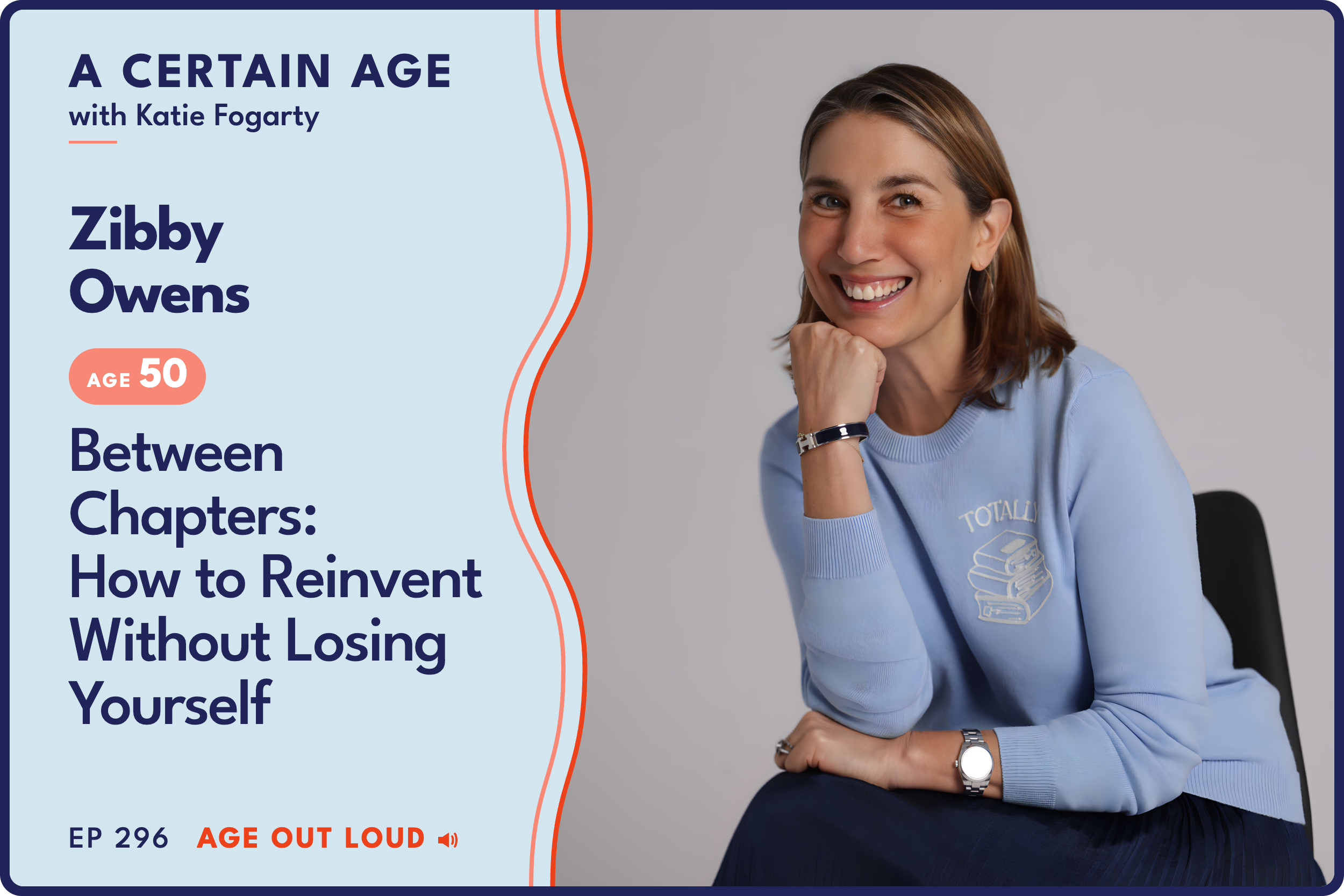
Starting over after a divorce, an empty nest, or a loss doesn’t mean starting from scratch. Return guest Zibby Owens is proof. Ten years ago, she was an Upper East Side stay-at-home mom of four. Today she’s a bestselling author, host of Totally Booked with Zibby, and founder of Zibby Media. Her new memoir, Between Chapters, is her most personal project yet.
In this episode:
How to reinvent your life without losing yourself along the way
Keeping friendships alive when your people are no longer next door
Raising kids while you become someone new
Making peace with midlife body changes, plus an honest, funny roadmap for your own next chapter
About Zibby Owens: Zibby Owens is the founder and CEO of Zibby Media and host of the podcast Totally Booked with Zibby. She is the author of the memoir “Between Chapters” and the USA Today bestselling anthology “On Being Jewish Now,” and is a return guest.
Show Links:
Follow Zibby:
Zibby’s podcast:
Zibby’s latest book:
Between Chapters: How I Started Over, Took Some Chances, and Found the Plot
Quotable:
How do we get from one chapter to the next? How do we find ourselves in this current chapter, and what does it mean to be in a part of life where you don’t know what the next chapter will bring?
Transcript:
Katie Fogarty 00:03
Welcome to A Certain Age, a show for women who are unafraid to age out loud. I’m your host, Katie Fogarty.
Beauties, how many of you have a version of yourself from 10 years ago that you wouldn’t recognize today? Not because life knocked you down, but because you got up. You survived what life threw at you: the divorce, the reinvention, the messy middle. And you built something entirely new, something that at one stage you could never have imagined.
That’s the story my guest today is telling. You know her well. This is her third time on this podcast, and every single time she comes back, she brings a new chapter. Literally. Zibby Owens is back, and this time she is cracking open the pages of her most personal book yet.
Zibby’s résumé alone could fill the hour. Best-selling author and editor of seven books, host of the award-winning podcast Totally Zibby, where she’s interviewed more than 2,000 authors, founder of Zibby Media, a publishing house, a bookstore, a book club, a whole ecosystem for readers. Vulture calls her New York City’s most powerful book influencer. People magazine has featured her. The New York Times has covered her. But today, we’re not talking about the empire she built. We’re talking about the decade that built her.
Her new book, Between Chapters, is the story of Zibby’s own relaunch from Upper East Side stay-at-home mom of four to divorced, remarried, and reinvented across every category: love, work, motherhood, grief. Zibby writes about the stuff that doesn’t make it into the highlight reel: friendships that quietly change shape, relationships that dissolve, love that shows up again when you weren’t looking for it. The daily tightrope of holding a family together while also becoming somebody new. She calls it a diametrically opposed balancing act. If you’ve ever felt that pull, this episode is for you.
Welcome back to A Certain Age, Zibby.
Zibby Owens 01:58
Katie, that was the most amazing intro. I was trying to memorize what you were saying so I could write it down. I’m going to have to transcribe it, and I will—
Katie Fogarty 02:06
Send you the transcript. I will send you the transcript.
Zibby Owens 02:09
That was really nice.
Katie Fogarty 02:10
Well, you know what? I so enjoyed writing it and thinking about it because you have been on this show three times. When you were newly into your book-building life, you came on to talk about Moms Don’t Have Time to Read during the pandemic. I was able to welcome you back when your latest anthology was out, On Being Jewish Now, and you connected me to Joanna Rakoff and [Dara Horn?] to be part of that show, which was really special. I think it was the first time I’ve ever had three guests woven together.
So I’ve been following your career from afar for so long, and I am going to tell you, I dove into this book feet first over the weekend and blazed right through it. It was so enjoyable, and I loved learning even more about you and your story. The book is funny, it is moving, it is sad, it is thought-provoking. It was totally enjoyable.
But my first question for you is about what we see on the cover: the title of this book. I know it went through three versions because I follow you on social media. It was Catching Up, then Between Books, and finally Between Chapters, which is what you landed on almost by accident. Why did Between Chapters end up being the right title when the other two weren’t?
Zibby Owens 03:25
That’s the thing with titles. When you get to the right one, you’re like, “Oh, well, this is so obvious.” But sometimes it just takes a while to get there.
First of all, when I was trying originally to title this whole thing, I thought about calling it Catching Up, because what I really wanted to do was catch up with readers the way I would catch up with a friend over coffee. I wanted it to feel informal, intimate, not like someone had to straighten up and take note. Like, this is a catch-up session. So I thought about calling it that, and then I thought about calling it Between Books, because I wrote all these essays between all the books I was reading, and also some of the books I was writing or editing. So I thought that worked. I was fitting this in, and I was hoping other people might fit it in between the books they were reading.
But then, as I was writing a Substack post, which I ended up sending, and you’re probably referring to it, I was writing about Between Books, and then I paused with my fingers over the keyboard, and I was like, “Wait a minute. Between books, this is really between chapters.” And then I was like, “Wait, shouldn’t this be called Between Chapters?” And that spurred so many other things, because that’s really what it’s all about, and what so much of us are going through: how do we get from one chapter to the next? How do we find ourselves in this current chapter, and what does it mean to be in a part of life where you don’t know what the next chapter will bring? Which is what we all are confronting. So it just made so much sense to call it that.
And then I thought, “Wait, I want to hear other people’s between-chapter stories,” and so I launched a new Substack essay platform where other people are writing their stories all the time. That’s been educational for me and soul-fulfilling. So sometimes you try and you try to make something work, and it just doesn’t. And then one day, out of the clear blue, the right answer just shows up.
Katie Fogarty 05:19
For me, that right answer usually shows up when I’m showering and I have no pen or paper, or I don’t have my phone, so I can’t tap it down. There’s something about that liminal transition space between bed and my day where things percolate in my brain. So I love that it just popped into your head one day and you had this epiphany: this is the right title, because it truly captures the book.
Another thing that I know, because I did my research, is that you don’t title your chapters until they’re over, even when you’re writing the book, because you can’t clearly see what the title is until you get through the essay. So I’m curious: is there a chapter that you’re living right now that you still can’t title, even after having written this book?
Zibby Owens
Ooh, a chapter I’m living right now. I recently dropped my twins off at college, and I’m in the post-college-drop-off chapter. I would say I can feel the start of the school year in every cell of my being, like the beginning, the feeling of the fall as a fresh start. I don’t know what the fall will bring, but I know it will bring lots of travel and trips and things like that. So I feel like this chapter is—I would maybe call it “Taking Off.” Yeah, it’s still unfolding.
And the college drop-off is a real thing. I’ve done it three times now, and every time it’s different. There’s a lot of anxiety that goes along with it. Like, will I be okay? Will they be okay? What have they forgotten? Will they make friends? Will they find their people? There’s so much uncertainty, but it’s also such a period of excitement and pride and joy, because you did it. You worked together as a team, and you got them out the door, and they’re on to their new thing.
Katie Fogarty
Congrats on the twins! This is actually maybe a very good segue into my next question, because you are—I don’t want to use the word busy, but you are, let’s say, prolific. You have twins, you have four kids, you’ve got the podcast, the publishing house, you’ve got a bookstore, multiple irons in the fire at any given moment. What made you decide that you wanted to sit down and take this new project on, to write this book, at this time in your life?
Zibby Owens 07:27
I know, why did I do this? No, I mean—
Katie Fogarty 07:29
Like, I’m glad you did, but it’s—
Zibby Owens 07:32
No. I was asking myself the same question. I always like to be launching or creating something. I am not happy unless I am working on something and bringing it into the world in some way, whether it’s an essay or a book or some random Instagram, I don’t know, something. It makes me feel good to create.
This particular project felt timely because I happened to have this huge stack of essays that I had written, which inspired me to write more, and it just felt like such a good time to reflect back a little bit on this crazy decade that I had. I hadn’t really taken a beat to do that until recently. Once I did, and I started rereading some of the essays from the past, I was like, “Wow, I wish I had this to read.” It might have made me feel better during periods of time when I felt very uncertain myself, about what was coming next or how to get through a certain something. So I thought, “Well, I don’t know, maybe other people will get something out of it, and this seems to be a good time, because it’s just such a natural decade-ending moment for me, and I had so much new I wanted to say as well.” That’s really why. I just felt like, okay, we’re going to breeze by this year. Soon it’ll be next year, but I might as well take this milestone birthday and this whole time to bring out something new.
I really love that every book I bring into the world, even though it comes with headaches and stress and worry and all of it, leads me to new people and connections and experiences that I wouldn’t have otherwise. Even through disappointments or setbacks, or early-morning flights, or whatever it is, afterward I absolutely love everything that each book has brought me. So I view each book as not just a book but a… I mean, not to say chapter again, because that’s hokey, but I do see it as a new launchpad for conversation and connection, not just between me and readers, but between readers with each other and readers with the material.
So this seemed like the next right project. Even though I will say at the outset, I was like, “Well, I don’t even have to go on tour. Maybe I don’t even have to make this a real book. Maybe I could just silently send it out as an ebook to friends.” And then of course the whole machinery got in the way, and I was like, “Okay, now I’m going to launch it as a book.” And—
Katie Fogarty 10:08
It’s such a gorgeous book, too. I absolutely love the cover. It’s got your iconic color-coded bookshelf on it, which, if you’re a frequent visitor to the Zibbyverse, either your podcast or your social media, is a beautiful, inviting, colorful image. It really pulls the reader in from the jump.
You’ve been writing your entire life. You talk about in the book how you were a nine-year-old who really wanted to write, and you had early jobs at Seventeen magazine writing. As I said at the top of the show, you’ve got seven books. You celebrated a milestone birthday. I believe it’s 50. Is that correct?
Zibby Owens
It is, yeah.
Katie Fogarty
And I totally connect with your desire to assess, look, and make meaning out of this chapter as you approach this milestone birthday, because that’s why I launched this podcast six years ago. I wanted to do something to mark 50. I’m not even a big birthday person. I’ve got friends who spend the entire month celebrating their birthday, and I’m like, I’m done with one day and some cake, I’m good. But 50 felt very meaningful in ways that surprised me, and I really wanted to honor it in some way. I had an epic luncheon with all of my closest women friends from all different chapters of my life, and then I launched the podcast. But I will share with you, Zibby, that I did it 35 days before I turned 51, because I was like, “Uh-oh! I didn’t actually launch the podcast that I said I was going to,” so I got into action. So I love that you sat down and made this happen.
The book examines all these different chapters from the last decade. One of the messiest middle chapters, the murkiest chapters, was the pandemic. This was true for everyone, but in that chapter, you write very candidly about gaining weight: 30 pounds, nothing fitting, not even your shoes. There’s this one crystalline detail that you shared that I think is going to really speak to listeners. You asked the nurse at a doctor’s appointment if you could step on the scale backward because you didn’t want to see the number. You dedicate the book to Mounjaro. Midlife bodies change. I’m living in one that has. Women are usually told to be quiet about this. What made you decide to put that moment on the page, that dedication, instead of editing it out or just ignoring it like many do?
Zibby Owens 12:15
Thank you for the close read of the book and catching that moment, which I can just feel all the feelings bubbling up from, in the doctor’s office, where I felt so helpless and just defeated, and all the things. It’s not even about how I looked; it was how I felt. It was a lack of control. It was just this sense of doom that I felt about life in general at that moment, even though I’m generally a pretty positive person.
I’ve been writing about my relationship with my body and food and all of that since that first article came out in Seventeen. I mean, I gained and lost 20 pounds after my parents got divorced my freshman year of high school, which is ridiculous to even be talking about, things that happened that long ago. But I really sensed a shift in how people treated me and how I felt. And I wrote about it, and I published it, and people really related to what I wrote. I suddenly took the thing that made me most ashamed and shared it, and had never felt more understood. It fundamentally shifted how I felt about myself and my place in the world, after I took what I felt was a shameful secret, that I just couldn’t stop eating, or the things I was trying to hide under clothes, and just shared how I felt about it all. I have learned from that experience and continued to share because of it. Because I found that when you share, really at your most vulnerable, about the things you are holding closest to the vest, people tend to open up right back to you, and catch that with respect and dignity and understanding in a way that makes it easier to get through life, whether it’s weight or anything, grief. I mean, it could be anything.
So that early experience for me reinforced that sharing about that in ways that could be funny or heartfelt or whatever would not just be helpful for me, but helpful for others. And being helpful for others is something that I prioritize above all else. Really, I aspire to do that with everything I put into the world in some way, shape, or form. So I don’t think I share too much. I think I share the right amount. No one would want to hear every last little thing I was thinking.
And I’m in a very different place with my body. Right now, I’m at a weight that I would have considered a “before” weight, for example, when I was in my 20s. But now I’m just like, “Oh my God, thank God my body is working.” So again, it’s not about how I look. But now, because of Mounjaro, I don’t have to worry about what I eat, and I don’t have to worry about that sense of wanting to binge eat or whatever it is. I have found so much relief from that, and from GLP-1s in general, that now I’m a very outspoken fan, because those who need it and get on it and have the same food noise suddenly quieted after a lifetime are experiencing so much relief. So—
Katie Fogarty 15:12
And so much freedom. I love what you shared about how when we’re honest and vulnerable, we connect with people really profoundly, and then it provides them the opportunity to share back, and that’s where true connection is made.
I’ve interviewed wonderful doctors on the show. I’m thinking of Dr. Rocío Salas-Whalen, who wrote the book Weightless, which is about how to use GLP-1s, and she shared, too, that they’re really profoundly powerful in quieting food noise and giving people brain space back. And by the way, when you’re a midlife woman, you need all the brain space back that you can get, because our brains are full of a lot of things, including brain fog.
But when I opened up the book and saw it dedicated to Mounjaro, I laughed out loud, because normally it’s to my husband or my kids or my parents. It was the perfect example of using humor to diffuse the heavy stuff. So a question for you: did you deliberately set out to infuse the book with humor, with comedy, or did it just naturally bubble up, as it does in life?
Zibby Owens 16:10
It naturally bubbled up, but I will say I could have written this book 10 times over. I have so much material that I did not publish. It’s literally in a stack on my desk. So I tried to pick out the essays that I found elicited the most emotion for me when I read them over. The essays that made me laugh when I reread them, or laughed as I wrote them, I definitely kept in, and I kept in the ones that made me cry as I wrote them or reread them. So I wasn’t trying to write a funny book. I was trying to share the things that made me feel the most, hoping that it would do the same for readers.
Katie Fogarty 16:50
The sex ed—Zibby has this hilarious sex ed conversation with her twins at one point that had me howling, and I was reading at this point in a public space. So I was doing one of those like shaking quietly and having people around me think I was a big old weirdo.
Zibby, we’re heading into a break, but when we come back, I want to talk a little bit about friendships, because that’s a big theme of the book. We’ll be back in just a minute, Zibby.
[Ad break]
We’re back from the break. When we went into it, we were talking about friendships and how this is a huge theme of your book. In one of the early chapters, you open up and you’re telling a circle of friends that your marriage is ending, that there’s a new relationship on the horizon. These are not connected, but they appear in the same conversation. You surface friendship throughout the book at different points, and you write that friendships ebb and change because we ebb and change, right? That the love stays even when the coffee dates don’t. But you also said it took you over 40 years to realize that real friendship isn’t about proximity, and I really loved that. It hopped off the page for me, because I think I’ve watched this with my own kids. Friendship is who you’re sitting next to in kindergarten, who’s at the lunch table, and as we get older, we need to bring intention to our friendships because they’re no longer proximate. So I want to hear: what does this look like for you in practice? How do you nurture old friends, but simultaneously, how do you create new relationships in midlife to enrich it?
Zibby Owens 18:13
It’s the challenge, because friendships in general, I feel, I don’t know about you, take a back seat to all the other things. In a way, I almost feel like my friendships are for me. The things I have to do, the things for the kids or for my parents or for my work, those are non-negotiables. My husband. So seeing a friend is like, “No, that’s just as enjoyable as getting a massage.” So I’ve been guilty of not making enough time in my day-to-day life for friends. In fact, as I say this, I’m remembering someone who DM’d me yesterday to take a walk, and I’m like, “Oh my gosh, I have to call her back.”
In practice, it was more philosophical: sometimes you find yourself in a group that maybe you don’t feel like you belong in so perfectly, like you’re not a natural fit in that group, and sometimes it happens from one class to the next. I mean, I have four kids, and for each of their classes in preschool or grade school or whatever, there’s a group, right? There’s a group of parents, and for whatever reason, I relate more to some classes than others. It’s just the way it happens. I didn’t realize until I got on social media and started traveling for work and meeting people all over the place that maybe the people I felt most myself with weren’t necessarily the people I’m standing on the sidewalk with that day. Although I love people at my school, maybe they’re people I connect with on a level about books or something else. So I don’t know. I felt like the menu was set with who was in your life, literally next to you, plus old friends. But it’s actually much more far-reaching than that.
So in practice, what does that look like? I don’t know. I mean, I try to stay in touch with old friends, and I’m frequently texting with old friends, or sending birthday gifts, or things like that. And obviously I’m happy to be chatting with whoever’s in my day-to-day life, but also just carving out time to make time for people I’m connecting with emotionally, but not locationally, geographically. 100%.
Katie Fogarty 20:18
I love that. I love this topic, because women’s friendships are so important in my life, and I agree with you. I’ve had a very busy summer where caregiving needs for my parents really trumped a lot of things, so I didn’t get to spend as much time with people as I would like. But I’ve learned from creating this podcast that there are a lot of different ways to stay in touch with people or to create new friendships, and I have a more expansive view of friendship than I did before I first hit record on this podcast six years ago. I have met and befriended women I’ve met over Instagram, and we’ve turned it into, “Oh hey, you’re going to be at that conference, let’s meet up,” or “Let’s have a virtual coffee one-on-one.” And then all of a sudden, maybe we’re spending time together, and I’ve developed some very dear friendships through being active in this midlife space. That would have surprised me when I thought about launching this podcast six years ago. I never would have thought of that.
So when we think expansively, if you follow what lights you up, you’re going to find people who are lit up by that too, and it’s so much easier to add them to your life and to have those people become friends. And I see the way you behave, Zibby, on Instagram. You are an ever-present cheerleader for people who are authors, who are writing, who are creative. I’ve attended some of your conferences, or I don’t even know if we’re calling them conferences. What are we calling them? Retreats? Retreats, more fun. But I attended one of your book retreats, and it was super fun. I brought a friend with me that I met through the podcast. She was my roommate. I was like, “Laura, let’s go,” and we got connected through this. And then we got to bunk together, and it was super fun. So you create a lot of spaces to connect with people.
And I think that anyone who’s listening to this, it doesn’t have to be books for you. It doesn’t have to be podcasting. No one needs to throw your hat over the wall and create a big creative project. You could just go to the knitting class, or be curious about the dance class. There are so many different ways. You can volunteer at your synagogue, your church. There are so many different ways to add people to your life. But it is tricky when we’re prioritizing family, which is a good segue into my next question for you.
So much of the tension in this book, and when I say tension, I mean the push and the pull, and the ups and the downs, and the highs and lows, revolves around the fact that you are trying to redefine and reimagine your life during this decade while you’re simultaneously holding your family together, parenting your children, helping them through the divorce and the transition of your family, the transition in your family dynamics when you lose beloved family members. For a woman who’s listening right now, who feels like she’s either disappearing into her family or maybe abandoning them to find herself, how would you coach her to work through what you call this diametrically opposed tension? What has been helpful for you that you would offer as a gift?
Zibby Owens 23:06
I think I would say, don’t be too hard on yourself, because you have to do a certain amount of maintaining your own—I don’t know what you call it, maybe life force or direction or purpose—before you can really be your fullest, best self as a parent or a caregiver or anything like that. And it’s not easy. I make so many mistakes. I drop a lot of balls. Literally yesterday, my son was like, “You said that this thing I have is on Mondays,” and I was like, “It is.” And he’s like, “No, no, it’s on Tuesdays. That’s what this other kid’s mom said.” And of course, he was right. And I was like, “Yeah, but I signed up. Look at how I signed up 20 minutes after the link came in May. Right? Where’s the credit for that? How can I be expected to remember this?”
So I think it’s giving yourself the grace of looking at the mistakes and the setbacks as doing the best you can, and letting your kids into that. I mean, I let them make fun of me and say things like, “Seriously, you think I can hold your club activity from May 4 in my head, and now it’s September?” Like, okay, I should have looked at it, but, like, come on. And then we laugh, and I’m like, “What do you remember from me?” Anyway, I think it’s just, and this is a specific example, but—
Katie Fogarty 24:27
No, it’s letting your kids see that you’re human.
Zibby Owens 24:30
Yes, the—
Katie Fogarty 24:30
The older they get, the more you can do that. I find in my own life, the more you can reveal yourself to them. When they’re little, you want to be this zone of safety and security. You do also as they get older, but you can peel back the layers a little bit, and I think reveal more of yourself to your children as they age.
I want to ask you now about one of my favorite chapters in the book, which is called “Why Writing Matters.” I thought this was such a beautiful, powerful chapter, and in it, you are exploring why you’ve had this lifelong love of writing. But even while you’re writing this particular book, you ask yourself something honest. You say, “Do I really need to add my own story to the mix? There are so many books out there. What’s it all for?” You ultimately land on an answer. You write to make people feel seen and connected. You write because, as you put it, “I deeply understand how it feels to be excluded, and so I’ve dedicated my life to helping others feel included.” What role, if any, did aging play in helping you make that transition, to say, “Gosh, at times I have felt lonely, and so part of my mission is to ease that for other people”?
Zibby Owens 25:32
As I’ve gotten older, I’ve had more perspective on all the things that happened in the past. If you’re not feeling at your best, at your most authentic with the group of people that you are with, it can feel really isolating, and that group can be a marriage, it can be a group of friends, it could be a job, it could be anything. It’s really hard to go about your daily life when you’re essentially limping through it, right? Because you’re not fitting in quite right. It’s like when you’re wearing shoes the wrong size. It’s not the end of the world, but it’s uncomfortable, and maybe you get a blister, and then you’ve got to deal with that injury. And anyway, it’s a whole slippery slope.
So I would say getting older has allowed me to focus on the things that matter, the people that matter, to value the opinions that I really care about versus just opinions at large. It’s allowed me to accept a lot about myself, who I am. I feel good about who I am now, and not everybody has to like me. It’s okay. I’m maybe not for everybody. I mean, I still would love for everybody to like me, but I think we all have to do our own thing, and that’s okay.
Katie Fogarty 26:44
Sometimes we feel like we’re the round peg in the square hole, but it’s really the room that’s wrong. You’re in the wrong room, the wrong circle, the wrong circumstance. I think it takes maturity to understand, “I need to put myself into new spheres so I can find that better fit,” and it can take a while to evolve and learn that.
Zibby Owens 27:05
Literally, I know listeners can’t see me right now, but my neck is hurting because I’ve been nodding the entire time you’ve been talking. I’m like, “Uh-huh, uh-huh, yes, yes, that too.” Like, so wise. You’re bringing so much wisdom and perspective into this conversation, and I know all your conversations, but it’s so valuable. Thank you.
Katie Fogarty 27:24
I think I’ve learned so much from this. It’s, I think, my 293rd show, and so I have spoken—
Zibby Owens 27:31
Oddly specific. If it’s not, if you’re not, if it’s not the 293rd show, I’m—
Katie Fogarty 27:36
Like, I think I’m—actually, I know it is. But no, it’s because I have learned so much from talking to an incredible woman every single week. And you have spoken to more than 2,000 authors, which is a pretty astonishing number. You are very prolific. Your show comes out multiple times a week, and you also do these retreats and conferences, and you’re on stages in New York and across the country, really interviewing authors. So you’ve written seven books. This one, I think… I’ve read almost all of them. I didn’t read the children’s book, although I gifted it to my sister-in-law at her baby shower, so I haven’t read that one. But what about those interviews, and what you’ve culled from all of these amazing authors? What did you take from that and put into this book? Is there something that you’ve learned that really helped shape this book and make it different from the six that came before it?
Zibby Owens 28:24
I’ve learned that sometimes the most powerful thing is just figuring out what to include and what not to include, and I think that goes across genres. So many different authors have talked about this, and I think it goes for life as well as writing. You don’t have to put the full story down. You have to mine the story for the things that are relevant, the things that represent bigger-picture items. So when I was figuring out how to edit it and what to include and what not, that kept going through my head. Right? You don’t have to over-explain. Readers are really smart. You can jump from one thing to the next, and they’ll follow along. So I tried to include that.
But really, I’ve learned so much from the authors I’ve interviewed, like you, Katie. I feel like every conversation, it’s like a new friendship. It’s like a new connection. I learn something. I am inspired. I interviewed an author, Kate Hatch, this morning, and she was talking about how she likes to write the middle scenes of her book and then go to the beginning. And, wow, like, right? And I was like, “I know.” I was like, “That’s so interesting. I bet you’re going to find you don’t even need the beginning anymore.” So all to say, every day there’s something new to learn from someone else, and I feel so privileged to get to talk to such brilliant people who are all essentially writing about how we all get through life, whether it’s self-help or fiction or memoir or whatever. We’re all just talking about relationships and love and loss and the daily stuff.
So I try to put in what I find most appealing about books, which is books that elicit emotions from me. The books that I recommend the most are books that I read in one or two sittings, that make me laugh or cry, that don’t feel overwhelming and don’t make me feel like I have to think too hard to get through them. I can just relax and enjoy. And so I was trying to put all of that together for this book.
Katie Fogarty 30:31
And you did it so beautifully, from that sex ed chapter that had me howling to the chapter about the loss of your beloved stepfather, which was really… I was crying. It was so beautiful and moving, and it made me wish that he could read it, because it was just such a wonderful, wonderful chapter.
Zibby, my last question for you before I say goodbye. When I opened the book, I always love reading author blurbs, and I, of course, saw Jen Hatmaker. She’s been a guest on the show. I read her book Awake. I got to interview her at South by Southwest, at one of the events that was happening there, about her book Awake, which is marvelous. She wrote in the blurb for this book that it is a companion, a permission slip, and a reminder: it is never too late to rewrite your story. We are rewriting our stories again and again. I’m 56, about to be 57. I have new pages to turn. What is the next chapter that you want to write for yourself?
Zibby Owens 31:20
Oh, the next chapter I want to write for myself is… I would like some co-writers on this one. I would like to collaborate on the next chapter and go through it together with all these amazing authors. So maybe my next chapter is another anthology, so I can be in community with lots of other people and not have to take it alone.
Katie Fogarty 31:39
Yeah, absolutely. And you’ve created such wonderful community. Your book On Being Jewish Now was a multiple-week bestseller. You have the Substack where you’re collecting these Between Chapters essays. Before we say goodbye, I’m going to ask you to share with our listeners where they can find that.
But this book is a delight. You’ve been a three-time guest on the show. We also both contributed to the midlife anthology Midlife Private Parts. But Zibby, I’m going to say that reading this book taught me that we also share a favorite breakfast order, Denny’s Moons Over My Hammy. I was like, “Oh my God, from the vault!” I used to get that in college.
Zibby Owens 32:14
Oh my gosh, yeah.
Katie Fogarty 32:16
And as city kids, we both had some of our earliest dates at Florent. Yes, Florent. I went there with my prom date.
Zibby Owens 32:25
Oh my gosh!
Katie Fogarty 32:26
Before we went to prom, we went to get to know each other better, and we had a very awkward date at Florent. So I loved learning more about you. I love this book. It’s so enjoyable. I know our listeners, even if you didn’t grow up in New York and you’re not a fan of Denny’s, there’s a lot for you in this book. So thank you for joining me today. Where can our listeners keep following you in all things Zibby?
Zibby Owens 32:48
They can follow my Substack, which is zibbyowens.com, and also on Instagram at Zibby Owens, and that will lead you everywhere you need to go.
Katie Fogarty 32:58
Phenomenal! Thank you so much, Zibby.
Zibby Owens 33:00
Thank you, Katie. This was amazing.
Katie Fogarty 33:02
Beauties, what a treat to hang out with Zibby today. Truly, the only thing better than reading a wonderful book is getting to spend time with the woman who wrote it. I adored this conversation. Hanging with Zibby is always a treat.
If you also enjoyed the show, please rate and review it over on Apple Podcasts and Spotify. But more importantly, if you enjoyed this conversation, please consider buying Zibby’s book, Between Chapters. Indie bookshops, writers, and authors need our support today. We are living in the age of AI. It is more critical than ever to support human creativity. I know how hard people work to pour themselves into books. We can support and lift them up by buying, adding to cart, sharing, gifting it to our friends. So please go out and do that. Make a difference for another author.
Thanks for sticking around to the end of the show. And as always, special thanks to Michael Mancini, who composed our theme music. See you next time. And until then, age boldly, beauties.
