
Show Snapshot:
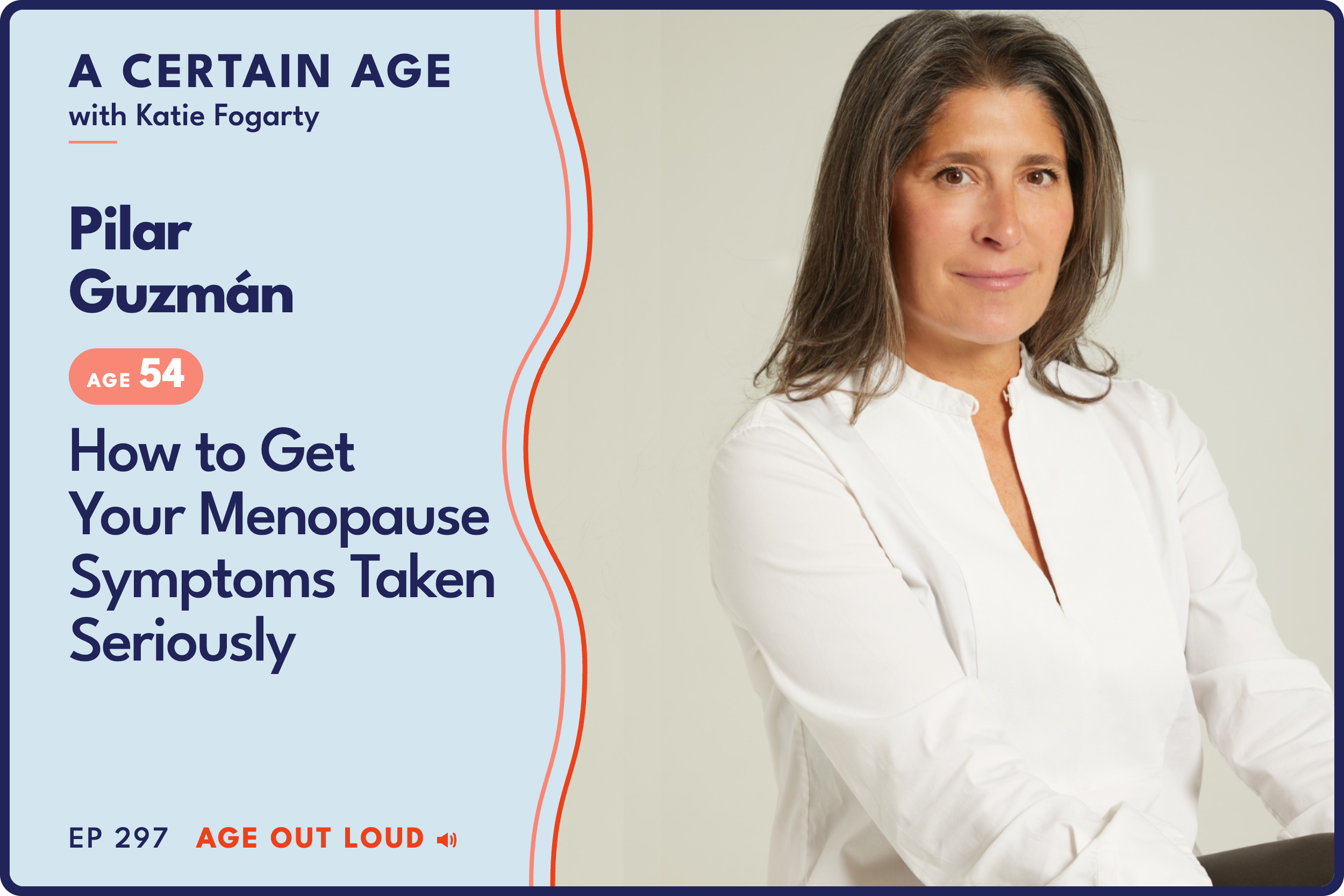
Tired of hearing “that’s normal” in the exam room while you feel like a stranger in your own body? Pilar Guzmán, editorial director of Oprah Daily and a three-time magazine editor-in-chief (Condé Nast Traveler, Martha Stewart Living, Cookie), has answers. Her new project with Oprah, The Book of Menopause, is a science-backed guide to perimenopause, menopause, and beyond.
In this episode:
How to walk into your doctor’s appointment armed with research and insight other women’s stories
Why the language we use for menopause shapes whether others take it seriously
Why skipping hot flashes doesn’t mean you skipped menopause
Why midlife anger can be a signal worth listening to, and how to stop following old rules about how you’re supposed to act
About Pilar Guzmán: Pilar Guzmán is the editorial director of Oprah Daily. She and her team launched “The Book of Menopause,” with an introduction by Oprah Winfrey. She is the former editor in chief of Condé Nast Traveler and Martha Stewart Living.
Show Links:
Follow Pilar:
The Book of Menopause: Real Talk, Real Science, Real Strategies for Your Next Chapter
Quotable:
We all have very tightly scripted narratives about who we are and who we want to be. They can be vice-like in their grip and in your ability to evolve. You’re usually the person who wears camel and gray and navy. And then one day you show up in a red dress, and people are like, ‘Oh, the red dress.’
Transcript:
Katie Fogarty (00:03)
Welcome to A Certain Age, a show for women who are unafraid to age out loud. I'm your host, Katie Fogarty. Beauties, if you've ever sat across from a doctor to share what's keeping you up at 3 a.m., heard the word "normal," and then thought, "Huh, normal? Then why do I feel like a stranger in my body?" Today's conversation is for you.
My guest is Pilar Guzmán, editorial director of Oprah Daily. She's also a three-time magazine editor-in-chief at places like Condé Nast Traveler, Martha Stewart Living, and the late, beloved parenting magazine Cookie. This October, alongside Oprah herself and her team, she's launching The Book of Menopause, a science-backed guide to perimenopause, menopause, and what comes after. We're talking self-advocacy in the exam room, the symptoms nobody connects to hormones, and what her team learned that isn't really explored in all the other menopause books on store shelves.
Welcome to A Certain Age, Pilar.
Pilar Guzmán (00:03)
Thanks so much for having me, Katie.
Katie Fogarty (00:03)
The Book of Menopause opens with a foreword from Oprah, and also with a very personal story: you ran into an old friend at a cocktail party on a cold winter night, and she was flushed and fanning herself in the middle of a hot flash. Her doctor had told her, "This stuff is normal," yet she felt like she'd aged a decade overnight. Tell me more about that moment, and why it prompted you to ask what kind of menopause experience we could all be having if we'd been listening to women all along.
Pilar Guzmán (01:33)
I've heard that so many times. Women say, "I feel like I've aged 10 years overnight." I feel like I'd have a dime for every time I've heard that at a dinner party or elsewhere. I think it really does feel that way. I think menopause can feel like an all-body, all-mind, all-spirit reset. In some ways, that can be very positive, but it can feel very tumultuous, as we know.
And I think what happens routinely is that women go to the doctor. They give their list of woes that they're not connecting to this phase of life, and they get told, "Oh, well, this is just aging." That crushes me every time I hear it. Every time I hear a woman blindly accept that and not feel like she has the authority to push back because the doctor said this is just normal, and this isn't just menopause. Of course, this is true of so many stages of life, which I think we will probably touch on. It's not just this one, but it happens to be a momentous one, because it comes at a time when women are already feeling like they're being sidelined anyway. So this kind of minimizing of symptoms, and minimizing of what's going on in her body, is perpetuated at every part of her life: professionally, and in the doctor's office, a place where she's supposed to feel safe. And then she's basically just told, "Yep, live with it. Yep—"
Katie Fogarty (03:05)
"Just live with it." That medical gaslighting is so real. The big blockbuster New York Times article several years ago about how women have been misled about menopause really puts a finger on that when it talks about our big cultural tolerance for women's suffering. But the good news is that this is changing. Women are not putting up with that. We are menopausing out loud and demanding better solutions, and we're seeing people rush in to help us.
There are a lot of wonderful menopause books on the market. I want to hear from you what sets this one apart, and how somebody of Oprah's stature and interest, and the wonderful editorial team that you have, created something that differs from the other books that are out there.
Pilar Guzmán (03:46)
For starters, I think we're standing on the shoulders of many great doctors and experts in this space. What we do as journalists is distill, highlight, message in clear ways, and cherry-pick from all of this great information that's out there. So I think what we do well is message in a way that lands, so that people can walk away with some clear learnings and also clear marching orders for when they go to the doctor and need to self-advocate. It is a distillation of the mind, body, and spirit relationships, all the ways in which this stage of life impacts women, all women. We are, in some ways, a clearinghouse for all of this, and a trusted place to start.
Katie Fogarty (04:34)
What did creating this book teach you? What did reporting on this topic, and on women's health more broadly over the many years you've been doing it, teach you about what effective self-advocacy looks like in the exam room?
Pilar Guzmán (04:46)
I think we all walk into an exam room, and many of us, I mean, we have sometimes women who don't have high blood pressure go into the exam room, and all of a sudden they have high blood pressure. It's just a stressful place to be, no matter what kind of relationship you have with your doctor. I just think the doctor's office is often nerve-wracking. And when you run the risk of not being believed, that just compounds the problem.
But if you have the masses of experts, and other women whose stories you've been hearing, whose symptoms are similar to yours, the support of the storytelling of other women, it's a kind of magical alchemy. It's like you go in with your girl gang. You come in from a position of strength when you know that there is all of this data and research and storytelling behind you. I think there's something really powerful about that combo.
Katie Fogarty (05:42)
Yeah, absolutely. I love the girl gang image because it's so true. I've interviewed so many doctors on the show who tell me that they deal with patients who've seen six, seven, eight, nine, 10 doctors before they wind up with somebody who's going to listen. And this ranges from things like female hair loss to pelvic floor disorder, depression, urology, painful sex, and the list goes on. It can be very hard to get to the right person.
Pilar Guzmán (06:09)
Yeah, I do think it's in some ways the fault of the system. Obviously, Western medicine is wonderful at specialization and the heroics. I think it's less good at treating the living, with our myriad aches and pains. We're learning a lot from other healing practices, and I think we've become much more open as a culture to looking at the whole person and the whole system, or the multiple systems within a given body. And that's the thing, in some ways, that menopause is highlighting.
We tend to focus on "bikini medicine" for women. We're not even looking at estrogen and progesterone, which, through podcasts like yours and publications like mine, and all the wonderful experts who have taught us, we've learned are important. We've learned why, when they go away, it's so disruptive. It's not just about fertility. And this is the big message that I think a lot of women are missing: this is not just about making babies. We have estrogen receptors on every single cell in our body, including our eyeballs. When these systems go, everything goes haywire. While I love that we are putting so much emphasis on menopause, I would love for this conversation to move more toward hormonal health at large, because it's not just about estrogen and progesterone. It's also about testosterone and lots of other things, and the impacts they have on our bones, our brains, our hearts, all of the things that you know.
Katie Fogarty (07:45)
How difficult was it to create the chapters of this book? Give us a landscape overview of what you decided to shape and prioritize in the content you covered. What can a reader expect?
Pilar Guzmán (07:56)
Menopause impacts every system in our body and all of our relationships. The organizing principle was just that: body, brain, relationships. There's a whole spiritual aspect as well. But it's not just that the hormones are leaving your body, which is the medical explanation. There is a whole life impact, and the symptoms are so dispersed, from mood shifts to frozen shoulder to ringing in your ear. All of these can be symptoms of menopause. And when people refer to "just hormones," I think, well, actually, hormones are everything.
Katie Fogarty (08:34)
We are our hormones. It's truly incredible.
Pilar Guzmán (08:37)
Exactly. And this was something Dr. Elizabeth Poynter, a wonderful physician who now practices concierge medicine but spent years treating some of the most complex issues in women's health, said: "Women's health is hormonal health. Full stop. That is what it is." It's not "oh, just hormones." So much of our thinking has to change through language. The way we language it actually has incredible impact on how seriously we take it. When we say "just hormones," we are minimizing it, and we're also giving other people permission to minimize it, including our doctors.
Katie Fogarty (09:16)
You can't just slap a patch on it and solve everything.
Pilar Guzmán (09:19)
Correct. And going back to the earlier question of how Oprah figures into this conversation: some 20-plus years ago, when she was going through menopause, she was actually very vocal about it, at a time when nobody else was. In fact, when she was still doing The Oprah Winfrey Show, she tried to get other celebrities to come on the show to talk about it, and nobody would. So, just to give you a sense of how much things have changed, thanks to some outspoken people of note, including Naomi Watts, Brooke Shields, Halle Berry, and now Drew Barrymore, they have incredible impact. It's like Me Too: somebody says something, and that emboldens the next person to share their story, and this is where you get the lifting of the cloak of shame that has dogged this phase of life for time immemorial. The power of naming a thing and not minimizing it has this domino effect.
Katie Fogarty (10:36)
I sometimes joke that I've done 293 shows, and menopause shows up in every one, because no matter what topic we're talking about, this impacts our relational health, our career, our energy, our sleep, everything.
When we come back: what surprised Pilar and her team the most while reporting this book? Make sure you stay with us.
[Ad break]
We're back with Pilar Guzmán. Pilar, what surprised you and Team Oprah the most once you started digging into this topic in real depth?
Pilar Guzmán (11:07)
I think it was the emotional aspect. Again, going back to this idea of saying it's "just hormones," the idea that psychospiritual health wasn't really taken totally seriously. I think there's still this artificial divide between the physical and the mental, or the physical and the psychological. What always shocks me is that it's not the first response when somebody is 50 years old and has a constellation of symptoms. These things tend to be treated so discretely and independently, rather than holistically.
Katie Fogarty (11:48)
Medicine is so siloed. It's kind of amazing, and I agree with you. There hasn't been as much conversation around the emotional and spiritual shifts, to use your word. I know that Oprah Daily and O, The Oprah Magazine, at different points, featured the writing of the wonderful menopause advocate and thinker, social justice and equity voice Omisade Burney-Scott. When she was on my show, she referred to menopause as a liminal space, a portal to moving into different phases of life. It was the first time I had heard somebody speak so optimistically about this transition, as a bridge to something beyond that was imbued with possibility and excitement, versus "Oh my god, it's a problem to solve." I think that conversation is shifting, but it's still not there, because women are catching up. A lot of women are still just trying to get basic information and access to resources, which is why these books are so important.
So when you looked at the spiritual or the social aspect of it, tell me what bubbled up for you in the book that you want a reader to know is there for them if they grab it. You are, in many ways, the best version of yourself in your 50s. Oprah says this all the time about Maya Angelou: your 50s are just the best, and it's very true. You know who you are. You know what jeans look good on you. You know what haircut works on you. You've figured all these things out, and what doesn't look good on you, right?
Pilar Guzmán (13:20)
Exactly. You know who you are, and you give fewer Fs than you ever did before. This is all true. Everyone I know feels that way, and then this hormonal flux comes in and bites you in the ass right when you're feeling you're at your peak. That's the rub, and I think it's really tough because these things are happening concurrently, and we have absolutely internalized this idea that this is a shameful period. I think it's only now, with this menopause revolution, that women are starting to feel okay about it. For so many years, it was this embarrassing thing. It was synonymous with your obsolescence. I'm sure you've, yeah, 100 percent, this is everything that you talk about on your show.
Katie Fogarty (14:07)
I know, but I think it's worth talking about again and again, honestly, because I have been in countless rooms of women where the conversation still needs to be lifted up. People need to know they're not alone. Everyone looks for information at the time they need it most. They didn't start six years ago; maybe they're starting today. They need to know they're not alone. It bears repeating over and over and over again, because it's Menudo, the boy band. You never age out of it, because they just keep replacing you, right? Women keep coming along who are like, "Hey, I'm one of the 6,000 on day one. Today's my day one. Help me." So I think it does bear repeating.
One of the great things about this book, first of all, I'm amazed. I've probably read a dozen books on menopause and perimenopause. I was so happy to see familiar names like Lauren Tettenbaum, who wrote Millennial Menopause, and Sharon Malone and Mary Claire Haver, people I've interviewed. But the reason this book still needs to be on a reader's list, even if you've read those other ones, is that you still learn something new in every book. I was surprised to learn things like that extreme stress can help cause early menopause. You have a wonderful personal story, not your own, but you spotlight a woman's personal story on that topic. There's a link between PCOS and cognitive dysfunction later in life that needs to be explored. These were new to me, despite having read some of these books.
Was there something you learned in creating this book that you're going to pull into your own life, that really shocked you, or maybe set you back on your heels a little bit?
Pilar Guzmán (15:37)
I think people tend to focus singularly on hot flashes and whether they have them or not. There's the myth that if I don't have hot flashes, then I'm not in menopause or haven't gone through it. I cannot tell you the number of well-educated people who should know better who say, "Yeah, I didn't really go through menopause because I didn't have hot flashes." Every time, I just fall off my chair, and I have to refrain and get off my soapbox, and I have to be really calm. What I really want to say is, "Are you effing kidding me?" But what I do say is that the bummer about not getting the hot flashes is that you don't realize the havoc it's wreaking on every other system in your body. That's the downside. The bummer of getting the hot flashes is getting the hot flashes, and the night sweats, and the disrupted sleep, and all that. You're very lucky if you don't have some of the visible symptoms. But what those visible symptoms belie is what's happening to your heart and bones. It's the canary in the coal mine.
Katie Fogarty (16:49)
Exactly. Honestly, the very first show I ever recorded, I had a dear friend of mine on, Dr. Anita Sadaty, and the headline I gave that show was "Is Toxic Rage the New Hot Flash?" Because I never had a hot flash, and I thought I'd skated through this menopause thing until, suddenly, drop-kick volcanic fury. And it was like, "Oh, okay."
Pilar Guzmán (17:09)
Yeah, that's not—
Katie Fogarty (17:11)
Normal. And Anita said, "Katie, that's mood instability." I was like, "Oh, this doesn't feel like mood instability. That sounds so genteel. This feels like volcanic fury." And to your point earlier about putting a name on it, I felt so relieved that it was something that could be named and that other people had it. It took me creating a— I had people DMing me, saying, "I had toxic fury too!" I'm like, we could start a band.
Pilar Guzmán (17:40)
Yeah.
Katie Fogarty (17:41)
But it subsided. Had I known that, I would have had a lot more peace during the time when I was really struggling, because nobody said, one, this is possible, and two, it's temporary. Once you're fully in menopause, yes, you've got to worry about your bones turning to dust, and yes, you need to worry about cardiac health and brain health, but a lot of the mood stuff calms down, which would have been good information to have.
Pilar Guzmán (18:06)
I mean, the flip side of that is, of course, when you are highly dysregulated and there's a good reason for it, at least that explains things, and that's wonderful. I think Mindy Pelz would argue that there's a certain level of righteous rage that women finally feel entitled to at this stage of life. Sometimes it's warranted, sometimes it's not. To your point, it can be temporary and episodic, and that's great.
Katie Fogarty (18:37)
Well, I'm all for my old-fashioned righteous rage. I have no problem with righteous rage, and I can conjure that up a lot. But when I felt a little out of control, it was like—
Pilar Guzmán (18:46)
Totally, yes. And there is a tipping point in some cases. I was worried when there were all those studies about the rise of gray divorce in midlife, and the culprit was menopause. There are certainly temporary disruptions that can wreak havoc on a relationship. But sometimes the loss of filters, which is essentially what the loss of estrogen is, because as women we are caretakers and pleasers, and a lot of that is fueled by our estrogen, reveals certain tolerances that we have lived with and maybe shouldn't.
Katie Fogarty (19:26)
The menopause era is the no-Fs era, as you've shared too.
Pilar Guzmán (19:29)
That's right. I guess what I'm saying is, let the anger be an invitation to inquiry, if it's not verging on absolute hostility.
Katie Fogarty (19:42)
Well, that's a beautiful invitation. That's a great way to put it: examine your feelings and ask why they're there, and if they can be addressed with a doctor, do it. And if they can be addressed by taking different steps and giving voice to things, that's also an appropriate way of managing it. I love that.
All right, let's switch gears. You've had a long career at many of the top magazine titles. You were at Cookie, Condé Nast Traveler, Martha Stewart Living. What's the thread that ties these together, and how does it show up in the work you're doing today?
Pilar Guzmán (20:15)
It's such an interesting question, one you can really only answer when you're looking in the rearview mirror, which at this age you do. I would say the thing I have always done is keep my ear to the ground and identify the pain points in the culture. Even with seemingly happy, smiley lifestyle publications like Martha Stewart Living, Martha had this promise of homekeeping, and she elevated domesticity in a way that was super appealing. But in some ways it didn't always feel attainable, especially to Gen Xers, who really were asked to make a choice between career and motherhood in many ways, and then we have families all of a sudden and don't know how to roast a chicken. So there was this disconnect between who we wanted to be and the skills that we had.
And with Cookie, there was an idealized version of motherhood perpetuated in the more traditional parenting titles. They did a wonderful job of that, but once again, for women who just didn't see themselves in these portrayals of motherhood, who felt like they had fallen short, that title really addressed the whole woman within the mother.
Katie Fogarty (21:42)
Pilar, Cookie was really built around a specific life stage: parenting. And now, with this book and the work you're doing at Oprah Daily, you're examining another big life stage. I'm curious what you see now that maybe you didn't see back then about how women move through these transitions, and what role, if any, your own aging process played in this new lens.
Pilar Guzmán (22:04)
I think our sweet spot really is midlife for women, women who have been taking care of children and managing households and holding down jobs. So many women get to this stage and they're like, "Wait a minute, what do I want? Who am I? What's my purpose?" So I think what we do is give her the scaffolding, the tools, the inspiration, the wherewithal, and then the kind of sisterhood. We sit at the intersection of journalism, storytelling, community, and advocacy, and there is a wonderful alchemy around that. Okay, we're all talking about this right now. Everywhere I go, women are having the same conversation: What is my purpose when I'm post-empty nest? How do I hold on to myself when I'm taking care of aging parents, and either teenagers or adult children? It just never ends. And the permission and the tools to take care of oneself is what this stage is all about.
Katie Fogarty (23:10)
I started this podcast to focus on women's health and midlife, and to really shine an age-positive spotlight on this phase of life, because I was just tired of my day-job clients telling me they didn't want anyone to know how old they were. I wanted to build a lot of excitement about midlife and aging. And now I'm in a phase where I'm like, "Gosh, it's really hard." I'm dealing with my parents and the midlife collision, the squeeze—
Pilar Guzmán (23:33)
The sandwich generation. Sandwich—
Katie Fogarty (23:35)
Generation. It barely even covers it. It's really more like a vise.
Pilar Guzmán (23:41)
Sandwich makes it sound delicious.
Katie Fogarty (23:42)
Exactly. I don't know what kind of sandwich you're eating, but I'm eating a shit sandwich over here. It is a lot, but...
Pilar Guzmán (23:51)
It's wonderful, too. I mean, I think that's the thing: it's all the things.
Katie Fogarty (23:55)
It is all the things. And I remind myself constantly, I'd rather be doing this than not. I'm in this season, and I'm just going to be here and be present in it, even if it's challenging. So, yeah. I have a lot of company.
Pilar Guzmán (24:07)
Absolutely.
Katie Fogarty (24:09)
Okay, Pilar, last question before I let you go, because this is a fun fact for our listeners. You and your husband, Chris Mitchell, who's also a magazine editor, have renovated 10 homes together, which is astonishing. I've done two, and boy, renovation is not for the faint of heart.
Pilar Guzmán (24:25)
It's not.
Katie Fogarty (24:28)
What has that process taught you about what's possible in terms of reimagining what is to create what's next, and how do you carry any of that over to how you think about women's health?
Pilar Guzmán (24:39)
What a great question. I would say that renovation is the one area of our lives where we don't fight, so it's a happy place. It's a happy creative canvas for both of us. What's interesting is that we moved 10 months ago, from our brownstone in Brooklyn, our home of 22 years, into an apartment after our younger son went off to college. I thought we were going to go out first in that house. It was the family home, and for a bunch of reasons, we decided we wanted to make a change. We wanted to move back into the city. There were a million reasons. I think what it tells you is that we all have very tightly scripted narratives about who we are, what we like, and who we want to be. They're very well crafted. Even if you are a really genuine, authentic person, and you don't think you get stuck in these storylines, they can be vise-like in their grip and in your ability to evolve.
Think about when you go to the office, and you're usually a person who wears camel and gray and navy, like me. And then one day you show up in a red dress, and people are like, "Oh, the red dress."
Katie Fogarty (26:04)
They're like, "What's going on?"
Pilar Guzmán (26:07)
Exactly. It's a little bit like that when you're embarrassed that you have stepped outside of your—
Katie Fogarty (26:14)
Your lane. Your thing. Your lane.
Pilar Guzmán (26:15)
Your comfort zone. It's a little bit like that. I think we have to get more comfortable with letting go of some of these stories that we tell ourselves about ourselves. I think that is the key to growth and evolution, which is everything that you know, everything that we're about, certainly at Oprah Daily. In my personal life, I'm always questioning: Okay, is this a story that I'm telling myself to be true, and it's familiar, and therefore it feels good? Is this good familiar or bad familiar? And can I be—? We all want to be yes and right. We all want to be able to be the person who mostly wears the camel and gray and navy, but occasionally throws on the red dress.
Katie Fogarty (27:00)
And that's okay, too. Absolutely. When you let go of that tight script, you reinvent. You open yourself up to possibility and change, and I think new friendships, new points of view, new perspectives, new hobbies and habits, and so much more. That spirit of possibility, we can use it in every area of our life. I love that answer. And 10 homes, wow, color me impressed.
Thank you for coming on today to talk about The Book of Menopause and for sharing the insights that led you to create it. It was such an enjoyable conversation, and I highly recommend adding this book to your cart. I think every bookshelf needs multiple perspectives on a topic this important. Thank you for being with me today.
Pilar Guzmán (27:40)
Thanks so much, Katie.
Katie Fogarty (27:42)
This wraps A Certain Age, a show for women who are aging without apology, for women who are reinventing and reimagining what it means to be in midlife, who are aging out loud and, as Pilar says, wearing the red dress when they choose. I loved Pilar's perspective on pushing yourself outside of your comfort zones, whether it's in career, creative projects, where you live, or how you show up in the world. Grab that fabulous red dress if the mood strikes. You don't have to be the same woman you were yesterday.
Thank you for sticking around to the end of the show, and as always, special thanks to Michael Mancini, who composed and produced our theme music. See you next time, and until then, age boldly, beauties.
