
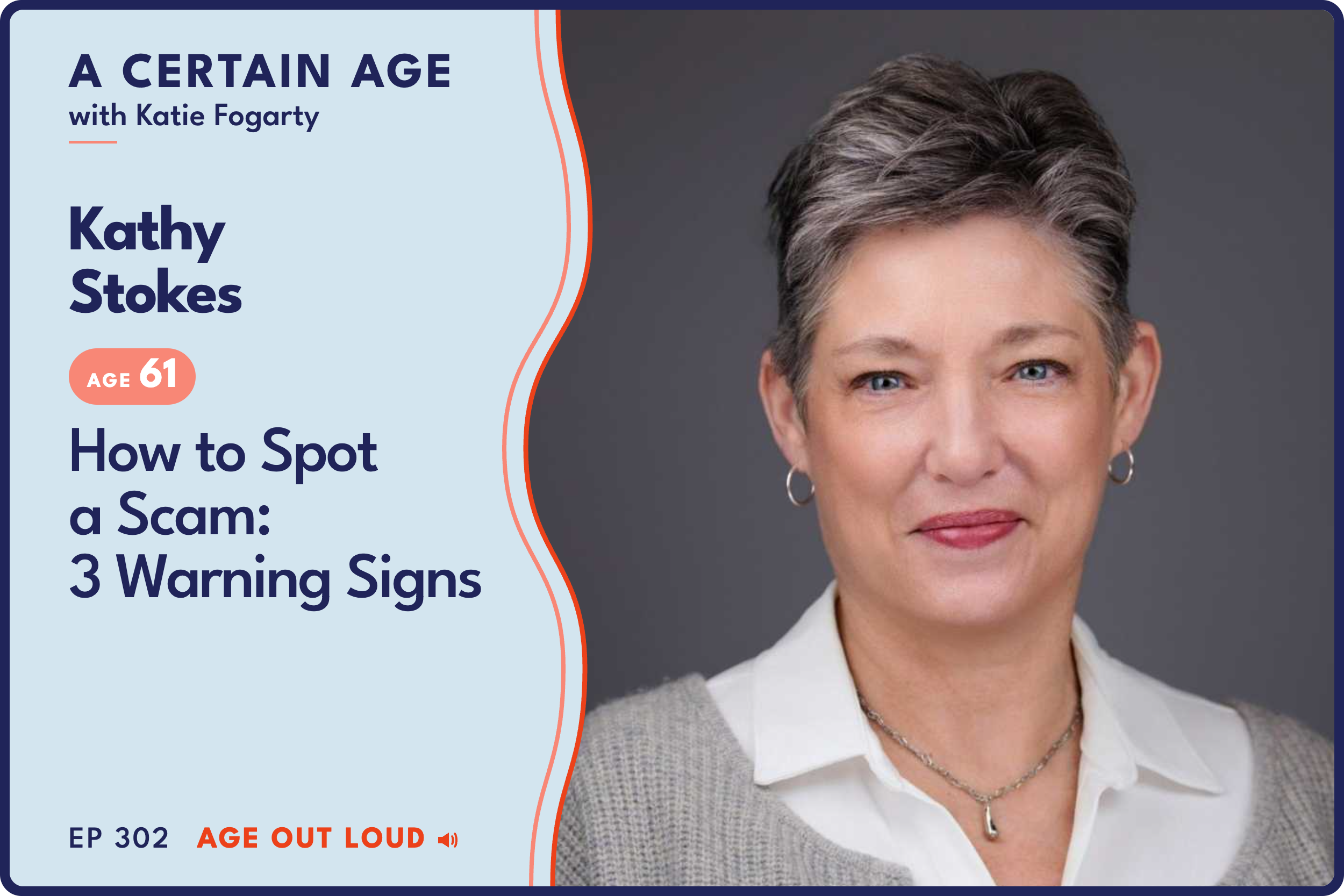
Show Snapshot:
Billions are stolen in scams every year, and scammers don't check your age, your degree, or how sharp you are. Anyone can be targeted. The playbook works because it hits when you're distracted, stressed, or rushed. Kathy Stokes, who leads fraud prevention programs at AARP and heads its Fraud Watch Network, shows you how to stay a step ahead. This topic is personal for Katie, whose mom lost a big chunk of her retirement savings to scammers.
In this episode:
The three warning signs nearly every scam shares
How AI has made fraud harder to spot than ever
Five protections to set up now, including a password manager and a credit freeze
What to do in the first 24 hours if the worst happens, and how to support someone you love who's been scammed without adding to the shame
About Kathy Stokes: Kathy Stokes is the Senior Director of Fraud Prevention Programs at AARP, where she leads the AARP Fraud Watch Network. She chairs the board of the National Elder Fraud Coordination Center and has testified before the U.S. Senate and House on scams targeting older adults.
Show Links:
Follow the AARP:
AARP's free Fraud Watch Network Helpline: 877-908-3360 | Mon-Fri, 8am-8pm ET
Listen to the Perfect Scam
AARP’s Fraud Wars
Quotable:
We, as a society, have tended to put the blame on the victim for experiencing the crime. We've allowed ourselves to believe that scams only happen to older people who aren't tech savvy, who may be experiencing cognitive decline, who may have trouble hanging up the phone because they're too nice. And honestly, those are tropes.
Transcript:
Katie Fogarty (00:03)
Welcome to A Certain Age, a show for women who are unafraid to age out loud. I'm your host, Katie Fogarty. Beauties, we all get them: the odd text, the call from a number we don't know, the email that says there's a problem with our bank account. Most of us hit delete and move on, but every once in a while, one lands at the wrong moment, and it feels real. We tend to picture the victims of financial scams as sweet elderly grandmothers who aren't tech-savvy. But that's not what the data shows. Yes, Americans 60 and older reported losing $7.7 billion to fraud last year, but $4.6 billion was lost by people in their 30s and 40s. That's billions with a B, beauties. And the FTC now estimates that as much as $261 billion left our economy to scams in 2025, once you count everyone who never reported. Here's the thing: scammers don't check your age, your degree, or how sharp you are. They just built an insanely effective scam.
Today's show hits close to home. My mother lost a significant amount of her retirement savings to scammers. I'm committed to helping you avoid the same pitfalls. My guest, Kathy Stokes, leads fraud prevention programs at AARP and heads its Fraud Watch Network. She's behind a simple framework that she calls the "stop, drop, and roll" for scams. Listen in to hear it. In this conversation, we get into the three triggers nearly every scam shares, how AI has catapulted fraud, her top five protections, and what to do in the first 24 hours if the worst happens. Kathy, welcome to A Certain Age.
Kathy Stokes (01:52)
Thanks, Katie. I'm so glad to be here.
Katie Fogarty (01:54)
Well, this is such an important topic, and truthfully, it's one I have not been talking about publicly. I only very recently started sharing that my mom fell victim to a financial scam. She lost a shocking amount of money, but I have been sharing that story privately, in small rooms and groups, for several years. And time and time again, I hear the same thing: women who've been targeted too. Kathy, just last month, a woman told me she lost $100,000 to a scammer while she was in a postpartum, new-mother haze in her 30s. There is no one-size-fits-all victim profile. So, let's start with some stage setting. Who is getting scammed? What does this look like in terms of dollars?
Kathy Stokes (02:35)
Unfortunately, I have to say, all of us are susceptible to fraud because of the playbook that the criminals have created and relied on and perfected over time. When older adults are the victims, the harms are much more profound. There's an emotional impact, but there's also the financial. And the financial, when it's an older adult, quite often is stealing everything. This isn't the way scams used to be. Now these criminals want to steal every possible dollar. When you're looking at an older adult who has retirement savings and housing wealth and maybe an insurance policy or something like that, that's where the greatest harm is.
Katie Fogarty (03:22)
Yeah, absolutely. As your runway for replacing your retirement income shortens, or perhaps has evaporated if you're fully into your retirement, you are so much more vulnerable. When my mother had this experience, when we learned that she'd been targeted and scammers took a large portion of her retirement savings, I did a lot of research. I was very surprised to learn that the FTC estimates real losses are near $200 billion once you count everyone who's never even reported. So, as a starting point, why do so few people come forward? Why is this an underreported crime?
Kathy Stokes (03:56)
Yeah, and the FTC just updated that number a couple of weeks ago in a report to Congress, where they're saying that as much as $261 billion left our economy in 2025 to scams. There are several reasons for underreporting or not reporting. I think the primary one is that we, as a society, have tended to put the blame on the victim for experiencing the crime. We've allowed ourselves to believe that scams only happen to older people who aren't tech-savvy, who may be experiencing cognitive decline, who may have trouble hanging up the phone because they're too nice. And honestly, Katie, those are tropes. Maybe that was the case before the internet age. I don't know, but certainly since the dawn of the internet and social media and smartphones, the attack surface, if you will, has grown exponentially. And because we've allowed ourselves to think it's a problem for one sector of society, we haven't really done anything about it for the last quarter century. All we've been saying is, "Well, we really need to educate consumers." And look where that's gotten us.
Katie Fogarty (05:13)
Yeah, well, we are here for this myth-busting. I agree. There's a very tired trope that this just happens to older people who are not tech-savvy. The woman I referenced at the top of the show shared with me that she got an email with a link. It looked like her bank. She clicked on it and fell into this Pandora's box of financial scam, predation, et cetera. And she was very, very savvy as well. So this is why we're having this conversation. We're going to explore how to identify a scam correctly and what some of your suggestions are to put protections in place for us.
But I do want to take one more minute to talk about the shame and the sense of why it's underreported. I know that AARP has a Words Matter campaign, where you take on some of the language that we use to talk about this. Language matters so much. We really need to arm ourselves with the right ways of talking about this, so we can move the needle on this conversation. How does language like "Oh, she fell for it" keep victims silent?
Kathy Stokes (06:11)
We're focusing on the wrong end of the crime. We should be focusing our anger and putting responsibility on the criminals, the perpetrators. When we say something like "she fell for it" or "she got duped," where's even the criminal in that discussion, right? We need to be thinking about it in terms of a criminal stealing this victim's money, not "she fell for it." It's so important that we embrace that, because it's not just words; it becomes a point of view. I know that in the last five years, I have been seeing a marked shift across businesses, across media, and even across consumers, to maybe a lesser degree, in understanding that it's not the fault of the victim.
Katie Fogarty (07:03)
This language reframe is so important. I will share that when my siblings and I became aware that my mom had been preyed upon by these financial predators, honestly, I felt an enormous sense of shame. I felt this enormous sense of shame that I had underestimated my mom's cognitive issues, that we had allowed her to become vulnerable, that we had allowed her to be taken advantage of in this way. I want to explore how you talk to families and what you share with victims a little bit further on in the show. But I want to start right now by talking about these scams. Let's identify how we can spot them. I know you found that most scams share three common triggers. I would love to hear what they are, and then the framework that you have that helps you identify and address each one of these triggers.
Kathy Stokes (07:54)
So, for years, AARP Fraud Watch Network, and really anyone out in the fraud and scams education space, we've led with, "Here are the 80 scams, and with each of them, here are the eight to 10 red flags you have to know." It's just overwhelming. And so...
Katie Fogarty (08:14)
Kathy, when you said 80, I was like, no one has time to learn 80 scams.
Kathy Stokes (08:20)
Exactly.
Even if you tell them 10, and there's 10 red flags for each, there's 100 things you have to remember. I mean, we're just putting so much on consumers for this. So, what we were trying to do is come up with much higher-level messaging. Do you remember when you were around second grade, Katie? I was about eight when I learned what to do in a fire.
Katie Fogarty (08:45)
Yeah, stop, drop, and roll.
Kathy Stokes (08:46)
Stop, drop, and roll. It comes right back.
Katie Fogarty (08:48)
I'm Gen X, Kathy. I totally know that.
Kathy Stokes (08:50)
See, me too. So, that "stop, drop, and roll" is something that we have been yearning for in this space. What we learned is that there is not a single trigger like fire. I mean, that's a mighty trigger, right? But we think that most scams, let's say 80% of the scams, come at us with three common elements: a contact from out of the blue, it puts you into a heightened emotional state, and it contains urgency. What we're trying to do in our education now is say, let's identify when these three things are coming at us, to recognize that it could be a scam and to take what we call an active pause: an intentional step back in that moment to think through what's happening and re-engage with the logic center of your brain, because the criminals get us right into action through emotion. The broader campaign we call Pause, Reflect, Protect. That's our "stop, drop, and roll."
Katie Fogarty (10:01)
Kathy, walk us through this three-part framework: pause, reflect, protect.
Kathy Stokes (10:07)
When we see these three elements, that should be our trigger: that call out of the blue that really freaks you out and contains urgency. We want people to pause, take an intentional step back, and reflect: think about what you might know about this scenario. For example, one of the common scams against older adults is the grandparent scam. It's 3 o'clock in the morning. You get a call from your grandson, Michael. That's the unexpected contact. He says, "Grandma, I'm in so much trouble. Please don't tell Mom and Dad. I've been in an accident. I'm out here in California, and I hit a pregnant woman, and she might die. And, oh my God, I really need your help. Can I put you on the phone with a lawyer?" It's freaking you out, right? Oh my God, I'm the only one who can protect and help him right now. How do I do that? And the "how do I do that" is, "We really need to get money to me right away," right?
So those three things are coming at you, and we want you to just take a step back and go, "Wait a minute. What do I know? Have I heard about this? Wait a minute, Michael was with us for dinner three nights ago, and we're in New England. He would have mentioned if he was going to California." You start to reconnect with logic, to be able to disengage and protect yourself and your assets.
Katie Fogarty (11:00)
We're heading into a quick break. When we come back, Kathy, I want to talk about the role of AI and technology, and how these moments of urgency feel so much more real today than they ever did before. We'll be back in just a minute.
[Ad break]
Katie Fogarty (11:00)
Kathy, we're back from the break. You were giving us this three-part framework. One part is an active pause, where we really need to sit, take a beat, and ask ourselves: Does this feel real? Is this realistic, given everything that I know to be going on and true logically? But AI has become more sophisticated than ever. Financial scams look real. I open up emails constantly where I have to double-check. It's harder and harder to distinguish what is real and true from what is fake. How do you think technology has really changed the scam game, and is it possible to protect ourselves from it?
Kathy Stokes (12:21)
Well, I've been referring to this era of generative artificial intelligence as the industrial revolution for fraud criminals. It has upped their game in terms of their ability to scale and to perfect. Just in the last three years, since we saw ChatGPT first coming out, look at the difference between then and now in terms of how AI is being used to create the perfect message that comes over by text or email and looks exactly like it's coming from your bank, complete with your bank's name, perfect English. The website that you go to looks exactly like the website you're expecting. They are even able to animate still images. I started seeing this, where they're able to have video conversations with their targets, and it's not a sentient being; it's a picture that they've been able to manipulate into looking like a walking, talking human being. It's really scary stuff.
It's gotten to a point where, and it's terrible to say, we cannot trust any form of incoming communication right now. We use our phone, our mobile phone, as intended, and we're at risk.
Katie Fogarty (13:37)
And so, what are some of the risk-mitigation levers that we can pull? If technology can work against us, it can work for us. What are some practical tools you would like to see listeners take advantage of to better protect themselves?
Kathy Stokes (13:53)
There are many things that each of us can do to shore up our defenses. My top one is passwords. We still see so much happening because criminals are able to easily break people's passwords. If you're using the same or a similar password for your kid's ballet class and also for logging in to your financial advisory firm, that's risk. I think a password manager is really the way to go. There are a lot of different ones out there. Some are free, some are cheap. I tell people to go to PCMag online, pcmag.com, because they do really great reviews, and you can see what the pros and the cons are of the various ones. They can create the impossible-to-crack password, store it for you in an encrypted vault, and then fill everything out for you when you go to the sites that you have the passwords for. So that's a really important one.
The immediate follow-up to that is multi-factor authentication, which I think we're all pretty familiar with now because so many more sites are requiring it. You have to have a third piece of information, aside from your username and password, to validate that it's you trying to access your account. That can come from a text message or a phone call, or from an authentication app that you have on your phone. It's just that one extra layer of protection.
Then, I was talking about how we can't really trust our phones. We can't trust text messages or emails that come to it, or live calls. With Apple iOS, I know that you can silence calls. If you don't have that, or you want a heavier set of layers of protection, there are a bunch of scam and spam call and text filters out there that can really help as well.
I mentioned operating systems. We need to keep those up to date. Make it happen as a matter of course. Don't have to think about it; when an update comes, have your phone set to automatically accept it, because increasingly those updates are to patch vulnerabilities that these companies are catching on to.
And I think the final thing is credit freezing. Combined with knowing what's on your credit report, it's really important in the event somebody does have information on you that they would then try to use to open accounts in your name.
Katie Fogarty (16:26)
Yeah, this is all such smart advice. I love the passwords and the two-factor authentication. I'm doing that everywhere because I really want to avoid opening myself up to vulnerability. I also want to share something with my listeners that I have shared with other women in my life. After we learned that my mom had $350,000 taken from her retirement savings, which is a massive amount of money that is really going to reshape the way her retirement looks, here is what I wish I had known to do at the time, and what my siblings wish they had known to do as well.
You can set up something with your bank that's almost like two-factor authentication with another human. We could say, "What is the largest amount of money I ever want to be able to withdraw from my own account without having somebody else be a backstop? What is the largest amount of money I'd ever want to be wired without somebody else saying yes to that?" You could partner with your spouse, with a parent, with a best friend, a cousin. There are different steps that you can take with your financial institutions to protect yourself. I want every listener, when they're done, to Google what your own bank offers in terms of financial protection.
So, Kathy, let's talk about the credit freeze. What does that look like?
Kathy Stokes (17:38)
So, we all have credit reports that are put together by the three main credit agencies: that's TransUnion, Equifax, and, I almost always forget that last one, Experian. These three companies keep information on our creditworthiness. If the report that they have on you isn't frozen by you, then there could be a risk that if somebody gets personal, sensitive information, they could use that to open up an account in your name, which would get added to your credit report, and you may not even see it if you're not following your credit reports.
It's not the easiest thing in the world to do, but trust me, it's worth the effort. You do have to go to each of those companies: Experian.com, TransUnion.com, Equifax.com. Once you get there, you have to look for the free credit freeze offering. This is something that Congress enabled many years ago. You can freeze it so nobody, including yourself, has access to your credit report, and then you can unfreeze it when you have to, if you're taking out a loan or something like that.
Katie Fogarty (18:48)
One of the best things about getting to midlife is learning that we can do hard things, and we can get ourselves over onto these three different websites and make sure we do this, because it's worth the time and effort.
So, for somebody who has been preyed upon by a financial predator, who has had this crime committed against them, what is your first line of response to the individual? Or if somebody's listening to this, thinking, "This happened to my mother, this happened to my dad, as a family we're struggling with this," what are some recommendations for navigating that moment?
Kathy Stokes (19:19)
So, we have a resource we call Words Matter. There's a consumer site at aarp.org/saythis, as in "say this, not that," and that's a really good place to start to catch on to the idea of what we're trying to say: to focus on the crime and the criminal, and not the person who the money was stolen from.
It's really important, when something like this happens to somebody in your circle, to really, really pause and reflect yourself on how you want to respond. Our knee-jerk reaction, for a bunch of different reasons, is to go, "Mom, why did you answer the phone? I told you never to answer the phone," or, "How could you fall for that?" That's the last thing anybody in this situation needs. We need to go into it with a trauma-informed response, understanding that not only is there a major financial blow quite often, but there's also a very big emotional impact that comes with it. So it's more about coming to them and saying, "I'm so sorry this happened to you. I've been hearing about this as well. Come on, let's work together. Let's figure out what we need to do in the short term, and then move on." Just make sure that you're not doing that knee-jerk reaction, because that causes so much undue pain.
Katie Fogarty (20:47)
You said the short term. What are we doing in the first 24 hours if we learn something has gone awry? If we can no longer get into our account, if money has disappeared out of it, if our credit report shows us that somebody's accessed our Social Security number or opened up a credit card in our name, what are we doing immediately that's effective?
Kathy Stokes (21:09)
What we try to help people think about is: try to stop the bleeding. If you realize something was fraudulent, and it was pretty quickly after it happened, there's a chance that your financial institution might be able to claw back the funds. So we say, call the financial institution right away to see if there's anything they can do to help you on that front.
A lot of times, the scam involves getting somebody to believe they can pay for some urgent obligation using a gift card. It's important to realize that you can flip that card over, call the number on the back, and say, "I just realized I bought this as part of a scam. Can you freeze what's on it?" Quite often they can, or part of it, anyway. So there are a couple of little things you can do there.
But I think most importantly, everybody needs to be reporting to law enforcement. It's not an easy thing to do right now. We do not have a universal understanding across the country, in state and local law enforcement, that this is a crime, that you were manipulated into giving information or money to somebody. So the reaction quite often is inappropriate. We need to understand that. For example, a victim goes to the desk at the police precinct and says, "I've just been scammed and I've lost everything. What do I do?" And the person, not knowledgeable, maybe not even law enforcement, may say, "Well, you gave away your money. What do you want us to do about it?" which is just horrible. If you do run into that, ask to speak to a detective in financial crimes, and hope that they have a financial crimes detective. Insist on the report.
I have heard anecdotally that a police report can be helpful in certain situations. For example, if you have incredible home insurance or mortgage insurance, it might be covered. Probably not, but you have that as proof. And I know there's a lot of burgeoning demand to really focus on getting money back to the victim. So there may be restitution at some point, and you want that police report to be able to prove what happened to you and be eligible for some of the money to get returned to you.
Katie Fogarty (23:39)
So, can you give us some landscape perspective on what's being done by financial institutions or the government to help make sure that the $260 billion that you referenced earlier doesn't continue to grow and grow and grow?
Kathy Stokes (23:57)
I don't have a lot of great news on that front, other than to say a lot more attention is being paid to the issue than even just a couple of years ago. I have either attended or, in some cases, provided testimony to a congressional committee where, several years ago, they would be talking old numbers and making assumptions that the only people this is affecting are people with cognitive decline or who are aged. Now we're hearing members of Congress use these figures, like what came out of the Federal Trade Commission. They're calling this a national security threat, which it absolutely is. This past Congress, there have been more than two dozen bills specifically trying to address the fraud problem, and they're all completely bipartisan. So that gives me a little bit of hope.
I think we are also seeing, with this current administration, an executive order that is requiring relevant agencies to basically be doing more than they're doing now, so I think that we may see some positive progress there. What I worry about is the quick solution. There is no silver bullet. There's so much we need to do. But sometimes you'll get a bill that says, "We're going to create a one-stop-shop website for people to report." Well, okay, that's just another place to report. And if it's not requiring action by law enforcement, there's no use in doing that, other than everybody's going to go to the same place and not get any justice.
Katie Fogarty (25:42)
Or we won't have preventative measures taken. Reporting is important, but preventing is even more important. And I love what you said about this not being a partisan issue. This is a purple issue. It affects everybody equally. There is enormous economic impact, there is personal impact, and we want to make sure that we are paying attention to it. So, fill us in on how we can get smarter about this with AARP. What are some of the offerings that you have to both help us prevent this, mitigate it, and then recover from it if this is something that impacts our lives?
Kathy Stokes (26:19)
On the prevention-through-education front, we do have a lot of resources. We have a website, aarp.org/fraudwatchnetwork. When you're there, you can sign up for what we call Watchdog Alerts, which come out biweekly. It's a very simple message, by email or text, that takes a single scam and breaks it down very clearly. We tell people to go ahead and sign up for those. When you get that every other Wednesday, let that be a trigger for you, a reminder that this is something you now know or know better, and should share, because we really need to be having a national conversation about this. We have state offices all around the country. We train volunteer fraud fighters to go out into communities, so you can keep an eye out for opportunities like that.
On the other side of the equation, we have a helpline. Quite often, the people who call are calling because they themselves realize they're a victim, or it's someone calling on behalf of a victim. We also get a lot of calls saying, "Hey, I just got this letter that looks exactly like it's from Publishers Clearing House, saying I've just won a million dollars and a car. Can you help me understand if this is real or not?" I love when people call and ask those kinds of questions, because you do see people stopping and thinking and trying to validate something.
We piloted, and now have, a permanent fraud victim support program as well. We do small-group conversations with fraud victims and a trained facilitator, typically a volunteer, sometimes a staffer here at AARP. We want people to know two things coming out of that, however long they stay, however short they stay: you're not alone, and it isn't your fault. Those are the two things that most people immediately put on themselves. "Oh my God, I can't believe I fell for this. How could I be so stupid? I can't imagine anybody else would have fallen for something like this." All this negative self-blame.
You could go to one of these sessions, or you can start going to the regular one at 2 o'clock on Wednesdays, where you get to know other victims and you're sharing your stories. In some cases, we see people regaining their own sense of self-confidence and agency, and then they want to get involved. They want to volunteer, or they want to tell their story, because the stories can be so impactful. So we get them in front of congressional staff, or in front of conferences, or in front of the media, to be part of the solution.
Katie Fogarty (29:01)
Yeah, to put a human face on the impact of these astonishingly large numbers and to tell their story of how it changed their lives. I think it's so, so powerful. Storytelling and communication and community, honestly, and conversation is how we affect any kind of change. It's so wonderful and heartening to hear that you're offering this. Kathy, I'm going to put the URL that you just shared into the show notes. Anyone who's listening to this can find that over at acertainagepod.com. Can you share the helpline number as well, live? I will also put that in the show notes.
Kathy Stokes (29:34)
Absolutely: 877-908-3360. We get about 100,000 calls every year, and we have about 160 trained volunteers who are taking those calls. You're actually going to talk to a human.
Katie Fogarty (29:52)
That's so powerful.
Kathy Stokes (29:54)
Yeah, yeah, and we're getting more and more calls from younger people. Sometimes from people in Canada. We only really cover America, but people are becoming more aware of it. The other thing I meant to say is we have a podcast ourselves called The Perfect Scam, and that is a really good look into a specific scam type with a victim, with law enforcement, with other people that are experts in this field, and we take it from the perspective of what happened to the victim. It's all about victim impact. And finally, on that front, we have something on AARP's YouTube channel called Fraud Wars, not "frog," "fraud," F-R-A-U-D Wars, and it's two seasons of a series of first-person victim accounts of what happened.
Katie Fogarty (30:47)
The more information we have, the smarter we can get as consumers, and the more likely we can protect ourselves and our loved ones, our aging parents, because that's all on the menu. That's what we're focused on. When you said you receive 100,000 calls on that helpline annually, I just thought, that's 100,000 stories of people who potentially are suffering or worried or have been impacted. So for everyone who's listening today who does not want to be one of those 100,000 people that call you this year, what is one habit that you wish every woman listening would adopt today to help tackle this head-on?
Kathy Stokes (31:24)
The passwords. If you can do one thing right now that's very protective, it's to adopt a password manager into your life. Also, I just want to ask people to look at this through the lens of the crime that it is, and get angry. Get angry that we hold all the responsibility as consumers to protect ourselves. That's just not working. It never has, and we need action from state, local, and federal government. We want to hold industry across the scam attack chain to account, to stop these scams from getting to us so easily to begin with.
Katie Fogarty (32:12)
And to pull our financial institutions in as well. I love this notion, because if they can market to us and win us as consumers, they can also take steps to help protect us. And if they can win our vote at the ballot box, they can understand that this is something of great urgency to us all. So we are going to get smarter. We're going to get on your website. We're going to get those passwords in order, and we are going to get loud about the fact that we need solutions to this very real-world problem. Kathy, thank you so much for being with me today to explore this really important topic. I am so appreciative and grateful for your time today.
Kathy Stokes (32:46)
Thank you so much for pointing your virtual lens on this. It's just so important to be talking about. Thank you.
Katie Fogarty (32:55)
Kathy Stokes gave us a "stop, drop, and roll" for scams. If a contact comes out of the blue, makes your heart race, and demands you act right now, that's your signal: pause, reflect, protect. And take one easy action today: set up a password manager or freeze your credit. It's free.
If you or someone you love needs help, AARP's free helpline is 877-908-3360. It's open Monday through Friday, 8 a.m. to 8 p.m. Eastern. You'll reach a real human. And for scam alerts and more, head to aarp.org/fraudwatchnetwork. Be sure to check out the AARP podcast, The Perfect Scam, and the video series Fraud Wars, both great places to hear real stories. All the links are over in the show notes at acertainagepod.com.
Thank you so much for joining me today. If you learned something or got value, please let me know in a podcast review. Reviews help other women find the show. Special thanks to Michael Mancini, who composed and produced our theme music. See you next time, and until then, age boldly, beauties.
