
Menopause, Marrakesh, and the Courage to Choose Yourself: Rewilding Your Life With Jane Green
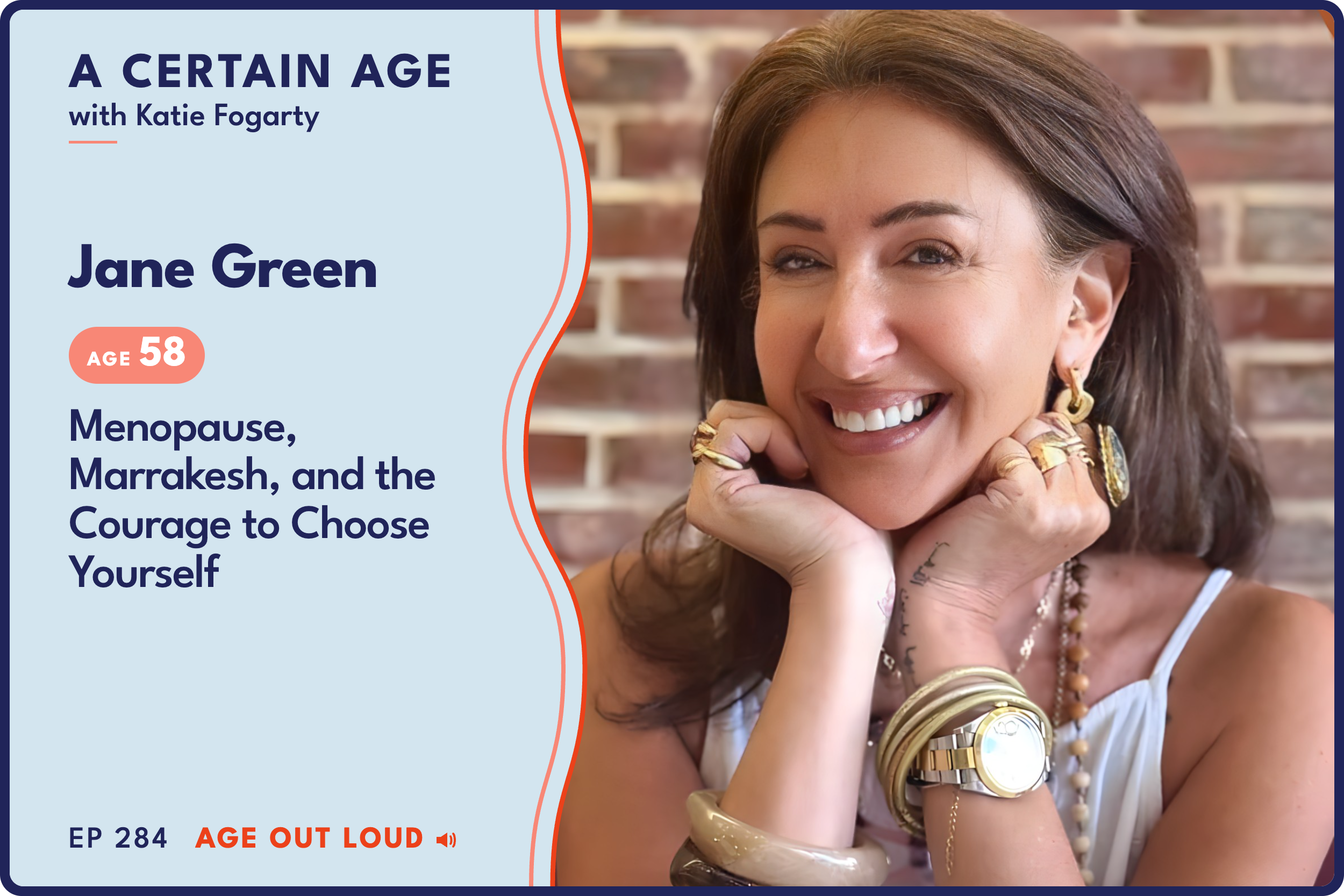
Show Snapshot:
Bestselling novelist Jane Green had a life that looked complete from the outside — a long marriage, a full career, all the boxes checked. Then, at 55, she packed her bags for Marrakesh and started over. Her memoir Rewilding is the story of what cracked her open, and this conversation goes deep in her immersive memoir.
In this episode:
How menopause cracked open Jane's entire worldview
Why psilocybin succeeded where years of talk therapy didn't
What somatic therapy taught her about trusting her own body
Her blunt take on which friendships deserve your energy — and which don't
About Jane Green: Jane Green is a bestselling novelist with 18 New York Times bestsellers and over 10 million books in print, and author of the memoir “Rewilding,” a return guest chronicling her move to Marrakesh and reinvention at 55.
Show Links:
Follow Jane:
Janes’s Latest Book:
Rewilding: Freedom, Friendship, and Finding Our Way Home
More Jane on A Certain Age:
This is Jane’s second appearance. Find her first episode here:
Author Jane Green Has 18 NYT Bestsellers. Now, She Has A New Act.
Quotable:
“Every person that leaves you who was wrong leaves a space for a right person to come in.”
Transcript:
Katie Fogarty(0:03)
Welcome to A Certain Age, a show for women who are unafraid to age out loud. I'm your host, Katie Fogarty. Beauties, today's show has everything: an incredible storyteller, audacious plot twists, a move to Marrakesh, saying yes to main character energy, the beauty of female friendships, the beauty of building a life that is fully your own, and so much more. We are also exploring big questions — questions like, what if the most radical thing you can do isn't to reinvent yourself, but to go back to the woman you left behind? So many of us hit a point where the life we built no longer fits. The kids leave, the career loses steam, the marriage cools. You wake up, and the life you so carefully created and curated starts to feel like a costume, a skin you're desperate to shed. Today, we're sitting down with Jane Green, who returns to the show to crack open the pages of her electric new book, Rewilding. Jane is a best-selling novelist. She first came on A Certain Age to talk about her novel, Sister Stardust. She has written 18 New York Times bestsellers. She is a storyteller, a truth teller, and she is here today to dive into her memoir, Rewilding, a story about walking away from a life that looks good on paper — a successful career, a beautiful home, a full family — but a life she had to shrink herself to fit into. At 55, she stepped out of that picture-perfect life to reclaim her own story. I cannot wait to dive into all of this with her today. Welcome back to A Certain Age, Jane.
Jane Green(1:42)
Thank you. So nice to be here.
Katie Fogarty(1:44)
Jane, I absolutely adored this book, and I did something that I don't usually do — I did a mix of print and audiobook, and I found listening to the story in your own voice absolutely mesmerizing. You describe at one point your 50th birthday as the moment you looked in the mirror and didn't recognize yourself. What did you see, and what came next?
Jane Green(2:05)
You know, it was the morning of my 50th birthday. I was throwing this wonderful party that night in the garden, and I remember walking into the bathroom with this echo of 50, 50, 50 in my head, and I looked at my reflection in the mirror, and I just thought, I have no idea who you are. And it was almost as if this little voice came to me that said, who would you be if you stopped caring what anyone thought? And I think that was the beginning of the whole journey. Fifty felt so seismic for me — it felt like the halfway point, although I'm sure it's past the halfway point — but I just had this dawning realization that I'd spent all these years as a people pleaser, as someone who didn't really feel she fitted in, but I was such a great chameleon, I could make myself fit in everywhere. And in taking on all these roles and these constructs, and creating this kind of persona as a best-selling author, I had lost myself entirely. I had no idea who I was if I wasn't stepping into a construct or a role. I had no idea who the real me was, and I think that was the beginning of my almost unconscious quest to find out.
Katie Fogarty(3:22)
You've titled your book Rewilding. You open with a bit of a definition — rewilding comes from ecology, it's a return to a natural state. What does it mean for you to rewild, and why did that word resonate with you more than, say, reinvention or transformation?
Jane Green(3:40)
Well, I have this theory that so many of us are these brave, fearless, strong little girls, and often it starts to change at puberty. Sometimes it's beforehand — many people grow up in very difficult homes, and we learn to tiptoe on eggshells and people-please very early. But even if we haven't, it really starts at puberty, when we suddenly start to mold ourselves into shapes in order for boys to like us. And so it goes throughout our lives — we are constantly stepping into roles of how we want to be seen, because I think so many of us carry this secret shame that we're not really good enough, and we're terrified that anyone around us will see through all these carefully constructed personas to the thing that we are most terrified of, which is what we believe to be true of ourselves: that we're not quite enough. And so we create these roles of who we want to be seen as — an employee, a colleague, a wife, a mother, a partner, a friend — and we also learn to squeeze ourselves into shapes that don't fit in order to keep a peaceful household and be palatable and be accepted. And what rewilding really is, at a stage of life, and it's all connected to menopause, and we can talk more about that, but if and when it all comes crashing down, and there is a seismic shift in menopause, which we're not fully prepared for, we actually have this opportunity to rediscover that brave, fearless little girl, and to tap back into somebody who wasn't scared of the world, and who wasn't scared of not being enough, and really find out who we actually are. Remember who we actually are, and then move through life with discernment and boundaries and acceptance and joy.
Katie Fogarty(5:36)
Yeah, the book is such a beautiful exploration of all these themes. So much fun to read — it was so much fun to engage with in terms of oral storytelling, too. I absolutely found it transportive; it was terrific. And you use the phrase "not quite enough" several times, when you felt that way. But again, on paper, you were a very successful author. You had co-blended your family, and you share in the book that you went through many years of happiness at different stages in your marriage, but also many years of struggle and pain. You use the word persona as well, and in the book you say that women leave marriages not because of a midlife crisis, which is what pop culture tells us, but in response, really, to years of feeling unseen and unvalued. So you had these good-on-paper roles — what do you wish, within your own marriage, that your husband had understood about what was quietly eroding you?
Jane Green(6:30)
Well, I think there are two separate issues here, right? I think there is an awful lot that I chose not to write about, because I was with my husband for 18 years, I loved him deeply, and I had no wish to air all of our dirty laundry out in public. But there were many things that had become completely untenable, and alongside that, there was also the fact that I felt very much that we were living something of a lie. I know what our life looked like — people presumed that we were enormously wealthy, that my career was wonderful, and that we were rolling in money and had this beautiful life. And actually, that wasn't the case at all. I was the sole provider and the sole breadwinner, and my career had changed, and I was scrambling, and I used to go to sleep every night with the albatross of financial fear around my neck. And I think, ultimately, resentment is so corrosive, and I think we each were carrying our own resentments against the other, and we had no way to communicate. But I don't think this is uncommon, and I think this is the part that menopause plays — I think that what enables us to sweep everything under the carpet, to say yes when we mean no, and to let all of those small things slide in order to keep a happy home, raise our kids, and create a peaceful environment, these all come crashing down at menopause. Because whilst we think we're prepared for menopause, and we know about things like hot flashes and night sweats and irritability, we are wholly unprepared for the seismic neurological reorganization that happens in menopause. And actually, when the estrogen goes, so does our ability to tolerate, our ability to sweep things under the carpet, and our ability to say yes instead of no. And suddenly all of the things that were once tolerable become intolerable, and we are wholly unprepared, as are our husbands. I think we go through this wondering what on earth has happened to our life, hoping that one day we will wake up and everything will be fine, and our husbands don't understand — how can they possibly understand it when we don't understand ourselves? And I wish that there were more education for women about what to expect, and not just for women, but for their partners, because I think it's just this earthquake that we go through, and we have no idea how to navigate it. Now, alongside that, there may be other very real issues, as there were in my marriage, and ultimately I think it became very clear that we were on very different paths. So I have no regrets, but it was painful. And I think that even when you go through it, you don't have to pack a couple of suitcases and move to Marrakesh, as I did, to run away — you don't have to do that in order to rewild yourself. But if you are staying within the marriage, you do have to bring your husband into the conversation, and you both have to educate yourselves on not just what menopause does, but also how to hear each other. And it's a story I'm hearing over and over — I'm out on the road, I'm touring in the UK, I'm going to be touring in the US in October, and I'm getting messages from women every day who are saying, I feel this, I feel lost, I feel untethered, I am so unhappy, and thank you for giving a voice to this. But the truth is they're so tired of not being heard, and I think that's really common, which makes me incredibly sad. We try and explain as best we can, as much as we understand what's going on, and very often we are dismissed, and that's how the resentment starts.
Katie Fogarty(10:22)
And menopause is, to your point, like a systems-grade nuclear meltdown. What you said — when estrogen exits the building, your ability to tolerate the intolerable just disappears, poof, overnight. I've talked about this on the show; the very first podcast I ever recorded was Toxic Rage: The New Hot Flash, because I was having bouts of episodic fury with my husband about what was going on in our lives. And I've written about this myself in an essay I contributed to, an essay collection on midlife called Midlife Private Parts, where women talk about saying the quiet parts out loud. And the quiet part out loud was me shouting at my husband in my driveway, "I want a divorce," because we had reached a tipping point of things we weren't dealing with during Covid. Also, Jane, when you talked about the role Covid played as this pressure cooker, where the lid finally came off the pot — I think a lot of women felt that. My story ends differently, and we're not here to talk about me. I had a lot of hard, uncomfortable conversations with my husband, we put the work in, we made some changes, and we were able to right the ship. But I agree with you that when you're going through this complete transformation, this hormonal restructuring in your body, and how it impacts your mind and your mood, and how that intersects with what's happening in your life, it can be quite dramatic. So you have a very beautiful part of the story where you and your husband, after the divorce, sit down and spend several hours finally communicating so honestly about what happened, sobbing and lamenting, and just experiencing the grief of the dissolution. So you were able to talk to your husband. But I want to broaden it a little bit now, because there are moments in the story where people in your life — either strangers on the internet who follow you because you're a famous writer on Instagram, or close friends in your personal life — could not understand this transition for you, and either shared unkind comments or very harsh judgments. What do you wish more people, generally, beyond your husband, knew about this moment in time and what a lot of women struggle with?
Jane Green(12:28)
So, before I answer that, I want to go back, because there's another piece to this that they missed, which is everything we just talked about — that you were able to right the ship — but actually, every relationship is a dance that two people do, right? So we're bringing all of our own childhoods and our wounds, and whatever it is that we experienced in our families of origin, to our marriages, and this is a huge part of what happens in menopause — when all these constructs crumble in this neurological rewiring, we're left with all of those wounds. And whether that's growing up in a family where you didn't feel valued, you didn't feel loved, we always recreate that in our marriages. So actually, there's also a massive psychological part, and really, what it requires more than anything else, perhaps, is us doing the work on ourselves and healing those wounds. And it's only when you start to love and value yourself, and heal everything that you have unconsciously brought to the table in your marriage — it's very easy to blame other people, to blame your husband — but actually, the key to healing, and the key to finding happiness and peace again, is to look at your own part, to look at your own childhood, and to do the very real work. And I think it's very confronting for other people, which is what you talked about earlier. I woke up to a message one morning from somebody I considered a friend — we'd been friends for 20 years — and she wrote to me and said, "I'm so sorry that you blew your life up for a midlife crisis." And I was absolutely furious, and I wrote back to her and said, "How dare you." Nobody knows the true story of a marriage, nobody knows what goes on behind closed doors. But actually, when I had time to think about it, this woman has herself been in a really unhappy marriage — in fact, I would go so far as to say I think she mostly hates her husband. And I think watching a woman make the very brave choice of leaving — because no woman leaves in her 50s for a life on her own unless she absolutely has no other choice — is really confronting for people, and I think women are often the most judgmental of all when it comes to other women. So I think a little bit more compassion, I suppose, and just really the recognition that none of us — none of us — knows the true story of a marriage.
Katie Fogarty(15:04)
I guess your leaving maybe put up a mirror to her that she didn't want to see in her own life.
Jane Green(15:08)
Which is why it was so confronting. Yeah.
Katie Fogarty(15:11)
And people are very quick to — in a very small example, like at different points, when I chose to send my kids to different schools, or my husband and I chose to move out of our town and live someplace else — it feels confronting to people, because you're making a choice that's different from theirs. And people who are very confident and emotionally mature are either excited or curious or just intrigued — maybe it's a choice they wouldn't make, but they want to know more. And then people who are angry about it, I feel that they tend to be more emotionally immature, and they're not able to — it makes them feel bad about their own choices, so they resent that.
Jane Green(15:46)
Yeah, that is so true. And actually, one of the great themes of the book is friendship and discernment, and actually the great theme of my life has been friendship. I have had some of the greatest joy of my life from friendship, and also some of the greatest pain, and in learning the art of discernment, I have learned that there is nothing more glorious than friendships with secure women, and there is nothing more toxic and dangerous than friendships with insecure women. And actually, I think so many of us go through life wanting to be chosen — whether it's by men, or by the right mom friends, or the right friends, whoever it is, we want to be chosen. And actually, when you stop needing to be chosen, and you start to choose, and really be very selective about who you allow in, you end up with a much smaller life, but you end up with a life where you only have the right people and good people around you. And this woman is not a happy woman, and perhaps she's jealous, perhaps she's insecure — I don't know. But either way, had I met her today, she would not have been somebody I would have chosen as a friend.
Katie Fogarty(16:55)
Your book is so much about learning to choose yourself. We're heading into a quick break, but when we come back, I want to explore the theme of friendship, which is important in my own life, and I also want to explore the notion of putting the work in.
Jane, we're back from the break. Before it, we talked about friendship, which we're going to get to in a minute, but I want to talk about all the work you put in to be able to shift yourself, to choose yourself, to push back against the notion that you were not quite good enough. You do this through a variety of ways — you move to Marrakesh and give yourself a new physical space to blossom and create a new life, but you also do active therapy: you do talk therapy, traditional talk therapy, you did psilocybin therapy as well, and then you do somatic therapy. But let's start with psilocybin therapy, because that was the first modality you introduced us to in the book as you started to put in the work to change your inner life. What do you want women who are skeptical, or scared, or maybe just unfamiliar with plant medicine, to understand about your experience?
Jane Green(18:03)
So, really, in the last couple of years of my marriage, I was in a very, very deep depression. I was diagnosed with clinical depression when I was 21, so this is something I've lived with for a long time, but it's never been like this — it's always been quite low grade, and I've always been able to manage it. I could not manage this, and somebody suggested that I try psilocybin, the active compound in magic mushrooms, but in a ritualistic way. And actually, it has been scientifically proven, over and over, since the late 60s, when a Harvard professor, Timothy Leary, was doing experiments at Harvard about this — but it really does change the neurological wiring of your brain. And actually, when you're in a depression, the neural pathways shut down, so you keep following the same lines, the same dark lines, and psilocybin actually lights up those paths to happiness again. So I did start by doing three journeys with psilocybin, which definitely helped enormously. It didn't fix everything, but I had been feeling like I was quietly dying — I felt like I was swimming underwater and couldn't reach the air, couldn't get to the light, and psilocybin allowed me to breathe. So that was really the first step, and it was huge; it was really transformative for me. Then I started with talk therapy, but I didn't find that helpful. Having been in and out of talk therapy for many years, I had a really clear intellectual understanding of all of it — I know exactly why I'm the way I am, where it comes from, I just didn't know how to change it — and that was when I decided to go into somatic therapy. So I ended up doing two years of intensive somatic therapy, based on the premise of the Bessel van der Kolk book, The Body Keeps the Score — that everything that's ever happened to us, every hard thing, every good thing, is all stored in our body, and actually until we can locate those feelings of grief and pain and fear and diminishment, whatever it is, in our bodies, and embrace them, using breath work and breathing to actually embrace them, knowing that feeling those feelings is not going to kill us, we're going to hold on to them forever. We have to learn to embrace them, because otherwise they're always going to hold us back. And I did find that I was able to release so much through somatic therapy. I also thought—
Katie Fogarty(20:43)
That was a very riveting section of the book, because you were walking us through your experience with your therapist — you were experiencing a certain emotional thought, and she's asking you, where was the body sensation, where is it showing up? And as I was reading that, I was, in a moment of sort of stressful time, in the car coming back from a stressful experience, and I could feel that my stress was in my jaw, and it was interesting to think about this idea of just trying to breathe and release that. And to your point, about creating these neural pathways where you can find new ways of linking thoughts to action in your body — I just thought it was really fascinating. What did this particular modality unlock for you?
Jane Green(21:24)
I think it unlocked freedom, because I think I'd spent my whole life running away from difficult feelings. I couldn't stand to feel anything uncomfortable, and so I would distract myself in any way I could — with work, at certain points with drugs, alcohol, with dating apps, with food. I would just try and use whatever I could to numb myself and not feel those feelings. I was so frightened of feeling them, and what somatic therapy and my therapist taught me was that there was nothing to be frightened of — they weren't going to kill me if I let them in and felt them. I was still going to be alive at the end of it. And so I found it enormously liberating. I just ended up realizing there was nothing to be frightened of.
Katie Fogarty(22:16)
It's so powerful — it really made me so curious. I love this section of the book, and I need to do a little bit more exploring about that modality on my own. I would say another big lever you use to move from where you were — where you felt like you were suffering and trapped in a phase of life where you didn't recognize yourself — and to where you reopened your life, was moving to Marrakesh. Marrakesh shows up like a character in the story, and I was again off Googling travel itineraries — I really, Jane, I want you to write a city guide for visitors, because I was like, how am I going to remember all of these restaurants and hikes and walks that she's talking about in the book. The book is so evocative, you really feel like you're immersed in that. I would love to hear, as a starting point — I think our listeners know from hearing you that you are English, you spent many years living in America, on the East Coast. What does Marrakesh give you that London and New York don't?
Jane Green(23:14)
Well, I think it was a couple of things. When I was researching Sister Stardust, which was set in Marrakesh in the 60s, I spent a lot of time there, but at a time in my life when I felt that I was quietly dying in suburbia, in Connecticut, the only place that made me feel completely alive was Marrakesh, because you can't really help but feel anything other than completely alive in Marrakesh. It is so vibrant, and it's also deeply spiritual — there are seven saints buried in the walls of the city of Marrakesh, and it feels like a deeply spiritual place for me, which is ironic, because I wasn't aware that I needed a spiritual awakening. It wasn't what I was looking for, but I think I really had one in Marrakesh. There was also something about Moroccans being incredibly open-hearted, and I needed to be in a place where I didn't feel any pressure to be anyone. I didn't need to be a best-selling author, I didn't need to be a not-very-wealthy housewife, I didn't need to fulfill anybody else's expectations. I felt a calling — I don't know how else to describe it, it was a calling. I knew that Marrakesh was absolutely the only place I was supposed to be, in order to do the real soul searching and growing and healing that I needed to do, and really, at its core, learning to value and love myself.
Katie Fogarty(24:48)
Can you give us a small snapshot of what your daily life is like there? As I said, the book is so evocative — you're so immersed in the sights, the sounds, the colors, the spices of that city when you're reading it. But for our listeners who haven't yet spent time with Rewilding — when you wake up, what does the rest of your day look like?
Jane Green(25:06)
Well, it's very different now. The first two years I was there, I actually lived in the Medina, so it was bonkers — I was in the soup, surrounded by people and noise and tourists, and because I was still running, for the first few months I didn't yet understand that I had to quiet down and do all the soul searching and the work. I said yes to every invitation, I spent night after night dancing on rooftops till three in the morning. But now — we're going on over two and a half years now — I have a little villa in the country, with a little pool and a little walled garden, and tortoises keep showing up, so I have a couple of tortoises, the last one's called Dino. I've got four cats — well, I've got five cats now, I'm only supposed to have two, but I rescued them in the Medina, I couldn't help myself. But I really have a peaceful, magical life there. Interestingly, I definitely feel a calling back to London now as well — I feel that I'm supposed to be in London much more, but I will always have something in Marrakesh. Actually, I'm now holding retreats in Marrakesh — rewilding retreats and writing retreats — so my goal is to build a farmhouse retreat center there, and I'm always going to have a base there. But I think I've also really let go of the need for permanence. I've really embraced the impermanence of life, whereas for years I wanted everything to be forever — when we moved into a house that I loved, I wanted it to be the forever house, when I found a new friend, I wanted her to be the forever best friend. I thought everything was going to be forever, and I've really become comfortable with the notion that sometimes things are supposed to be for a period of time, and that's okay. It's really learning to grow comfortable in the discomfort of not knowing what the future holds.
Katie Fogarty(27:02)
Friendships — those that work, those that don't — are another narrative thread that runs throughout the book. And you wrote this book over several years. What did writing this book, excavating your life, moving through these chapters that were somewhat painful in recent years, teach you about the role of female friendships in your life?
Jane Green(27:22)
I think I really learned the importance of showing up, and the notion that love is a verb. We often describe people as being our best friends, but we're not actually putting in the regular work of nurturing those friendships, and actually, the grass is greener where you water it. When I moved to Marrakesh, I started putting daily time into my oldest, closest friends, who had been in a different time zone — they're all in England, and I was busy in America, raising kids and working, and I'd always say these are my best friends, but I didn't really speak to them very much. Now I speak to those three every single morning — every morning starts with a call or a video call — and I have really put the work in, and it has been glorious. I have forced my best friends to become my true best friends again. But I've also seen huge changes in friendships — so many of the people that I considered friends, not my closest friends but friends, have dropped away, and maybe that's on me, I have left Connecticut, I haven't been great at staying in touch with many people. There are a couple that are very important to me, and I'm very in touch with them. I was really surprised at people unfollowing me on Instagram — people who I considered friends, but they were really friendly acquaintances, often in the book world, fellow authors, book influencers, people I'd known for 20 years that I'd always felt I'd had a good relationship with. And I was astonished to realize, oh my goodness, they've unfollowed me. But I think, again, one of the other things I've had to learn is being comfortable with being disliked or dismissed. I'm not for everyone. I had to become really comfortable with being disliked, and I was the consummate people pleaser — I wanted to be loved by everyone, that was also part of the persona, she was always sparkling and charming and trying to make everyone love her. And actually, I don't need everyone to love me now. So the people who have stopped following me, vaya con Dios, do your thing — I've actually really fully embraced that if I'm not for you, that has nothing to do with me. I mean, it might have something to do with me, but it doesn't really. I'm not for everyone, and it's fine.
Katie Fogarty(29:45)
I've had a wonderful guest on the show twice, Cindy Spiegel, who talks about this notion — I think she even has a T-shirt that says "I'm not for everyone." She truly understands herself, and she doesn't want to be for everyone, because if you're for everyone, then you're not for yourself.
Jane Green(30:00)
That's exactly right, because you're constantly striving to be liked and to be loved, and so you're not being authentic. And as soon as you start being authentic — yep, of course — people are going to drop away, because you're suddenly not the woman they thought you were.
Katie Fogarty(30:16)
You are somebody who's been very visible throughout your life — you've written numerous best-selling books, you've had a three-decade career as a very visible author, you're a columnist at the Daily Mail — so people probably have a parasocial relationship with you, too, where they feel like they know you.
Jane Green(30:32)
Yeah, I think that's very true.
Katie Fogarty(30:34)
Talk to me about that a little bit, because you've used the word persona a couple of times in our conversation, and you talk about persona in the book too — Marrakesh gave you a place where you could drop that persona and feel most like yourself. But I'm curious to know what role, if any, your aging played in integrating all these different parts of you, because I've thought about this a lot — it comes up with different guests on the show. I had a wonderful writer, Laura Cathcart Robbins, who wrote a book about her sobriety, and she said being sober allowed her to finally integrate herself. She said she felt the architecture of her addiction was her unwillingness to let people know her.
Jane Green(31:13)
Yeah, well, and that's all shame — which many people believe is the root of all addiction at its core, but it all comes down to shame. And when we don't feel good enough, that's when we're trying to be someone we're not for other people. It's why we turn to substances that aren't good for us — it is all about hiding, that's one of the key things, really. If you are brave enough — and I'm not sure, I think it's much harder to be brave enough to do this when you're younger, but this is the glory of menopause — you stop actually caring. And if you are brave enough to step up and talk about all the things you feel shame about, and all the vulnerabilities, that's when those people will drop away, the wrong friends will disappear, you're not who they thought you were. But it's also what that does — every person who leaves you who was wrong leaves a space for a right person to come in.
Katie Fogarty(32:08)
So beautiful, I love that. When—
Jane Green(32:11)
You are intentional about your life, when you are discerning, when you are very clear about the kind of people that you will allow in your life, and the ways in which they will show up — you start to see, and it's not even seeing, it's actually about feeling. And I think that was the real shift with somatic therapy, sinking down from my overthinking mind into my body — it also unexpectedly allowed me to completely trust my intuition in a way that I had never done before. We all have it, I think — women are all born with this extraordinary gift, this magical superpower of our intuition, but we allow our heads to override it. We don't trust it, but we always know when we meet someone, when we feel a bit off, and then we get seduced into a friendship, or whatever it is, and it always goes wrong, and we always say, we knew, we knew the first time we met them. Somatic therapy taught me to trust how my body feels, and I now trust it every time, with every person, in every situation. I don't think about it — I sink down into my body, and I feel how my body feels, and it has never shown me wrong.
Katie Fogarty(33:36)
Readers are going to adore this book, because there are so many wonderful moments. You talk about intuition, and Jane, you also call yourself a little bit witchy in the book, because you conjure up Harry Styles.
Jane Green(33:46)
I did. There's just—
Katie Fogarty(33:48)
So many marvelous snippets, anecdotes, moments in this book — it's such a pleasure to read, Jane. I want to ask you one last question before our time wraps. In the book you say rewilding is not a destination. For a woman who is hearing this conversation, reading your book for the first time, and is beginning to have that quiet inner knowing that something has to change — how does she begin?
Jane Green(34:12)
So, I do have the steps in the book, and it really starts with keeping the focus on you. It's very easy, especially when we're in marriages and we're unhappy, to keep our gaze outwards and blame the other person, but that means you're a victim in your own life, and no healing and growth can come from being a victim. So rather than blaming anybody else for where you are and how you're feeling, it's about putting your gaze very firmly on yourself, looking at your childhood, understanding how you ended up where you ended up, and then putting in the work to actually heal yourself. There are some wonderful inner-child guided meditations there. A coach that I adore — she's actually a relationship coach called Gillian Terecki, she also has a podcast called Gillian on Love — she taught me so much about how to value myself and what not to put up with, and has informed so many of the choices I've made in my life, not just in dating, although she does a lot of work in the dating world, but in every relationship. Read the self-help books, go off on the retreats, spend time on yourself, but really put the work in to remembering who you were as a little girl, both the good and the bad — and when I say bad, I mean the painful — and do the work to heal the painful. And that's when you get the opportunity to have a life that is truly filled with unparalleled joy.
Katie Fogarty(35:49)
What a beautiful note to end on. Jane, thank you so much for being with me today to dive into this book. It's receiving so many gorgeous reviews — this one caught my eye: "Jane Green's most compelling heroine yet is herself." I loved getting to know you better through the process of reading this book, and in this conversation. Thank you so much for your time today.
Jane Green(36:07)
Katie, it's been a delight. Thank you.
Katie Fogarty(36:10)
This wraps A Certain Age, a show for women who are aging without apology. I adored hanging out with Jane today. I loved this book — it is so evocative and immersive, it's thought-provoking. I listened to a large chunk of it, and Jane's voice is such a treat to have in your ear. If you are looking for a book for a summer road trip, a book to hang out on the beach with, I cannot recommend Rewilding enough. If you enjoyed this conversation, if you think your friends are going to enjoy this book, please share this with the women in your life. This conversation truly was such a treat. Thanks for sticking around to the end of the show. And, as always, special thanks to Michael Mancini, who composed and produced our theme music. See you next time. And until then — age boldly, beauties.