
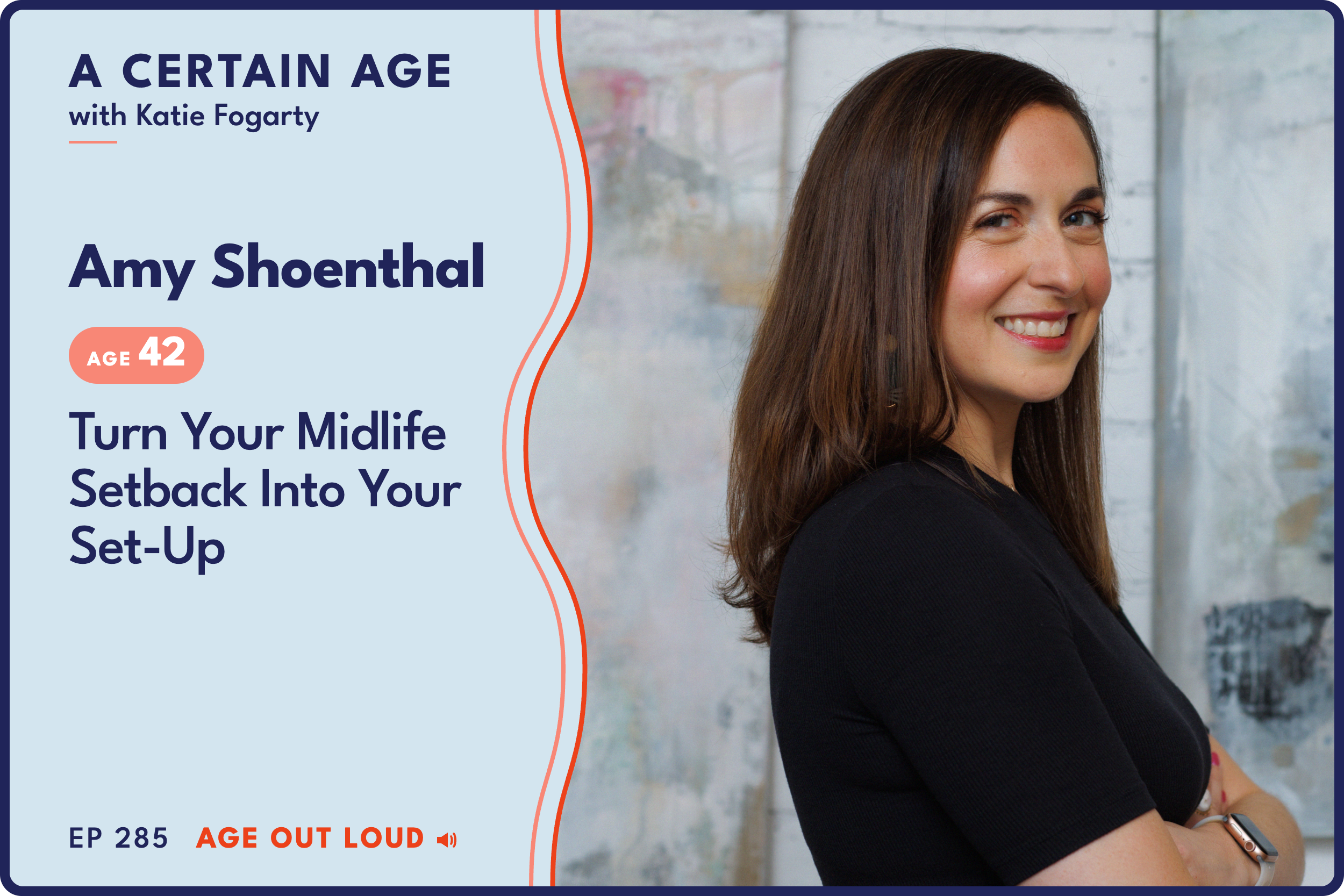
Turn Your Midlife Setback Into Your Set-Up with Amy Shoenthal
Show Snapshot:
You know the feeling: midlife hands you a hard reset? Forget "stay positive." That advice is everywhere and it's basically useless when you're staring down a layoff, a divorce, or a diagnosis you didn't see coming. Journalist Amy Shoenthal got curious about what truly separates women who bounce back from those who stay stuck, and turned years of research into a real, usable framework.
In this episode:
The Setback Cycle: a science-backed roadmap for recovering from layoffs, divorce, and diagnoses
How Amy turned her own layoff into a thriving coaching business
Why "AI anxiety" is the new midlife career stressor — and how to think through it
The mindset shift that turns a setback into your next chapter
About Amy Shoenthal: Amy Shoenthal is a USA Today bestselling author of “The Setback Cycle” who has worked with teams at Google, LinkedIn, and Meta to guide them through challenges and strategic decision-making. Her viral TEDx talk has helped hundreds of thousands of people turn self-doubt into reinvention.
Show Links:
Follow Amy:
Amy’s Book:
The Setback Cycle: How Defining Moments Can Move Us Forward
Quotable:
“Think about building a strong foundation as you're going through the setback cycle... if the foundation is secure, and one little brick falls loose, you'll more easily be able to replace that brick, versus one brick falls loose on a shaky foundation, and the whole house comes crumbling down."
Transcript:
Amy Shoenthal0:00
Women are always holding up all the walls around them, and they are holding up a heavy wall that is just like trying to fall down, but you feel like you're holding it up with all your strength. But what happens if you let the wall fall down? The whole room opens up.
Katie Fogarty0:18
Welcome to A Certain Age, a show for women who are unafraid to age out loud. I'm your host, Katie Fogarty. Beauties: midlife is a series of ongoing reinventions. We get a handle on menopause, we get a handle on our protein intake, and suddenly along comes AI. Over half of American workers are anxious about what it means for their jobs and their next chapter. We are juggling existential dread and still trying to navigate life's bread-and-butter setbacks — trains that go off the tracks, job loss, divorce, maybe a weird or a truly worrisome diagnosis, maybe a reinvention you absolutely did not see coming. As you peer around the corner and into the future, I want to introduce you to an excellent guide: a journalist, author, and creative thinker who is going to set your head on straight about how to work through life's inevitable setbacks and emerge smarter, stronger, even gloriously recalibrated. As the USA Today bestselling author of The Setback Cycle, Amy Shoenthal works with leaders and teams at places like Google, LinkedIn, and Meta to help them triumph over setbacks, work through challenges, spark innovation, and stay mentally resilient. She has a viral TEDx talk that has helped hundreds of thousands of people turn setbacks into strategic advantage. Whether you've been blindsided, are stuck right now, or just want a framework for what's coming up next — stick around, we have a show for you. Welcome to A Certain Age, Amy.
Amy Shoenthal1:51
Thank you so much for having me. What a great intro.
Katie Fogarty1:54
Well, I am really excited about this one. I had the pleasure of attending one of your From Setback to Set Up salons recently in person. I've, of course, spent time with your wonderful book. I got to hear you speak several months ago at a women's leadership event in DC, so I know my listeners are in for a treat. We are going to cover so much today — your career, your work, your book, The Setback Cycle, and also those new offerings I mentioned, the in-person salons — but I want to start with some stage setting. Let's define "setback." How is a setback different from, say, a challenge, an obstacle, or a mistake, and why does this distinction matter?
Amy Shoenthal2:34
It's so funny, because when I was writing this book, I came to the idea of the Setback Cycle because I had interviewed so many leaders for my Forbes column, and I noticed there was this cycle they went through. I wasn't even calling it a cycle at the time, but I noticed there was this very common formula that I kept seeing over and over, and I kept trying to articulate what it was. It wasn't just an obstacle they had to overcome, it wasn't just a disappointment or a trauma — it was truly that they had been bumped backwards, they had to regroup and find a new way forward. Then I came across the definition of a setback, which is quite literally a reversal in progress. So it's like you're moving forward on a path, you're working towards a very specific goal, and then for one reason or another you're bumped backwards, and now the original path you were on no longer exists. You are forced to either find another path or create a whole new route, and that's where creativity, innovation, and resilience are born. Once I came across the definition of a setback, I was like, that's it — that's the cycle they're going through. And I didn't really find any literature on it, so...
Katie Fogarty3:53
You created it — which I love. That's a common theme of the show: women seeing white space and stepping in with either a business, a brand idea, or a book, and a way of moving forward. And I know for this book you mentioned you interviewed hundreds and hundreds of leaders for your Forbes column. I was very excited, reading this book, to see several A Certain Age podcast guests featured — you have Stacy London, Susan McPherson, Cate Luzio of Luminary, and others. These are all fabulous women, they've all been fabulous podcast guests, all high achievers. What surprised you the most about how successful people — in both your book and your column — move through setbacks?
Amy Shoenthal4:31
Well, I don't know if it surprised me, especially as I continued this research and came to understand why our physiological and biological instinct is to shy away from action when we're faced with a setback. But what I noticed about these women, whose stories I included in the book, was that they had been bumped backwards so many times before that they had overcome the whole shying-away-from-action part of reinvention, and they had built up the strength to know that when they are bumped backwards, they can find a new way forward. And the common denominator with the women you just named is that they all found this reinvention in midlife. I don't know if I'm skipping ahead to a question you have later on, but I think midlife is a really pinnacle moment where a lot of people find that reinvention, and it's only because at that point we've been through so much, and we've had the experience of being bumped backwards before. So when we're faced with it, we recognize it, and we have the confidence to rebuild and move forward. It's not to say it's pleasant, but I think that's why you're seeing a lot of these stories pop up in the 45-to-65 age range.
Katie Fogarty5:59
Yeah, you don't get to the north side of 40 without going through hard things, and without becoming a setback pro in so many ways.
Katie Fogarty6:05
I interviewed the wonderful New York Times bestselling author Jen Hatmaker on the podcast, and she said, "If you haven't had a setback or a challenge by 40, just keep going, because it's coming."
Katie Fogarty6:16
So let's talk about the Setback Cycle. You identified a four-phase framework that you're now calling the Setback Cycle, which is such a wonderful name: Establish, Embrace, Explore, Emerge. I want to hear your quick definitions of them, and also why it's a cycle — like, why you don't just move through it once and then you're finished.
Amy Shoenthal6:35
As I was building it out and workshopping it with the people I interviewed — neuroscientists, psychologists, executive coaches, people who could really weigh in on this because they worked with people going through it — the most interesting thing I found was that we had to build a whole phase around establishing that you're in a setback, because, going back to what we were saying before, not everyone recognizes the setback when they're faced with it. It is truly that bump backwards, and you can't start working your way through the cycle without acknowledging the moment you're in. You could equate that with the not-quite-cliché-but-very-common idea of "name it to tame it" — you have to acknowledge where you are in order to deal with it. The Establish phase is actually one of the most important, because so many of us don't even realize we're in a setback as it's happening, and many of us can sleepwalk through them for years. Think of someone who's maybe in a relationship that's not necessarily serving them, but they're just trying to make it work, trying to make it work — or someone who's in a job where they're just coasting and not really advancing, and it's not really doing much for them. Inaction is a decision, and a lot of people stay in those setbacks for years. So there's a whole phase called Establish for a reason: you do have to do a little bit of work in case you think you might be in a setback, and I have a whole list of exercises to help you determine if that's what's happening right now.
Katie Fogarty8:11
So, acknowledging the setback is step one — recognizing that you're in it — and what you said about people staying stuck and inaction being a decision really rings true. I'm thinking of people in my own life who've been in a job they've hated for ten years. So, moving forward requires embracing the second phase. Talk to us about Embrace, Explore, and Emerge, and what each one is, in a top-line fashion.
Amy Shoenthal8:38
Okay, so after you establish that you're in a setback, you have to go into phase two, which is Embrace — and I don't mean give your setback a warm hug and welcome it in, like...
Katie Fogarty8:51
That sounds hard.
Amy Shoenthal8:52
Yeah, it's not really realistic to be able to do that. I mean, if someone can, that's great — please contact me, because I'd love to interview you about it. But I think Embrace is more about the fact that the only way out is through, and you have to really sit with the discomfort. You have to understand what happened, why you were set backwards — whether it was societal, personal, individual, or team-related. A layoff is obviously a very common setback, and you have to evaluate and reflect on why that happened, whether you could have done anything differently, whether it was beyond your control — because that's how we learn, that's how we figure out that you can't just go forward and repeat the same mistakes. The whole point of working through the Setback Cycle is to prepare yourself for future setbacks and arm yourself with the tools that will prevent you from making similar mistakes and finding yourself in the cycle over and over again. So, really embracing and sitting with it and reflecting on your experience so that you can take those learnings into your next phase, which is the third phase of the Setback Cycle: Explore. Explore is almost like a reward for having worked through Embrace, because Embrace sucks — it's the worst phase — and Explore is really fun, because that's when you get to say, okay, I worked through the reflection part of it, and now it's time to take some action, but not necessarily commit to anything. I think the in-between phase is the most fun, because you're testing things out, you're turning to your community, you're sharing certain ideas. I think at the beginning of this interview you mentioned the salons — I'm hosting these From Setback to Set Up salons, and this was just an idea I had because I wanted to bring the Setback Cycle framework to people outside of just the companies that hired me to do workshops with their teams, or to coach their individual employees or leaders. I wanted to bring this to a conversational level, where I could bring in people from all different industries. So this is me exploring — it's not that I came out of a setback to do this, but I think we could all perpetually remain in the Explore phase just to test things out. For me, these salons were just a fun thing I wanted to do, and yeah, maybe they'll lead to more business, maybe they'll lead to new connections with people I admire or want to work with down the line — and that's all happening, but it's low stakes. We're just testing things out, and if they didn't work, I would just go back to speaking at companies and coaching individuals. But they are working — after I hosted the first one, I had requests for five more, and this month, when we're recording this, I've hosted five new From Setback to Set Up salons, and now I have companies interested in sponsoring them and hosting them at their organizations. I'm going to host one at an exercise studio. It's exploding, and that's just because I went out and tested an idea, turned to my community, and listened to the feedback. I'm making it better and better, and that's why I love the Explore phase so much — you do things, you share ideas, you see what works, you lean into what works, and you abandon what doesn't, but you keep the learnings fresh.
Katie Fogarty12:13
Yeah, you don't have to know how something's going to end to get started, and this is such a perfect example — you created one salon, you got positive feedback, and it led to new opportunities, and who knows, it could grow into new businesses. I think for many of us, we sometimes feel like we need to know the end goal in order to take action, and it's so not true. When you put yourself in motion, it's the magic of compounding action that produces all sorts of wonderful new opportunities and opens new doors.
Amy Shoenthal12:42
That's so smart. And what you just said about not knowing the end — that's a really great way for people to navigate uncertainty. So many people, in whatever field they work in, are navigating economic uncertainty or the disruption of their role in the workforce because of AI, and I think that's right — we don't have to know the end, we just have to know what we're doing on the journey to figuring out what's next.
Katie Fogarty13:10
Amy, we're heading into a quick break. When we come back, I want to talk about the fourth and final phase, Emerge, and then talk a little more about navigating uncertainty and dealing with some of the emotional fallout that happens along these different phases — maybe recrimination, self-blame, or even fear. We'll be back in just a minute. Amy, when we headed into the break, you had given us an overview of the first three phases: Establish, Embrace, Explore. Let's talk about Emerge — when you move through the liminal space and get into the fourth phase of the cycle, what can we expect during this stage?
Amy Shoenthal13:46
Well, Emerge is funny, because you think of it as this phoenix moment where you rise from the ashes of your setback and step gloriously into your next chapter, knowing exactly what's going to happen and finding nothing but success, praise, and reward. But we live in the real world, and that's not quite how it works.
Katie Fogarty14:08
We're realists. I mean, getting to midlife teaches you many, many lessons, and one of them is: you've got to be a realist.
Amy Shoenthal14:15
Totally. And I always equate the Emerge phase to New Year's Day — think of times when you've made a New Year's resolution, and you've thought about it in December: "Oh, I'm going to drink more water in the New Year," "I'm going to only eat vegetables," whatever your big proclamation is. You're confident, you know this is your New Year's resolution, and you are absolutely certain you're going to do it fresh out of the gate on January 1st. What happens when you wake up on January 1st?
Katie Fogarty14:52
Do I have to answer this question honestly?
Amy Shoenthal14:57
If you want.
Katie Fogarty14:58
I just think it's so true. Really, I mean, we do sometimes live in a culture that sets us up for feeling like we're disappointing ourselves, because we roll into the new year thinking, "I'm having a bright, shiny new me," and along the way we realize that's often unrealistic. No one wants to reinvent themselves in the dead of winter — maybe people are knocking it out of the park in Hawaii, but in New York I'm back under the covers and not dealing with it. So when we're experiencing the Emerge phase and it doesn't look the way we expect — there's no shiny new you, there's no phoenix-like moment — what are we actually experiencing instead?
Amy Shoenthal15:35
Well, you wake up, you have your reflection that you made during the Embrace phase, you have all the plans and ideas you tested out during the Explore phase, and now you have your plan — you know what you're going to do in your next chapter, or you have an idea of what you're going to do. Say you're sitting on the couch, and all you have to do to step into the new plan is hop up off the couch and walk out the door, but you feel like you're glued to the couch, because it is so hard to take that step forward. So many people struggle with the Emerge phase after working through Embrace and Explore, and what I encourage people to do in that moment is just break the big thing down into teeny tiny steps. If your goal is to get off the couch and walk out the door, maybe step one is just sitting up, planting both feet on the floor; step two is taking one step forward; step three is taking the second step forward, and making your way out the door. So if your Emerge phase is transitioning from a 25-year career in the corporate world into starting your own business, but starting your own business feels really big and scary — just start with the basics. Form your LLC one week. The next week, go open a business bank account. The next week, apply for your business credit card. The week after, make your website. Just break the big thing down into tiny, actionable, tangible steps so it doesn't feel as big — it breaks down into smaller things you can easily check off a to-do list. Then you get to have that phoenix moment we were talking about. You really do come out of your setback with clarity and confidence, and you can look back at everything you went through and everything you built, and know that the next time you're faced with a setback — the next time you're bumped backwards on your path — you have what you need to figure out a new path forward, to forge your own route.
Katie Fogarty17:42
You've made that plan before, and then you can put a new one into action. It's such great advice. You used the word "scary" a minute ago — the book is very clear and supportive that at different phases along the Setback Cycle, there are going to be emotional and mental challenges. Fear is one of them: fear that we might be afraid to try again, fear that the setback indicated a real failing in ourselves. Is fear a signal to pay attention to, or is it something you want people to push through and move past?
Amy Shoenthal18:18
It's both, because you have to pay attention to it when you're going through a setback — you have to take the data, take the information, and learn from it. A lot of that information isn't fun to collect — it's about potential mistakes or missteps you made on your way to the original goal that didn't go as planned, and now you've been bumped backwards. But you have to take that information and use it as you create your new path, as you come out of your setback. So yes, fear is going to come up during that process. Another thing that comes up is blame and shame, and that can lead you into a spiral — a process or a moment of rumination where you feel just horrible about yourself, about what happened. And I say, if you feel that, give yourself a little timeline. I always say, give it three days: if today is Wednesday, I'm going to give myself Wednesday, Thursday, and Friday, but on Saturday, I'm going to get up, walk out the door, and do something positive — meet up with a friend for an exercise class, go get bagels and coffee with someone. Allow yourself to process, allow yourself to grieve, because grief is part of this too — whatever went away, you are grieving that original thing you were working towards. Go grieve, but then give yourself a deadline and come out of it. And of course, if you're struggling to come out of it, please seek mental health care, help from a professional, because there are people who can really help you through it.
Katie Fogarty20:06
Terrific advice. So this data collecting you're talking about is key, but it may be hard initially to do it honestly — to do that accurate self-assessment of all the different data points. Your book is full of prompts and exercises. If somebody is struggling right now to do a self-assessment, what might be a prompt that could help them?
Amy Shoenthal20:32
I think if someone is struggling to do the reflection exercises and they need a little infusion of positivity, and they need to be their own hype person — fast-forward to the superpower chapter. I don't have the book in front of me, so I don't know what chapter it is, but it's during the Explore phase. Read about superpowers — it sounds very woo-woo and wishy-washy, but it's actually very scientific, because there are a lot of superpower exercises, like you'd do on a team offsite, or as part of a workplace assessment to show you where you belong on your team. I went through so many of these — I want to say like a hundred of these superpower exercises — and I pulled what I think are the best questions to ask yourself. Things like: what are some of the good things people have said about you? What are some compliments you've heard? What do people turn to you for when they need advice? What's something that comes easily to you that doesn't come easily to others? There's a whole list of questions in this exercise, and I really encourage you to do it honestly, or sit with a friend and have them answer the questions on your behalf, because sometimes the people around us see our positive traits more clearly than we see ourselves — and it can be really clarifying and really motivating, frankly.
Katie Fogarty21:59
Amy, midlife has a way of delivering some of the setbacks we've been talking about in giant clusters — we're dealing with things like empty nest, career pivots, relationship shifts, and we're all dealing with body changes, like it or not. Perimenopause rolls into town and does its thing. Do you feel like your framework works differently when the setbacks are stacked? Do you recommend breaking them apart and doing them one at a time? What is your thinking on the pile-up of midlife setbacks when they all show up at the same time?
Amy Shoenthal22:30
I believe the correct term is a setback cyclone.
Katie Fogarty22:39
Oh my god, that's hysterical.
Amy Shoenthal22:41
Totally. I get asked this question all the time — what happens if I'm in a setback and then another one comes my way? And that's actually very common. Think about what you're doing during the Setback Cycle: you're trying new things you've never done before. You are not going to be perfect at this — when you're trying something new and testing out new ideas, you are going to fail. You are going to have setbacks within setbacks. What you need to do really depends — it's hard to give blanket advice on this, because it depends on the severity of the setback. Are you experiencing micro daily setbacks, or life-altering major ones? If you have several at a time, I'm going to give you different advice than if you're having one major setback and then a couple of quick hiccups within your daily life. What you can do is apply whatever phase you're in to all of the setbacks you're facing. If you're doing your superpower exercise and you find that, say, your superpower is synthesizing what people say and telling them how great they are in a way they've never considered before — I'm saying that because that's actually my superpower — you can turn that on yourself, or use it to help if you're in the Explore phase. Figuring out your superpowers in one area, think about how you can apply that to other areas where you're struggling. There's usually a more connective thread than you may realize as you're going through it. So just try to zoom out, see the big picture, and think about how the things you're doing to address one area could potentially help you in other areas.
Katie Fogarty24:28
Well, let's keep zooming out, because a lot of the setbacks we've been talking about, and that you identify in the book, are personal setbacks — readers are definitely going to identify with the examples you share and see themselves in them. But when we think about a setback, we think about our own sometimes, and we are all collectively living through a moment of massive uncertainty. We cannot open a paper or turn on the news without hearing about AI career disruption. Midlife reinvention, for a lot of us, is hitting all at once. How does the framework hold up when the ground feels like it's shifting on a daily or weekly basis?
Amy Shoenthal25:07
Well, think about building a strong foundation as you're going through the Setback Cycle. What you want to create is the clarity, security, and stability that will help you move confidently into your next chapter. And if the foundation is secure and one little brick falls loose, you'll more easily be able to replace that brick, versus a brick falling loose on a shaky foundation, where the whole house comes crumbling down. So I think you have to zoom out and see what you can do to create that sturdy foundation in order to pivot or tweak in the areas that feel a little less sturdy. For example, if your family life or your relationships feel sturdy, you might feel more comfortable tweaking and pivoting in areas like your career or your hobbies. Or if your career feels really stable, maybe you consider moving, or changing your physical location, or buying or selling a house — especially entering the empty-nester phase, maybe this is a good time to downsize, maybe this is a good time to go somewhere you've never lived before. That's going to shake up the foundation, but if everything else is sturdy, you can shake things up a little there. It's about calibrating, and not making too much change at once, because there's always going to be change you can't predict.
Katie Fogarty26:46
Well, I think it's a little bit like "don't put all your eggs in one basket" — or maybe the inverse of that: let's have a lot of eggs.
Amy Shoenthal26:53
Yeah.
Katie Fogarty26:54
Let's work on making certain things sturdy, so that when things are unraveling, or we're being pushed back in one area of our life, we're still held up by the support and success of other areas of our lives. My day job is also working as a career coach, and I sometimes joke I feel like a therapist — when someone's dealing with a long, exhausting job hunt, I'll want to hear where else they're succeeding in their life. Maybe they love baking, or volunteering at their synagogue, or whatever it is — because if you can feel productive, joyful, and valuable in a certain area, it helps shore you up while you're navigating challenges. For listeners who want more on this, Amy recently wrote a really great article in Forbes about the intersection of AI, anxiety, and setbacks, with advice from four really powerful women — I'll link to that in the show notes. Amy, I want to ask you now about your TEDx talk, which I'll also link to in the show notes, so make sure you hop over to certainagepod.com, listeners. You talk about your own major personal setback — yes, you've interviewed hundreds and hundreds of high-powered women, but within your talk, you share your own personal setback. You lost a dream job right after buying a house — bad timing — but you go on to call this setback a green light. Walk us through that moment and how you were able to look at that setback and reframe it as a "go" versus a "stop."
Amy Shoenthal28:25
Well, one of the women I interviewed for the book said that women are always holding up all the walls around them — they are holding up a heavy wall that is just trying to fall down, but you feel like you're holding it up with all your strength. But what happens if you let the wall fall down? The whole room opens up. I had this great job — I've always worked in marketing for my whole career. For the first 20 years of my career, I was at various marketing agencies, and I had reached this really senior role. I was really proud of that, I was really proud of the team I had built, I had built this huge book of business. And when I came back from maternity leave, I was removed from a lot of the business I had worked so hard to build. At that point I said, "Okay, I see what's happening." I fought it, I spoke up about it — that didn't go great — but I knew my days were numbered at that agency, because if you don't run a big piece of business and you're in a very senior role, the numbers just don't work out. The math is too expensive.
Katie Fogarty29:29
Yeah, you're massive.
Amy Shoenthal29:31
And the math doesn't math. I was bitter — I built this business, I spent years building this business, I worked like a dog, even when I was nine months pregnant, and nobody cared, because that's the thing — nobody cares.
Katie Fogarty29:46
No one is coming to save us, which is why we have to save ourselves.
Amy Shoenthal29:50
Totally. And when you work in the corporate world, you can feel as personally responsible for something as you want, but you don't own anything. I built those businesses, but I built them at an agency that got to make the decisions. I was gone for twelve weeks — that's all I was allowed to take at that time — and decisions were made without me. When I came back, I had to fall in line. You do not have autonomy, you have to play the game, you have to demonstrate your value where you can, and you have to play by the rules. When that all happened, I started making other plans. I said, okay, I'm going to start building a business on the side, because I'm sure I'm going to get laid off soon, since the numbers just don't work. Now, I actually ended up holding on to that job for another five years, because I built my way back up, I started working on other pieces of business — but I think my heart wasn't really in it anymore, and I saw what could happen, and I saw that these decisions were not really being made with the people in mind. So I thought, I'm going to create my exit plan, I'm going to test things out and see what I can do on the side, and when the day comes, I'll be as ready as someone could be. But I was so afraid, I never would have left on my own, because I was so afraid to lose that cushy salary. I said, oh my god, I'm never going to make as much money as I do now if I go off on my own — who's going to hire me for me when I've always had a big company name behind me? How could I possibly build a business successful enough for me to pay my mortgage and live the lifestyle I want to live, support my child, send her to camp, do all the things I want to do, if I don't have this big company and cushy salary behind me? Well, lo and behold, I got laid off, and I was as ready as a person could be. I had clients, I even had a space to work from, because I was a Luminary member — you mentioned Cate Luzio, I was already a Luminary member, so I had an office to go to. I had clients, but it was still such a shot to your identity when you get laid off, even if you know it's going to happen — your identity takes a hit, because I was a person who had climbed her way up in corporate, and at the end of the day, your identity is shaken when a big transition happens, whether you think you're prepared or not. Now, I will say, because I was so prepared — I think I got laid off in June, and by August of that year I had signed two big clients, and by the end of that year I had almost fully replaced my agency salary, and I was so proud of that. One of those early clients, Katie, you may remember, was Sadie Lincoln of barre3, who you interviewed at a conference we were both at in DC — it was a great interview, and that's how we met.
Katie Fogarty32:42
Oh my gosh, I love Sadie so much. I knew she was a client, but I didn't know she was one of your inaugural ones — one of the people who greenlit you to drive forward into this new chapter where you work for yourself. And by the way, working for yourself — sometimes I love it, I love it, I love it. Sometimes I feel like I don't know if I'm the best boss or the worst boss, but on a good day, I'm the best boss, and I do love having the buck stop here, having full control of the decisions. Of course, you work with clients, and that's an important part of the equation, but truly being in the driver's seat of your own destiny just feels so incredible. So I love that you shared how this unexpected setback allowed you to build something entirely new, and that's another theme of the show. The women who come on the show are re-imagining — I don't always want to say "reinvent," because we are drawing upon all our experiences, our lived wisdom, everything that got us to where we are today. So we're not necessarily doing a reinvention, a complete 180 — we're re-imagining how we apply our expertise, our energy, and what we're looking to build.
Amy Shoenthal33:50
So true. And that expertise is so much more transferable than you think it's going to be.
Katie Fogarty33:56
Yeah, pop culture tells us so many lies. I think capitalism tells you that you need to be a cog and rely on a paternalistic structure to make it all work, but we see evidence against that every single day, and you're another example. So, Amy, you've taken the Setback Cycle framework off the page — it's in a book, but you've taken it into the room. We talked about it a little bit — you've been hosting this series of in-person events, From Setback to Set Up salons, which I absolutely love. What made you want to bring this work face to face?
Amy Shoenthal34:30
So, I've always been invited to conferences and organizations to do keynotes — I was invited to do that TEDx talk — and I've also gone in and done a lot of workshops with teams navigating uncertainty, to help bring the Setback Cycle framework to them so they can collaborate through whatever organizational setback they're going through. My favorite part of this work is not the big stages — those are great, those are great for the ego, those are great for Instagram — but my favorite part is when I go into a 12-to-15-person leadership team, or something around that size, and I see people finally start to understand the Setback Cycle framework within the context of their own lives. They see their own experiences through a different lens, and watching this thing I created help someone in real time is the most rewarding version of this work for me. I was talking to a few friends, because I was saying how I only really do this once a month, once every two months sometimes — it's not a very frequent thing I get to do, and I also only do it when a company hires me to. But what about the people who don't work at companies? What about people who are working for themselves? There are all these really wonderful professional and even social networking communities, especially around New York City, so what if we brought this into a salon format, where we do light prompts, serve some food and coffee, and make it more of a conversation? Because I think I'm happy to come and guide people through the Setback Cycle, but so much of working through setbacks is building and relying on your own community, and I am naturally a great community builder — I bring all kinds of wonderful people together. I think you're like this too, Katie — we just naturally have these big, wonderful networks we've built over the course of our careers, and over the course of just living in New York City, being out there, going to fun events, meeting people, and staying in touch with them. So I wanted to create some way where all the people I'm connected to could then connect with each other, and I could help them in some way by offering a light touch of the Setback Cycle framework. So we've been gathering in groups of 15 to 20 at coffee shops, at restaurants, at private homes, at offices, all kinds of locations, doing the salon series. It's not a workshop where you're in a boardroom and I'm presenting slides, but it's also not just a cocktail party where you're forced to make conversation — it's small, intimate rooms where real conversations can happen, and everyone in the room has space to speak or be heard, and to leave with something they can actually use. Bringing together this curated group of professionals has opened up so many doors — not just for me, because these salons aren't about me, they're about the people in the room walking away with new ideas, new connections, and things that will bring them into their next chapter, whatever that may be.
Katie Fogarty37:54
I had such an enjoyable experience at the salon you led a few weeks ago, and for listeners who are thinking, "I want to be in on this," I'm going to let Amy share in a few minutes where you can follow her work. But if you live in far-flung areas of the country, you're not in New York City, and you're looking to build your own community and add new people to your circle and your orbit, I have two great podcasts I've recorded — one with Susan McPherson on her book, The Lost Art of Connecting. It's about how to network and grow the people in your life; it's wonderful, and I'll link to that in the show notes. I also had Shelly Lombard on the show, who has a networking community called Schmoozer, where she helps you learn how to connect with people in your life — I'll link to that too. And I have my own recommendation: I think you should buy Amy's book, The Setback Cycle. Read it, find the prompts that speak to you, and then organize your own setback salons in your own homes or coffee shops, because you too can create community this way. Amy, this has been such a phenomenal conversation, I'm so glad we got to do it — I knew it was going to be great, because I've had the pleasure of seeing you in action live, and you're just as good behind a podcast mic. So, before I say goodbye, how can our listeners find you and learn more about your work?
Amy Shoenthal39:08
Well, thank you — you're very kind, and you're also very good at interviewing. I really admire your interviewing skills, and I think that may have been the first thing I ever said to you.
Katie Fogarty39:17
Thank you — maybe that's my superpower. I think my superpower is actually listening, because I think you really have to be curious about somebody, their work, and what they bring to the world in order to be good at interviewing. Maybe my superpower is curiosity.
Amy Shoenthal39:32
It's probably all three — curiosity, listening, and facilitating a conversation that's interesting to listeners.
Katie Fogarty39:41
Amy, thank you so much for those kind words. This is a treat, but we want to make sure listeners know where to find you and learn more about your work.
Amy Shoenthal39:47
So, I write a Substack called The Sunday Setup. It only comes out every other week, because that's my boundary — I only have the bandwidth to write it every other week, but it's really delightful. Short — I like to keep it short — and it's a way for you to take control of your week, your schedule, your time, your relationships, and each week has a little action that helps you organize your life and also have more fun. I also have setbackcycle.com if you want to learn more about the book or my speaking, and you can connect with me on LinkedIn and Instagram — those are the social media platforms where I'm most active.
Katie Fogarty40:25
I am a subscriber to Amy's newsletter, and I've already put some of her tips into action. She got me with her subject line, "Make Claude Your Chief of Staff" — I was like, I need a chief of staff — and I worked through some of the recommendations you gave about using AI tools for administrative tasks and organization. It's been truly transformative. So I am so appreciative, Amy — thank you, good to see you today.
Amy Shoenthal40:50
Thank you so much.
Katie Fogarty40:52
This wraps A Certain Age, a show for women who are aging without apology. I can think of easily half a dozen women in my life who would absolutely love this conversation and benefit from it. We go through things in midlife — we experience setbacks and challenges and hard things, we want to be more resilient, we need new ideas. I plan to share this with my friends, and I would encourage you to do the same. Send this to the women in your life that you love — your sister, your girlfriend, your colleague, your text thread. Let them know this wonderful conversation is out there in the world, with incredible information, and also, I think, shows up like a really warm, supportive hug from one of your most thoughtful friends. I loved hanging out with Amy — she shared so much great advice on this show. I also want to say thank you to everybody who's written Apple Podcasts or Spotify reviews — I've been asking for those on the show lately, and they've been popping up, and every time I read one I feel so grateful. So if you've learned something on the show, or you just enjoy it, if you think it's a fun way to spend your time, if you feel uplifted after you listen — let me know in an Apple Podcasts or Spotify review. Reviews help other women find the show. Thanks for sticking around to the end, and, as always, special thanks to Michael Mancini, who composed and produced our theme music. See you next time, and until then — age boldly, beauties.