
Ritualizing Menopause and Midlife Milestones with Pro-Ager Skylar Liberty Rose
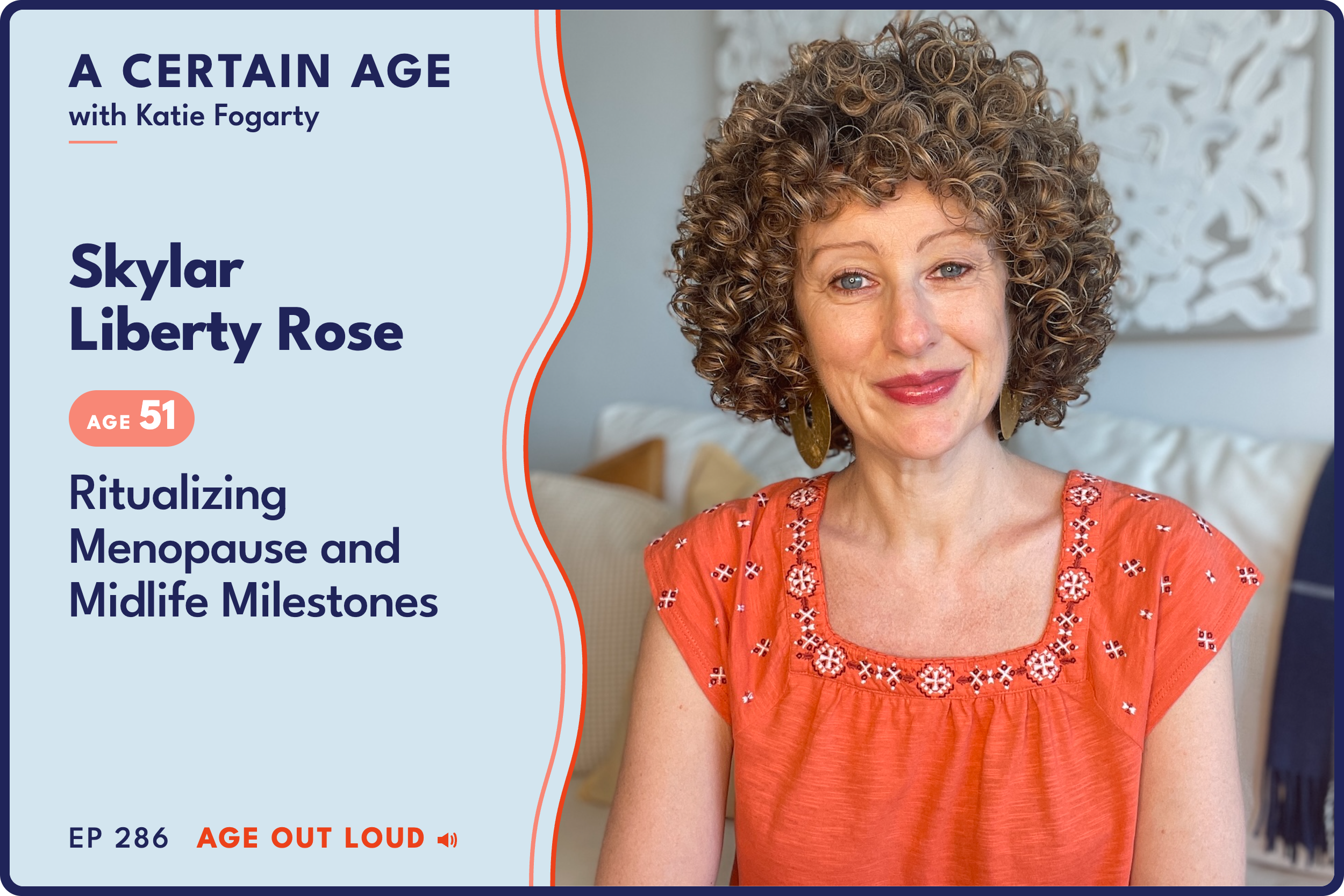
Show Snapshot:
Weddings get toasts. Retirements get parties. But menopause? An empty nest? Culture just expects you to absorb those quietly and move on. Meditation teacher Skylar Liberty Rose (140K+ followers on Insight Timer) thinks that's backwards — and she's built an entire practice around giving these moments the ceremony they deserve.
In this episode:
Why the anti-aging industry profits off making you feel invisible
How to build your own ceremony for menopause, empty nesting, or any big shift
What a "Touchstone" is — and how personalized audio rituals actually work
Why naming a transition out loud changes how you move through it
About Skylar Liberty Rose: Skylar Liberty Rose is a meditation teacher, pro-age advocate and the creator of Touchstones and Customized Ceremonies, personalized meditation and ritual practices designed to help women navigate major life transitions. Her guidance has reached more than 140,000 listeners on Insight Timer.
Show Links:
Follow Skylar:
Quotable:
“The people who love us aren't going to remember how many wrinkles we had or what the condition of our skin was, if it was crepe-like or smooth…They care about the moments that we had with them... They'll remember how you made them feel."
Transcript:
Katie Fogarty — 0:03
Welcome to A Certain Age, a show for women who are unafraid to age out loud. I'm your host, Katie Fogarty. Beauties, midlife has a way of showing up like a hurricane. Everything you thought was solid is shifting, buffeting against your will. But my guest today says if you can find your footing in the eye of that storm, there's a moment of real clarity waiting for you. Skylar Liberty Rose still remembers the day she walked past a mirror, saw her reflection, and thought, “Dear God, when did this happen?” That moment cracked something open: grief, then anger, then a hard look at how much of her life had been built around how she looked versus how she lived. Soon after, on a Zoom call full of brilliant women putting themselves down, she decided to put her foot down and build something different. Now she helps women mark and celebrate the transitions our culture doesn't know what to do with: perimenopause, menopause, empty nests, and more. She does it through personalized audio meditations she calls Touchstones, and customized ceremonies that give these transitions an actual container instead of letting them slip by unmarked and unnoticed. Skylar is also a clear-eyed pro-aging voice. Today we talk about why the anti-aging industry is selling us something that doesn't exist, and why the people who love us will not remember if our skin has started to sag — they will only remember how we made them feel. Welcome to A Certain Age, Skylar.
Skylar Liberty Rose — 1:36
Thank you so much, Katie. It is such a pleasure to be here with you today.
Katie Fogarty — 1:40
I'm really excited for this conversation. The universe has just a funny way of putting people into your path, into your orbit, that you need to know. I know we got connected, I think, through Instagram initially, through that activity in the midlife space, and then we were lucky enough to be part of a really beautiful project together, Midlife Private Parts, the essay collection created by our mutual friends, the Dinas — Dina Aronstein and Dina Alvarez. It's just been such a joy to be in your orbit, in your world. And I'm really grateful that you're with me today.
Skylar Liberty Rose — 2:13
Thank you, Katie. And likewise — yes, I think it was Instagram, and then, of course, the Midlife Little Hub, which is kind of like one of those places where you get to know everybody. So yeah, it's been a joy to get to know you, and of course the Dinas, who have been instrumental in this space.
Katie Fogarty — 2:29
I want to start by asking you about something I saw on your website when I began researching for this conversation. You call midlife a reckoning, but you also call it an invitation, which feels so warm, beautiful, and welcoming. What is it about this life stage that forces women to really and honestly examine what's going on in their lives? And how many women do you feel reach midlife and realize they've been living somebody else's script?
Skylar Liberty Rose — 2:58
Gosh, I mean, I want to say all of us. Honestly, I feel as though the reckoning part, we're quite familiar with, inasmuch as there's so much about midlife that can feel quite unsettling, quite confronting. Practices that we may have relied upon for many years as coping mechanisms all of a sudden aren't quite as effective. It's a very revealing time, and it can be quite an uncomfortable time because of that. There's so much uncertainty, so much is shifting against our will, and I think it's a time when we can crumble or we can really come into our own. It's kind of like there's a hurricane, and then there's the calm in the eye of the storm. If you can find yourself — just find your footing in that eye of the storm — there really is an opportunity to get clear about what it is you want, because for so many of us we've gotten caught up in decades' worth of caregiving and people-pleasing, and some of us haven't really considered what we actually want for ourselves, what's true for us versus what we've been handed to believe should be true, or other people's opinions and expectations. So there really is an invitation there for us to get intentional and to consider how we want to live the next chapter of our lives in a way that feels authentic to us, versus what we've again been told should be true for us.
Katie Fogarty — 4:43
You use the word hurricane, which is just such a great analogy. We get buffeted by the changes of menopause. We get buffeted by the changes that happen within our family dynamics, our relationships, our sense of self as we continue to age. There is a version of midlife that we see in social media. We see it in pop culture, where we are told that this is a season of loss — that we are losing our youth, our fertility, our relevance. You offer a completely different reframe on this. Where did that first take hold for you, and how would you describe what you see as the possibility of midlife for our listeners?
Skylar Liberty Rose — 5:26
I think I first became aware of it when I first started to see that I was visibly aging, and that really was a defining moment in my life. I remember catching sight of myself in the mirror and thinking, “Oh dear God, when did this happen, and where does this end?” It literally felt as though I'd aged overnight. And my next thought was, “Oh gosh, well, that's it — my life as I know it is over,” because for me it felt so devastating. As is the case with most women, we're conditioned to believe that beauty is a currency, and if we feel as though we've reached an age where we've aged out of attractiveness, then that's a huge dent to our self-esteem. So I had this moment where I really just felt quite depressed about my appearance and how quickly I felt as though my youth had escaped me. And what quickly followed from there was this feeling of anger — like, “Hold on a minute, I'm not ready to just say goodbye to my life. I'm not ready to just fade into the background.” And then I started to realize how much of my life up until that point had really been about appearances in all the ways — how I looked physically, how other people perceived me — and I realized how much of my life I'd given over to people-pleasing. It really changed everything for me, because I was very clear that wasn't going to be how I was going to continue. So it was the first time that I felt as though I was taking the reins of my own life, but doing it in this whole new chapter of midlife. And yeah, it's quite something to land on a point in your life that you never really expected to get to, because the thing about aging is, I think we always assume it's going to happen way down the line, and I certainly wasn't prepared to have a moment like that in my 40s. So it was quite the turning point for me.
Katie Fogarty — 7:44
Skylar, I just saw something very funny on Instagram, and I may not remember it exactly, but the quote went something like: aging always seems like it's in the distance, right? It's happening to other people who are beyond you, and then when you arrive at that age, you think, “Huh, I'm not old.” At 56, I might look at 66 and think that's old. By the time I get to 66, I'll think, “Oh, old is 76.” The goalposts keep moving. But I do think there is a point at a certain age — the reason the show is called A Certain Age is because we all experience these little aha moments, these epiphanies, whether it's menopause, or the loss of a parent, or a challenge to our bone health. At a certain age, it varies across chronological time, but we do arrive eventually at a moment where we have to start asking ourselves new questions about a variety of things: how to manage our health, how to manage our mind, how to manage our sense of self. And I think midlife is such a wonderful time to take stock. So I want to switch now into what it is that you do with women, because you had this epiphany for yourself that you were going to embrace this moment in your life, that you were going to reject some of the narratives trying to make you feel bad about this diminishment, this loss of radiance or beauty, and instead recognize that this is a moment of opportunity. When did you decide to start translating this message beyond just your own sense of self and really push it out into a wider audience?
Skylar Liberty Rose — 9:24
Really, when I started to recognize just how much power we hold in midlife and how much we don't acknowledge that. I remember clearly, I was running a workshop about creativity and courage, and I remember looking around my screen on the Zoom call — all these little boxes — and thinking, “My goodness, all of these women have spoken on this call, and almost all of them, in some way, have been disparaging about themselves.” There were comments about their physical appearance, or not being good enough in their jobs and chosen careers, and it just startled me, because all I could see were these intelligent, capable, vibrant women, all their faces lighting up my screen, and I was thinking, “My goodness, we're so much more than we're giving ourselves credit for, and somehow we're losing the thread of that.” So I really wanted to pivot the work I was doing then, which was still with midlife women, but had a focus on helping them find their courage through creativity, and I wanted to be the person who holds the thread. I don't think it's that we don't know what to do or how to go forward, as such. I think it's more that we're constantly pulled in a number of different directions that sever the connection between us and our core selves. Because there's so much caretaking and tending to in midlife — whether it's looking after kids, looking after aging parents, running households, holding down jobs — we're doing so many different roles and showing up in so many different ways that staying connected to the core truth of who we are is really, really challenging. So I wanted to step into a role where I was able to do that for women, and it's been incredibly rewarding, because to see somebody recognize their strength, their resilience, their power — that things aren't actually diminishing, that we still have so much potential and possibility ahead — is quite a wonderful thing. Because, as you said, Katie, there's so much focus on loss and what we're having to let go of, and I do want to acknowledge that there's grief in aging, and not all of it is easy. I don't see much merit in pretending otherwise. I know some people want to gloss over that, but I think we have the capacity and the ability to hold space for the depth and breadth of this experience. So it's okay to acknowledge that there's grief in aging, that there's grief in endings, because I very much believe in holding space for both. And we can also get excited about what we're still becoming and what we still have agency over. So I think it's a very broad experience that we've been convinced is a shrinking down and a narrowing, and it really doesn't have to be that way.
Katie Fogarty — 12:46
You talk about acknowledging the duality of aging — that there's grief, but there's also potentially excitement around this phase. Sometimes the loss of something is the door opening to a new experience. Let's talk a little bit about how you help women both mark, acknowledge, and celebrate some of these moments. You create customized ceremonies for women to celebrate milestone transitions in their lives. You describe these ceremonies as a container for the decisions you want to make. Why does a woman in midlife need a container? What happens when a change unfolds without one?
Skylar Liberty Rose — 13:26
Well, there are so many thresholds in midlife, and what's interesting to me is that culturally we understand the importance of ceremony. We're very used to having ceremonies for births, engagements, weddings — we understand that there is meaning in ceremony, and that we can use it to help mark and make meaning of transitions. Yet when it comes to midlife — say, when it comes to perimenopause, when it comes to menopause, when it comes to becoming an empty nester or stepping away from a career that may have informed our identity for decades — suddenly we're just left to wing it and move through that transition without support. So often we have this feeling of being caught between who we know we once were and a vision of who we might be becoming, but we don't have a container to hold that crossing of the threshold. We don't have any real idea of how to bridge the gap. Sometimes it can feel like something meaningful happened — we know that on some level, but we don't know how to acknowledge it. It's like the world just keeps moving, and we don't have a particular container in which to acknowledge and process that change. So with the ceremonies I do — some of the examples I've just given, perimenopause and menopause — it's really about being seen in that moment, having it held for us as an important and meaningful transition, and getting clarity on what has brought us to this point. If we take menopause as an example, that's a really defining time, and a lot of the time it's shrouded in shame because it's still a taboo subject, even though we've made some incredible ground over the last few years. And Katie, I know you've had some of the people instrumental in changing the menopause narrative on your show. We now have information about hormone therapy, for example, being spoken about really widely in a way that it just wasn't before. But alongside that, there's a shift in identity and a real emotional piece that doesn't always get acknowledged. So a ceremony for somebody who's either moving through perimenopause or is postmenopausal can be a really wonderful way of honoring the versions of you that have brought you to this point, and also acknowledging that this chapter of your life is coming to a close — but it doesn't have to be a terrible ending. It's really about focusing on that actual threshold and what you're stepping into, being clear about who you're choosing to become through this change. That's where the agency comes in, and there's a sense of completion. I think that without ceremony, that's just not there. If you think about it, we've all attended some kind of traditional ceremony — weddings are probably one of the most common ones. We expect to feel different after we get married, in some sense, at least, because we've declared something either to ourselves or to other people, and as a society, we understand that this has meaning, that it has significance.
Katie Fogarty — 17:11
Skylar, we're heading into a quick break right now, but when we come back, I want to hear about how you work with a client to create a personal ceremony, and then ask you to take us into one and walk us through what unfolds. We'll be back in just a minute.
[ AD BREAK ]
Katie Fogarty
We're back from the break. Before we went into it, we were talking about the power of ceremony to both mark and make meaning out of significant times in our lives. We recognize that for things like weddings or confirmations, a declaration is being made, and that there's a sense of transformation that occurs when it's over. So for a client who's coming to you and wants to honor and spend time thinking about something that doesn't get the same kind of ceremonial airtime — the transition to perimenopause, the transition into the menopausal state — what does that look like in a ceremony? How do you partner with somebody, and what happens during the actual ceremony itself?
Skylar Liberty Rose — 18:07
Well, we start with a conversation — and I always say it really is a conversation, not an interrogation. I get a sense of where you are in your life now, and what it is about the experience you're having that is significant to you, and from there I get a sense of how to start creating the ceremony. It really is a co-creation, so I'm working with what you share with me, and I get a sense of what kind of tone would feel right for you — whether it's something you want to do privately. I do these virtually and in person. For some women, it's something that feels like a very private thing they want to hold space for, just the two of us. Other people like to have some close friends or family gathered with them, depending on what the ceremony is for. Because it's customized, there's no one way to do it, which is the beautiful thing about it. I tailor it so that it makes sense for you, and then I design the ceremony around your story, what it is you want to declare about who you're becoming. So we can weave in rituals, we can weave in words, language, moments of reflection that are significant to you. It becomes something they can stay connected to — it acts as an anchor. And in this time of so much upheaval in midlife, I think that's super important, that we have these anchors, these spaces we can return to that help us feel tethered.
Katie Fogarty — 19:44
Skylar, I'm hearing you talk, and I'm thinking about my own life. It wasn't a ceremony per se, but my husband and I sold our family home a year ago. We left the town we'd lived in for 20 years, and we created rituals to mark the transition. We did a special night with our kids where we visited our favorite places — the ice cream shop we first went to when we entered that town 20 years ago — and we ended the evening with home movies. It was really important for me to spend time as a family focused on saying goodbye to that home and that town. The morning of the move, I literally walked through the house and said goodbye to each room — goodbye to my bedroom and my beautiful view every morning, goodbye to my dining room where we'd hosted countless meals, goodbye to my kitchen where we'd watch the birds. It felt so beautiful to honor it that way, and it made me feel very complete about the move. So I recognize the power of putting a period on the end of a chapter and marking it in some beautiful and special way. I think it's so intriguing that you've built this for people, that you're able to help them through that. I want to ask you now about your other offering for midlife women, but also beyond midlife. You have a substantial following on something called Insight Timer. For listeners who don't know, I believe it's the biggest free meditation app in the world, and you have more than 130,000 downloads and thousands of five-star ratings there, where you share guided meditations. So you clearly know what works when it comes to audio guidance. But you've taken that idea and transformed it into personalized Touchstones, a custom daily audio anchor. I'd love for you to tell our listeners what a Touchstone is and how it differs from an affirmation practice or a meditation app.
Skylar Liberty Rose — 21:48
Yeah, absolutely. As you said, Katie, I've been a teacher on Insight Timer for about five years now, and I love creating guided meditations for people — specifically guided meditation, because I am not somebody who can just drop into lotus position and empty my mind. I've never been that kind of meditator. I've always needed guided meditation, or moving meditations, or something that isn't simply “empty your mind and don't think about anything.” So I'm a big believer in guided meditations, and I would often get feedback on the app where people would say, “Oh my goodness, I feel as though this was written just for me. I felt like you were inside my head.” People got really excited about feeling like they were having a personalized experience. So I thought to myself, well, what if they actually were? What if I created something where I got to weave in a person's name, speak to their specific set of circumstances, touch on their goals and aspirations — what might that impact be like? So I launched Touchstones last year, and it's truly one of the best things I've done, because there was an audience for it immediately. You're never quite sure — sometimes you think, “Oh, I think this is a good idea,” and you launch it, and it doesn't really land. But this one really did.
Katie Fogarty — 23:25
I love the idea of having something that's very specific to a period of time you might need to move through, where you really need that support with what you're struggling with mentally, because we all have those dips. So when you partner with somebody to create a Touchstone, how does it work? What's the process from start to finish?
Skylar Liberty Rose — 23:46
The first thing is a conversation. As with the ceremonies, I always start by listening, because every woman who comes to me has a story — everybody has their own unique set of circumstances, no two people are the same. So I'm a really good listener. I am asking questions, yes, but I'm really listening for what they're telling me in between the answers. From that conversation, I get to find out a little more about the person — what it is they want to focus on, what kind of support would be most meaningful for them at this particular moment in their lives. One of the questions I ask, for example, is: if they were to call their best friend in the midst of all the upheaval they're dealing with, what would be the advice or support their best friend would give them? Again, I'm just paying attention, I'm listening. And from that conversation, I go away and I also ask about language, because that's very personal, right? What might feel really uplifting and motivational and soothing to one person might be language that doesn't resonate at all with the next person. So I get a sense of the tone, the style, the language, what kind of music they might like to listen to — again, very personal. Some people like piano music, some people absolutely do not. Some like nature sounds. I've had all kinds of different requests since I started doing this. Then I go away, I create the meditation, I record it, and within a week the client gets their Touchstone sent to them. There's no right or wrong with this — you don't have to already be a meditator, because I think that sometimes puts people off, like, “Oh, I don't know how to meditate, this isn't something I'm familiar with.” You don't need any previous experience with meditation. You can be seasoned in meditation, or this can be the first time you're doing it. Sometimes the tone is more traditional meditation style, and I've had other people — notably, I think, more in corporate, high-up jobs — say, “I need something that's a little more like a pep talk,” and that's just their preference. And then it's something you can listen to daily. Some people listen every morning — I've had clients say, “Oh my goodness, you go on a walk with me every morning.” Some people listen at lunchtime. If I'm working with someone to help them release the day, it'll be an evening wind-down. And sometimes it might be something they listen to once a week or a couple of times a week. So I design the Touchstone so that it fits into your world, rather than asking you to fit into a template-style meditation you might find on any app. I think the specificity of the personalization is what really works.
Katie Fogarty — 26:54
So Skylar, do people ever get multiple Touchstones? Because it sounds like you could have one for your daily needs, but you might have one for specific moments of stress or transition you're going through. Are multiples common?
Skylar Liberty Rose — 27:06
They are, yeah. I've worked with clients who came to me for help — there was one client who wanted help as she was working on her first book, so I worked with her specifically for that experience so she could listen to the Touchstone before she sat down to write each day. Later on, she wanted something that spoke to boundaries she wanted to create within her family — again, something completely different. And I've had people say, “Oh, I've got a morning one that helps me set myself up for the day, but now I want an evening one so I can bracket the day with a different kind of meditation.” So there are absolutely multiples, and it's nice when people come back — that's a really enjoyable part of it, because you know that what you've already given them is working, so having the opportunity to do it again is a really wonderful thing.
Katie Fogarty — 28:05
And for these customized Touchstones, what's the delivery mechanism? Do they go through Insight Timer, but customized, or is it something you send as an audio file? How does it work?
Skylar Liberty Rose — 28:17
This is completely separate from my teaching on Insight Timer. It's done through my website, and it's an audio file they can save to their computer or their phone — I think most people save it to their phone, so it's super easy to access.
Katie Fogarty — 28:33
Skylar, thank you so much for giving us that overview of Touchstones. In a minute, I'm going to ask you to share pricing with our listeners for Touchstones and ceremonies, because I'm sure people are curious about how they can incorporate these practices into their own lives. But before we do that, I want to shift gears and talk a little more about your pro-aging advocacy. This is what connected us to begin with — we found each other on Instagram because we were sharing the same kind of content. We had the same ethos: that aging is a time to embrace, that midlife is a time of excitement, even if there are things that are challenging and hard. I feel like I'm in a season of midlife that's quite difficult, as I help care for one of my aging parents — it's been challenging, but there's so much beauty and vibrancy in this phase of life too. Tell us a little bit about what made you first start sharing pro-aging content, and what, if anything, you think has shifted in the zeitgeist since you and I both began having these conversations five or six years ago.
Skylar Liberty Rose — 29:36
So for me, pro-aging is really a direct response to a culture of anti-aging, and anti-aging is the brainchild of the beauty industry — it's all about us being opposed to, or against, the process of aging, which is really just the act of staying alive. The only way we're not aging is literally if we die. It's not a crime to age, and I think many of us know this, but it feels like it's a crime to visibly age. Yet we're constantly bombarded with rhetoric that keeps us invested in trying to turn back the clock. And because we've long since aligned our self-worth with our appearance, we panic that we're aging out of relevance, aging out of attractiveness, and that if we could only look younger, we'd feel more fulfilled, we'd have better lives. I don't think that's sustainable for us. It's definitely not sustainable.
Katie Fogarty — 30:39
It's definitely not sustainable. It's like trying to push a boulder up a mountain — it's never going to work. And who wants to spend the last 20 or 30 years of their life pushing a boulder up a mountain? You want to be climbing it joyfully, picking wildflowers. There's just so much — it always kills me when you see all this anti-aging stuff, because this wonderful woman I've had on the show, Carrie Brown, this wonderful skincare entrepreneur, says, “Aging is living,” and that is so true. But we fail to recognize that at times, and we spend our short and wondrous lives fighting it tooth and nail, which always baffles me. But I feel right now, watching my mother navigate her cognitive decline, that it is heartbreaking, so I can see why there's fear around aging. Once you get over the beauty piece of it, the reality is that aging comes with a lot of hardship and heartbreak as well, and I feel like I'm firmly in that piece of life right now. But I also want to make sure I'm not spending this time mourning my future loss of vibrancy. You have to walk the knife's edge of grappling with the sorrow that comes with it while also living your life so fully and abundantly, because soon it'll be my turn to be fully old and to have my life shape-shift in ways that are hard. There's just no way around it — it's incredibly hard.
Skylar Liberty Rose — 32:16
I do have fears about the future — it's not that that doesn't exist for me. I am concerned, having seen my mother-in-law's experience. Both my husband's parents passed away last year, and unfortunately my mother-in-law was in a nursing home prior to dying, because we couldn't care for her. She needed round-the-clock care, and that's something you never want to think of happening to your loved ones, let alone yourself. So I do have fears about the future, but I try to really keep myself in the moment, and make changes in my life — with regard to my health and exercise — that I hope will put me in good standing for the future. But it's all unknown, really; we do what we can. I think that's another reason the work I do, specifically the Touchstones, is really about keeping you tethered in the present moment, so you're not going too far in any one direction worrying about things we can't control. I think it's quite clear that the aging experience we're having isn't what our mothers or grandmothers had. So I do feel that, as a culture, we're changing the way we think about aging, and I'm interested to see where that goes. I know there's a lot of talk about longevity at the moment, and some of that, unfortunately, falls into the category of more anti-aging rhetoric. But I think it's really about trying to stay as connected to the present moment as possible, doing what we can to pave the way for hopefully an empowered aging experience, and not letting ourselves get sidetracked by what's not important. The people who love us aren't going to remember how many wrinkles we had, or the condition of our skin, whether it was crepey or smooth — they don't care about those things. They care about the moments they had with us. Katie, when you talked about your kids and the rituals you did as you were saying goodbye to your family home — their memory of that won't be about how you looked that day, or what you were wearing, or what your skin looked like. None of that will matter. They'll remember how you made them feel. So I think we give this far more weight and substance in our lives than it deserves. Just try to stay connected to what's truly important.
Katie Fogarty — 34:57
I love this notion of being rooted in the present through these Touchstones you've created, where you can identify for yourself what grounds you, what gives you joy, where you need support, and create something that helps you stay present — because it's really challenging. You said at the beginning that we have multiple things competing for our attention, and while women have a true sense of what they need when they have quiet space and can tap into their inner knowing — I know that sounds very woo-woo, but when you have that quiet space, we all know what we need and want and should be doing. It's just hard to find the time, because we're constantly under assault by modern life. Having a Touchstone carved out that allows you to reconnect to what you need and know, so you can be reminded daily, is such a beautiful practice. So this is a great segue — tell us how we can get these Touchstones, and how much they cost. I'd also love to know a little about the pricing of your ceremonies — I imagine that might be harder, since they're very custom.
Skylar Liberty Rose — 36:03
Absolutely. Touchstones are currently $108, although the price is changing this summer. With regard to ceremonies, as you said, because they're customized, the pricing can definitely vary, especially for an in-person ceremony, since it depends on location, travel, and so on. Virtual ceremonies range from $390 to $700, and in-person ceremonies start at $500 and go up from there. So that gives you a sense of what to expect.
Katie Fogarty — 36:39
And where can our listeners find more information about your services?
Skylar Liberty Rose — 36:43
On my website, which is skylarlibertyrose.com — everything is there.
Katie Fogarty — 36:48
I would also say, follow Skylar on Instagram. She shares wonderful, inspiring content that will light you up, that will make you feel excited and seen as a woman in midlife, as a woman of a certain age. Skylar, thank you so much for being with me today.
Skylar Liberty Rose — 37:03
Katie, it has been such a pleasure. I've really enjoyed this conversation. Thank you.
Katie Fogarty — 37:08
This wraps A Certain Age, a show for women who are aging without apology. Thank you for hanging out with me and Skylar today. I loved hearing about the experiences she's created for midlife women to help them honor and make meaning out of important transitions and milestone moments in their lives. Skylar has such an incredible voice and is such a joy to listen to — I can only imagine that waking up with her in your ear in the morning, with a guided Touchstone helping you move toward something you're working on in your own life, is such an incredible treat. If you're interested in learning more about Skylar's work, head to skylarlibertyrose.com — I'll also link that in the show notes. I'd love to hear what you're working on. I'd love to hear about a Touchstone you need in your own life. Let me know what you took away from the show in an Apple Podcasts or Spotify review — I read and appreciate every one of your reviews. Reviews help other women find the show. Special thanks, as always, to Michael Mancini for creating our theme music. See you next time, and until then — age boldly, beauties.
