
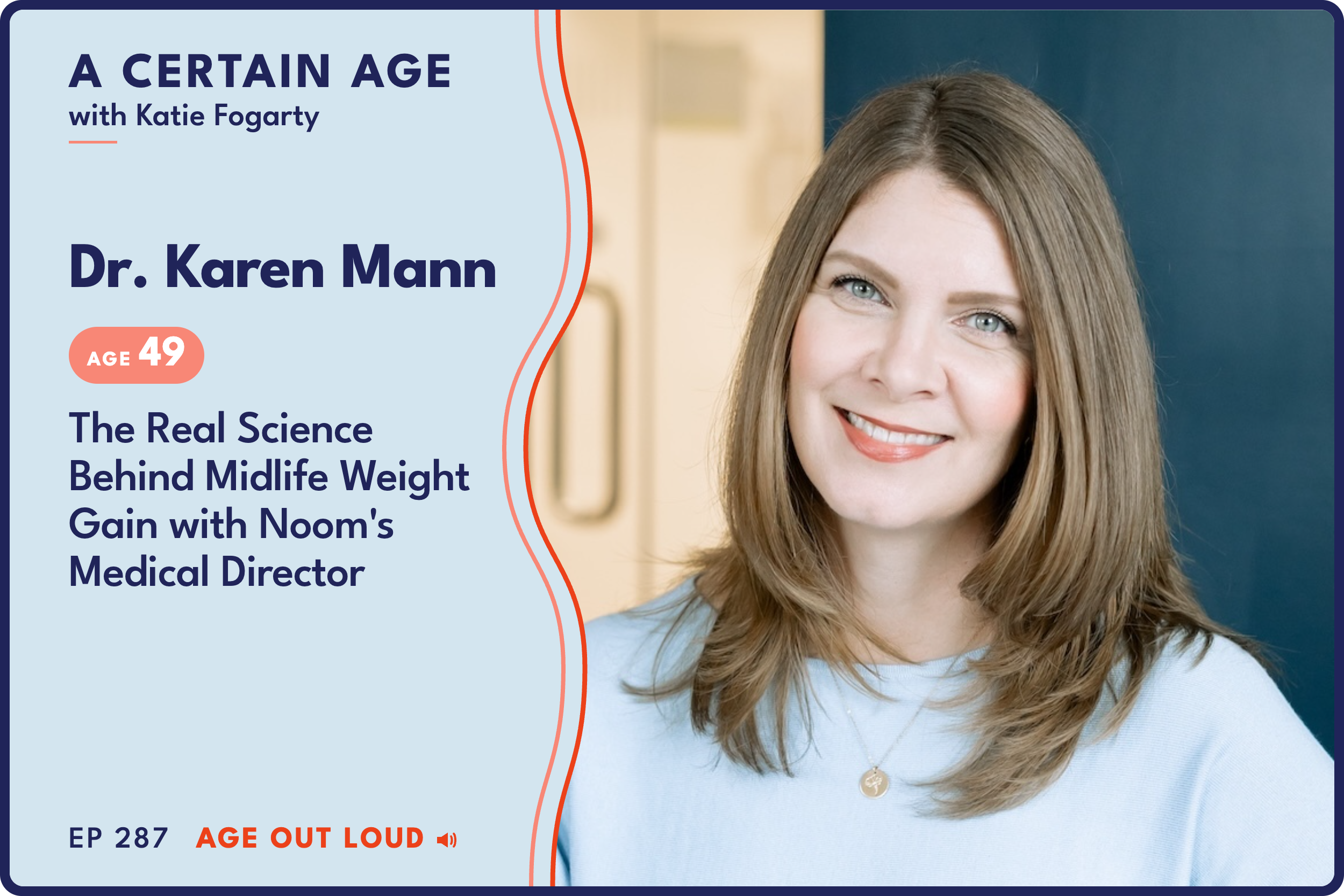
The Real Science Behind Midlife Weight Gain with Noom's Dr. Karen Mann
Show Snapshot:
Doing everything "right" and still gaining weight in midlife? It's not a willpower problem. Dr. Karen Mann, OB/GYN, obesity medicine specialist, and medical director at Noom, breaks down what's actually driving it: hormones, metabolism, and mindset, not discipline.
In this episode:
Why pairing GLP-1s with behavior coaching leads to 48% more weight loss than medication alone
How to safely combine HRT and GLP-1s, and in what order
Why perimenopause is your window to get ahead of muscle loss and metabolic slowdown
Dr. Mann's philosophy: "How you feed yourself is how you love yourself"
About Dr. Karen Mann: Dr. Karen Mann is a board-certified OB-GYN, obesity medicine specialist, and Medical Director at Noom. She earned her MD from George Washington University, completed her residency at Kaiser Permanente Los Angeles, and is certified by the North American Menopause Society and the American Board of Obesity Medicine.
Show Links:
Follow Dr. Mann:
Follow Noom:
Other A Certain Age shows on this topic:
Quotable:
"Obesity is a medical condition. It is a chronic disease — it is no longer something that has to do with how you look."
Transcript:
Katie Fogarty 0:03
Welcome to A Certain Age, a show for women who are unafraid to age out loud. I'm your host, Katie Fogarty.
Beauties, before we dive into this week's show, I want to take a minute to thank everyone who's written an Apple Podcasts or Spotify review. I read and see each one of them, and I truly appreciate it. Reviews help other women find the show. Reviews help podcast sponsors recognize that A Certain Age is worth supporting. Reviews truly help the show grow. So if you have not yet taken time to rate or review the show, I would love it if you would take two minutes to do so over on Apple Podcasts, Spotify, or wherever you find your shows.
Now, on to this week's episode, beauties. I want you to sit with this for a second: for 20 years, doctors across this country pulled back on prescribing hormone therapy to menopausal women — not because new science showed it was risky, but because one study from 2002 got misread and misinterpreted. And an entire generation of women paid for it in hot flashes, sleepless nights, brain fog, and weight that won't budge.
That gap is finally closing. But here's the twist: midlife metabolic changes and weight issues aren't simply about getting your hormones back on track. Turns out, people who pair medication with real behavior coaching lose 48% more weight than people on meds alone. You don't need a stronger dose. You don't need a better drug. The difference is what's happening in your mindset.
It's not hormones versus habits. It's what happens when we stop treating midlife weight change like a personal failing and start treating it like a medical issue — hormonal, metabolic, and psychological, all at once.
My guest today lives at that intersection. Dr. Karen Mann is an OB/GYN and medical director at Noom. She's an MD from George Washington University, trained at Kaiser Permanente LA, and certified by the North American Menopause Society and the American Board of Obesity Medicine. She's also Stanford-certified in nutrition science and a trained life coach — hormones, metabolism, food, mindset, she speaks all of it.
Today, we're digging into why midlife weight change is a medical story, not a willpower story, and what it looks like when hormones, medication, and behavior science stop fighting each other and finally work as one plan.
Welcome to A Certain Age, Dr. Mann.
Dr. Karen Mann 2:45
Hi, Katie. It's so great to be here. Thank you so much for having me. It's just nice to have some time with you on this beautiful Friday in the summer. I am excited to reconnect.
Katie Fogarty 2:45
editor's note: speaker label corrected — the following was misattributed to Dr. Mann in the source transcript
So, listeners, I got to meet Karen when we were both in Miami several months ago at a wonderful menopause conference put together by Dr. Jila Senemar, who's also been a guest on the podcast. When I saw Karen up on stage, I grabbed her afterward and said, "Let's make this happen," because I know what you're talking about is top of mind for a lot of women who tune into the show.
So I kind of want to start with a little bit of stage-setting before we get into the nitty-gritty. You are board-certified in obesity medicine, and this is a specialty that didn't really exist when most of us were developing our eating and nutrition habits. If you're firmly Gen X like me — help us understand what that certification trains you to see that a general OB/GYN or primary care doc might miss.
Dr. Karen Mann 3:41
Totally — such a beautiful question. And I have to say, I went into obesity medicine later in my career, after sort of being... I don't want to say disappointed, it sounds negative, but I wasn't getting what I wanted from just being an OB/GYN in terms of the picture around metabolic health and weight.
Obesity medicine is a newer specialty — I think it just started in about 2011. Every year, more and more providers are getting this certification so they can better understand obesity. As we understand it now, it is a medical condition. It is a chronic disease. It is no longer something that has to do with how you look — it has everything to do with what's going on inside. And to be able to understand the science of obesity, what's going on in your body — there are so many layers behind what puts weight on our bodies.
To understand each one in a granular way — for me, that's where it was at. I really wanted to understand the basic science of it so that I could apply it, and also understand it for myself, as somebody who's struggled with my weight my entire life. When I got to the point of realizing that the psychology alone was not explaining the entire picture, I wanted to get into the science.
So what we learn in obesity medicine teaches us that a fat cell is part of an endocrine system. We learn about how hormones are produced, how inflammation is influenced by the way our fat accumulates. We learn about the system around nutrition and eating — we learn about food insecurity, we learn about basic nutrition, we learn about weight stigma. We really dive into some of the finer points around what goes into weight, and then the medicine of it — as I mentioned, the hormones, how it interacts with your endocrine system, the medications that we know cause us to gain weight. So an obesity medicine specialist will dig into what you're taking and see if there are ways to optimize it so that it can impact your weight loss.
And then, ultimately, the cornerstone of obesity medicine these days is really being able to provide medical treatment. So with the psychology of weight loss comes the science of weight loss, and obesity medicine allows us to see the whole picture. I personally think it's great that more and more people are getting interested in this field and looking into it.
Katie Fogarty 6:20
We are going to dig into the psychology of weight loss, and of course the science of weight loss, in this conversation. But listening to you speak, it's just so clear how multifactorial weight is. When you just outlined all the different pillars you studied within obesity medicine, it could range from food insecurity, to genetics, to lifestyle choices.
So for a woman who's listening to this show, who's in her late 40s, maybe mid-50s, and she's dealing with all the other menopause stuff — the hot flashes, the brain fog that comes on when our hormones start to change — for many people, stubborn weight that wasn't there a few years ago is a big issue. I know this because every time we cover this topic on the show, I am flooded with DMs from people who share that this is one of their challenges. It's not everybody's challenge, and if a listener thinks, "This isn't for me" — fine. But many women are concerned about this.
So where would that listener start? Is this a conversation she starts with her doctor? Does she do some stuff on her own first, before she seeks interventions? What's the right starting point for moving toward success a little faster?
Dr. Karen Mann 7:27
So I think when it comes to the starting point, it's going to vary per person. I don't think there's a black-and-white, yes/no answer that fits everybody. So I would ask everyone listening to think about your belief system and what you feel is going to be the most supportive — because in this age of the internet, social media, so many books out there, we have all these experts, we have our providers, we have Noom, we have so many places to go to get answers and start our journey. So really dig in, figure out what resonates most for you, and go there.
That being said, I think it's a perfectly reasonable starting point to get the basics down. Wherever you can figure out what the basics are — again, Noom is going to provide this for you. There are many programs out there that will help you understand how nutrition works, how to look at your macros, how to understand muscle and how that impacts your body. So we're just talking the basics here — that's where everybody needs to start, and then from there you can go into more nuanced places.
Talking to your doctor is a great idea as well. Not every physician is going to give you the most nuanced advice. There are many providers — nurse practitioners, PAs — a lot of different ways you can get medical care. Some are still recommending you just cut calories and increase activity. That approach is becoming outdated. We're understanding, again, that obesity is an endocrinological disorder, so it's not just about the thermodynamics of what you take in and what you put out. There's more to it, but a lot of providers are starting to understand this and will start a conversation with you on what changes you can make in your individual diet — and if medical treatment is now appropriate for you, that's also a conversation you can have with your provider, and then they can refer you elsewhere if they don't feel comfortable prescribing medications themselves.
But I think getting the basics down is really helpful — that's where we all need to start.
Katie Fogarty 9:41
Yeah, it's such a great point that the calories-in, calories-out model is outdated, and that there are different pillars we need to be paying attention to. You've got to figure it out for yourself to a degree.
But one of the things that really jumped out at me when I was prepping for the show was spending time on Noom's website and learning that stat: people lose 48% more weight when they're pairing medication with coaching versus medication alone. So I think the psychology piece is something a lot of people don't recognize has such an impact on truly moving the needle. And your career is so interesting — you're a medical doctor, you've added certifications and training along the way in obesity medicine, nutrition, you've become a life coach. All of these kind of ladder into the psychology piece of weight. Why does that move the needle so much versus just a drug alone?
Dr. Karen Mann 10:37
The simple answer is that our brains, our thoughts, our beliefs are so powerful, and we underutilize them when it comes to not just weight loss, but any treatment. I always like bringing up this anecdotal story about how, when we're treating pelvic pain as gynecologists — which is like the bane of our existence, because it's so complex, so hard to treat, not very responsive to treatment — there are studies out there showing that the factor most linked to good outcomes with treatment is the relationship with the doctor. So that speaks to how what you believe and what you're thinking helps you get outcomes that are actually rooted in the science. What's going on molecularly, and that belief system laying on top of what's happening with the science — those two work together in a really powerful way.
So when you're quoting that statistic, that's with the GLP-1s specifically — that's talking about just doing the medication on its own. These medications work. It doesn't matter what you do, you put them in your body, you're going to lose weight. Most of us are going to lose weight, and that's great. They're effective even for the person who's unable to do the lifestyle piece, whatever the reason.
But when you utilize this medication to create space for you to explore the psychology, then you're able to get that exponential shift in the results, because the medication kind of opens up what's going on biologically — it creates space in your brain. I'm sure you've heard of this whole thing around food noise, which many of us have going on in the background. This is because we've been exposed to foods that have impacted our brains, our neurochemistry, and it's kind of always there — our brains are always aware that food is out there and we want it. These medications quiet that down, and in that space is where new habits can form. In that space is where you can have the relationship with your coach, to really talk about your belief system and the things you're telling yourself about how you're feeding yourself — and I always say, how you feed yourself is how you love yourself.
So this is also a great opportunity to start to explore how to better love and nourish yourself. And I think this is where things diverge, because in obesity medicine we're not really going to talk about that, but in the psychology piece, we do. So the marriage of the science and the psychology is what's going to get you the better results — results that last long term — because once you have those habits in place, if you do come off the medication, the weight regain either doesn't happen, or it happens at a much slower rate than what we see if those habits aren't in place.
Katie Fogarty 13:23
Karen, we're heading into a quick break, but when we come back I want to explore this — the free space and the quieting of the food noise — and how it creates room for new habits. Let's talk about those new habits after the break.
— AD BREAK —
Katie Fogarty 14:02
Karen, we're back from the break. When we went into it, we were talking about why the psychology piece is so important, and how when the medicines work to quiet the food noise, giving you space to finally tackle these other elements of weight gain and weight loss, it creates the opportunity to build new habits, because you just have more brain space to focus on new things. So what would some of these new habits look like?
Dr. Karen Mann 14:02
Yeah. So, number one, I want to talk about muscle in general and how important it is to really focus on that, especially in the midlife transition. I know many of the guests you've had on address this — it's the thing of the moment, where we're all talking about how important it is to maintain muscle. It's hard to avoid when you're investigating these medications and weight loss in general.
So the habit is really around being mindful about what you're putting into your body and how you're using your body. Small habits can look like counting your protein macros during the course of the day. Small habits can look like replacing something you'd normally have — maybe an ultra-processed food — with a whole food, something that's more nutrient-dense. Small habits can be doing five minutes of activity at the end of your workday, during your lunch break, in the morning, whatever it is. So basically, it doesn't need to be a huge thing. Find a place to focus, and I recommend focusing on muscle building and muscle preservation, especially in midlife.
Start there. And with Noom — not to sell Noom or advertise for Noom, but we do have specific content that helps people really focus on protein and muscle maintenance. So it's just, in general, universally good advice for everybody to focus on those two areas.
Katie Fogarty 15:39
You mentioned former guests I've had on the show — we've talked about weight training with Holly Rilinger, who's a fitness trainer, and the importance of protein intake and muscle building with Dr. Vonda Wright, who talks about the role of muscle as an engine of longevity. I'll link out to all of those shows in the show notes so people can go find them.
I also had Dr. Rocio Salas-Whalen on the show, talking about her book Weightless, and she gave us really a master class in GLP-1s. I'll link out to that as well. In that conversation, Dr. Salas-Whalen shared that for many of her clients, once they start using a GLP-1, they're able to lose enough weight that they can do what they know they need to do, which is be active and exercise — sometimes weight gets in the way of doing that. So that's another interesting component: once you've removed some of that weight, you can adopt some of these healthier lifestyle choices that maybe felt out of reach when you were carrying a lot of weight.
So, Karen, I'm curious — we've talked a lot about GLP-1s on the show, I've obviously done a lot of shows on HRT. What does the decision-making process look like, in your view, when you're talking to a woman about how she incorporates these two in tandem? What questions should she be asking her doctor that she might not be?
Dr. Karen Mann 16:53
When it comes to utilizing both of these medications together — they're both going to have long-term health benefits. Usually when we're starting treatment, it's a risk-benefit conversation: where are we going to get the most bang for our buck, what's the most urgent thing that needs to be treated right now? When it comes to weight loss and management of menopause, the two can really compete with each other, so I don't think you necessarily have to prioritize one over the other, but you have to figure out what's most important for you in that moment.
If you have debilitating vasomotor symptoms — the hot flashes, the night sweats, that kind of thing — that might be the place you want to go first. If you're in this perimenopausal or menopausal space and having those symptoms, once you get them under control, that also opens up space for you to start these habits that can help with your weight. Conversely, you might have a patient who's just so overwhelmed by the weight she's putting on in this transition that that's the first place you want to go, and she'll deal with the menopausal symptoms later.
Starting them at the same time is completely reasonable, but it might make it difficult to tease out side effects, so I would normally stagger how people start them. Again, the order isn't terribly important. But what I'm seeing more is patients coming in on either one or the other, curious about the other treatment and concerned about whether there's an interaction, or a reason you can't do both. And you absolutely can do both. We have small observational, retrospective studies out there that get a lot of attention — basically looking at what it looks like when we put these two treatments together — finding that people actually do better when they're using them together.
Katie Fogarty 18:35
If we're staggering, Karen, what's the time frame you'd recommend, so you can really tease out what's moving the needle and what symptoms are being addressed?
Dr. Karen Mann 18:45
Well, if you're starting with hormone therapy, you can generally get honed in on where you need to be pretty quickly. Usually people will start at a certain dose, and then you can up-titrate from there — six weeks, eight weeks — so that can happen more quickly. Once that's narrowed in, then you can add in the GLP-1. The GLP-1s take a little longer, because you have to titrate up very slowly, so that might take longer. Again, I want people to think about what's really bothering them the most — if the hormones are debilitating, then start those, and starting your GLP-1 even six to eight weeks later would be totally fine.
Katie Fogarty 19:20
Yeah, fantastic advice — identify where you're suffering and get a handle on that. And when you say "titrate up," what does that mean to the layperson, like me? Is that just moving your dose up slowly?
Dr. Karen Mann 19:32
Yeah. So with hormone therapy, you generally start at a low dose — again, that's going to vary based on where you are in your transition and your needs, but starting at a low dose or a mid dose. There are two schools of thought — you can either start higher and work down, or start low and work up. Neither is wrong; it's basically just picking a dose, going for it, seeing how you do over six to eight weeks, or even 12 weeks, and then increasing or decreasing from there. That's how hormone therapy generally works. Most people can dial in on what they're happy with over the course of several months.
When it comes to the GLP-1 therapies, we start at the lowest dose, then go up to the next dose after a month, and the next dose after another month. The trials — the way these have traditionally been prescribed — is to just up-titrate, going up to the next dose every month, kind of regardless. That's what the studies did: they up-titrated to the highest dose and sat people there to see what happened.
What we're learning more, which is what excites me, is that we're allowing people to use these medications in a more individualized way. We're seeing some studies coming out of Europe where people are up-titrating much more slowly — instead of month to month to month, we're seeing people stick to a lower dose, and in practice, we're seeing people find very good results on the lower doses, minimizing side effects that way. Because the side-effect profile of the GLP-1s is one of the things that limits people from getting to the higher doses, or from staying on the medication. So really working with a physician who's comfortable letting you take your time, letting you find where you feel best, seeing results with minimal side effects — and not necessarily doing exactly what the textbook says to do, but doing what's best for your body.
Katie Fogarty 21:21
And for a listener who hasn't yet tuned in to my earlier episode with Dr. Salas-Whalen on GLP-1s, what would be some of the side effects people are seeing? Help catch them up to speed.
Dr. Karen Mann 21:34
The side effects are largely going to be what we call GI, or gastrointestinal, side effects, because when you think about what these medications are doing — they're slowing down your digestion, keeping things in your stomach for longer. That's one of the ways they work; they keep you satisfied for longer, they make you feel full sooner. So this is all really beneficial when it comes to weight loss, but it can be kind of a drag because it can have these GI side effects — nausea, even vomiting, and on the other end, constipation or diarrhea.
Those are the most common things we see. They're very common, they were very prevalent in the studies that were done, and they're typically manageable. There are medications you can take for nausea, for heartburn, for constipation — I always advise people to add a little more fiber to the diet, maybe even a stool softener. You can use things to calm down diarrhea short-term. Ultimately, most people are able to get through those uncomfortable first doses and the titrations with management of the side effects. So that's typically what we see.
But I think a lot of people actually tolerate them really well. I think the side effects get a lot of press and a lot of publicity, but there are many patients who do well. I personally was using a GLP-1 and did not have side effects — and again, that's anecdotal, that's just me, I know I'm not everybody — but I see this with our patients as well.
Katie Fogarty 22:59
Many of my listeners are in menopause, but perimenopause listeners are tuning in as well — if you're here and you're in your 40s, welcome. Is there a different way we should be thinking about these interventions based on where we are in our hormonal transition? Does the plan change by phase, or are the recommendations the same through menopause and beyond?
Dr. Karen Mann 23:21
So for HRT, and for the GLP-1s for medical management of obesity, perimenopause is a perfectly fine time to start either of those treatments. This is different than what we thought years and years ago, and it's one thing I hear from patients — when they see their OB/GYN and say, "I'm having periods every month," they immediately get dismissed and told, "Well, this isn't perimenopause." But we know the hormonal changes are happening years before we see the shift in our period — it's not necessarily going to show up the way the textbook says, with periods getting irregular.
So as we learn more about perimenopause — it wasn't even a term when I trained, 15, 20 years ago — we're starting to open the conversation around it, acknowledging it as its own unique hormonal stage. It's a perfectly fine time to start hormone therapy if you're having symptoms of hormonal fluctuation. So we can do HRT in this population, and start a GLP-1 at the same time — again, the two seem to complement each other, the GLP-1 treatment and HRT.
So the perimenopausal space is a great opportunity, maybe even to get ahead of things — because as you lose muscle mass, as things slow down in your system and weight gain becomes harder to deal with, beating it to the punch and getting on board while things are still more manageable is the way to go for some people.
Katie Fogarty 24:54
Yeah, it's such a terrific reframe to think of perimenopause as this window of opportunity, right — this is when you can start banking muscle, banking bone health, doing the things you know you need to for healthy aging, greater longevity, and mobility. You can get ahead of it and enter the menopause transition in a much stronger state.
It's interesting for me to hear that perimenopause wasn't really even a phrase when you were training — it was certainly not on my radar when I was going through it. I really started learning more about perimenopause and menopause once I launched this podcast six years ago, and it's interesting to see how the cultural conversation has shifted, how training in medicine has shifted, how doctors are talking about it — because for decades, midlife weight gain was really filed under the diet-and-discipline category. I know that's changing; you mentioned obesity medicine is now recognized as its own thing that needs to be addressed. When did the idea of weight gain move into endocrine-condition territory? Help us understand why the science is catching up and changing.
Dr. Karen Mann 26:04
I think a lot of it has to do with the introduction of obesity medicine as its own discipline, its own science, its own field. When the American Board of Obesity Medicine formed in 2011, providers had started to understand what was going on, but the "calories in, calories out" mindset persisted. I think with the advent of the GLP-1s, and even maybe several years before that, that's when the speed of research really started to increase.
So, in terms of what we're understanding now — when we're in perimenopause and we gain weight, we tell ourselves so many things. We tell ourselves stories about what's gone wrong, and we feel helpless. There's grieving, there's such an emotional rollercoaster that we go through in perimenopause, and I'm sure you can attest to that too. And so I think we blame ourselves for the weight gain. Really, what I'm trying to do as the medical director here at Noom is help people understand that it's an endocrine disorder — it's not your fault.
So we have this thing called evolutionary mismatch. I don't know if you've heard this term.
Katie Fogarty 27:15
I haven't. No, tell me.
Dr. Karen Mann 27:17
Okay, I love this topic so much. Basically — and just so everybody understands the basics — we call a BMI of 25 and up "overweight." Anybody with a BMI of 30 and above, we call "obesity," and that's staged. The BMI is a very crude, not generally helpful way to categorize bodies, because it doesn't speak to body composition — but that's where we are, and that's largely how we decide whether to treat patients. Again, that is evolving.
Back to the evolutionary mismatch: when obesity and overweight started to really pick up, and we started to see more of it in our society, it corresponded with some historic shifts. When we understand the origin and evolution of how our bodies have changed over time, we see that what our bodies are doing is really trying to respond to what's going on outside, to keep ourselves alive — everything comes back to survival. From an evolutionary standpoint, our bodies were meant to hold weight. It's not our fault when we gain weight; our bodies were meant to do that. It's actually a survival mechanism.
So I think people get frustrated at weight gain without understanding why it's even there in the first place. For millennia, the problem of human evolution was not being able to eat, not finding enough food, and fighting off infection. We've been able to solve those problems largely in the Western world, and we're left with new problems, because this surplus environment we live in caters to overweight and obesity. So people need to let themselves off the hook. That doesn't mean we can't dig in and use all the tools to solve the problem at the level of the individual, but the problem surrounds us — it's much bigger than that.
Katie Fogarty 29:17
It's wired into us all. It's so interesting to think about.
Dr. Karen Mann 29:20
Yes, exactly. And so obesity medicine becoming more popular, more acknowledged and respected as a field, allows us to really have these conversations about what's going on in the body — how it's really just a survival mechanism, and how it's kind of gone awry because we're in environments that cater to our survival but have had the downside of disrupting our metabolic health. And that comes in the form of the food we eat. I'm a big proponent of eating whole foods — our agriculture has issues with pesticides, so we get exposed to toxins, we have microplastics in our environment, our electronic devices keep us up at night, our work schedules are crazy. All the things going on around us are influencing our weight. So just the complexity of it — I think people need to keep that in mind as they go on their individual weight-loss journey.
Katie Fogarty 30:14
editor's note: a diarization glitch in the source transcript briefly split this sentence across three mislabeled turns; reconstructed here as one continuous line from Katie Fogarty.
Yeah, it's such a supportive way of looking at it. Truthfully, we're battling enormous challenges — our food supply, a lot of it is poisoned with plastics and chemicals. And we're also — I'm going to put myself firmly in this category — like, I love a pint of Häagen-Dazs. There's just delicious food out there that's calorie-laden and enticing us to maybe consume more than we should. So your point about whole foods is really spot-on.
This is maybe a good time to switch gears, because I'm really curious about a line on your résumé. I talked at the beginning about your qualifications, what you're doing today, and where you came from, and you have a very long list of amazing credentials in this space. But you're also a certified life coach, which is not something — and by the way, Karen, I think this is the first time — I'm really excited, because I think you're the first doctor I've interviewed on the show, and I've interviewed about a hundred, who also has this life-coaching certification. And I love this, because I'm always so curious to hear about why and how people decide to evolve their careers and pivot and add new things. I'd love to hear more about how you got started with that, and what it allows you to bring to the table that you wouldn't if you didn't have that certification.
Dr. Karen Mann 31:23
Yeah, thank you. And also — plug for Häagen-Dazs — maybe they'll come advertise.
Katie Fogarty 31:27
I mean, I'm serious, I love some Häagen-Dazs — and what I do is I kind of DIY it. I drizzle my chocolate Häagen-Dazs with my own crunchy peanut butter, ice cream — I make it myself, I mix it together.
Dr. Karen Mann 31:41
That sounds amazing. That's funny — peanut butter chocolate is my go-to flavor too.
Katie Fogarty 31:46
Don't get me started — point me toward a Reese's peanut butter cup, that's my thing. Oh my—
Dr. Karen Mann 31:50
Gosh, same.
Katie Fogarty 31:51
That's so funny. Oh my god, Karen — maybe we'll get together and have some ice cream one of these days. We'll do a deeper dive into life coaching, but tell me how you got there — I am genuinely curious.
Dr. Karen Mann 32:03
Yeah. So, as I was saying, my own personal journey was one of dealing with weight I was not happy with, on my body, for most of my adult life. I think I started gaining weight in my late teens, and since we're all Gen X, I think a lot of us can relate to this. We did all the things — I was doing intense cardio, I was doing the low-carb diet, Protein Power, the South Beach Diet — I was trying all the things, and the problem followed me. It just kept following me. I would lose weight, I would gain weight, I yo-yoed. I could never figure out what I needed to do to keep it off permanently.
So that's what informed my journey toward becoming a life coach, because I really started seeing the connection between what was going on internally and how I was feeding myself. I don't think people really acknowledge that ultra-processed food is addictive. It absolutely is — it's what we all turn to in moments when we're stressed, sad, angry, whatever it is we don't want to feel. Then we reach for the addictive substance, which is food. So, for me, I wanted to start to address that. I'm still addressing it — at my age, I'm going to be 50 soon, it's still there. But doing the life coaching helped me understand this dynamic more clearly than I ever had before.
And the key takeaway, the number one thing I learned in life coaching that I still carry with me, is that you have to understand your discomfort as not always being a negative thing. I think we understand this when we exercise — we feel the burn of the workout, and we think, this is good. But when it comes to saying no to foods, it hurts. Calorie restriction can feel painful. So when you acknowledge the pain caused by having to say no to yourself, and you're okay with that pain — or you reconceptualize that pain, and let that discomfort be your signal that you're doing something to take care of yourself, that this is going to link you to freedom, to a better understanding of your habits, to self-love at the end of the day — sitting in that discomfort, getting through it, getting to the other side of it, helped me eventually get to a weight I feel comfortable with. It's not perfect, I'm not perfect, but I think the life-coaching component really was helpful for me.
And then I went on and did the obesity medicine training, because I realized it's not psychology alone. As much as you can believe you can lose the weight, and do all the things to lose the weight — again, we come back to this: it's a neuroendocrine problem, it's a hormone problem. We have to look at it from all sides. And I have to be honest with you — I did think, "Oh, I can solve obesity just with willpower, just with discipline, just with what I've learned from coaching." And now, where I am in my career, I understand how complex it is. Your body fights back. Your body wants to get back to the weight it was at, and it adjusts all your hormones to try to get you back there — which is why weight maintenance is really the hard part, versus weight loss.
But that's why I went into coaching — kind of to solve my own problem — and then I love being able to learn something for myself and give it away to other people, share it, and help other people have success as well.
Katie Fogarty 35:39
When you talk about sitting with uncomfortable feelings — that's a theme that's come up on this show again and again, across different guests. I remember one of my very first guests, a psychologist, Dr. Brooke Peacock, came on and talked about anxiety. She talked about it as an alarm bell signaling something to you, and encouraged listeners not to beat themselves up about feeling anxious, but instead to ask themselves, "What is this signaling to me?" So even negative emotions can come with a positive undercurrent, if we're willing and able to examine them closely and ask what they're teaching or signaling to us.
It's so interesting to hear you say that, and I really love how you talk about managing metabolic health and midlife weight as a three-legged stool, right — we're looking at the endocrine system and what our hormones are doing to our metabolic health, we're looking at the psychological component, and then we're looking at the lifestyle choices and everything else that impacts how we consume and eat food and how we power and energize our bodies.
So interesting, Karen. I want to ask you one last question before we wrap up our time today. Noom's been around for a long time — it started off as a straightforward weight-loss app, and it's really moved into a more multidimensional offering. We see a lot more conversations in the zeitgeist about GLP-1s, a lot more education, and we've really shifted the way people see weight. There's been a lot of exciting developments. What's exciting you most today about this field? What do you think the future looks like — if you could take out your crystal ball, where do you think we'll be in five, ten years on this topic?
Dr. Karen Mann 37:28
Oh, gosh — if I'm being really utopian and optimistic, what I'm hoping is that as we have healthier weights, less inflammation, and just better overall metabolic health — thanks to these new treatments, and thanks to pairing them with lifestyle change — it's going to open up space for working within the system and fixing what's actually the problem, which is our environment and our food system. I think that's where the work needs to be done. As we get healthier, we have the opportunity to say, "What can I do within my space, my community, my family, to make improvements outside?"
So I think these drugs are here to stay. I think they're already making us healthier — we already see the obesity curve coming down — and with that comes the opportunity to focus elsewhere, on where the problem actually lies. That's a very long-term, utopian view of things, but I really do think that's going to be the beauty of it: this isn't going to be our focus anymore. We're going to treat the disease as it's supposed to be treated, and then move on into other spaces in our lives where we can make other changes.
Katie Fogarty 38:41
Yeah — where consumers are going to vote with their wallets and demand more and better choices.
Dr. Karen Mann 38:45
Absolutely.
Katie Fogarty 38:46
I agree. Well, thank you so much for this smart, nuanced conversation — I know it's a challenging topic. I also appreciate your vulnerability in sharing that some of your interest in this topic is rooted in the personal. I think when we're able to share our stories openly with people, we move the needle for others. So I truly appreciate your time today. Thank you for being with me, Karen.
Dr. Karen Mann 39:06
Thank you so much for having me here. This was fun.
Katie Fogarty 39:09
This wraps A Certain Age — a show for women who are aging without apology. I took so much away from this conversation. I appreciate Dr. Mann's vulnerability, I appreciate her expertise, and I truly learned something on this podcast, as I do every Monday.
If you found this helpful, useful, or inspiring, please let me know in an Apple Podcasts or Spotify review. Consider sharing it with the women in your life who you think would be interested — sharing is caring, and I love when you pass the show along. I hear from listeners all the time that they learned about the show from their girlfriends.
Thanks for sticking around to the end of the show, and as always, special thanks to Michael Mancini, who composed and produced our theme music. See you next time — and until then, age boldly, beauties.
