
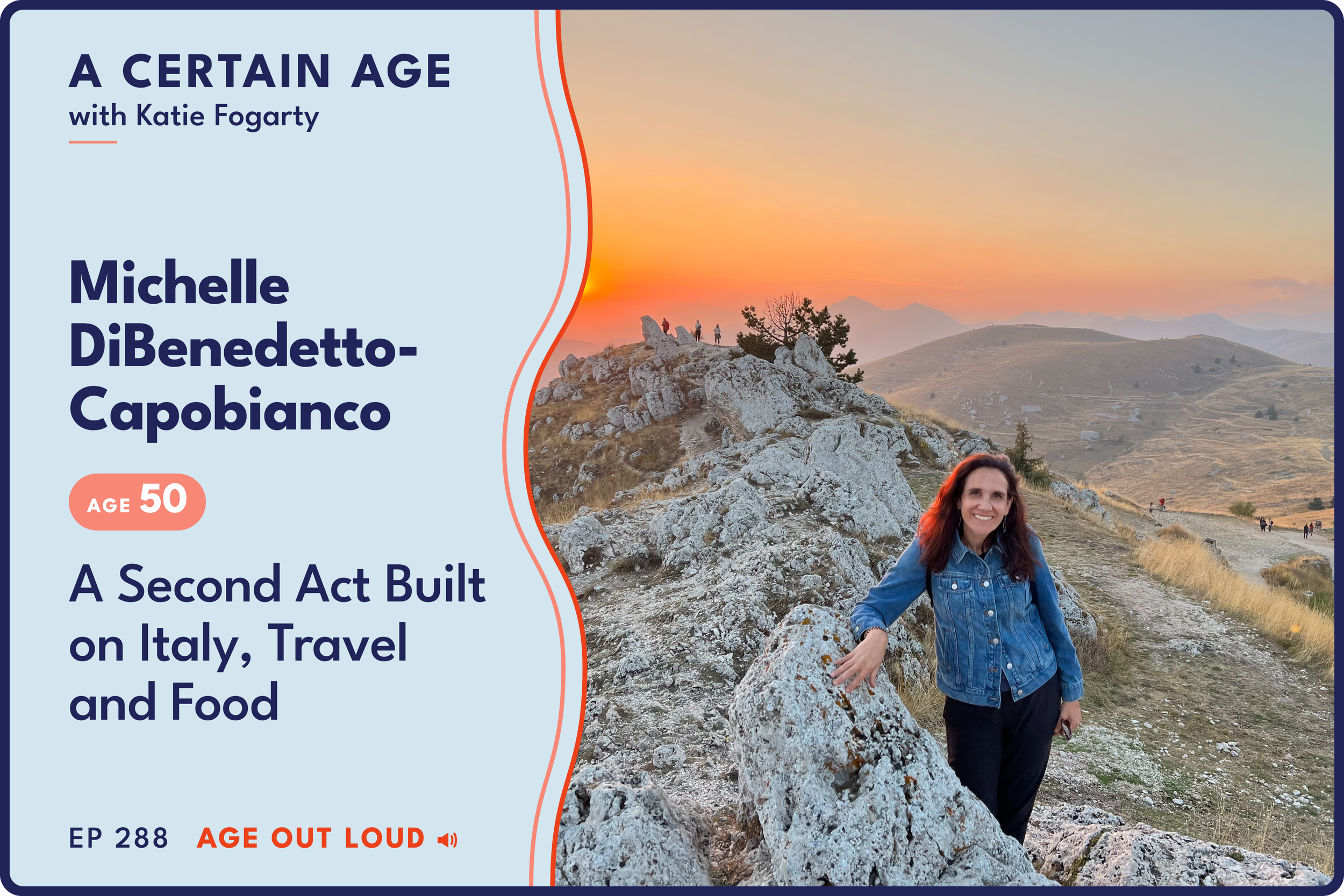
A Second Act Built on Italy, Travel and Food with Michelle DiBenedetto-Capobianco
Show Snapshot:
Plenty of people daydream about quitting their job and moving to Italy. Michelle DiBenedetto-Capobianco built a life around that daydream, though not in the way you'd expect. The corporate-lawyer-turned-entrepreneur now splits her time between running a cooking school on Long Island and leading small-group trips through Italy's under-the-radar corners.
In this episode:
Michelle's full identity pivot, from corporate law to a culinary career to Abruzzo and beyond
The parts of Italy tourists miss entirely on their way to Tuscany
Why "traveling deeper" beats checking boxes on a bucket list
A farro-peach salad recipe worth making tonight, plus the one-line mantra Michelle credits with helping her reinvent her own life
About Michelle DiBenedetto-Capobianco: Michelle DiBenedetto-Capobianco is the co-owner of The Cooking Lab in New York and founder of Majella Tours of Italy, curated small-group trips through Abruzzo, Puglia, the Dolomites, and the Italian Riviera.
Show Links:
Follow Michelle:
Quotable:
"We only have one life to live. That's it, there's only one life to live... find the thing that makes you feel like you're going to matter, to yourself and to the world."
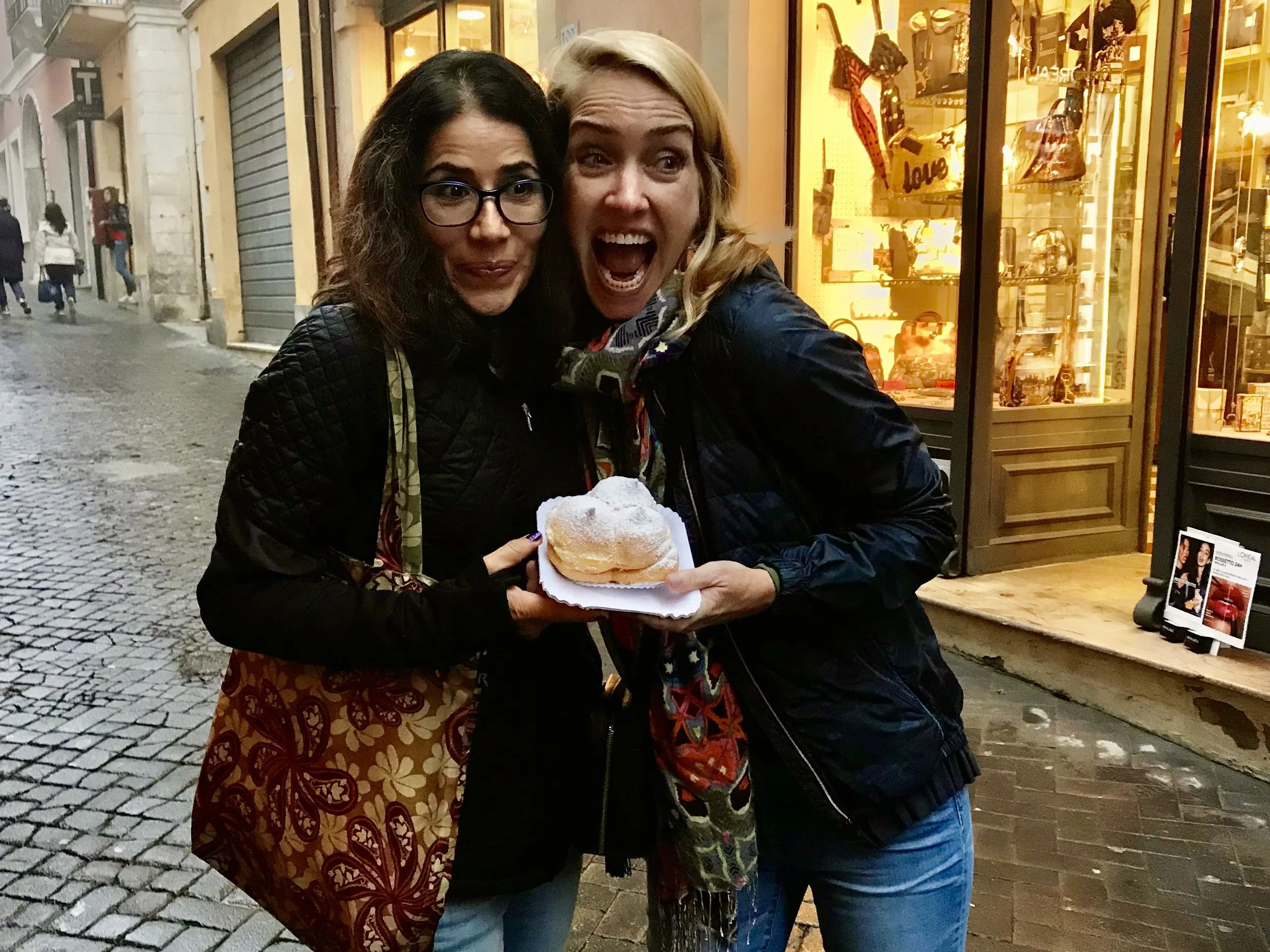
As promised during the show, a photo of host Katie Fogarty with first ever ACA guest Dr. Anita Sadaty with the pastries called nun's breasts' — sise delle monache, made by cloistered nuns in the town of Guardiagrele, Abruzzo.
Transcript:
[00:03]
KATIE FOGARTY: Welcome to A Certain Age, a show for women who are unafraid to age out loud. I'm your host, Katie Fogarty. Beauties, close your eyes for a second. Picture this: cobblestone streets, the smell of fresh herbs and pasta, a glass of local wine, and a vast mountain range stretching through unspoiled, under-the-radar Italy. Now picture saying goodbye to your corporate law career to make travel and culinary experiences your life's work.
Some people travel in a straight line. Others take the fork in the road. My guest today arrived at one of life's mile markers and asked herself: Am I living the life I want? Or can I create something entirely new? Today we are exploring that answer. I am joined by a wonderful friend, Michelle DeBenedetto-Capobianco. Michelle is the daughter of Italian immigrants, a mom of three boys, a recovering corporate lawyer, and the owner of The Cooking Lab, a culinary school in Port Washington, New York, where I recently lived — more on that soon. She is also the founder of Majella Tours, which offers small-group, experience-based travel through the Abruzzo region of Italy and beyond — think Puglia, the Italian Riviera, and the Dolomites. Michelle and I co-led a trip to Italy together, and there is no better guide to the Italy hiding in plain sight, and no better example of reinventing yourself on your own terms.
Today we're talking about how to reimagine your life, what to eat, drink, and do to experience Italy like a local, recipes that let you bring Italy home to your own kitchen, and why undiscovered Abruzzo needs to be on your radar as a bucket-list trip. Michelle, welcome to A Certain Age.
MICHELLE DEBENEDETTO-CAPOBIANCO: Hi, Katie, thank you so much for having me.
KATIE FOGARTY: I am so excited about this. I moved from Port Washington nine months ago. One of the things that I missed most about that town, aside from the stunning sunsets over Manhasset Bay, is seeing wonderful people and friends like you. So I'm so thrilled that I am seeing you behind a podcast mic for this conversation today.
MICHELLE DEBENEDETTO-CAPOBIANCO: Well, Katie, Port Washington also misses you very much.
[02:19]
KATIE FOGARTY: I'm excited for this conversation, and we are getting into it all. I had such a phenomenal trip to Italy with you several years ago, and I want you to bring listeners today into that experience. So let's start with some stage setting. You went from corporate law to culinary school owner to travel tour leader — that's not a small pivot, it's a full identity shift. What cracked this pivot open for you, and what surprised you most about who you are today on the other side?
MICHELLE DEBENEDETTO-CAPOBIANCO: Well, yes — truly a life-changing pivot for me. The only reason I even went to law school was because I was the daughter of Italian immigrants. It was my senior year of college, and I'll never forget the moment I was in the library and said to myself, "My God, my Italian immigrant parents just paid all this money to send me to college — what am I doing next?" And I said, well, okay, I don't think it's too late to apply to law school, maybe I should just do that. So I made what I think was a bit of a rash decision, signed myself up for an LSAT course, got some applications for law schools without doing much research, and applied. I got in, I went to law school, and I came home after my first day and said to my roommate, "My God, I don't think this is for me." And she said, "What do you mean?" And I said, "I just don't think this is for me. I don't think this is something that's going to feed me." But I am the daughter of Italian immigrants — I finish what I start. I wanted to make my parents proud. I was only 22 years old. So I stuck it out. Then I got a job at a large law firm. I did well; I was being groomed for partner at that point, and I made mid-level associate. But I was never happy. I was never happy. I stuck around at the firm for six years. I'm not saying I would come home and cry every night, but I definitely came home and said, "My goodness, nothing is inspiring to me, nothing is exciting to me — I'm just doing this because it's a job. Is this the way it's going to be my whole life?" And at that same time, as my outlet and my escape, I turned to Italian cuisine. I would come home and pore over cookbooks.
[04:41]
I would really start to research regional Italian cuisine. My parents were from two different regions of Italy, and I became so fascinated with all things having to do with Italian gastronomy. I stuck with it until the point when I couldn't stick with it anymore — and that point was when I became pregnant with my third child. I had three kids under the age of four at one point, and I said, "I can't do this. I can't do these hours. I can't live this life." I took a little foray into in-house counsel for a client, thinking that would be better for quality of life, but it was basically the same work — it wasn't inspiring, it wasn't fun at all. And again, we all know work isn't always fun, even when you're doing something you love. But I wanted something that was at least going to get me excited to wake up each morning.
So it was the most difficult decision I have ever made, because it felt like a complete shift in my identity, even though I was 32 years old. I still didn't want to disappoint my parents, who were so proud of their daughter, the lawyer. But I really thought hard and reflected — we only have one life to live — and I left it. I stayed home for a few years with my three little boys. I quickly got a little antsy, but two things happened that gave me an opportunity. Even though I had these three little boys, somehow I found myself doing more cooking. I started puttering around and experimenting with food, with different types of Italian cuisine, really trying to perfect my hand at it. And I found myself with more time to travel to Italy, particularly in the summers, because my husband's an educator, so he had summers off.
So every single summer we started packing up the kids and going to the village in Abruzzo, Italy, in central Italy — I'll talk more about that later — where my dad was born. We started spending our summers there, and the kids essentially learned how to ride bikes in the piazza in that small village. I started making my way into every single person's kitchen that would allow me in —
[07:08]
— whether it was my neighbors, local restaurateurs, farm owners, B&B owners. That's really where I got my culinary education — they taught me how to cook, they taught me about the traditions of Abruzzese cuisine. From there, I started my own little cooking business from home, which eventually led to a few cooking classes, and eventually to opening a cooking school.
KATIE FOGARTY: Let's fast-forward to your Abruzzo tours, because you've been leading tours in this beautiful region since 2017. Many of our listeners have probably never heard of it, right? Tuscany gets all the Instagram posts, everyone goes to Rome — it's on the bucket list — but Abruzzo has your heart. You alluded to that, you're connected through your father. What made you decide to lead tours to this particular underrated spot of Italy?
MICHELLE DEBENEDETTO-CAPOBIANCO: During all of these summers that I began spending in Abruzzo — obviously I spent a lot of time there as a child too; many of my summers were split between Abruzzo and Sicily, where my mom was from. The reason I started traveling to Abruzzo as an adult, and especially as a young parent, is because we actually had our own house there. My dad and his brother and my grandmother kept a house in this village.
I really think that seeing this place through the eyes of my young family, as a young mother, is what made me understand how special it was. It's a region where life is still being lived in a very authentic way. Nothing is polished, nothing is Instagram-ready. Abruzzo is truly — it's almost as if it's a part of rural Italy where time has stood still in many ways, but where young generations are trying to find their mark, trying to figure out what their contribution is going to be, in a place that was truly isolated from tourism for years because it's a mountainous region. We're talking about 30% national parkland.
[09:25]
KATIE FOGARTY: Staggeringly beautiful. Could you quickly paint a picture for our listeners? What are we seeing in the topography? What does the geography of Abruzzo offer a traveler?
MICHELLE DEBENEDETTO-CAPOBIANCO: So Abruzzo is considered the region — it's called La Regione del Mare e Monti, mountains and sea. We have the highest mountain range in Italy after the Alps: the Apennines. The highest peaks are found in Abruzzo. We have three different national parks there, and the mountains all look a little different. You have the Gran Sasso, which has almost this primitive feeling — everything is a little barren and rocky. But then you have my part of Abruzzo, the Majella — which is what my tour company is named for, named after that mountain. It's considered the mother mountain of Abruzzo — very green, very fertile, almost like the Majella is giving you a warm hug. I know that sounds a little gimmicky, but it's really true — generations have taken real strength from those mountains because they feel it. She's very much the feminine; she's considered the mother, whereas the Gran Sasso is considered her son, the masculine. She's named after the goddess Maia, who is said to have died up in those mountains as a sacrifice for her son. She's right across from her son, the Gran Sasso, so she's able to look over him every single day. There's something very mystical about these mountains. This part of the region is very green, spring wildflowers everywhere.
But then you're only one hour from the coast — it's on the Adriatic side, the eastern coast of Italy. There are parts of the coastline that are still truly unspoiled, with these almost mysterious, spider-like fishing platforms called trabocchi. Do you remember them?
[11:38]
KATIE FOGARTY: Katie, though — I remember the trabocchi! That crazy meal, right? Oh my gosh — listeners need to understand, I want everyone to think about that famous I Love Lucy episode where the conveyor belt of chocolates comes down and Lucy and Ethel are forced to eat them like maniacs, just shoving them in their mouths. We had this unending, unspooling seafood dinner where every time I turned around there was another dish groaning with marvelous, phenomenal seafood — I felt a little like Lucy trying to keep up. It was a once-in-a-lifetime meal.
MICHELLE DEBENEDETTO-CAPOBIANCO: It truly is. And it's right on these ancient fishing platforms that no one knows exactly how they originated. One theory of their origin is that immigrants newly arrived from inland Spain, during the Spanish Inquisition, were thrust into Italy and settled there. But they were afraid — they knew they had to make a living from the sea, but they had no experience fishing. So instead of going out on boats, they built these fishing platforms, and they traded with the farmers in the hills right behind them.
What's interesting is that the coastal cuisine in this part of Abruzzo is very much a mix of land and sea. But instead of meat, you have these coastal farmers cultivating different legumes, bartering and trading with the fishermen. In many parts of coastal Abruzzo, you have stews that combine, for instance, mussels and borlotti beans.
KATIE FOGARTY: Ugh, the food is so wildly good. Michelle, we're heading into a quick break, but when we come back, I want to explore a little more about the food in the Abruzzo region, how it differs from the rest of Italy, and also some of the other trips and foods you expose your guests to. We'll be back in just a minute.
[ AD BREAK ]
[13:46]
KATIE FOGARTY: Michelle, we're back from the break. Before we went into it, we were talking about the trabocchi and the seafood caught and consumed on these wonderful, otherworldly restaurants. How does the food in the Abruzzo region beyond the Adriatic coast differ from the rest of Italy? Is there a particular dish, cuisine, or ethos that home cooks and restaurants use to serve their food?
MICHELLE DEBENEDETTO-CAPOBIANCO: I think "ethos" is really the right word, because Abruzzo was historically a very, very poor region. Even though we're located in central Italy geographically, culturally we're very much part of the Italian south. And the Italian south, including Abruzzo — the cuisine is rooted in la cucina povera, peasant cuisine, essentially making do with nothing. I think one of Abruzzo's most iconic dishes really represents this cucina povera: it's called pallotte cacio e ova — in dialect; in standard Italian that would be polpette caccio uova. In English, they'd be meatballs made of bread, eggs, and cheese — meatless meatballs. And by the way, controversial perhaps, they're so much better than meaty meatballs. I don't know if we tried them, Katie — I hope we did.
KATIE FOGARTY: Somewhere along the way. I remember so many meals. I remember the wonderful little grilled meats on a skewer we had somewhere — a specialty of that particular town we were in. I lost track of how many I ate. It was incredible.
MICHELLE DEBENEDETTO-CAPOBIANCO: Well, it's true — they're meant to be eaten by the dozens. I'll talk about those too.
KATIE FOGARTY: Definitely, we all did.
MICHELLE DEBENEDETTO-CAPOBIANCO: But these pallotte cacio e ova — the idea is that these poor mountain farmers, mountain shepherds, these poor peasants in Abruzzo, would take their leftover scraps of bread, soak them in milk or water, and turn them into essentially what makes up a meatball. Mix them with eggs, mix them with cheese, form them into fritters, fry them, and then stew them in tomato sauce.
[16:09]
There was no waste. This was a way of wasting nothing but nourishing their families. And to me, these are just so absolutely delicious. This is why, when you used the word "authentic" before to describe the experience of spending time there, it's so spot-on — because this was sustainability before it was a buzzword.
KATIE FOGARTY: That's right.
MICHELLE DEBENEDETTO-CAPOBIANCO: Right — this is really just making the most of the land and everything you have, true farm-to-table, using everything, which is something people work to cultivate today, but there it's just baked into the food and the way people live their lives.
KATIE FOGARTY: What are some other dishes that you feel are true revelations of what makes Abruzzo so special?
MICHELLE DEBENEDETTO-CAPOBIANCO: Well, the arrosticini that you referenced are lamb skewers — well, actually not lamb, it's actually mutton. We've translated them into "lamb skewers" here because we can't find the older sheep, but it also speaks to the character of Abruzzo — these aren't beef skewers, they're not pork skewers, they're lamb skewers. Abruzzo is a pastoral land, sheep country — it's one of the symbols of the region. It's called la transumanza — the journey shepherds took with their flocks of sheep. They went up to the highest mountains of Abruzzo — for instance, Campo Imperatore, one of the highest alpine plateaus in Italy — in the summertime, to protect them, because it was warm and the sheep could survive. But then, come September, they would travel down to the lowlands of Puglia, to protect them from the cold, snowy, fierce winter in the mountains of Abruzzo. This was the entire journey, every single year. And what's so fascinating is that the ones left to take care of the villages, to take care of life in the villages, were the women. There's often a joke that everyone's birthday is around the same time of year —
[18:26]
— because the shepherds would come back to their families at a certain time of year.
KATIE FOGARTY: Oh my god! And the whole town — and by the way, I'm crying, that is so funny.
MICHELLE DEBENEDETTO-CAPOBIANCO: Totally. And, by the way — if someone was born —
KATIE FOGARTY: Of course —
MICHELLE DEBENEDETTO-CAPOBIANCO: — out of season, this is quite scandalous. Who do you think — who's the only man left in town? Can you guess?
KATIE FOGARTY: Oh my god, the priest?
MICHELLE DEBENEDETTO-CAPOBIANCO: Yep. Yep.
So there's so much women's history that's part of these villages. These villages were basically taken care of throughout the year by women — women who would take the wool from the sheep and dye it. There are porticos in some of these shepherding villages where you can still see the soot on the roofs, because that's where these women would gather with their cauldrons. They would take, for instance, the Montepulciano grapes — Abruzzo's signature wine — take the skins of the grapes and turn them into dyes. They would use saffron — not the actual threads, because those needed to be sold for tons of money, saffron is so valuable — but they'd take the scraps of the saffron flowers and turn them into dyes for the wool, so the women became an integral part of the economy as well.
KATIE FOGARTY: I'm going to pop in here to say that on the trip Michelle and I co-led, there was a saffron-harvesting experience. I'm trying to remember the place we were — but the man who owned this particular — Alessandro! Alessandro, who owned this particular beautiful — I don't even know what you'd call it, a farm, a saffron farm. But he had all the flowers laid out, and we had to delicately remove the saffron fronds, or threads.
MICHELLE DEBENEDETTO-CAPOBIANCO: The crystals, the threads, exactly.
KATIE FOGARTY: That then needed to be toasted and then sold. At one point, this basically paid for women's dowries. It taught me why saffron is so expensive, because there's this laborious, delicate, human-centric operation to remove these threads and then toast them very carefully. It was a —
[20:51]
— super cool experience. And we use saffron all the time, because my husband loves to make paella and incorporates it into other rice dishes — he loves to cook. I'll say I also came home from this trip with a really wonderful souvenir, and I'm going to ask Michelle to share some souvenir recipe ideas with you. But I came home with a chitarra —
MICHELLE DEBENEDETTO-CAPOBIANCO: Right, a chitarra.
KATIE FOGARTY: Yeah — a guitar — which is a long wooden tool that looks like it's strung almost with guitar strings, which is why it's called the chitarra. You make pasta with it, and we use that all the time too. So, since our listeners aren't in Abruzzo with us and can't harvest saffron and leave with their own chitarra — what would be a dish you'd recommend for the clients who travel with you? What can they take home easily — something the home cook can make in their own kitchen?
MICHELLE DEBENEDETTO-CAPOBIANCO: Sure — anything with farro. Farro is one of the most ancient grains in central Italy. Thousands and thousands of years ago it was turned into a mush called puls (P-U-L-S) — that's the root word for "polenta," basically; it was an early polenta. Roman soldiers used to keep it in their satchels to stay nourished before going off to battle.
For many, many centuries after that, it was abandoned. Then, in the past 30 or 40 years or so, it's been brought back by new generations and recultivated. What's great about farro, and so many of these ancient grains, is that it's a blank canvas — you can turn it into soup, add it to salads, do anything you want with it. In the summer, there's nothing I love more than looking in my pantry or going to the farmers' market and playing around with ingredients to make a farro salad. My favorite doesn't necessarily come from Abruzzo, but from my own imagination — using farro with a little bit of sweet, really good-quality balsamic vinegar, peaches, pine nuts, and arugula. It's light, fresh, and easy.
[23:12]
KATIE FOGARTY: Are the peaches raw and chopped, or do you grill them?
MICHELLE DEBENEDETTO-CAPOBIANCO: Nope — you can do either. Ripe peaches don't need to be grilled; if they're a little under-ripe you can grill them a bit more to caramelize them. But if it's a super ripe peach, or a nectarine — actually I'd even prefer nectarine, because you don't have to peel it — you really don't need to do anything, just chop them up.
KATIE FOGARTY: Love it. What's another summer dish from Italy that you look forward to when you're there?
MICHELLE DEBENEDETTO-CAPOBIANCO: So I'm going to shift a little to Puglia. One summer dish I love — because Puglia is even further south than Abruzzo, and shares that same la cucina povera tradition — is called ciaredda: a rustic, cold, stale-bread salad, very similar to panzanella but with a distinct regional twist, with the addition of not just tomatoes, cucumbers, and stale bread, but also olives, capers, and oregano. That's where the regional twist comes in — that super-southern-Italian, strong, sun-kissed flavor of briny olives, capers, and anchovies too. You soak the bread — you can toast it a little, or just soak it briefly and let it do its thing — with some red wine vinegar, super ripe tomatoes, and basil. In Puglia, they actually use a cucumber that's a cross between a cucumber and a melon.
KATIE FOGARTY: Can we find that in the US?
MICHELLE DEBENEDETTO-CAPOBIANCO: We can't, but what you could do is use a super sweet, ripe cucumber, or an under-ripe honeydew — the inside of it, not the outside, because the exterior would be too under-ripe. You could chop up the heart of it, and it'd be really interesting.
KATIE FOGARTY: I feel like I always have under-ripe honeydew because I'm a bad guesser — so now I know what to do with it!
MICHELLE DEBENEDETTO-CAPOBIANCO: Exactly — use the interior, chop it up, mix it with the tomatoes, some oregano, and —
[25:36]
— the capers and olives go beautifully in there too.
KATIE FOGARTY: I love this. So, you've led Abruzzo trips for many years — you just mentioned Puglia, which I know is one of your expanded offerings. What made you go beyond Abruzzo to add some of these other regions of Italy? Can you share with our listeners what they are and why you love them?
MICHELLE DEBENEDETTO-CAPOBIANCO: The reason really was my clients. One of the things I'm proudest of in this tour business — I think I just counted — is something like 40 repeat clients who've come on different trips with me. Not just different trips — a few of them have come back to Abruzzo two or three times, which to me shows so much. It's not about me, it's about Abruzzo, and about the hospitality they were shown, and the fact that they wanted to experience that again. But many of these clients said, "Okay, when are you going to some other regions? I'll join you anywhere, whenever you want, but I want to explore different areas of Italy with you." So last year, 2025, was the first time I added two new regions — Puglia and Matera. That felt like a very natural marriage, because that's pretty much the region directly south of Abruzzo, and it shares many cultural similarities. But Puglia is just sun-kissed. Whereas Abruzzo has this quieter, rustic beauty, Puglia's a little more in-your-face in terms of color and vibrancy. There's something very Greek about it — especially these white towns, shockingly white, on this crystal-blue sea. But then I felt really strongly about not just exploring Puglia but also the neighboring region —
[27:58]
— Basilicata is the region that neighbors Puglia, and that's where the ancient city — we're talking about the 7,000-year-old city of Matera — is, with these ancient cave dwellings. It's a city of caves with a fascinating history, and it's also known throughout Italy for its very distinct cucina povera, including peppers called i cruschi peppers, that they dry and then rehydrate and fry, or turn into sauces throughout the year. They grow these peppers in the summer, then dry them and use them throughout the year, again as a means of sustenance that's now become part of the culinary fabric of that region. I really loved how much food is part of culture and identity in Puglia and Matera.
And then last year I also added Liguria, which most people know as the Italian Riviera — which is just fun, what can I say. The colors, the colorful, technicolor villages on the sea. But there's so much more to it than just Cinque Terre, than just Portofino. There are towns no one has heard of — I don't like to say "waiting to be discovered," because I don't want them to be over-discovered. I want them to stay charming and not become just another Instagrammable opportunity, but instead retain their true character. It's one of the smallest regions in Italy, but so rich, both in culinary culture and its own maritime culture.
KATIE FOGARTY: You're talking about smaller, undiscovered, charming regions that people don't necessarily have on the typical Italy itinerary. I want to switch gears now and ask you a bit about — I know why you started focusing on Abruzzo, your family connection — why are your small-group tours so intentional? I know you use a phrase with Majella Tours — you promote a philosophy of "travel deeper." What does travel deeper mean to you, and who is the ideal Majella Tours traveler?
MICHELLE DEBENEDETTO-CAPOBIANCO: My very first tour was in 2017. I had this now-or-never moment and said, okay, I'm going to try this. People had been telling me for years, "I wish I could explore Italy as deeply as you do." So there it is — that idea of traveling deeply. And traveling deeply, to me, means the people —
[30:18]
— it means the people on both ends. It means the people you're meeting — and, Katie, you referred to the saffron harvester, you remember him, Alessandro. You remember Francesca, the olive oil producer and sommelier. And your beautiful hiking guide, Daniela, is still my beautiful hiking guide — amazing hikes to these little hidden hermitages on top of a mountain. It was extraordinary.
We can all remember places, right, somewhat — but it's the people who really stay with us, who really brand themselves into you when you travel. So I'd say my trips are very people-focused — a real insistence on local guides. I'm the tour leader, I'm the person who puts it all together — someone once called me "the sherpa." I like to think I'm also a cultural bridge, introducing my clients to the people doing everything they can to preserve the culture, customs, and cuisine of these regions. I want a traveler who's going to be open, who wants to travel deeply, who wants to crack the surface and not just pause every second to take the best photo for their Instagram feed, but instead travel a little more purposefully — to be a participant rather than just a voyeur.
KATIE FOGARTY: Than a spectator.
MICHELLE DEBENEDETTO-CAPOBIANCO: Exactly. Absolutely.
KATIE FOGARTY: So I said earlier — and for listeners wondering, "How on earth did Katie co-lead a trip to Italy with Michelle, what's her background?" — we did a sort of women's leadership, week-long trip where we got to enjoy Italy but also had some workshops on asking questions of ourselves, what we wanted to do with our lives, and how we might want to reimagine or reinvent. It was a wonderful experience, so I got a chance to see you operate on the ground. But for listeners who haven't done that — walk us through what a day, a morning, a week looks like on a Majella Tours trip. And what are some of the trips you have planned over the next 12 months?
MICHELLE DEBENEDETTO-CAPOBIANCO: Some of my trips are purposely all-women — they're absolutely women's trips.
[32:38]
My other trips, the ones I just leave open to all, end up being either 75 to 100% women. That's just the way it's evolved, even from 2017 — and I absolutely love it. I love when I have all these women from different parts of the country sharing their experiences, both in Italy together and in their life experiences. But a few years ago, a friend of mine — she's become a friend, Mira — she and her cousin Debbie were on a trip in Abruzzo, and they created a little award ceremony for the last night of our trip, where they gave everyone little awards. My award was being able to successfully fit 30 hours within a 24-hour day.
KATIE FOGARTY: So you're a little — we're talking packed. You've got a packed week!
MICHELLE DEBENEDETTO-CAPOBIANCO: Okay, so I'm a little go-go-go — my trips are definitely a little more go-go-go, but there's always some downtime, always some time to relax. I just had this dream Dolomites trip with a group of 12 women — it was my first non-food-focused trip ever. Last year, when I visited the Dolomites for the first time with my family, I was hiking these trails and said to myself, "My God, imagine doing this with a group of women — how cool would that be?" I mentioned it to a client who's come on three different trips with me, and she said, "I'll be the first person to sign up." On this trip, we hike from 9 to 3 p.m., with breaks in these amazing mountain refuges for lunch, and then you have the evening free.
So we're go-go-go, but then you have the evening free. Other trips — take Puglia, where in the morning you'll have a cooking class, then a really cool boat tour, then a few hours free, then an amazing dinner. I really try to focus on what the region offers, and craft it so everyone sees the greatest hits —
[34:56]
— but I also want you to have some time to explore on your own. One new trip for 2026 is Parma and Bologna, in the Emilia-Romagna region — the food valley. I really struggled with whether to base myself in one of those two cities and do day trips, or stay in both. In the end, I decided we'll base ourselves in both — four days in Parma, three days in Bologna — because I want people to experience the nightlife, the energy of the evening passeggiata culture in both cities, which is quite different. Bologna has this raw, magnetic energy — it's a university town, young people everywhere, singing in the piazza. At any point you'll have groups of students bursting into songs and sing-alongs. It's the coolest place in the world — it's where I would move right now, if I could move to Italy tomorrow, I'd move to Bologna.
KATIE FOGARTY: Well, this — I have to go to Bologna, because if you're willing to leave Abruzzo for Bologna, I need to check this out.
MICHELLE DEBENEDETTO-CAPOBIANCO: If — that's where I'm at right now. I was really able to spend a lot of time in Bologna this past year and a half — my son studied abroad there.
KATIE FOGARTY: So you got to know it well.
MICHELLE DEBENEDETTO-CAPOBIANCO: Oh, that's hysterical — he's like, "Mom's visiting again, you have no idea, here comes mom again." Oh my god, poor guy — his first two weeks into his study abroad, semester abroad, I happened to be "passing through" because I was on my way to the Riviera.
KATIE FOGARTY: That's the same thing!
MICHELLE DEBENEDETTO-CAPOBIANCO: And I said, "Well, Mikey, I'm literally passing through, maybe I'll just stop in." And for two weeks — thankfully it was only an overnight, okay, both times it was an overnight. But, by the way, he's no fool — he got free meals out of it, so it was all good, and mom knows how to pick the restaurants, by the way.
KATIE FOGARTY: Of course — everyone's a winner. I love this.
MICHELLE DEBENEDETTO-CAPOBIANCO: Exactly. But then there's just the juxtaposition — in Parma, this very genteel, elegant, refined city, where basically the passeggiata is an opportunity to put on your new fabulous Max Mara coat.
[37:14]
So I really wanted this trip to be both cities — they sound so distinct, so different.
KATIE FOGARTY: And I think that's the point — don't get locked into just one thing.
MICHELLE DEBENEDETTO-CAPOBIANCO: Really, yes.
KATIE FOGARTY: Okay, so we might be a little busier — but actually, that's a great segue. Don't get locked into one thing, because I do want to ask you a few more questions about this transition, how you made it, before we wrap our time. So many of us, like I said at the top of the show, are locked into one lane. We're locked into one thing. Others either seek out the fork in the road, or the fork in the road is thrust upon them — for whatever reason, change comes, whether you like it or not. So for a woman who's listening right now, who's maybe sitting in a career she's outgrown, or a phase of life she feels she's outgrown, what might you say to her to help her consider a leap, or to make a successful leap?
MICHELLE DEBENEDETTO-CAPOBIANCO: The only thing I can say is what I told myself: we only have one life to live. That's it, there's only one life to live. And I don't say this with naivety — people need to make money, people need to support their families, people need to fulfill their responsibilities, whether to children, parents, or their community, whatever it is they have. But at the end of the day, you also have a responsibility to yourself. And if you're not happy — if you're going to work every day saying nothing is filling me up, the only thing fulfilling about this is the paycheck — which is what happened to me all those years ago when I was still practicing law. Yeah, I loved the shoes and bags I was able to buy, but it's lonely at the end of the day with your shoes and your bags. I really felt like, how am I going to feel like I matter? I want to matter — but what does that mean to me? Because we all just want to matter in some way, shape, or form — to the world, to ourselves, whatever it is. Find the thing that makes you feel like you're going to matter, to yourself and to the world.
KATIE FOGARTY: "You only get one life" is wonderful big-picture advice. What's a practical piece of advice you'd give somebody — something you really think is a lever —
[39:39]
— for making whatever pivot they're making successful? It can be super practical, weird, wonky.
MICHELLE DEBENEDETTO-CAPOBIANCO: Yeah — if you have a single curiosity, right, if there's something you've always wondered what it would be like — you have every resource out there to start researching it. Ask, "What could I do to actually make this part of my life, or part of my work?" Do the research, talk to people, talk to your girlfriends — say, "Do you know anyone who's worked in this realm? Can you connect me with them?" Katie, you are the great connector — I don't know how much your listeners know this, but Katie is one of the most amazing connectors in the world. There have been so many times, when I was living in Port Washington and I was stuck, I'd say, "Okay, Katie, what can I do to grow this or that?" And Katie would have a million different ideas — "you can talk to this person, you can talk to that person." Use your network to fulfill your curiosities and take the next baby steps.
KATIE FOGARTY: Thank you so much, Michelle — thank you for saying that, it makes me feel so good, because I do love connecting people and putting amazing people together. I'd say, to build on what Michelle said about using your network — also don't be afraid to grow a new one. Because sometimes your desire, your dream, where you're heading next, requires a new community. I learned that through podcasting, when I launched this — I got connected to a group of women interested in both the midlife space and in podcasting, and they became a community that helped me grow this. So if you have a new goal out there, there's a community of people who are lit up by that too — go find them.
Okay, Michelle, we're nearing the end of our time together. I want to ask you one last question. For somebody listening right now on their AirPods, on a run, in a car, at their desk, thinking, "I want to go to Italy" — you're obviously going to let them know how they can go with you in just a minute — but when they land, what's the first thing you're going to recommend they eat?
[41:55]
MICHELLE DEBENEDETTO-CAPOBIANCO: Okay — so this is like a weird one out of left field. It's not out of left field at all, actually, because there is no one answer. There is no one answer, because — don't go to Rome and try to eat pesto, don't go to the Italian Riviera and try to eat carbonara. Italian cuisine is so regional — eat what the locals are eating. So if you go to Rome, go stuff your face with a maritozzo, this sweet bread filled with cream — that's the quintessential pastry to have with your cappuccino in Rome. If you're in Florence, fill yourself up with white beans, cannellini beans, because that's what they're eating — they're the bean-eaters, that's what you eat in Florence. If you're in Puglia, eat focaccia until you can't take any more focaccia, because — but lean into the regional cuisine of Italy. I can talk about this all day. Don't just think you're going to sample what we think of as "Italian food" in every destination — lean into the regional cuisine, because that's how you understand the culture and traditions of that particular town, city, or region.
KATIE FOGARTY: I love that, I love that. In fact, I'm thinking of those "nun's breasts" we had with you — sise delle monache, made by cloistered nuns in the town of Guardiagrele, passed through a little window — but they were also meant to represent the mounds, the rounded peaks of the Majella. The Majella doesn't have jagged peaks, she has rounded peaks — so they're also the Majella peaks.
MICHELLE DEBENEDETTO-CAPOBIANCO: Soft, rounded pastry peaks.
KATIE FOGARTY: That's really the picture from this trip, with my very first podcast guest, Dr. Anita Sadati, who was on this trip with Michelle and me so many years ago — we're holding these delicious pastries. So for anyone who's curious, I'll put those in the show notes when the episode is live — you can pop over and see these puffy pastries in action. Michelle, this was so much fun. Before I say goodbye, though — how can our listeners find you, learn more about your trips —
[44:19]
— and follow all of your culinary adventures?
MICHELLE DEBENEDETTO-CAPOBIANCO: Well, you can definitely check out my website, but also, obviously, on Instagram and Facebook, you can find me at Majella Tours. It's Majella with a J — it's a little weird, it reads and sounds like it's Spanish, but it's actually the Latin spelling for the Majella, again, which is the mother mountain of Abruzzo, where I took so much inspiration, and which inspires so many women too.
KATIE FOGARTY: I love it. Michelle, thank you so much for being with me today.
MICHELLE DEBENEDETTO-CAPOBIANCO: This was — thank you so much, so fun, you are just the best.
KATIE FOGARTY: This wraps A Certain Age, a show for women who are aging without apology. What a phenomenal, immersive conversation — I can see Abruzzo unspooling before my eyes. Puglia is on my list, Parma too. Michelle paints such a wonderful picture of these towns, villages, communities she loves in Italy.
I adored this conversation — reconnecting with an old friend, hearing the story of a woman who reimagined her life in midlife, who chose a different path. It was so inspiring, so much fun to hang out with her. I hope you enjoyed the show as well. If you did, let me know in an Apple Podcasts or Spotify review. If you have your own Italy recommendations, I want to hear them — DM them to me, or share them in an Apple Podcasts or Spotify review. Reviews help other women find the show.
Thanks for sticking around to the end, and, as always, special thanks to Michael Mancini, who composed and produced our theme music. See you next time, and until then — travel boldly, beauties.
