
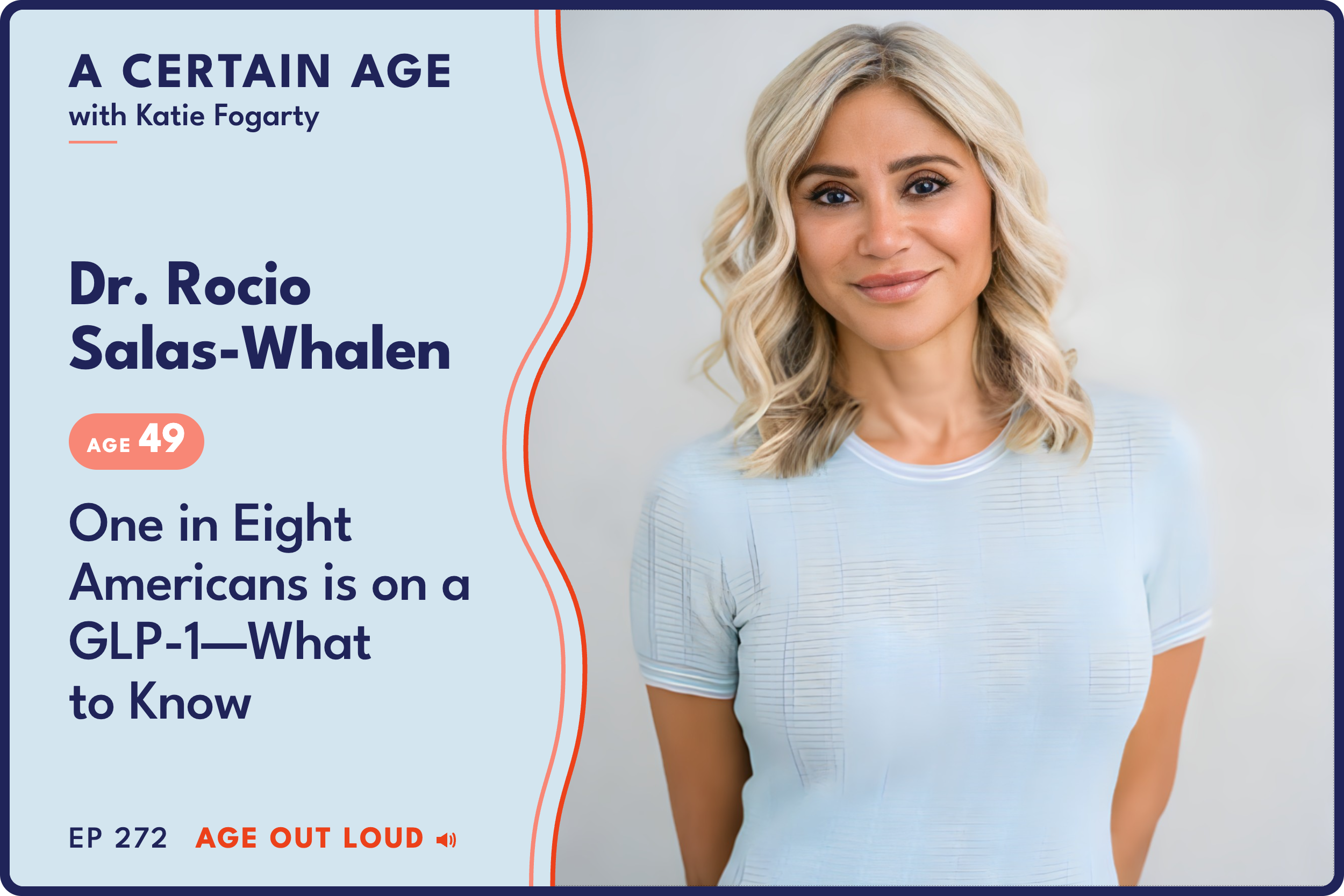
One in Eight Americans Is on a GLP-1 — Here's What Dr. Rocio Salas-Whalen Wants You to Know
Show Snapshot:
One in eight Americans is now on a GLP-1, and most of them got a prescription without the conversation that should've come with it. Return guest Dr. Rocio Salas-Whalen, board-certified obesity specialist and bestselling author of Weightless, sits down with Katie to have that missing conversation — the one your own doctor probably doesn't have time for.
In this episode:
Who's actually a good candidate for a GLP-1 — and who isn't
How to preserve muscle mass while losing weight on the medication
Whether "microdosing" GLP-1s is legitimate or just a TikTok trend
Foods to avoid while on the medication, and why muscle mass matters more than the scale
About Dr. Rocio Salas-Whalen: Dr. Rocio Salas-Whalen is a board-certified obesity medicine specialist and bestselling author of “Weightless.” A returning guest on A Certain Age, she cuts through GLP-1 hype and misinformation with real clinical guidance — from who's actually a good fit for the medication to muscle preservation and what your doctor probably isn't telling you.
Show Links:
Follow Dr. Salas-Whalen:
Dr. Salas-Whalen’s Book:
Find more Dr. Salas-Whalen on A Certain Age:
This is Dr. Salas-Whalen’s second appearance. Find her first episode here:
Quotable:
"When a patient comes to me, I tend to be their last stop. Many patients have seen many doctors, feel gaslit — and I can physically see the weight that they're carrying. And I'm not just talking about pounds. I can hear the years, and for some, decades of trauma, of shame, of guilt."
Transcript:
Katie Fogarty 0:03
Welcome to A Certain Age, a show for women who are unafraid to age out loud. I'm your host, Katie Fogarty.
If you have ever wondered whether GLP-1 medications like Ozempic could work for you, but felt too confused or overwhelmed to even know where to start, stay with us, because today's show is going to cut through the noise. One in eight Americans is now taking a GLP-1 medication — Ozempic, Wegovy, Mounjaro, Zepbound — you've heard the names, but here's what most people don't have: an expert in their corner who can help them use these medications safely, effectively, and with compassion.
Today's guest is changing that. We are welcoming back to A Certain Age Dr. Rocío Salas-Whalen, a board-certified physician and one of the country's leading experts in obesity medicine. Her new book, Weightless, already a national bestseller, is being called a game-changer by none other than Mel Robbins, who says it gives readers the science and the compassion this conversation has been missing.
In today's show, Dr. Salas-Whalen is going to blow up the myths you believed about weight, willpower, and midlife metabolism. You'll learn why "eat less, move more" sets people up to fail — and what actually works. She'll walk us through how to get the most out of GLP-1 medications, how to protect your muscle, manage side effects, and navigate the physical and emotional changes that come with real, lasting weight loss. Whether you're already on a GLP-1, thinking about it, or just want to know more about why this medicine is suddenly everywhere, this episode is for you.
Welcome back to A Certain Age.
Dr. Rocío Salas-Whalen 1:45
Thank you so much for inviting me back.
Katie Fogarty 1:47
I am really, really excited. We had a great conversation the first time you were on the show. Since then, you've taken all of your years of expertise, all the curiosity around this topic, and have created a really compelling, easy-to-read, user-friendly guide, and I'm excited to explore it. So one in eight Americans are now using a GLP-1 medicine — that's obviously a very high adoption rate — but I think there's even greater curiosity around these medicines. What made you decide the time was right for this book?
Dr. Rocío Salas-Whalen 2:18
Because I saw a great need for real, actual supervision of the medications. I can see the results when they're used the right way, but I can also see the results when they're not. And this book is basically your guidebook when you're starting, or even thinking about, a GLP-1 — and it walks you through every single step.
Katie Fogarty 2:43
And it does that so beautifully. It's really divided into three big sections. The first is about weight — we talk about obesity and some of the myths around weight loss. Then there's the middle part of the book, where you guide the reader through the journey: how do you get started, how do you manage dosing and side effects, and some of the benefits. And then the third part of the book is what comes next — how do you maintain, how do you perhaps go off the medicines, how do you manage weight, mindset, etc. So it really takes a reader through the entire arc of consideration. I want to ask you about the title, though, before we dive into the content. You call the book Weightless, and to be weightless implies both a sense of physical but also emotional relief. What made you choose that as the title?
Dr. Rocío Salas-Whalen 3:31
This book was realized, was made, was conceived, thanks to my patients, and the title goes along with what I saw my patients experience in this journey of weight-loss medication. When a patient initially comes to me, I tend to be their last stop. Many patients have seen many doctors and feel gaslit when they come to see me. I can physically see the weight that they're carrying — and I'm not exclusively talking about pounds, about physical weight. I can hear the years, and for some, decades of trauma, of shame, of guilt that they carry with them. And what I see when a patient starts this journey with me is that I can see them become lighter — but not only in weight, also emotionally. They start to feel liberated from the guilt and the shame, once they understand it wasn't their fault and that there's something we can actually do. I see patients become lighter and lighter until they're almost floating at the end of the journey. So I see patients become weightless — not only in physical weight, but in the emotional heaviness they've been carrying for years, and for some, decades.
Katie Fogarty 4:53
It's such an optimistic title, and the book really delves into not just the how-to, but kind of the why too, and a lot of the emotional burdens that you just discussed. We're going to get into all of it — the drugs themselves, the benefits, the risks, who's a candidate and who's not. But I do want to continue with a few more big-picture questions. First, a lot of people still think of weight struggles as a willpower problem. You alluded to patients coming in with a sense of shame, having existed in a physical body for years with both internal and external criticism around it. Talk to us a little bit about why weight struggles are not a willpower problem.
Dr. Rocío Salas-Whalen 5:35
I mean, we've come a long way in medicine and science to understand and see the truth about somebody struggling with weight. I grew up in the teaching that we had to ask patients to eat less and exercise more as the complete and only treatment that we had. At the time, we didn't know that there were other things causing somebody to have obesity, to struggle with weight loss, or to maintain weight loss. We always attributed it to the patient's fault for not improving. And I think that's another reason that drove me to write this book — to share with everybody what I've learned through my patients. What I learned through my patients is that they were doing every single thing that we were actually asking them to do at every single visit. And when we didn't see the results, we were asking them to eat less, exercise even more. The patients were actually following our recommendations. There's nobody who wants a person to lose weight more than the person carrying the extra weight themselves — so they would, physically, emotionally, mentally, and spiritually, follow everything we recommended, some even trying harder. But we know now that obesity is a multifactorial chronic disease. It's no longer just a risk factor for other diseases; it is actually considered a disease on its own. I think letting patients know that the weight they carry may not have been theirs to begin with is really important — it liberates the patient from that guilt. Because when we do that, the window — the door — for accepting treatment can open up. Otherwise, it won't.
Katie Fogarty 7:33
You've been prescribing GLP-1 medications since 2010, which is far before they became mainstream in the way that they are today. What was it like learning about GLP-1s as a physician? Why were you an early adopter?
Dr. Rocío Salas-Whalen 7:48
I had a pivotal moment when Dr. John Eng, the endocrinologist who isolated GLP-1 from the Gila monster — he was the first to isolate GLP-1 outside the human body — came and gave a talk at Albert Einstein hospital, where I did my residency. He was from the VA here in New York, in the Bronx, and he came to talk about this new medication that had been approved, that he had isolated, and the results they were seeing. I remember — I can still remember where I was sitting, what I was listening to, and the feeling I had. I saw the vision of it. I thought at that moment: this is a drug that is going to change everything we know. At that time, it was only for type 2 diabetes, but my passion in medicine — the reason I went into medicine — was type 2 diabetes. So having a completely different class of medications for type 2 diabetes, I was in awe. And it was a medication that didn't cause weight gain, because many of the anti-diabetic drugs we have, including insulin, can promote weight gain. We had never had an option for patients that could both improve their glucose and also make them lose weight. Before, we could either improve your glucose while you maintained weight, or we could try other approaches. So for me, it was just a very eye-opening moment that really marked the turning point of my career.
Katie Fogarty 9:17
In our first conversation, when you were on the show probably a year or so ago, a big "aha" takeaway for me was that these drugs have actually been around for a long time. I think they're very buzzy now — they're all over news headlines, one in eight Americans are taking them — so the casual observer might think this is a brand-new drug. But the reality is they've been around for decades, for people navigating diabetes. Before we get into the actual specifics of the particular drugs and how to use them, one last stage-setting question: what do you want the listener to know about the safety and efficacy of these drugs?
Dr. Rocío Salas-Whalen 9:56
I want them to know that these medications are pretty safe in regards to side effects and long-term effects, and they're very beneficial. But what's really going to determine those positives is how much expertise the provider — the doctor prescribing them — has to guide you through it. I think that's going to truly determine the outcome: how many patients have they treated, what have they learned, what is their expertise, and how are they basing the recommendation to start a GLP-1?
Katie Fogarty 10:37
Let's get into that. You have an entire chapter called "Are GLP-1s Right for You? Evaluating Your Candidacy and Risks." Walk us through what we need to know from this chapter.
Dr. Rocío Salas-Whalen 10:49
In my book, I give you a step-by-step guide on how to find the right doctor — what questions you should be asking from the moment you call to make an appointment. What are the green flags? What are the red flags? Patients should also be partners in this journey, and they need to do their due diligence before they start this medication. So ask the right questions when you call: How long has this doctor been prescribing these medications? Does the doctor do a body composition assessment? How does the doctor base their decision on starting you on a medication? What are the most serious complications the doctor has encountered in any of their patients treating with GLP-1s? That will give you a real window into what you can expect. If a doctor is not doing a body composition on your first visit, if they're not talking to you about exercise — which exercises are better, how to increase or maintain protein in your diet — then that's the wrong doctor. You need to go to somebody else, because all they care about is giving you the medication and watching the scale go down. And that doesn't mean success. That doesn't mean your health has improved. It can actually sometimes even be worse if we don't watch your muscle mass and body fat — if you're just losing weight, but losing muscle, that's not a win.
Katie Fogarty 12:10
That's a great checklist, and it makes it really easy for the reader to feel like they're becoming a smarter patient — and smarter patients ask better questions and get better outcomes. Dr. Salas-Whalen, we're heading into a quick break, but when we come back I want to talk about some of those complications and side effects. We'll be back in just a minute.
[BREAK]
We're back from the break. When we went into it, you were talking about the green flags and the red flags that help you figure out if you're partnering with the right caregiver on the use of these medications — because there are complications and there can be side effects, and you want to be working with somebody who truly gets it. So what are some of the common side effects that patients grapple with?
Dr. Rocío Salas-Whalen 12:53
Side effects really depend on which generation of drug you're on. Older generations may have more nausea and more constipation as side effects. The newer generations — tirzepatide, which is the newest of the bunch — I see fewer gastric side effects, less nausea, less constipation. Actually, patients who were struggling with constipation find that their bowel movements become pretty regular. It's very rare for me to find a patient that I start on tirzepatide and have to stop or decrease their dose due to nausea. Now, diarrhea can happen with any of the GLP-1s on the market, and this is due to consuming anything fried or high in fat while on a GLP-1. You will most likely experience diarrhea. So try to avoid anything fried or very high in fat when you're using a GLP-1 to prevent that.
Katie Fogarty 13:57
Great advice. So there are different brand names — you just mentioned one — and we see them all over: Wegovy, Ozempic, Mounjaro. How do we know which one to choose? Are they interchangeable? Are they all doing the same thing?
Dr. Rocío Salas-Whalen 14:11
When somebody asks me what's the best drug to go on, I tell them it depends on which drug you're going to be able to maintain long-term — either because your insurance covers it, or because you can actually afford it out of pocket for long-term use. That will be the best drug for you at that moment. And with all of them, when you have experience with these drugs, you can get the most out of them with the fewest side effects, if you're guided correctly. I would say the newest that we have is tirzepatide, which is Mounjaro and Zepbound. Compared to semaglutide — Ozempic and Wegovy — I definitely see much less nausea and constipation. With any of the GLP-1s we've had available from 2005 until today, diarrhea is going to be a side effect if you consume anything fried or heavily fatty. So we always recommend avoiding those types of foods while using a GLP-1.
Katie Fogarty 15:12
Are there any other dietary modifications one needs to make while on these medicines?
Dr. Rocío Salas-Whalen 15:18
The most important one is to start watching your protein intake, because you can and will lose muscle mass if you're not accounting for the protein you're consuming. The muscle loss we see with GLP-1s is the same reason we see muscle loss with any other type of diet, any other calorie-restrictive diet — the side effect is muscle loss, because you're not getting enough protein to maintain the muscle mass you started with. So again, the doctor you pick should be having this conversation with you. If they actually know how the drug works and how to prevent side effects, they will. If you haven't had a conversation about nutrition and macronutrients, that's not the right person to guide you on a GLP-1.
Katie Fogarty 16:07
And how often should you be doing check-ins? Because you mentioned at the top that a green flag is a care provider who will start off with a body composition assessment. Do you need to do that quarterly? Every six months? Annually? How often are you checking in with your patients to make sure they are maintaining that critical muscle mass?
Dr. Rocío Salas-Whalen 16:29
When I start a patient until we reach the goal, I like to see them every eight to twelve weeks to make the appropriate adjustments to their medication — either up or down — to continue with the fat loss. Once I have a patient on maintenance and have figured out their maintenance dose, then I can see them every six months. But at every visit, from the very first one to the follow-ups every eight to twelve weeks, and through to the six-month visit, I always do a body composition, because I don't truly know what's happening inside if I don't see your body composition.
Katie Fogarty 17:07
And for somebody who has not yet taken a GLP-1, what format does it come in? Is this traditionally injectable?
Dr. Rocío Salas-Whalen 17:15
The first one, which was Byetta in 2005, was a twice-a-day subcutaneous injection, because the GLP-1 molecule can be degraded by stomach acids. That's why at the beginning we didn't have an oral form — it was only subcutaneous. We moved from twice-a-day to once-a-day to once-a-week, which is what we have now. Maridebart is another GLP-1 that is coming, hopefully in the near future, and that's a once-a-month injection. So basically, what distinguishes them is the longevity the medication has. Now we do have oral medications — oral semaglutide, which is Rybelsus — and we've had it available since 2019. So this isn't something new that just arrived this year, which many people seem to believe. We had oral semaglutide back in 2019. The reason it didn't make the same splash that Ozempic did at the same time is because I personally didn't see the same weight loss I would see with the injectable. Patients required much higher doses of the oral version to achieve somewhat significant weight loss, but they also had more side effects, so we couldn't really increase to the right dose to see similar weight loss as the injectable due to severe gastric side effects. The verdict is still out on the Wegovy pill. The difference between now and then is that the initial dose in 2019 was 3 milligrams, and the initial dose now is 1.5 milligrams. I do think they corrected that, starting much lower to allow the patient to acclimate to the oral medication.
Katie Fogarty 19:08
And why would somebody choose the oral medication over the injectable medication, if it requires higher doses and comes with those side effects? Are there some people for whom the injection is simply not an option?
Dr. Rocío Salas-Whalen 19:21
Patients with needle aversion — that may be one significant reason to start on an oral version. Price may also be something that guides some patients toward the oral medication. But you have to understand that the advertising can be tricky. The oral Wegovy at 1.5 milligrams is $150, which you might say, "Wow, this is the least expensive GLP-1 we've ever had." Yes, but at 1.5 milligrams, you will not see any weight loss — zero. It's just really there to help you tolerate the 3-milligram dose, then they go up to 4 milligrams, then 10, then 25. The prices at those higher, effective doses are comparable to the injection. So they're not really, in reality, cheaper than the injection. It may be an option for adolescents who don't want to inject themselves — I think the oral pill will be an option there, as long as they can tolerate the gastric side effects. But at this moment, patients feel very comfortable with the injection and doing it once a week. Patients adapted very quickly to it. And if we're going to have a once-a-month injection, it's going to be hard to validate that a pill taken every day is better than something you can inject yourself once a month.
Katie Fogarty 20:49
And what's your take on microdosing? I see that term bandied around all the time. People are talking about microdosing these medicines. Does that actually work? Where do you land on this?
Dr. Rocío Salas-Whalen 21:00
I've been observing this from the sidelines for 16 years, and I can see where trends start to happen and what the reasons are. I saw microdosing take off and create buzz when people with no experience prescribing this medication wanted to jump on the wagon of prescribing it, and were causing severe side effects simply because they didn't know the actual function of the drug, how to prevent the side effects, how to help the patient avoid them. And they started causing severe side effects. So their thinking back then was: "Well, maybe if I give you a lower dose, I will avoid all the side effects I'm causing you." That was the first initial thinking around microdosing GLP-1s. But you have to remember that the doses we have available are the doses at which a therapeutic effect was observed — either improving your glucose or causing weight loss. Lower doses didn't show that therapeutic effect. So I think it's important to remind people that the microdosing concept started with people causing severe side effects in patients and then justifying continuing with the drug at a lower dose to avoid the side effects. But I've had thousands of patients on the real, initial doses without severe side effects. It all comes down to how much experience and knowledge the person prescribing you this drug has.
The other reason for microdosing comes from the wellness community — thinking, "Well, maybe if I use a little bit, I can still get some benefits." The problem with that is that we're minimizing this drug from a prescription medication requiring supervision into something more like a supplement you take at will to get all the benefits, even if you don't need to lose weight. People need to know one thing: there is not a single study from 1994 through 2026 that has studied the GLP-1 effects on people with a normal weight. All the studies we have are either on patients with type 2 diabetes improving their glucose, or on patients with obesity or overweight improving their weight. Because we improve those two things — and obesity causes chronic inflammation, hyperglycemia or elevated sugar also causes inflammation — when we decrease those, we see improvement in many other things: sleep, inflammatory markers, blood pressure. But the results we see are because we're improving your weight and your glucose. We don't have a single study that tells us that if you have a normal body composition — meaning high muscle mass and low percentage body fat — taking this medication will benefit you. If we're not doing body compositions, and we give you this medication, and you think you don't need to lose weight but you feel improvements, most likely you did lose some body fat. Or you were consuming a high amount of pro-inflammatory foods — salt and sugar — and this medication is making you eat less of those, which is why you feel better. But in that case, you'd need the regular dose. We don't need to microdose — you would benefit from the medication at the regular dose. And people say, "But what about the side effects?" The side effects are minimal if you're guided the right way.
Katie Fogarty 24:53
So for people who are either on these medicines or intrigued about incorporating them as part of their wellness toolkit — is a GLP-1 something that you take until you see improvements and then get off, and you're done? Or is it something you need to stay on for a long period of time? Or again, does it depend?
Dr. Rocío Salas-Whalen 25:14
That's another misconception. These medications were never developed with the idea of being short-term use. They were never developed with the idea of: "Okay, you take it now, you don't have diabetes, your sugar is normal, you can stop it." No. Or: "Okay, you take this medication, now you're at a healthy weight, you can stop it." No. These medications were designed to take you to the goal and to maintain you at the goal. The idea of "Oh, you can use it just until you lose the weight or improve your sugar" is coming from people who have zero understanding of how these drugs work. And then many people say, "Oh, when you stop it, you regain the weight — and even more." Of course — if you stop it, your sugar is going to go back up. If you stop your blood pressure medication, your blood pressure is going to go back up. If you stop your cholesterol medication, your cholesterol is going to go up. Because these are chronic diseases and chronic conditions that need chronic treatment. So I don't want people to be surprised that they lost the weight, stopped the medication, and are regaining it.
Katie Fogarty 26:17
Right, your book outlines this, and it also talks about what comes next — what is maintenance. So in a minute, we're going to get to maintenance and how we use the drugs sort of beyond once we've hit our goal. But I want to take a minute to zoom back, because in your book you share many wonderful real-world examples, including your own. You've had two experiences on these drugs yourself, and I would love to hear you share those, if you're up for it.
Dr. Rocío Salas-Whalen 26:49
Yes, definitely. I talk very openly about them in my book. The first time I tried a GLP-1 was back in 2010 with Victoza, which was the daily injection — liraglutide, the generic drug also known as Saxenda. Victoza was indicated for type 2 diabetes; Saxenda was indicated for weight loss. When I started prescribing this to my patients out of fellowship, I saw patients come back not only with improved glucose but also losing weight. I picked up very quickly that this medication could also promote weight loss. And the benefit of GLP-1 is that it only acts as an anti-diabetic drug if you actually have abnormal glucose. So if you don't have diabetes, if your glucose is completely normal, it's not going to drop your sugar further — meaning there was a possibility to use this medication in non-diabetic patients who needed to lose weight, because it doesn't cause hypoglycemia. It's not like insulin, where you give it to somebody and it's going to drop their sugar no matter where they start. This is a glucose-dependent effect on the pancreas. So I started prescribing it significantly to my patients, but I didn't yet have the knowledge or enough clinical experience — partly because it wasn't as available, and partly because I was in training in an institutional academic hospital where we couldn't use newer branded medications. We stuck pretty much to what we had: Metformin, insulin, pioglitazone, Glyburide back then. So to really know what to tell my patients, I decided to try it myself. I didn't need to lose weight — I've always been super fit and have been lifting weights since my early twenties, almost 30 years ago. But I wanted to know what to tell my patients, what they should expect, positive and negative. That's the reason I went on Victoza the first time for a few weeks. I really understood what the effect was, and felt more comfortable telling my patients: "This is what you should expect, this is what you should avoid, these are the side effects that may come."
The second time I used it, I actually needed the drug. I had my first child at age 38 and my second child at age 39. In my first pregnancy, I gained more than 70 pounds. And in my second pregnancy — which began five months after delivery — I was still carrying a lot of weight. So I ended up in my early forties, in perimenopause, with about 30 to 40 pounds of weight gain that I couldn't lose. At that point, I used Ozempic for six months, and I was able to stop it and haven't used it since. But in my case, my family doesn't struggle with obesity; growing up, I never struggled with obesity. For somebody in that scenario who has a family history of obesity or personal early struggles with obesity, most likely — given that midlife is happening — many will stay on the medication.
Katie Fogarty 30:09
So typically, if you have a family history or a personal history of obesity or diabetes, this is potentially a lifelong drug for you — and you were able to use it as an episodic moment and get back to normal on your own. Is that what you're seeing from your patients? And where do people tend to come in? As an endocrinologist, before Ozempic became familiar to the general non-diabetic population — do you see mostly diabetic patients now, or are people coming in for these interventions to get themselves back on track?
Dr. Rocío Salas-Whalen 30:47
I have about 2% of my patients with type 1 and type 2 diabetes, and 98% of my patients have obesity or are overweight without diabetes.
Katie Fogarty 31:00
Okay. And what happens when GLP-1s stop working, or somebody has to come off them for whatever reason — they've made a different health choice, or there are financial considerations, or they're having effects. What happens then? I feel like that's a part of the story that sometimes doesn't get enough airtime.
Dr. Rocío Salas-Whalen 31:15
Most medications that we have available have an effect while being used. Once the medication stops being used, the effect is no longer there — with the exception of something like antibiotics, where you use them for seven days, you resolve the infection, and you can stop them, because that's an acute problem. Having an infection is an acute problem. Obesity and being overweight are chronic. They're not something that happened in the last three months or the last week and is going to improve in the next two weeks with treatment so you can go back to normal. For the majority of people, obesity is something chronic that they've carried, many of them for decades. So these medications don't cure any chronic disease — they are designed to treat long-term chronic diseases and to be used for maintenance. I always try to remind people that, for the first time in history, we have something that can actually help them maintain the weight loss. And I don't know why we see that as such a bad thing, because anything else you did before — any strict, crazy, restrictive diet, fat camp, extreme exercise — it only worked while you were actively doing it. Once you stopped the diet, once you stopped the extreme exercise, your weight came back. Now we have something that can actually help you stay in maintenance, which I think is the holy grail of weight loss — and it's the only piece we didn't have before. My goal for my patients is the lowest dose long-term. We may max out a medication to get you to the goal, but once we're at the goal, I start to gradually, slowly reduce the dose to the lowest dose that's effective in maintaining your weight.
Katie Fogarty 33:15
Yeah, it's interesting that you say people sometimes see this as a bad thing — either internally, or they're hearing that from external voices — because I really do think the conversation is beginning to shift. People are recognizing that this is a tool that helps manage a chronic, ongoing health condition that impacts you both physically and mentally. And your book really makes the optimistic case that this is a wonderful tool to put into your toolkit, that you can partner with it, that you are ultimately in charge. At the top of our conversation we talked about willpower and how some people internalize shame around this, feeling like they don't have agency or control over a really critical part of their health maintenance. Your book has a lot of great examples of how people use this personally to great effect. I'm curious — zooming the lens out — what do you think the impact can be on a population level? Yes, we can have an incredible impact on one person's life. But when we widen the lens, what do you see as the impact on managing obesity, which is a chronic epidemic in the US?
Dr. Rocío Salas-Whalen 34:34
It's going to have a huge impact on the way we practice medicine and the way we experience health. These medications are already teaching us so much that we didn't know about weight, about its effects on the body, about muscle mass, about strength training, about protein. They're already bringing us so much knowledge right now. And I am not sponsored by any pharmaceutical company; I'm not paid by any pharma. The reason I talk so positively about these medications is because I've seen what they can do through more than a decade. I think that thanks to these medications, we are going to see less incidence of certain types of cancer related to obesity — including breast, colon, prostate, pancreas, and thyroid cancers. We're also going to see fewer chronic diseases. Possibly in the next two or three generations, we may not even have type 2 diabetes. I mean, that is just something to imagine. We're going to have fewer diseases. I think we're going to improve the quality of life of many people. I think people are going to find joy in exercising, because once you remove the pressure of weight loss from exercise and they start exercising for health, it becomes very different. Patients accept it more and incorporate it into their day-to-day. So I think when used the right way, these medications are going to truly improve the way we live and our health.
Katie Fogarty 36:02
And you mentioned diabetes as well. I was really surprised to learn in the book that your background — you're from Mexico — and you shared that diabetes has touched your family and that fear around diabetes was something omnipresent, and that it's the third leading cause of death in Mexico, which I had no idea. When you think about a tool like this, if you could use it to help just shift that needle in a more positive direction — to me, it seems incredibly optimistic. You treat thousands of patients; you've been doing this for a decade and a half and more. What does real, lasting success look like, and what separates the people who get there from those who don't?
Dr. Rocío Salas-Whalen 36:43
I think success — what I consider success in my patients — is that they learn how to build muscle, they fall in love with strength training, they incorporate it into their life, and they accept and understand that obesity is not their fault. That way, they can understand that it's not entirely up to them to lose or maintain the weight — that we have a medication that can truly take care of that — and I want them to concentrate on metabolic health without the pressure of weight loss.
Katie Fogarty 37:20
I love that. Okay, so this is my last question, and it's related a little bit to what you just shared. I flagged something in your book that you actually touched on at the top of the show. You wrote: "Each of my patients has shown me that we've misunderstood obesity and we've deeply misjudged people living with it. What I discovered was this: no one wants to lose excess weight more than the person who is struggling to carry it — not just to feel healthier, but to feel at home in their body, to feel free. I hope this book is showing you how this medical tool can help make that dream of freedom a reality." I love this. I wrote it down because it felt like such an optimistic encapsulation of the lens you bring to this book — it's such a supportive conversation. And one of the first steps to freedom is becoming an educated, smarter patient. What is the biggest idea you want people to take away from your book, Weightless?
Dr. Rocío Salas-Whalen 38:15
Many things — but above all, I want people to feel validated and no longer gaslit. I started my book with an apology. The entire introduction is an apology letter to patients with obesity everywhere, saying: we didn't understand what was causing obesity. We didn't know back then. We were not being mean to patients, or trying to make them feel bad, but that's what we knew at the time. Unfortunately, we tended to judge patients, assume they weren't following recommendations, assume they didn't really want to lose weight, otherwise they would have already done it. I wanted patients to feel validated by my book. Because once you accept it as a health problem, you open yourself to medication. If you're still attributing your weight to your lifestyle choices, it's very hard to let go of the control and accept medication. I think that's what makes or breaks it for a single person with this medication — to start off by knowing that it's not your fault, and that anything you do on your own is either not going to be the whole solution, or it will have to be so restrictive that it takes over your life. And weight loss should never feel like your full-time job.
Katie Fogarty 39:40
What a powerful note to end on. Dr. Salas-Whalen, thank you so much for coming back on the show and having this thoughtful, nuanced conversation with me. I so appreciate it.
Dr. Rocío Salas-Whalen 39:49
Thank you so much.
Katie Fogarty 39:50
This wraps A Certain Age, a show for women who are aging without apology. Truly, every single week I pinch myself that I get to spend time with so many smart, interesting women and so many top doctors. It is hard to find an incredible doctor today — to be able to walk into her office and get 45 minutes of her time sharing her expertise. So when a woman comes on this show and gives that to you and to me, I am so thrilled. Dr. Rocío Salas-Whalen is one of the leading experts in this country on GLP-1 medicines. I am thrilled she sat down to open up the pages of her bestselling book, Weightless, to share the 15-plus years of experience she has with this medicine, and to share her thinking and knowledge with me and with you. If you took something away from the show, if you found it interesting, if you learned something — let me know. I want to hear about it in an Apple Podcasts or Spotify review. Please share this show with the women in your life who are interested in this topic. Sharing is caring and helps get the word out about the show. I see and appreciate all of your Apple Podcasts and Spotify reviews — keep them coming. And thanks for sticking around to the end of the show. As always, special thanks to Michael Mancini, who composed and produced our theme music. See you next time, and until then — age boldly, beauties.
