
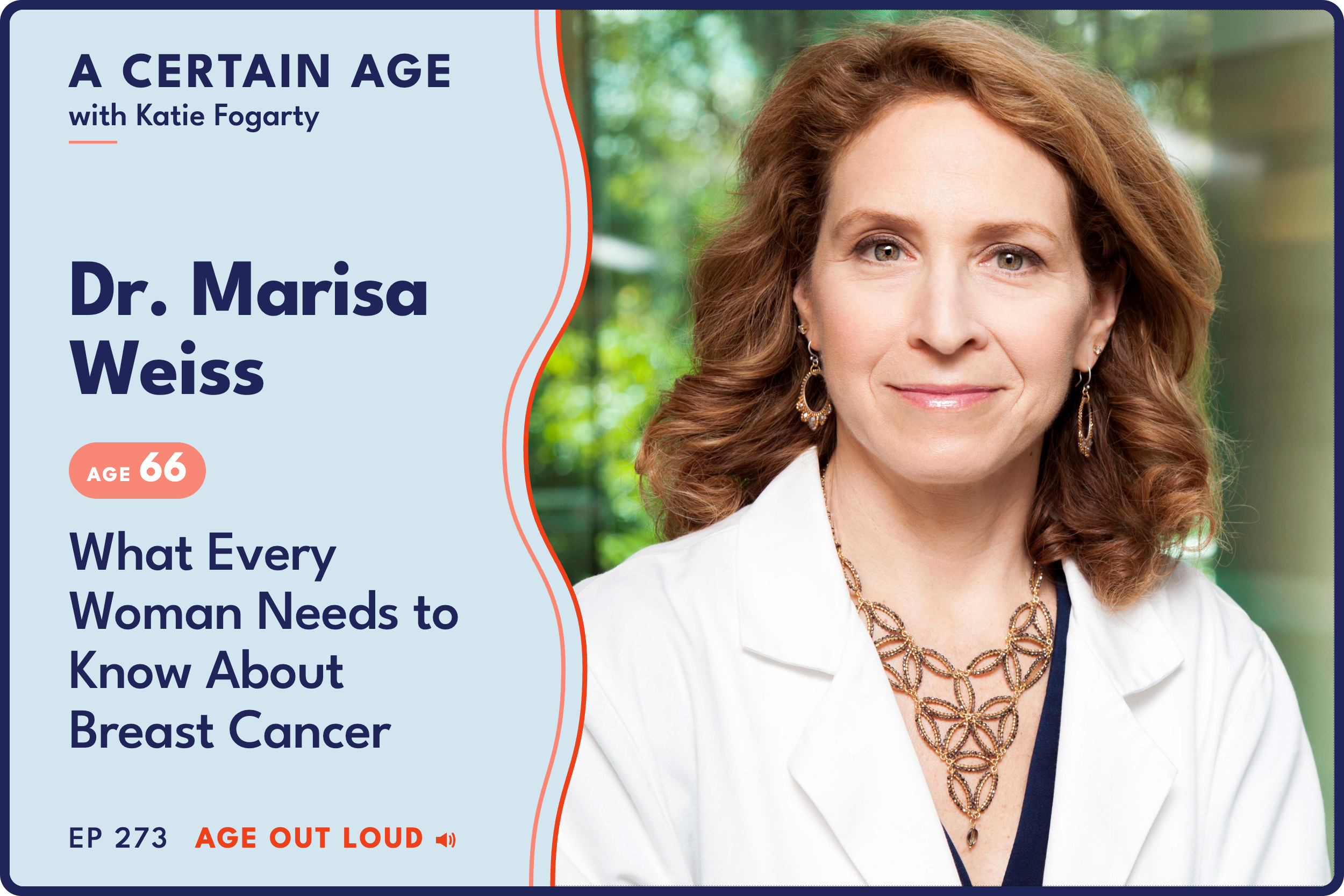
What Every Woman Needs to Know About Breast Cancer with Dr. Marisa Weiss of Breastcancer.org
Show Snapshot:
Breast health deserves a real conversation every month, not just a pink ribbon in October. Dr. Marisa Weiss — breast oncologist, founder of Breastcancer.org (250 million people served), and a survivor herself — joins Katie to break down what's actually moving the needle in treatment today, cutting through both fear and misinformation.
In this episode:
Lifestyle shifts that genuinely reduce breast cancer risk
The real truth about alcohol and breast cancer risk
The latest treatment breakthroughs worth knowing about
The HRT and breast cancer conversation many doctors aren't equipped to have with you
About Dr. Marisa Weiss: Dr. Marisa Weiss is a breast oncologist, breast cancer survivor, and founder of Breastcancer.org, which has served over 250 million people worldwide. She's a leading voice on what's actually moving the needle in prevention and treatment — from risk-reducing lifestyle shifts to the HRT conversation many doctors aren't equipped to have.
Show Links:
Follow Dr. Weiss:
Follow Breastcancer.org:
Quotable:
"85% of the time, people have no family history and no known inherited genetic abnormality — which is why it's so important to know thatmost breast cancers happen through the wear and tear of living.“
Transcript:
Dr. Marisa Weiss0:00
Well, I had to learn what it's like to get that phone call where the person on the other end of the phone is saying, "I'm so sorry to tell you that the biopsy showed you have breast cancer." It doesn't matter if you're a doctor, a stay-at-home mom, a grandma, or a corporate leader — whoever you are, when you get that phone call, the clock stops and you panic.
Katie Fogarty0:31
Welcome to A Certain Age, a show for women who are unafraid to age out loud. I'm your host, Katie Fogarty. Today we're doing something that is so overdue, and I have to tell you, I'm a little shocked it's taken this long. This show has been running for five years and we have 270 episodes, but today is the very first time we are doing a deep dive into breast cancer. And yes, I know it's not October — because here's the thing, cancer doesn't check the calendar. It doesn't wait for pink ribbons and awareness months. One in eight women will be diagnosed with invasive breast cancer in their lifetime, and that is a conversation we should be having all year long.
So today I am joined by a wonderful guest for a frank talk on a hard topic. Dr. Marisa Weiss is a breast oncologist with over 35 years of practice and is the founder of BreastCancer.org, which has reached more than 250 million people. She sees patients, she does the research, she writes the books — she is the real deal. Dr. Weiss, welcome to A Certain Age.
Dr. Marisa Weiss1:37
Thank you so much for having me. I love your podcast.
Katie Fogarty1:39
Ah, I appreciate hearing that — it's such a joy to create, and I love to hear that it connects with listeners. I want to congratulate you. I know that you just celebrated the 25th anniversary of BreastCancer.org. You've reached a remarkable 250 million people. These are incredibly inspiring numbers of reach and impact, but they're also tinged with a depressing reality — these numbers show how breast cancer impacts so many women and families across the globe. So I would love to just start with the basics. What actually is breast cancer? And when we say one in eight women, what does that really mean in terms of everyday risk?
Dr. Marisa Weiss2:17
Yeah, so breast cancer is the most common cancer to affect women. The breast itself is not just a mound of fat — it has a gland that makes milk, and that milk drains out through the pipes called ducts to the nipple. The cells that make up all those structures are supposed to grow and rest, grow and rest, in a regular way. It's up to the genetics to control the growth and rest periods, and if the genes aren't doing their job right, then an uncontrolled growth of cells can occur — and that's breast cancer. So breast cancer, by definition, is an uncontrolled growth of cells. It's always due to a genetic abnormality, but most of the time — about 85% of the time — people have no family history or no known inherited genetic abnormality. That's why it's so important for your audience to know that most breast cancers happen through the wear and tear, stress and strain of living: what goes in, on, and around us; how we age; how we evolve in our lives.
Katie Fogarty3:10
You're using the words "genes" and "genetics." I know that anyone who's listening to this is familiar with things like the BRCA gene — we'll explore that in a minute. But you said breast cancer is impacted by what is going on in our lives. I know that you're also certified in lifestyle and obesity medicine. Beyond genetics, which we'll get to, what are some of the choices that we can make? What are things that we can control that help influence whether or not — and when — this shows up in our lives?
Dr. Marisa Weiss3:30
Absolutely, and that's the good news about breast cancer — there are so many different risk factors that we can actually modify. It's not like smoking causes lung cancer, which is the main cause, or the human papillomavirus (HPV) causes cervical cancer. When it comes to breast cancer, there's actually a list of things — of which there are many — that we can change.
Growing older, being a woman — those are things we can't really change. But nor do we want to, by the way. We want to be who we are and evolve and keep going through the journey of life. So in your everyday life, it's important to think about steps that you can take to reduce your risk of breast cancer and improve your overall health. Breast health equals women's health.
Getting to and sticking to a healthy weight. Exercising regularly — we want to aim for 150 minutes of moderate to vigorous exercise a week, and also do two to three times a week of strength training and resistance training. But even five to ten minutes each morning — that shorter period of time makes a big difference. We need to build that into our lives. Exercise is no longer optional.
Dr. Marisa Weiss5:00
Exercise is mandatory. It's just one of those things we have to do, like brushing our teeth. It's also important to limit the amount of alcohol we drink. I know parties are more fun when you have something to drink, but you can actually find other drinks that you enjoy — like a flavored seltzer with lime and mint in a wine glass can be a nice substitute for a glass of wine.
Katie Fogarty5:20
Let's talk about alcohol, because the research has really shifted on this. Even one drink a day can really increase breast cancer risk. I love the idea of the mocktail you suggested. I've actually been embracing that increasingly in my own life because I've been sort of sober-curious, and I recently had a wonderful guest on the show — Suzanne Waryi — who wrote the book The Sober Shift, which really encourages women to think about outgrowing and breaking up with alcohol. So help us better understand this — as women are looking, because sometimes it is hard to put down the wine glass if that's just been a habit. Talk to us about the link.
Dr. Marisa Weiss5:55
Women today shoulder the burdens of the world — work outside in the office, work at home, taking care of family, social support networks, community responsibilities. At the end of the day, we want to reward ourselves and kick back and have fun and chill with good friends. But the more you can do that without alcohol, the better.
Personally, I'm also a breast cancer survivor — 15 years, yay! It's been rock and roll. But one of the changes I had to make was cutting back on alcohol, not just for my breast health but for my overall health. I've always had to work hard to get to and stick to a healthy weight. And as soon as you cut out alcohol, you cut those calories, cut the calories of all the mixers, and cut the calories of all the extra caloric foods you tend to eat when you've had that glass of wine — the chips and cheese and nachos and all that yummy stuff.
If you can stop drinking, you will be healthier overall — not just breast-healthy but overall women's-healthy. Your risk of all kinds of illnesses goes down. You'll think better, sleep better, have better sex, drive safer, be better at work. There are just so many different reasons. And personally, I love a glass of wine and I love great food, and they go wonderfully together, so...
Dr. Marisa Weiss7:38
I personally limit my alcohol to the times that matter most to me. So if I'm out for a good meal, I'll have a glass of wine — enjoy a cocktail, have fun. If I'm at a work party, I don't drink, because I don't need alcohol to have fun with the people I work with, and I don't want to say the wrong thing to a co-worker or my boss. So I try to be selective about when I drink alcohol — but generally speaking, less is best.
Alcohol is associated with an increased risk of breast cancer, especially in younger people. And one of the reasons why breast cancer is more common today is because more people are drinking alcohol — more women and men — and they're starting at younger ages. That's something we can change.
Katie Fogarty8:20
We were definitely going to explore that sort of age demographic shift as well, because I think it's important — the listeners of my show are firmly in midlife, but we have young women we care about in our lives, and we want to better understand that. First of all, I love this advice on alcohol, and I really do believe it totally improves your sleep when you're drinking less — and sleep is the Holy Grail, so that's another reason.
I'm going to chime in to say that when I interviewed Suzanne, we also talked about how sobriety is a skincare superhero. So if you want to get your glow on, it's another reason to put down the wine glass.
Let's shift into mammograms. I learned from researching the show that 66% of breast cancer cases are diagnosed at the localized stage — meaning while it's still in the breast and before it's spread. So this really spotlights the critical importance of screenings, because you want to catch breast cancer when it's in its most treatable form. Mammograms — when should we be getting them? What if somebody's overdue? What's the cadence?
Dr. Marisa Weiss9:10
Great question. Breast cancer is the most common cancer to affect women, so we really need to be tuned in and stick to a plan. At BreastCancer.org, we recommend that you get annual mammograms — that's once a year — starting at age 40. But if you are from a family with a lot of breast cancer in it, or you have an inherited genetic abnormality, you may start earlier than 40, and you may have not just mammography but alternate it with MRI and maybe ultrasound. If you're at extra risk, it's always important...
Dr. Marisa Weiss10:00
...to have extra surveillance in case breast cancer does happen. Every woman needs to have her best shot at early detection, and that involves getting your annual mammogram starting at age 40, doing your own breast self-exam just to know the lay of the land — so if something changes and persists and is of concern, you get it checked out — and having your doctor, nurse practitioner, or physician's assistant do a careful breast exam once a year. Between those three different approaches to early detection, you'll have your best shot.
Talk to me about dense breasts, because this term gets thrown around a lot, and I was actually surprised to learn I have dense breasts. I'm like, "How could that be? They're like the world's smallest breasts." So talk to us a little bit about dense breasts, breast size, and whether that plays any role in how we evaluate and whether we're more likely to have an issue.
Dr. Marisa Weiss10:40
Absolutely. Breast density is defined by a mammogram — it's the mammogram that tells you if you have dense breasts or not. Half of people who get mammograms will have dense breasts. Of those, some will be heterogeneously dense, which is like little patches of density. And then about 10% or so will have extremely dense breasts overall.
Basically, breast tissue is not just fat — which appears dark on a mammogram — it also has white areas, like the glandular tissue and supportive tissue. If the mammogram looks very white, then they call it dense breasts. It's tricky, because when you have dense breasts, it's a little bit harder to find a problem in there if it's there — kind of like trying to find a polar bear in a blizzard.
Katie Fogarty11:55
I love that. Yeah, it's a little bit tricky, but we have better techniques today than ever before to sort through dense breast tissue to see if there's anything there that's not supposed to be there. And breast density is not dependent on size — I learned that. So whether you've got big ones, medium-sized ones, or little fried eggs — as women describe them — breast density can affect women of any size. Half of women will have breast density.
These are such great visuals — the polar bear in the blizzard, the fried eggs. I love it. Dr. Weiss, we're heading into a quick break. When we come back, I want to talk about genetic testing, BRCA — who actually needs to be tested. Is this something every woman should worry about, or is it really family-specific? We'll be back in just a minute.
Katie Fogarty12:47
Dr. Weiss, we're back from the break. When we went into it we were talking about mammograms as the gold standard, self-testing, and other options to explore with your doctor. Let's talk genetic testing. Everyone's heard of the BRCA gene. Is this something where if you know you have it in your family, you're obviously on the road to genetic testing — but what if you don't know that it's in your family history? What if you don't even know your family history? A lot of people could be adopted, or come from a family that doesn't talk about things, never did any testing, or never explained why people died. Do you recommend that every woman think about genetic counseling? Are there specific signs we should be paying attention to?
Dr. Marisa Weiss13:15
Well, genetic testing has a very important role — not just in assessing your risk of getting breast cancer for you and people in your family, but these days it also helps us pick the best treatments for you. So even if you have no family history, if you're diagnosed with breast cancer — especially at a young age, and "young" is considered 50 and younger — you could benefit from genetic testing.
Especially if there is a family history of breast, ovarian, prostate, melanoma, pancreatic, or colon cancer — but anyone diagnosed with breast cancer may qualify for inherited genetic testing. That's the test that looks at the genes you were born with. About 5 to 10% of people with breast cancer will have one of those breast cancer genes, like BRCA1, BRCA2, or PALB2, which are associated with a high risk of getting breast cancer over your lifetime, as well as other related cancers like ovarian, melanoma, and pancreatic. About 10 to 15% may inherit a moderate-risk gene that can moderately increase your risk. Basically, genetic testing is an important piece of information that helps us as doctors know how best to follow you over time based on your risk and your family.
Dr. Marisa Weiss15:00
It also helps us take better care of you. I saw a woman yesterday in the clinic who had a long list of people in her family who had breast cancer, and I said to her, "Have any of those people had genetic testing?" No, no, no, no. "How about we start with you? Why don't you get genetic testing?" She said, "No, I don't really want to know." I understand you may not want to know right this minute, but it will really help you and help us get smarter about the best way to take care of you over time. So I'm a big advocate for inherited genetic testing — especially if you've been diagnosed with breast cancer, and even if you have no family history.
There are certain people who are at higher risk than others. Let's say breast cancer has affected your family at young ages, maybe multiple family members, maybe on both sides, maybe more than one cancer in one individual. Maybe they've had ovarian, prostate, melanoma, or pancreatic cancer in the family. Men with breast cancer are more likely to have an inherited BRCA2 mutation. People diagnosed at young ages — 50 and younger — should definitely get inherited genetic testing. It could save your life. You don't want to miss the opportunity to do something smart that will help you protect your life.
And when we talk about women of a certain age, it's so important to talk about the big picture first: why are we doing any of this? It's because we know that your life is precious, and we want to give you your best shot at what I call the "full life you" — which means most women want a long life full of wonderful things, where they get to do what they want to do, when they want to do it, and remain independent. Avoiding illness is part of that. If you're diagnosed with breast cancer, most people want to take care of it, move on, and put it in the rearview mirror, and that's what we're talking about today — how can we be smart about your breast health?
I know firsthand as a breast cancer survivor that it's rough going, but those same steps you take to improve your breast health also improve your overall health. You get extra credit for that exercise, for limiting or omitting alcohol, for getting to and sticking to a healthy weight, exercising regularly, eating well — like a Mediterranean diet — mostly fruits, vegetables, nuts, seeds, beans, grains, spices, colors of the rainbow — and having your meat, chicken, fish, and pork more as a sideshow. Avoiding smoking. Sleeping well. Staying connected socially, not being socially isolated. Managing your stress.
Katie Fogarty17:30
Being a smarter patient is a theme of this show. I was surprised to learn in researching the show that the median age for breast cancer diagnosis is 62 — and the reason that surprised me is that I'm 56, and I have many women in my life my age and younger who have been diagnosed, some as young as in their 40s. What are you seeing with demographic trends? When should women be paying attention to this? You said 40 is the starting point for a mammogram. What's going on with the age swings in breast cancer?
Dr. Marisa Weiss18:00
I'm so glad you asked that question, because even though breast cancer risk increases as we grow older, anywhere from 15 to 20% of people with breast cancer are diagnosed before age 50 — in the prime of their lives. And these days, we're trying to figure out why, but more young women are being diagnosed. So even though we start getting mammograms at age 40, we do want people to learn about their breast health and be aware of what's going on in their body, so if something comes up that's not quite right, you get it checked out.
The other thing that's really important is that even though we're all of a certain age here, we are leading by example. Even if you think your daughters aren't paying attention to you or they're ignoring you — oh, that...
Dr. Marisa Weiss19:29
...can happen — they're still watching you. You are still setting an example that they're learning from. So if you are taking care of yourself and sharing the knowledge — the lessons learned, like from your podcast today — you're teaching by example. And that's a powerful role that we have in our lives. Women are the main driver of health in their families. We are the chief...
Dr. Marisa Weiss20:00
...health officers of our families, and we need to start with ourselves. If you're not taking care of yourself, it's really hard to take care of anybody else. We want to make it clear that there are things you can do in your everyday life to be as healthy as possible.
Katie Fogarty20:15
I love this notion of being like the Chief Health Officer in your family. And I know from talking to women in my own life, and from showing up in rooms and conferences around midlife health, that women have a lot of curiosity about this, but oftentimes we fall to the bottom of the to-do list. I was joking to a friend — I forgot I hadn't been to the dentist in a while because I've taken my mother eight times since she has cognitive issues and needs my assistance. One day I thought, "I'm always at the dentist, but it's not for me." So we need to prioritize our check-ups, our screenings, those midlife musts.
So Dr. Weiss, I want to switch gears for a minute and talk more about BreastCancer.org — what it offers cancer patients and their families. And if you're willing, I'd love to hear a little bit about your own experience, because I know you launched this organization 25 years ago, and then 10 or 11 years in, you suddenly found yourself on the other side of the equation as a patient. So what made you launch BreastCancer.org to begin with?
Dr. Marisa Weiss21:10
So I started BreastCancer.org just over 25 years ago to help each person diagnosed get the best care possible — by giving them the medical expertise they need and personal support, not just through the information we provide, but also through an amazing community of people who help each other. I started it because as a practicing breast oncologist, I could see that your life is your greatest gift and it's your responsibility to take care of it. Most people who are diagnosed are just in shock and don't know where to begin. They need to be able to jump into the hot seat, work with their doctors, and make the best decisions for their lives. You need to be prepared for that, and you need to learn what you need to know in order to participate in your care and get the best care possible. The role of BreastCancer.org...
Dr. Marisa Weiss22:14
...is more indispensable today than ever before, because it remains the most common cancer to affect women. Each person's situation is unique, and it's your life that's at stake. You need to find your voice and use it in order to protect your life — because if you don't, you may not get the best care possible. Doctors are really busy, people are rushing everywhere. You've got to hold on to what you need to know, and that's why BreastCancer.org is very busy every day, every night.
One person's day is another person's night, and there are people in our community ready to help each other get through and beyond this diagnosis. We also help a lot of people who are living with metastatic breast cancer — they always want to know what's new that can benefit them so they can live longer with the best quality of life. And that's actually where some of the great news is: there are more advances in breast cancer today than ever before. That's why our BreastCancer.org team is at all the national meetings and combing through all the major journals to find treatment and diagnostic advances, so that people around the world can get access to them right away and protect their precious lives.
Katie Fogarty23:10
And so what are some of the services that BreastCancer.org offers? I know from spending time on your website that you have science writers and health journalists writing articles, there are resources. What are some of the other tools you offer?
Dr. Marisa Weiss23:25
Yeah, so for anyone who's dealing with or worried about breast cancer — let's say someone in your family was diagnosed and you want to know what impact that risk has on you — you can learn about that. We have extensive information on risk, diagnosis, treatment, recovery, and moving beyond for those who develop recurrence or metastatic disease. All of our writers and editors are medical editors and writers, and we have some of the best doctors from around the world who review all of our content before it goes up.
And then in the discussion boards — which are an active community — we have so many different conversations going 24/7, where people can help you whether you're just diagnosed or you have a very specific problem. Like, "I have HER2-positive breast cancer and I'm looking at my third treatment" — or "I'm having difficulty with side effects from treatment and want to know how to manage those so I can stick to my treatment plan."
Dr. Marisa Weiss25:00
And live a life that you can enjoy. So managing hot flashes, weight gain, hair loss, brain fog, muscle and joint discomfort, diarrhea — whatever it is — we have expert medical information, and there are people in our community ready to help you navigate these twists and turns of the breast cancer journey.
The good news is we do have better treatments and tests than we've ever had before, but if you don't know about them, you won't get the benefit. And if you are prescribed a treatment that you don't get along with and you're thinking, "We're not getting along — I'm going to stop this" — before you make that decision, go to BreastCancer.org and learn what you need to know. There may be simple steps that can help you manage side effects so you can stay on the treatment that gives you the benefit.
It may be that you're looking at a big surgery and don't know what to expect — how long you'll be out of work, whether you can pick up your two-year-old. That's the kind of information we provide: to help you prepare for what's ahead, so you can move forward with more clarity, more confidence, feeling more optimistic.
Because I can tell you, as a breast cancer survivor and as a breast oncologist — to the people I take care of in the hospital and through BreastCancer.org, the 12 million people who depend on us — it's a rough ride. It's hard and it can be lonely. But you don't have to do it alone. You need to reach out for help, even if all your life you've been helping everybody else and never complaining or never asking for anything, not knowing how to say no. You'll learn all those things, and we'll teach them to you.
Whatever you practice gets stronger, and you might be learning all kinds of new things that you never knew before, and you can apply those to other aspects of your life — like finding your voice, asking a question, going into your doctor's office prepared so that you can share in the decisions being made about your life. Those are really important life skills that you can apply in many different arenas, not just your health.
Katie Fogarty27:00
Yeah, absolutely — everybody wants to be a smarter patient and to feel informed so they can best advocate for themselves. And you're so right that once you learn how to do that, you can take those skills into other arenas. You became a patient yourself. You obviously walked in as a smart patient because this is your medical training — you had built this organization, you had run it for more than a decade before you were on the other side of the equation. What did your own experience with breast cancer inform — how you continue to shape and evolve the organization? And what did you have to learn for yourself?
Dr. Marisa Weiss27:40
Well, I had to learn what it's like to get that phone call where the person on the other end of the phone is saying, "I'm so sorry to tell you that the biopsy showed you have breast cancer." It doesn't matter if you're a doctor, a stay-at-home mom, a grandma, or a corporate leader — whoever you are, when you get that phone call, the clock stops and you panic.
So I learned through my own diagnosis how scary it can be, and how much every word that the doctor uses — and that you hear — can be either informative, inspirational, or really scary. That insight — not just from my own diagnosis, but from having the privilege of taking care of each person who comes to me as a patient and each of the 12 million people who come to us at BreastCancer.org — as the founder and Chief Medical Officer, I understand what an honor and a responsibility it is.
Because behind or beside every woman who's diagnosed, we know there are so many more people who are affected. And while each year we hear statistics like 322,000...
Dr. Marisa Weiss29:31
...new people are diagnosed with breast cancer in the United States each year, and 4 million people in the United States are living after having had a breast cancer diagnosis — I know that number is just the beginning, because there are so many people who depend on us, and so many others who are affected as well.
So my own diagnosis was humbling, and it also made me find my...
Dr. Marisa Weiss30:00
...own voice, because I was a pleaser. As a doctor, everyone assumed I knew everything — which I didn't — and your own situation is unique. You need to spend the time to learn what you need to know to make the best treatment choices. You make the best decisions at the time, and then you move forward with a plan that you put together, that you design together. And then it's a lot of work to implement that plan. I was on those medicines for seven and a half years. That means that every night I had to find my pill bottle and take those medicines, and every day and every night I had to deal with some little this, little that — little side effects here and there.
So I know what's at stake, but I don't want to ever assume that my experience is someone else's experience. And that's why at BreastCancer.org, we really try to best understand what your situation is, so that we can provide you with the expert information that applies to you, that's most relevant to you. Because when you're stuck in the ditch with a diagnosis and you only have so much time and energy, you don't want someone to throw a textbook at you. You want to know only the information that applies to your situation.
Katie Fogarty31:20
Yeah, because I imagine when you're diagnosed, you're really building the plane while flying it — trying to learn everything about how to take care of yourself and treat yourself while you're navigating this absolute shock.
Dr. Weiss, women who listen to this podcast are age 45 to 65, although I'm sure we have outliers who are younger and older. I know from the conversations on this podcast — I've interviewed probably 100 doctors on different elements of menopause: how it impacts brain and bone health, sexual wellness, and more. I'm on the board of Let's Talk Menopause, which means I'm often in conference rooms surrounded by women talking about menopause. HRT is an enormous question that people explore when they start to navigate hormonal changes, hot flashes, brain fog, sexual dysfunction, and more. There's a lot of excitement around how the conversation has shifted around HRT and the role it can play — there's better science and a better understanding of why it can be an important tool in the toolkit.
But one question that continually comes up is: how does it affect women with breast cancer? I would love to hear your thinking on this — who can safely consider it, and what kind of conversation should they be having with their doctors?
Dr. Marisa Weiss32:30
Right. Well, as you pointed out, the median age for getting breast cancer is 62 — that means half the women are younger than that and half are older. And the median age for going into menopause is around 52.
Dr. Marisa Weiss32:59
Around 52. So most people who get breast cancer are already in menopause, and most people with breast cancer — about two thirds or so — have a breast cancer that responds to hormones like estrogen and progesterone. So we don't want to give the cancer what it wants. We want to take it away, because those hormones are like "go-go juice" — they fuel a breast cancer's growth.
So frequently, people who are diagnosed with breast cancer are treated with anti-estrogen therapy, and they suffer symptoms of menopause. They may be thrown into menopause early if they're young and going through chemotherapy, or they may be put into menopause early with medicines because they have a high-risk hormone receptor-positive breast cancer. And people who are already in menopause may be put on anti-estrogen therapies — called endocrine therapies — which can actually make menopausal symptoms worse.
So it is hard to be a woman with breast cancer who's hearing all about the other world of women now asking their doctors for menopausal hormonal therapy.
But what we can say is that vaginal estrogens — whether the creams, little pellets, little rings, or all the different ways you can deliver estrogen to the vagina — can help make the vagina happier: a little wetter, a little longer, a little thicker, better able to handle the demands of sex. We believe that anyone with breast cancer, even hormone receptor-positive breast cancer, can safely use hormonal therapy applied to the vagina — after they've tried other things first.
Dr. Marisa Weiss35:00
Like great lubrication, vaginal moisturizers, good foreplay, a vibrator, or whatever it is you're using to get ready. When the vagina has been stimulated and a woman has an orgasm first, the vagina is more receptive to sexual activity — whatever kind it is. And it's also important for bladder health as well.
Katie Fogarty35:15
I've had urologists on the show that talk about the importance of vaginal estrogen to maintain bladder wellness. I think that's an important note to distinguish, because sometimes people are not sexually active, but vaginal estrogen supports your entire pelvic region, including your bladder — so it's important for all of these reasons.
I'm so happy that you mentioned vaginal estrogen, because I know there is still confusion among women between local and systemic estrogen. Vaginal estrogen is applied topically within the vagina. I love hearing you share that it's safe even if you are experiencing breast cancer.
Where do you land for a woman who's done with her breast cancer journey but doesn't have an estrogen receptor-positive cancer — can they consider moving to systemic HRT in the future?
Dr. Marisa Weiss36:00
Yeah. Well, to your point — so vaginal estrogens, and I would say it's not just to the vagina, it's also to the vulva and to the outer aspect, the labia. Because a lot of women who are in menopause or approaching menopause can have pain when urinating, or when using soap — even a mild soap — down there, or wearing jeans, or riding a bike.
Katie Fogarty36:30
Dr. Weiss, I had a listener DM me to say — she mentioned putting it on your labia to improve your bike-riding experience — and she DMed me and said, "I shared this with my entire cycling group because we're always complaining about how uncomfortable it is." So I love that you mentioned these very real-world, practical reasons.
Dr. Marisa Weiss36:50
Yeah, girlfriend! And then to your other question — for women who have hormone receptor-negative breast cancer, meaning a breast cancer that has no receptors for estrogen and progesterone, they may be a candidate for menopausal hormonal therapy. It's still not well understood. We don't have a lot of data on it, and I know that doctors feel uncomfortable giving menopausal hormonal therapy to anyone who's had breast cancer, and they probably don't know enough to know who can and who cannot use it.
That said, I know women who have had breast cancer — and I take care of many of them — who say, "To hell with it. My quality of life is so much better on hormonal therapy that I'm willing to take the risk. I'm beyond my diagnosis, I finished my treatment, I've been good for 10 or 15 years, and I'm having trouble keeping my bones strong, my muscles strong, my vagina happy, my hair on my head, and my skin looking like it's got a little life to it. I'm going to explore it and use it and see how it works."
Also, for any woman as we grow through life and handle the demands of everyday life, just getting a good night's sleep is a real challenge. And like you said, sleep is queen. There's a point in life when a lot of women have to choose between sleep and sex, and I think if you asked 100 women of a certain age which is more important, a lot would say sleep — or they'd put up boundaries with their partner: "Look, if you want it tonight, we need to plan for it. We need to go to bed at the same time. And I'm not happy when you wake me up in the middle of the night."
Katie Fogarty38:30
That's hysterical. Sleep is the holy grail — we're always working on it.
Yeah, and the women you were describing — who are safely out from their breast cancer experience and have a certain type of breast cancer — if they're considering HRT, it's very hard to find doctors who will have that conversation. I know this anecdotally from women in my life. But if you're looking to be a smarter patient, there's a wonderful book called Estrogen Matters, also written by a breast oncologist, and it can help educate you as a patient to have these conversations yourself.
Thank you so much for helping us better understand the HRT/breast cancer axis. For women who have hormone receptor-positive breast cancer and are far out from their diagnosis, they...
Dr. Marisa Weiss40:00
...may feel more free to consider using hormonal therapy to manage their symptoms of menopause and their overall health. But it is true that if you have a hormone receptor-positive breast cancer, there's a risk of recurrence...
Dr. Marisa Weiss40:14
...over the rest of your life. Hopefully you'll never get it again — the risk of your getting breast cancer again is lower than your risk of dying from something else. But there's still reason for concern.
If you have hormone receptor-negative breast cancer — the kind that doesn't have receptors for estrogen and progesterone — those types of cancers, if they come back, are more likely to come back in the first few years. So if you're five years out, oncologists might be more willing to green-light the use of menopausal hormonal therapy with your gynecologist.
Katie Fogarty40:50
Yeah, it's such a nuanced conversation, and one that you need to have with your entire care team. Thank you so much for having this conversation with me around HRT. I know that women are really anxious about the intersection of hormones and breast cancer, and I really appreciate your perspective on this.
Dr. Marisa Weiss41:10
Yeah, I would just add one thing — as we grow older, only part of what makes us feel older is the absence of hormones. There's a lot about growing older that's not solved by hormones. So if anyone is having problems with joint pain or arthritis, aches and pains, or weight creeping on — there are a lot of solutions that don't involve hormones to help you make your way through life. It does involve a lot of careful conversations.
You need to do your job at articulating — really letting your doctor know what's bothering you, putting the most important things at the top of the list, and going in prepared. That's your homework. And when you go into your doctor, find a doctor that listens and takes you seriously. It helps when you give the doctor a printout or an email of talking points or your story, and when you express your gratitude for their listening — because those steps will help increase the chance that they'll actually listen and take you seriously. These are important conversations, and that's what's behind this whole podcast — finding your voice and using it to your benefit.
Katie Fogarty42:30
Yeah, and I love that you said aging brings other issues — hormones don't solve everything. They can be part of a toolkit, but only part of a toolkit. There are lifestyle choices that we can make to help us with other things. Such a great point.
So, Dr. Weiss, our time is coming to an end, but before I let you go, I want to ask you — you've been in this field for 35-plus years. You've watched a lot of seismic change over the years and built and grown this robust organization. What advances are you most excited about right now? We're living through a very tumultuous moment in history, with a lot going on politically and geopolitically in the headlines every week. What are reasons we can feel generally hopeful about how breast cancer is being treated today? How can we be hopeful for our daughters and the women coming behind us? Do you see them having a different breast cancer experience?
Dr. Marisa Weiss43:15
Yeah. Well, first of all, I'm hopeful that more people will have access to early detection through high-quality 3D tomography mammograms, and that the use of MRI, ultrasound, and genetic testing will expand. I'm hopeful about the new advances we have to offer people that give them a better shot at cure — to get rid of the cancer or put it into remission for longer. And if one treatment ceases to work, that there'll be other advances available to try as a next step.
I'm also hopeful that women can take steps in their everyday life to be as healthy as possible and have their best shot at a full life — where they are able to have a joyful life full of wonderful things, where they can do what they want to do, when they want to do it, and remain independent and manage side effects from treatment. Those things give me a lot of hope. And it's also exciting to know that BreastCancer.org...
Dr. Marisa Weiss44:42
...is a place people trust for expert medical information, and that we have this amazing community of people dedicated to helping each other — what a gift. So I'm more hopeful today about all those things, and I look forward to future advances and all kinds of other ways that...
Dr. Marisa Weiss45:00
...we as an organization can help more people in more meaningful ways.
Katie Fogarty45:05
And what word of encouragement would you give to a woman if today were her diagnosis day?
Dr. Marisa Weiss45:10
Your life is precious. Don't do it alone. We're there for you. Get the medical expertise and support you need. There's no emergency — you can take the time you need to get the best information so that you can make the best decisions for your life. And once you move forward with a treatment plan, know that there's a lot we can do to support you along the journey. Don't do it alone.
Katie Fogarty45:34
I love that. What a great note to end on. And before I say goodbye — where can our listeners find you and follow the work of BreastCancer.org?
Dr. Marisa Weiss45:43
Oh, well, thank you. We have BreastCancer.org online. We also have BreastCancer.org on Instagram and on TikTok. We're on Facebook. And as a doctor seeing patients, I see people outside Philadelphia. We are open to your ideas — so if you want to share your experience through our community, please do. If you've got ideas about how we can do a better job, we want to learn from you. Thank you so much.
Katie Fogarty46:13
This wraps A Certain Age, a show for women who are aging without apology. I thought this was such a fantastic, so overdue episode. I am so grateful that Dr. Weiss hung out with me today behind the microphone. This is an episode to share with the women in your life — your daughters, your friends, your mothers. We need to continue to get the word out about the tools that are out there to help women, families, partners, and friends as they navigate this challenging topic.
If you took something away from the show, if you learned something, if you feel encouraged by what you heard today from Dr. Weiss about what is happening in the world of breast cancer and her optimistic take on how it might look different for our daughters and the women coming behind us, please let me know in an Apple Podcasts or Spotify review.
Special thanks for sticking around to the end of this show. It was an important, thoughtful conversation. And as always, special thanks to Michael Mancini, who composed and produced our theme music. See you next time. Until then — age boldly, beauties.
