
This episode is brought to you by Alloy Health — get $20 OFF your first order at MyAlloy.com with code KATIE.
Show Snapshot:
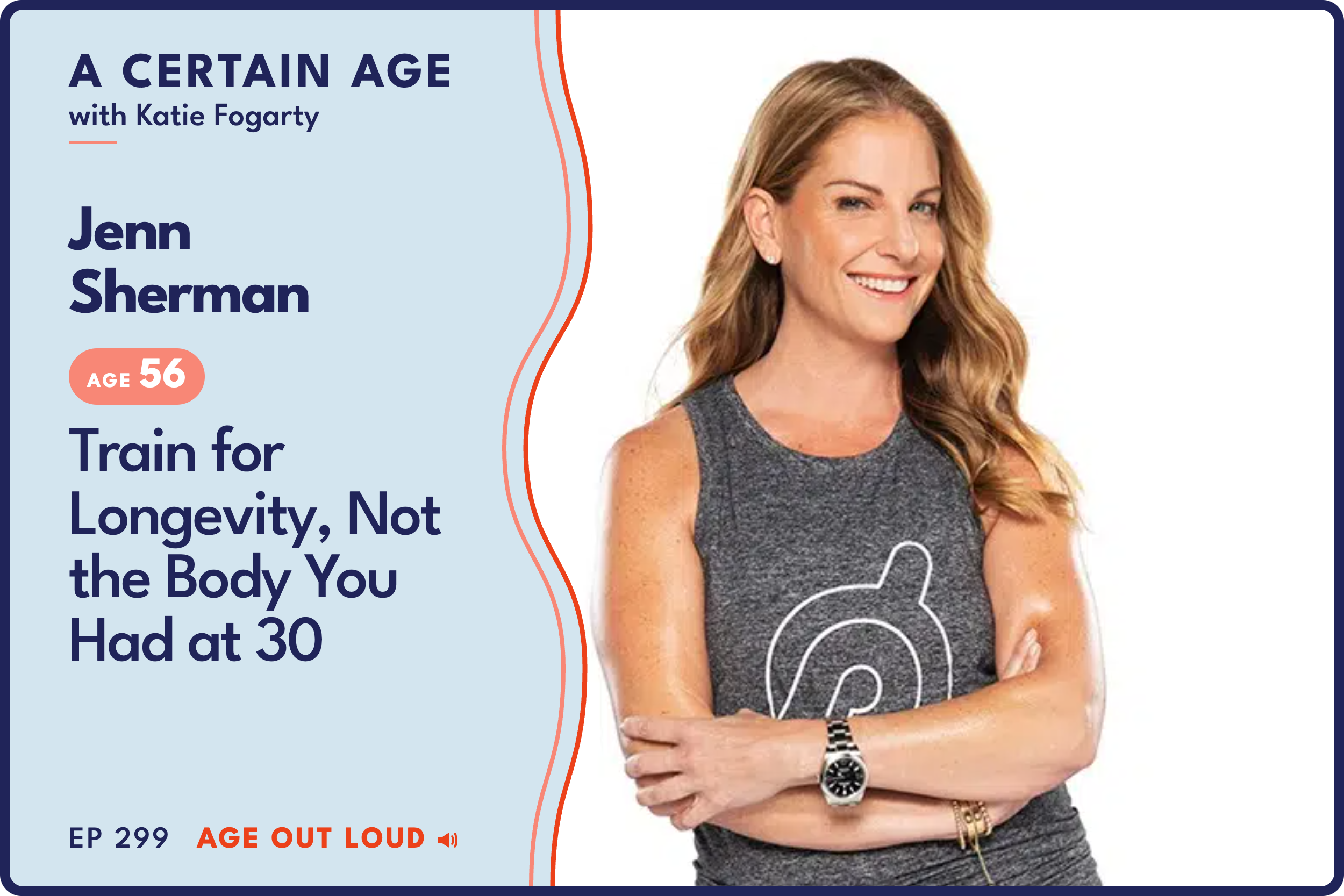
Jenn Sherman has moved her body her whole life, and her first bone density test still came back as osteoporosis. It’s a reminder that staying active and knowing your bone health are two different things. The Peloton instructor and creator of The Back Nine Era is sharing her journey on her Substack, and it’s the reason we’re re-releasing our first conversation. Her advice on strength and longevity lands differently now. Press play, then talk to your doctor about getting your bone density checked.
In this episode:
How to start strength training when you’ve never done it before
Training for capacity and independence instead of the body you had at 30
Why rest is non-negotiable
How Jenn went from stay-at-home mom to Peloton’s very first cycling instructor at 45 after sending one email, and why it’s never too late to bet on yourself
About Jenn Sherman: Jenn Sherman is Peloton’s first instructor and has taught thousands of classes there since 2013. She is the creator of Back Nine Era, a functional fitness playbook and weekly Substack for women over 50. She writes openly about adjusting her training after an osteoporosis diagnosis.
Show Links:
Follow :
Quotable:
Who decided that there’s an expiration date on becoming who you want to be? … With every year that passes, we get wiser, we get more confident. We know who we are, even more than we did five or 10 years before.
Transcript:
Jenn Sherman 00:00
The fitness industry still talks to women in midlife like we’re trying to look the way we did at 30, and that’s not what’s happening anymore, right? That’s not the goal anymore. The goal for women our age, Katie, is longevity and capacity, and being able to train in a way that’s going to end up giving us the strongest, healthiest life we can have. The way I’m training now, Katie, is so I can pick up my grandkids in 10 years. The way I’m training now is so I can get up off the floor without assistance when I’m in my mid-60s.
Katie Fogarty 00:40
Welcome to A Certain Age, a show for women who are unafraid to age out loud. I’m your host, Katie Fogarty. Beauties, today I’m re-releasing one of my favorite conversations, and if you don’t know Jenn Sherman yet, you are in for a mega dose of inspiration. Jenn was a stay-at-home mom in New Jersey who took her first spin class in her early 40s. At 45, she became Peloton’s very first cycling hire. How she got that job involves a 10-minute email and an email subject line I am still thinking about. You’ll hear that story in just a minute. We also get into strength training as a newbie and what Jenn calls the Back Nine Era. Think of the Back Nine Era as the time to get more strategic in midlife about how you move, fuel, and spend your energy.
Jenn has been busy since we taped this. She started a Substack, The Back Nine Era, and I got to interview her live in New York at The Marvelous Mrs. Menopause during World Menopause Month. She was joined by her BFF Pam Sunshine. They are a blast, a riot, so much fun to hang out with, and they are taking their live show on the road. Dates will be in the show notes.
Now, some news: Jenn shared at that event publicly for the very first time that she has osteoporosis, and she’s writing about it now with real honesty on her Substack. So when you hear her talk about training for strength, getting up off the floor on her own in her 60s, and picking up her grandkids, listen with that in mind. It hits differently, in the best way. Here’s Jenn.
Jenn Sherman 02:14
That was some intro, Katie. Thank you.
Katie Fogarty 02:16
Well, you deserve it all and more. I’ve loved following your career, learning about you, and prepping for the show, spending time on your Instagram. I know people are going to be excited, because I was so excited when I hung out with you socially, and I’m really thrilled to be hanging out with you behind the mic right now.
On A Certain Age, we love reinvention stories, and you have a unique one. I want to hear what prompted you to take that first spin class, and how did you go from student to Peloton’s very first cycling instructor?
Jenn Sherman 02:46
Wow, let’s throw it back. I owe my very first spin class to a dear friend of mine, Barbara Albert, who will probably listen to this podcast. She was the one who dragged me to my very first spin class many, many, many years ago. I was going through a rough time. I had just lost my father, and it was she who said to me, “You’ve never done a spin class, and you need to come with me. I think you’re going to love the kind of energy that is in the room at a spin class. Just come to one.” And I was like, “Fine, you know what? I’m up to try anything.”
I was always someone who worked out. Movement and fitness were always important to me, but I had just never been to a spin class before. We’re going back, let’s call it, 15-plus years now, right? She took me to my very first class, and I was instantly hooked. I didn’t have to go back two or three or four times to decide if I loved what I had just done. I was one and done, and that might have been, on that particular day, the combination of the instructor and maybe the music. Even though it was new to me, and I probably didn’t feel like any kind of expert at getting through the class, I was so taken by it.
My first class turned into an addiction of sorts, a good addiction, something that I was doing so many times a week, Katie, it was crazy. I had days where I did double classes. I was riding, let’s call it, five days a week. It became my workout of choice. It was just so good for me, mentally and physically, and I fell deep into it. It became my thing.
After riding as just a participant in the class for about a year, riding pretty regularly, like I just mentioned, five days a week, sometimes taking doubles in a day, I thought, “I think I would be really good at this.” That’s not something I said to myself often in my lifetime, you know what I mean? I thought, “I think I might be able to get certified and be really good at this.” I went to the owner of the local studio in New Jersey where I was riding. I was a suburban mom at that point with two young kids, riding at a studio five minutes from where I lived, and I was there all the time. I let them know that I was thinking about possibly getting certified, and they were so excited. They said, “Let us get you certified,” and that’s exactly how it all began.
I got spin certified, and then I started teaching in that very same studio where I had taken all of those classes. Local, small, right here in New Jersey suburbia, and my classes were quite popular. From the very first ride, I was half friends, half word of mouth, and I really started to hone in on my skills and try to get really good at what I was doing. I wound up having this amazing following in New Jersey: sold-out classes and wait lists and all of that. And I loved it.
It was at a perfect time in my life, Katie, because my kids were old enough that they were in school all day. I had been a stay-at-home mom, which I loved and felt so blessed that I got to do. But once the kids were off in school all day, I started to feel this pull. I wanted to do something that was just mine, and getting certified to teach classes was the most perfect thing, because it wasn’t nine to five. It gave me something that was all my own, but I wasn’t behind a desk all day. I was still able to drop off the kids, pick up the kids, live my life. That’s how it all started.
Katie Fogarty 06:42
And how did you move from a small studio in New Jersey to Peloton? Because that also is a big leap. You moved from student to instructor, and then from studio to Peloton. Walk us through that.
Jenn Sherman 06:52
I could never have imagined that part coming. So let’s cut to now. I’m teaching these classes in New Jersey, and they’re going well, and I’m teaching for my little studio. It started out like I was teaching three classes a week. Then it went to four. Then it went to five. I was teaching every day except one. I was teaching six days a week, a really popular class that was always filled and hard to get into. And I was very happy doing what I was doing in New Jersey.
One day, something popped into my inbox. It was a newsletter from an online publication called Well+Good, which talked a lot about wellness and fitness, and it was always covering the latest opening of a studio of some kind or another. I happened to read what I think, and what I say every time I tell this story, was the very first published piece on a brand-new startup that was coming to life called Peloton. It was a short, one-page briefing of what Peloton was. It explained the concept and the idea. And at the bottom of this newsletter there was an email address, a very generic email address. I don’t even know what it was, something like info@onepeloton.com, whatever it was, and it said something like, “If you are interested in becoming an instructor, please email us here.”
It was just a one-pager explaining the concept: a bike you were going to be able to purchase for your home, and on the end of the handlebars there was going to be a television screen, where your instructor was going to teach you an indoor, boutique-style cycling class. Because this was back in the day when SoulCycle was blowing up and Flywheel was blowing up, you were going to be able to take a class like that in the privacy of your own home. And I was like, “Huh, this is an interesting concept.” I didn’t know if I thought it was something that could work, Katie, because part of what I loved so much about those cycling classes in the early days was the energy of being inside the room with everybody, you know what I mean? Being in one closed room and feeding off the energy between one another. Well, let’s put that aside. I did think the idea was genius. I just didn’t know what it could really be. So I decided, you know what? I’m going to answer this email address. I’m going to write a little email to… I don’t know who. I don’t know who I’m sending it to. I’m going to…
Katie Fogarty 09:43
Send it out into the void, you know, the World Wide Web, and take my chances.
Jenn Sherman 09:47
That’s right. It was just like, “You know what? Fuck it. I’m going to write an email. I don’t know who I’m writing this to, and I’m going to tell whoever is on the other end of this that this sounds like a genius idea, that I would love to hear more, and that if you’re really hiring instructors, here is why you need to hire me.” That is what I titled the email, and that email, Katie…
Katie Fogarty 10:13
That’s a good subject line, Jenn. That’s a really good subject line. It was “Here’s why you need to hire me.”
Jenn Sherman 10:18
That’s what I said: “Here’s why you need to hire me.” And then I went on and on and kind of told my story in this email to whoever I was sending it to. I hit the send button, and I didn’t think much about it. I actually thought I would never hear back from anybody.
Within a couple of days, I got the most incredible response from a man named John Foley, who was the founder and CEO of Peloton. We’re taking this back to 2012 now. 2012, 2013. I sent that email, and he answered me back and said, “We’ve gotten a ton of responses, and you are the first email that I am actually answering.” There was something about what I put in that email. I love this story with him. I typed it out and I wrote it very much the way I speak. And if anyone listening knows me from the bike, I was very much myself in that email: “Here’s why you need to hire me. Here’s why I kick ass. Here’s why I’m a rock star. This is what I do. I’m a mom of two young kids, but this is my passion, and here’s why I pack my room, and I’ve got a wait list and sold-out classes, and my music is awesome.” I wrote all this in that email.
Foley wrote me back, and a week after that, I drove into New York City and was having my first cup of coffee, sitting across from John Foley, genius John Foley. One conversation led to another and another, which led to an audition in front of three people: him, his wife, and another one of his co-founders. And long story short, he made me an offer, and I got the job. I was Peloton’s very first instructor, which still gives me goosebumps to say 13 years later, and I’m still here, still doing my thing. So that’s the story.
Katie Fogarty 12:07
Jenn, this is such a marvelous story, and it speaks to so many things I love about creating this show. I feature women who throw their hat in the ring, who take a chance on themselves at a certain point in their lives. They think to themselves, “Why not me?” They draw on all their experience, all the things they’ve built. You had built a career where you were beloved and packing rooms, and you thought, “Why not me? Let me take a bet on myself,” and they decided to bet on you, which is so super cool. I also love it because it’s a little bit of the serendipity of midlife. Sometimes we just put ourselves in new rooms and new places, and things come together.
Jenn Sherman 12:46
And so many women don’t even believe that that’s a possibility, and that’s why I love telling my story. I sent this email out not expecting to even hear back from someone. Not only did I hear back, but when John asked if I would come into the city to sit down and talk more about Peloton, the next part of this was, “Okay, well, I’m going to sit down in front of this guy, I’m in my early 40s, and he’s going to take one look at me and not be interested.” He was building a fitness company from the ground up, and the fact that John Foley took a chance on me, and that his very first instructor was in her mid-40s, a mom of two young kids, when he could have hired anyone in New York City, much, much younger. That’s one of the parts of the story that I’m the most proud of, and I love telling people.
I tell John every year, I write John a note when I see him, and we still speak. I thank him for changing my life, because he really gave me a chance at 40-something years old that I never thought I would have, and it reinvented my entire life. Where I was at that point in my life was a major pivot, and I’m really proud of it.
Katie Fogarty
Yeah, it’s so, so powerful, Jenn. We’re heading into a quick break. When we come back, I want to ask you what you’d say to women who feel like the window for reinvention has closed. We’ll be back in just a minute.
[Ad break — not transcribed]
Katie Fogarty 14:30
Jenn, we’re back from the break. When we went into it, we were talking about how you had this wonderful opportunity where somebody looked at you and said, “45, get on the bike. You’re our first hire,” and it was such a powerful moment.
I love this story too because I have something similar in my own life. I had been a stay-at-home mom for a bunch of years, with a master’s in broadcast journalism that was collecting dust on a shelf, unused. I had five minutes between somebody’s nap, and I saw something online, much the way you did. Patch.com, which was at the time AOL’s hyperlocal news platform, was looking to hire writers in my community, and I said, “Why not me?” I pulled out my dusty resume and sent it off, and I got hired to write, and I wrote for them for a year. So I can so relate to being this mom, this active mom, taking a break from whatever you do professionally, and then really just taking a chance on “why not.”
So this is a great lead-in to a question for listeners to this show who are thinking for themselves, “Maybe the window is closed for me.” Jenn did this in her mid-40s. I was in my mid-40s. I’m now 56. I know you’re 57. What would you say to women in that zone who might be thinking the window for reinvention has closed?
Jenn Sherman 15:37
Right. For those women who think it’s too late, I say back: says who? Who, honestly, decided there’s an expiration date on becoming who you want to be, and when? I know that as we start to age, and as the years go by, a lot of women, including myself, start to lose confidence in who they are or what may lie ahead, what opportunities there are. Women have to tell themselves that they are more equipped than they realize, and more equipped than they have ever been. With every year that passes, we get wiser, we get more confident, we know who we are even more than we did five or 10 years before.
Women just have to not be scared, as you put it, to throw their hat in the ring. You’ve got to be willing to take a chance and take a shot. If I had sent that email, Katie, and nobody had answered me, which is what I was expecting, what would I have lost? It took me 10 minutes to write the email. Ten minutes. If I never heard back from anyone, I never heard back. But I did hear back, and one thing led to another, and it changed the entire course and direction of my life in my mid-40s. So I say to those women, “Bullshit! It is not too late.” You need to just tell yourself, “Why not me?” and that’s where you start. Why not me? I deserve it as much as somebody else.
Katie Fogarty 17:03
Yeah, 10 minutes to a new life. Love that idea. This is a great time to talk about what you’re doing with your life right now. You’ve been 12 to 15 years at Peloton. Right now, you’re in the midst of creating something special, which you’re calling the Back Nine Era. I would love for you to share with our listeners what the Back Nine Era is, and why you felt compelled to create it now.
Jenn Sherman 17:25
Let’s talk about why I felt compelled to create it now, because I was living through a time in my life that no one seemed to be talking about loudly enough. So I’ll back up. The Back Nine Era really is a mindset. It came from a very personal realization. You mentioned I’m 57 now, but it came to me in my mid-50s. It just hit me, like it does, that time is not unlimited anymore. And I don’t say that in a depressing way. It was kind of an awakening for me.
When I talk about the Back Nine Era, because a lot of women ask me about it, the back nine is a golf analogy. I don’t play golf. I happen to be a big fan of golf, and I watch golf, but I don’t play the game. When I came up with the title, if you’re on the back nine of a golf course, the round of golf is far from over, right? But when you are playing those last nine holes, you’ve got to become really thoughtful about how you play each one of them. You become more strategic. You’re paying attention. You’re making smarter choices. You’re not just swinging the clubs wildly. And that’s exactly what this chapter of life was feeling like to me.
Women in midlife start asking different kinds of questions, and they start feeling things that seem to come out of nowhere, Katie. And it’s like, “What the hell is going on? Why do I feel this way? Why do I look different? Why do I have this brain fog? Where’s this coming from? Why is everything that I’ve been doing successfully for the last 10 years, that’s been working so well, why does it feel like none of that is working anymore?” All of those things hit me at once, and I was like, “You know what? Why isn’t anybody talking about this?” Because women, in their bodies and their minds, go through a lot when you hit, let’s call it, late 40s, early 50s, mid-50s, and we should be talking about it.
I just decided that I was going to start speaking loudly about this period of my life, because it’s an amazing time of life. It’s not a time where we should be fading into the background. It’s just about becoming more intentional with how we move, how we fuel ourselves, how we spend our time, and where we choose to put our energy. Let’s call it that.
Katie Fogarty 20:01
Yeah, we’re bringing intention, we’re honing our focus, and we’re getting loud. To your point, the tagline of this show is “Age Out Loud.” We are embracing this period of life. I also don’t play golf, but I do watch it because my husband’s a fan. I think there’s so much enjoyment and so much juice you can squeeze out of life during these back nine holes, but you’re right: we have less time in front of us than we have behind us, and we need to bring intention and focus.
So let’s talk a little bit about how we bring intention and focus to fitness during the second part of life. How has your relationship with fitness and your own body changed as you’ve moved through some of those changes? You were saying brain fog. We deal with perimenopause, menopause. How has your own relationship with fitness changed from your 40s to your 50s?
Jenn Sherman 20:49
Oh my gosh, it has changed so much. We’ll get into it, but I just want to say one thing about the fitness industry and what they get wrong, and I want women in their 40s and 50s to hear this. The fitness industry still talks to women in midlife like we’re trying to look the way we did at 30, and that’s not what’s happening anymore, right? That’s not the goal anymore. The goal for women our age, Katie, is longevity and capacity, and being able to train in a way that’s going to end up giving us the strongest, healthiest life we can have. The way I’m training now, Katie, is so I can pick up my grandkids in 10 years. The way I’m training now is so I can get up off the floor without assistance when I’m in my mid-60s. And there are things that have to be done differently.
You asked me what I’m doing differently. I was the cardio queen. I don’t know who else can relate to this out there, but I have a feeling some of your listeners can. I was always chasing cardio, cardio, cardio, and while I still love my cardio, and I’ve made a career out of riding a bike, and cardio, of course, is still so important for the health of your heart, cardiovascular fitness is important, in this Back Nine Era we need to focus on building strength, building muscle, building resilience. The conversation shifts away from aesthetics to longevity.
The first big change I made was starting to pick up weights. Even though I worked out my entire life, it was not something I did a whole ton of. I did some weight training, but now weight training is at the core of what I do. I’m in the gym lifting heavy things, pulling, pushing, all those important motions. I’m doing that four days a week, sometimes five. I don’t recommend that right out of the gate. I tell people to start really small, because if you dive in with too much, you’re going to fail. You start very small and you build, but lifting weights is really important. Women, you’ve got to get into the gym if you’ve never been there before.
Katie Fogarty 23:18
That’s a great segue. So, for somebody who really is a late adopter to active fitness or to weight training, what is your recommendation post-50? What does the research say, and what does your own experience say? Because you are in front of rooms of men and women…
Jenn Sherman 23:38
Yeah.
Katie Fogarty 23:38
…and you’ve been doing this for a long time. What has your own lived experience taught you about how to get going when it hasn’t been something that’s part of your regular life?
Jenn Sherman 23:48
People tend to overcomplicate fitness, and if you’ve been out of a routine and you’re just getting back to one, I really have to emphasize this: start small. Start really small. What that means is, even if we call it three workouts a week, 20 minutes at a time, what’s most important is building the habit first. Then it becomes a routine.
What people tend to do is jump in. They think they have to go all in immediately. Women or men who haven’t worked out in months or years suddenly decide they’re going to start training six days a week. And guess what? That’s setting yourself up for failure. Consistency is the key to this entire thing. The fittest people in the long run are the ones who continue to show up. So it’s about building the habits, right? Start small, three workouts a week, 20 minutes, and then build from there. Once it becomes a routine, you can add on.
And to the people out there who don’t know where to start, women or men who have never really even picked up a dumbbell, the beautiful thing is, if you don’t belong to a gym, things have changed so much from when I first started working out. You have the resources at your fingertips with the internet, whether you have the Peloton app or a different app on your phone or no fitness app at all. You can find everything you need right at your fingertips to find someone who can walk you through a very beginner’s experience of starting to move your body with weights and dumbbells. People always say to me, “I don’t have the Peloton app, or I don’t belong to a gym right now, or I can’t afford to join a gym right now.” You just need to get your hands on some dumbbells, and if you’ve got access to a phone or a computer, the resources are endless and they’re out there. So that’s a great thing.
Katie Fogarty 26:08
Yeah, there’s a lot of great free stuff on YouTube as well. But I like your point about the app, because I have found that when I do use fitness trackers or trainers, it’s helpful to keep me honest. I’m going to be totally candid: I haven’t tried Peloton, but I’ve been doing barre3. When I log onto my online classes, they have a little calendar helping me see how many minutes I worked out during a week, or what types of classes I’ve done. I find that technology is helpful. It makes me feel motivated, and it helps me track where I’ve been spending my time. I know apps like Peloton offer that, and other types of apps as well.
But I love your point that it can be as simple as… and this is going to be so embarrassing. I moved several months ago, and when we downsized, we got rid of my son’s weight bench, and all these dumbbells and all this stuff that we had in our basement exercise area. So I wound up in my two-bedroom apartment in Manhattan without even any little hand weights. When I was doing the barre thing, I ordered some weights online, but I was actually using soup cans at the beginning.
Jenn Sherman 27:13
Wow, I have seen that before. And guess what? That is a great…
Katie Fogarty 27:17
I don’t recommend it, because my hands aren’t that big, and I was like, “I’m going to drop this flipping soup can on my toe, and I’m going to be really out of luck.” But…
Jenn Sherman 27:27
Oh, that’s really funny. You can…
Katie Fogarty 27:29
DIY stuff.
Jenn Sherman 27:30
You can DIY stuff, again. I started out this part of the conversation by saying that people tend to overcomplicate things, and you don’t need a complicated program. A simple framework could look like, let’s call it, two to three days of strength work, and then one to two days of higher-intensity cardio. That might include some interval training, where you’re really pushing yourself for, let’s say, 20 or 30 seconds, an all-out effort followed by a recovery. So it’s a little bit higher-intensity cardio on one to two days, and two to three days of strength training. Don’t overcomplicate it. You can have an effective routine. It can be a simplified routine, and you can build on it from there. The basics work. That’s what I want to remind people.
Going out and taking a vigorous walk… I remember the days, Katie, of saying, “I’m not walking. Walking’s not exercise.” Well, boy, do I want to eat those words. Walking is one of the best things you can do for your body in midlife, and it doesn’t require a gym. It doesn’t require any equipment. That’s what I’m saying also about getting some of that cardio in: taking that long walk, that short walk, whatever you have time to do is better than doing nothing at all. It doesn’t have to be overcomplicated, and that’s what people have to know, because people get scared. They’re so intimidated. There’s so much out there. There’s so much information. Strip that away. Start simple and build from there.
Katie Fogarty 29:14
And do it with a friend. I love the fact that your friend Barbara Albert was the one who said, “Hey, Jenn, come to this class with me.” And then you were hooked, and you were into it. We could easily reach out to our friends and say, “Let’s take a walk. Let’s try a new class together.” If you’re anxious, it’s…
Jenn Sherman 29:29
A huge part of it. I mean, community is a huge part of it. Having a friend you can call up and say, “You want to go take this walk with me today? You want to go on this hike with me today? How about we try this Pilates class?” Whatever it might be, doing things with a friend always makes everything more fun. I always say that.
Katie Fogarty 29:46
Community is built at the gym too. So talk to us a little bit about why you see community as being so central to women’s health and fitness at this stage.
Jenn Sherman 29:54
Community is everything, and it’s such a huge part of what separates Peloton and makes it different. Community just makes people feel seen. It makes people feel a part of something. You’ve got people surrounding you who are championing you, who are pushing you, who you can stay accountable with, and it’s everything. It’s a great way to move through your fitness journey: being a part of some kind of community, whether it’s online, or you’re going and taking your local class and you’re used to seeing the same people there every other week. Community is everything, and when you have a partner in crime to go through it with, it just makes it more fun. Like I said, Katie, if I don’t feel like working out, but you called me on a Tuesday morning and said, “Jenn, come on, we made this plan. You just need to get up. I’ll meet you in 10 minutes,” guess what? I’m going to be more apt to get up and do it, Katie, because we’re going to do it together. I know.
Katie Fogarty 30:50
Oh my gosh, Jenn, I’ve got a funny tip. If somebody has trouble keeping themselves accountable, make your accountability partner your early-rising friend. My alarm went off yesterday morning at 6:00 a.m. because I had agreed to meet my friend Lisa for a hike, an hour’s drive from me. When that alarm went off at six, if it were just me, I would have hit snooze. But I was like, “Oh, I told Lisa we were going to be on a mountain together.” And I got up. I put my clothes on. I made some coffee. I got in the car. I drove an hour, and we hiked for 90 minutes. So, guess what?
Jenn Sherman 31:24
I love that story because it’s that simple. You know what? Lean on your friends, lean on one another to keep each other moving and to keep each other accountable. It’s a great thing.
Katie Fogarty 31:36
Yeah, 100%. So let’s talk a little bit about planning and habits too, because I know a lot of the Back Nine Era and a lot of your work focuses on fitness, but you’ve been thinking broadly about how we age vibrantly, and interpersonal health is a big part of that. What are some of the choices, the habits, that you recommend for women that you think are effective when we’re moving into our 50s, 60s, and beyond, to really be thriving?
Jenn Sherman 32:04
Yeah, there’s so much that goes on with us in midlife with all these hormonal changes, et cetera. This is going to sound like a cliché, and you’ve heard it before, but training smarter instead of just harder is one of my many mantras that I find myself repeating over and over and over again to women. It’s really about prioritizing things like strength training, which needs to become non-negotiable. It’s prioritizing recovery, because Katie, I was never great at that. I really was never great at that. It’s so important at this stage of our lives to prioritize recovery: your sleep, your rest. We haven’t mentioned drinking our water, and we haven’t really talked about the nutrition part of it all, trying to be really mindful of our protein and all of that. It just needs to be intentional. It needs to be thought about: the way you’re fueling, the way you’re moving, and the choices that we’re making.
Here’s another thing that I think is really important in the Back Nine Era. I kind of feel like I’m going all over the place here, but I want to just get this in. Being able to make choices at this point in your life that matter, being able to do things that bring you joy in a more intentional way at this stage of life, is so important. Here’s one of my big things in midlife: being able to say no to things that we used to say yes to in the past that didn’t serve us or bring us joy. There are obligations in life, right? Some things we just have to do. But the power of being able to say no, to choose and make decisions that are going to serve you well, is so powerful. It’s so freeing. You know, I was always…
Katie Fogarty 34:06
It is freeing, but it can be a little bit hard sometimes. So, Jenn, what would be an example in your own life? What is something that you said no to lately that might have been hard for you to do when you were younger?
Jenn Sherman 34:15
Listen, I say no to a lot of things. I’ve become the queen of saying no. It brings me so much joy at this point in my life.
Katie Fogarty 34:21
You’re like, “I have a PhD in saying no.” I haven’t gotten there.
Jenn Sherman 34:26
And it feels fantastic. And I’m not saying this is about being rude to people. That’s not what we’re talking about. It’s about being comfortable saying no to, let’s say, an invitation to something, where you know that if you go and join this group of people on this certain night, you also have a workout planned in the morning, or you’re going to be on a podcast in the afternoon. Or saying no to attending a party or something that just doesn’t serve you, because you know what you have coming the next day, or maybe it’s bringing you into a room where you don’t feel comfortable, and it’s not a place where you need to be or where it’s important for you to be. Being able to say no to the things that don’t serve you is going to give you so much extra energy and life. It’s really unbelievable. Once you start doing it, it just feels really good.
Katie Fogarty 35:24
Yeah, and it gives you more time. I think a lot of us, and I’m putting myself on this list, are sometimes a bit on autopilot. We have habits or practices or relationships or obligations that are held over from a previous season in our lives, but we forget because we’re not reevaluating them, and we move along on autopilot. But when we look at where we spend our time and energy, and think to ourselves, “Well, what can I put down for now? What can I move off this list in order to, like you said, give myself energy, but also give myself time to take on new things?” Maybe if I put something down, maybe I can pick up Peloton.
Jenn Sherman 36:07
Correct.
Katie Fogarty 36:08
We have to sometimes ask ourselves, “Is it time to reinvent a little bit?” Or, sometimes the word “reinvent,” I think people have an allergic reaction to, because it implies you need to change your life. But maybe a better word is “reimagine.” Can I reimagine the kind of exercise that I do? I’ve been doing Bikram for years. I slowly added barre, but maybe I can also reimagine my mix and add in Peloton. Or I could reimagine how I volunteer and do different things.
Jenn Sherman 36:37
I like thinking of it like that. In this chapter, I’ve been talking to women all over the place about the Back Nine Era. In this chapter, we’re stronger, we’re smarter, we’re more seasoned. So “reimagining,” I love that idea as well. You want to stay engaged with life. You want to do things again that bring you joy. I’m big on saying that, and it could be something as small as picking up a book because you haven’t read in a really long time. The Back Nine Era is not just about being stronger in a physical way. I really want women to take time to make intentional choices with everything they’re doing in their lives, because this is, again, an amazing time in life. It really is. It’s not the time to be shriveling. It’s not the time to be fading into the background. It’s about doing everything you can so you can live your best and strongest life 10 to 20 years from now.
How do I stay independent? How do I stay engaged with life? What are the things we can do so we are our strongest version of ourselves? I’m worried more about how I’m going to feel. I’m 57 now. I want to feel this great at 60 and 65 and 70 and 75. Everything I’m doing now is so I can be my strongest and most capable self when I’m 65, 75, God willing, 85. I’m putting in all the work now to make those years the best years for me as well.
Katie Fogarty 38:09
That’s the goal. That’s the goal. So when you think about training for longevity, and you’ve outlined a little bit about what you do, what is something else, besides strength training, that you feel too many women undervalue or under-prioritize?
Jenn Sherman 38:27
Again, let’s just touch on recovery for a minute. There are a lot of women in the Back Nine Era who have the physical part down pat, moving their bodies the right way, training their bodies the right way. But a lot of us do not take the time to really give our bodies the rest that they need and that they deserve, whether that’s by way of sleep, recovery, all of those things. I am finding more and more women saying to me, “Oh my God, I’m the worst. I don’t know when to take a day off. I’m so caught up in my routine.” I see both sides of the coin. A lot of women have trouble slowing down, and they have trouble giving themselves the break that their body and their mind both need.
I speak to so many women who are training and fueling properly in this era because they want to be the strongest versions of themselves 10 years from now. But a lot of those women come to me and tell me that they don’t carve out much time to really take what they need to rejuvenate and recharge the battery. That’s important as well, and women need to realize that after all of these years of taking care of ourselves and our families and our partners, and if we’ve raised children, now in midlife, when our children are a little bit older and out of the house, it’s our time. Now it’s time to really focus on taking care of you in the best way possible, and that includes really listening to your body, taking recovery seriously, and resting when you need to. Women aren’t giving themselves enough time to just really recover. That’s a big problem as well.
Katie Fogarty 40:21
We have such a busy modern life, and it feels like it never stops. There’s this hysterical-slash-sad meme that goes around the internet, which says something like, “Life is just saying to yourself over and over again, ‘It’ll calm down tomorrow,’ until you die.” Every day, you’re like, “Oh, maybe next week will calm down,” and guess what? Next week is still jam-packed. So you really have to be intentional about creating this rest and recovery.
What does that look like for you in practice? I have a lot of listeners to this show who do love to work out. I know that because they tell me over DMs, and a lot of the people who listen to the show are really actively and intentionally involved with their healthy aging. So we probably do have some of the routines down pat, but how would you, in practice, encourage us to slow down? What is the rhythm of that?
Jenn Sherman 41:08
Every week is a little bit different, only because my career is in fitness, right? I’ve got my fitness that takes place on the bike, teaching classes to thousands of people during the week, but then I’ve also got what I’m doing on my own to try to maintain this strength, this journey that I’m on. So every week is a little bit different. But if I’ve gone really hard, like today, I taught a 30-minute cycling class this morning, so I got some cardio in today, and I’m feeling like I need to get down to my gym because I didn’t lift any weights today. But yesterday I had a super intense day, so I have decided, I’ve made this choice: I taught my class this morning, I got my cardio in, and for the rest of the day I am not going to worry about getting down to the gym and lifting any weights. I’ll be back to it tomorrow.
I will take the rest of the day off after I’m done speaking to you. I’m going to go downstairs and think about what I’m going to be preparing for dinner later. I’m going to crack open my book, and I’m going to take the rest of the day and just treat myself to a relaxing afternoon, knowing that I’m going to get back to my fitness routine. I’m going to be lifting weights again tomorrow morning. It’s really just telling yourself that you can take that time off. Going hard at it every day is going to break your body down as well. That’s going to leave you injured. That’s not going to leave you in the best shape you need to be in. It’s about longevity, right? That’s what we’re talking about. It’s about being able to do this for the long run, for the long game, not the short game.
So it really does mean figuring out your week: when you’re going to take those breaks, when you’re going to take those days off. If you’ve had a really intense, long run day, and I’m speaking to a lot of people who are big runners, I’m not a big runner, but there are different ways to train your body depending on what you’re really doing with your body. If you’re someone who prioritizes running, then you’ve got a whole different routine, let’s say, than someone like you and me. But I’m trying to encourage the women who just don’t stop to let themselves take a break. You’ve got to know that taking a break is doing a service for your body. You’re not doing your body a service if you’re just going to pound it into the ground. You need to understand that you can take that break. Your body needs that break, and then you can get back to it. It’s a balance.
Katie Fogarty 43:55
Yeah, I think if people are planners, you could put those breaks on the calendar, just like you would your workouts or your classes. I love the fact that you looked at your calendar, you looked at the white space in your day, and you said, “I’m choosing my book, and I’m choosing some meal prep.” I also find that things like that empty your brain. You switch on and switch off your brain in different ways when you’re doing different things, and it’s probably just as important to have that kind of neuro shift, doing something entirely new.
So, Jenn, as we wrap our time together now, you’ve given us such a great sense of… I love the story about the opening of your career and how you got there. I love your thinking on fitness and how it’s available to us at any level. But I’m curious to know what you think the Back Nine Era movement could become. You tapped into the universe 15 years ago and shot off an email that opened a door and changed your life. As you sit here at this moment in time, thinking, “What could I put out into the universe that might change my life so it looks radically different in 15 years?” what are you hoping the Back Nine Era movement might become?
Jenn Sherman 45:02
I just want to grow this community. The women out there who have been listening to me talk about the Back Nine Era for these last several months, since I’ve really come forward with it, it has really, really resonated. I have never seen a reaction as strong as I have to anything I’ve put out there in the 13 years I’ve been on the Peloton platform. Women want to be able to discuss what they’re feeling and what they’re going through in midlife. There are things happening that really do come out of nowhere, and I want women to know that they are not alone. It’s very empowering to feel like you have like-minded women surrounding you who are feeling and going through the exact same things.
I want to just keep continuing to be loud and proud about what a great time of life this is. It’s a mindset. You just have to shift the way you think about it. Doing this alone is a lot harder than doing it together. When you have people around you who support you, it takes on a different kind of meaning and a different kind of momentum. I don’t know. I just want women to understand that we are strong and we are capable, and this stage of life should be looked at as an exciting one, not one that we are scared to enter, not one that we are depressed about. It’s about thinking about what we can do to honor these amazing years that are ahead of us, and I’m going to keep talking as loud as I can, as long as someone out there will listen. That’s my plan.
Katie Fogarty 46:49
I love it. I love it. I love it. We are aging out loud over here, and I’m so glad to be doing it with you. Midlife is more fun with friends, and we think of the Mary Oliver quote: “What are you doing with your one wild and precious life?” And you’re going to keep living it fully, vibrantly, and for as long as you can.
Jenn, this has been such a pleasure hanging out with you. I knew it was going to be amazing because, as I said, I’ve been following you and I know your energy. I’m so grateful that you brought it to the show today, especially after you were already in a New York studio, reaching gazillions of people with your class today. Before I say goodbye, though, where can our listeners who are not yet connected to you follow you and find more about the Back Nine Era?
Jenn Sherman 47:34
You can find me on Instagram at @pelotonjenn, Jenn with two Ns. I’m putting out a lot of content about the Back Nine Era all over my Instagram platform, and of course, if you are on the Peloton platform, you’re going to find me there. I’m about to dive into Substack, Katie. Have you?
Katie Fogarty 47:56
I haven’t. I’m a reader. I’m a Substack fan, but I’m not a Substack creator yet. But I’ll read yours.
Jenn Sherman 48:02
So yeah, I’m going to just start building out a Substack, so people will be able to find me there at Peloton Jenn as well, and that’s where you can find me. And hopefully, who knows where this will lead me? I’ll let everyone know where I am as I begin to grow the movement, and it is growing quickly, and I’m so proud of it.
Katie Fogarty 48:22
Yeah, phenomenal, Jenn. Thank you so much for your time today.
Jenn Sherman 48:25
Thank you so much, Katie, for having me. I really appreciate it.
Katie Fogarty 48:29
That was Peloton OG Jenn Sherman. Beauties, I hope this conversation gave you what it gave me: a nudge to send your own 10-minute email, a reminder of the power of starting small, and a reminder to give your body both the strength training and the rest it needs. To keep following Jenn, find her on Instagram at Peloton Jenn and subscribe to her Substack, The Back Nine Era, where she’s sharing what she’s learning about osteoporosis as she goes, in real time. If you want to catch her and her BFF Pam Sunshine live, the dates are in the show notes. You can also follow the pair over on Instagram at Sunny and Jenn.
If this one resonated, send it to a friend. As Jenn says, doing this together beats doing it alone. I would also love a review on Apple Podcasts or Spotify or wherever you tune into the show. Special thanks to Michael Mancini, who composed and produced our theme music. See you next week, and until then, age boldly, beauties.
