
This episode is brought to you by Alloy Health — get $20 OFF your first order at MyAlloy.com with code KATIE.
Show Snapshot:
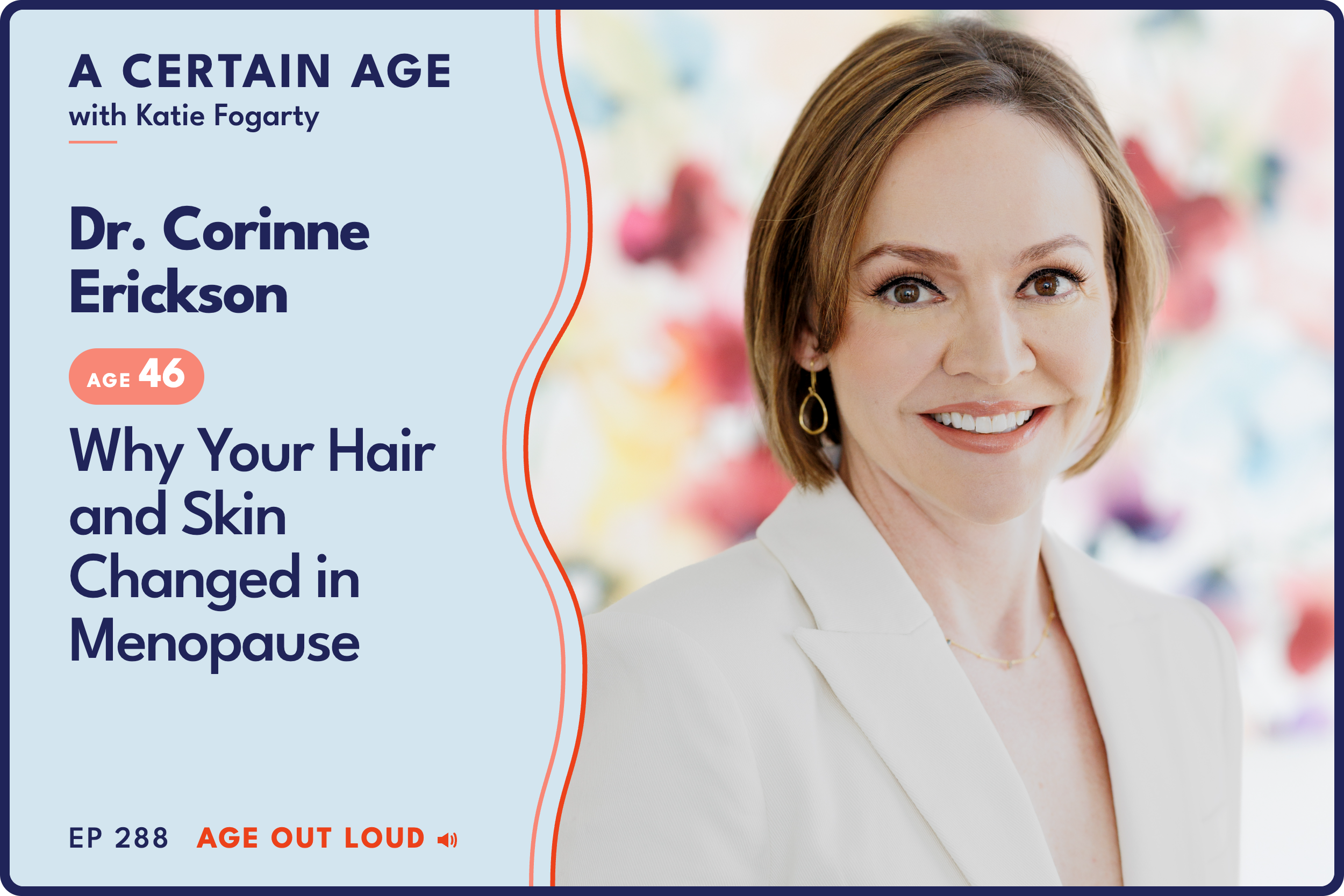
If your mirror is showing thinner hair, crepey skin, and chin hairs that weren’t there last year, you’re not imagining it, and you’re not alone. Return guest Dr. Corinne Erickson, dermatologist and Alloy Health advisor, explains how your hormones are driving these changes. She also has a new name for them: PSM, the pilocutaneous syndrome of menopause.
In this episode:
Why menopause changes your hair and skin, and what your hormones have to do with it
What to say at your next skin exam so you’re taken seriously
How hormone therapy and hair and skin treatments work together
Why a name like PSM gives your doctor the language to take these changes seriously
About Dr. Corinne Erickson: Dr. Corinne Erickson is a board-certified dermatologist, a Menopause Society-certified practitioner, and a medical advisor to Alloy. She writes The Skin Pause, a Substack on hormones, skincare, and aging.
Show Links:
Follow Dr. Erickson:
Quotable:
The menopause movement is really showing women that we have to be our own advocates, and we have to be fluent in our bodies and in our hormones and what we need.
Transcript:
Katie Fogarty (00:03)
Welcome to A Certain Age, a show for women who are unafraid to age out loud. I'm your host, Katie Fogarty. Beauties, a quick history lesson, but stay with me. This is less ancient history and more news you need to know now. Back in 2014, doctors retired the term "vaginal atrophy" and replaced it with a more scientific name. The genito— I knew I was gonna mess that up. The genitourinary syndrome of menopause, or GSM. I think we can all agree this was an improvement.
Then in 2024, researchers proposed another: the musculoskeletal syndrome of menopause, for joint pain and muscle loss. Here's why this matters. Until a symptom has a name, it's easy for a doctor to wave it off. It's easy for you to wonder if you're imagining it. A name gives you words to walk into the exam room with. Today's guest is proposing the next big medical language upgrade, one for your skin and your hair.
This is the part of menopause that everyone can see. Dr. Corinne Erickson is back on A Certain Age to name what so many of us see in the mirror: thinning hair and dry, crepey skin. You may remember Dr. Erickson from our Glow Getter Summer Skin episode, where she told us women lose about 30% of their collagen in the first five years after menopause. Since then, she's become a medical advisor to Alloy Health, and she's co-authored a paper proposing pilocutaneous syndrome of menopause, or PSM. "Pilo" is for hair, "cutaneous" for skin. Dr. Erickson has a thesis: these changes aren't random, and they aren't separate. They're driven by the menopause transition, often before any other symptom shows up. Today: what PSM is, why a name gets women better treatment, and exactly what to say at your next GYN appointment to get the tools you need to look and feel your very best.
Welcome back to A Certain Age, Dr. Erickson.
Corinne Erickson (02:08)
Thank you, Katie. So happy to be here.
Katie Fogarty (02:11)
Well, I am really thrilled. It's funny, the seasons have changed. You helped us head into the summer months armed with some great information about taking care of our skin and helping it bounce back after a summer of fun in the sun. Now you're back to talk about something bigger and broader that goes way beyond a season. It's really for the whole season of menopause, perimenopause, and beyond.
You are a board-certified dermatologist, but you're also a Menopause Society Certified Practitioner. What was the moment when you thought, "The skin and hair changes that I'm seeing in my patients, or even my own mirror, need a new language and a new way of thinking about their treatment"?
Corinne Erickson (~02:55)
Well, I think it was one of those nights, probably around 2:30 or 3 o'clock in the morning, when I was up just thinking, not sleeping. I thought about the patients I'd seen earlier in the day and my patient lineup for the next day, and how everyone aged 40 to 55, all women, were coming in. And it was never just one thing. It was, "My skin is really dry and irritated, I'm breaking out in rosacea, and by the way, my hair's really thinning too. And is there something you can do about my jawline?"
I just kept thinking, gosh, I'm hearing the same thing from patient after patient, all along this menopause continuum. I'd already become menopause certified and was really learning and researching what estrogen does for the skin when we have it, and then what happens when it goes away. And I just thought, this deserves a name. The chaos that women are feeling and the litany of symptoms that we as providers are hearing from them, we need to clarify this. And how do we do that? We name syndromes. We put them together in a group, and that helps us organize our thoughts. It gives a foundation for the conversation. And in thinking about it, I was like, pilocutaneous syndrome of menopause, PSM. It explains what's happening to the hair and to the skin as our estrogen declines, and as we then have a resulting relative androgen excess show up.
Katie Fogarty (~04:25)
Well, let's break this down. Let's break PSM down into plain English. There are two hormonal drivers that really do change our skin. I know that one of these drivers is fast-acting: it's when estrogen exits. The other is a bit slower. You say that one takes the stairs. Tell us about these two hormonal drivers.
Corinne Erickson (~04:50)
Right. So we have our estrogen and we have our androgen hormones. As we hit menopause and our ovarian production stops, we lose about 90% of our body's estrogen. That's what I mean when I say estrogen base jumps, right? It takes a very, very sharp fall off a cliff for us as we hit menopause.
Androgen hormones like testosterone, however, are less menopause-impacted than they are chronologic-age-impacted, and they just continue declining more gradually. They take the stairs down from the top floor. What that results in is this gap, and a lot of the changes that we see happen in that gap, where our estrogen has fallen dramatically and rather suddenly, and our testosterone level has stayed relatively high, even though it's still declining. So it's in that ratio where things are really shifting.
Katie Fogarty (~05:41)
So for this relative androgen excess, explain that to us. If we could actually hang on for a second, I'm sorry, Corinne. I'm distracted because there's a siren. Fortunately, when you're speaking, we're going to be able to edit it off of my track, but I was hoping it would be gone when I opened my mouth and it's still there. Okay, now that it's gone, I'm going to start again. I love this notion of taking the stairs; it makes it so clear that testosterone is exiting more slowly.
Corinne Erickson (~05:44)
Sure.
Corinne Erickson (~05:48)
Great.
Katie Fogarty (~05:51)
You talk about relative androgen excess. What does that term mean to somebody who's never heard it, who it's new to today?
Corinne Erickson (05:55)
It means that the things that testosterone can tell your skin to do are going to be louder. Testosterone has kind of taken the microphone. It's lost the estrogen around the skin cells that was keeping it under a little bit more control. And so when testosterone takes the microphone, it tells our oil glands to secrete more oil, usually in a jawline pattern. What does that translate into? A hormonal acne breakout at times. Testosterone tells our facial hair follicles to go from a white, fine peach fuzz to a darker, coarser terminal hair. Testosterone tells our hair follicles on our scalp to get thinner, finer, less dense. So those are the three key testosterone-driven, or androgen-driven, manifestations of PSM.
And again, typically it's not because we have too much testosterone. Remember, it's declining too. It's that it's just not as held in check now that our estrogen has dropped. And when estrogen drops, another thing called sex hormone-binding globulin goes down, which makes testosterone louder still. It's more, we call it, bioavailable.
Katie Fogarty (~07:10)
And so for a woman who's looking to hold this in check, I'm sure people listening to the show are probably nodding in agreement. They're experiencing the thinning hair on their head. They might be seeing their peach fuzz replaced by those stray, errant-looking hairs. What are we doing to hold things in check? Are we having a conversation with our doctor? Are we looking to stock our medicine cabinet with different products? What is your advice?
Corinne Erickson (07:43)
These are great and important conversations to have with your dermatologist, because hormonal acne, hair growth on the face, which is something we call hirsutism, and female pattern hair loss on the scalp can all be managed. And we need to manage them very carefully. One thing I always look at is whether a woman is also on testosterone, which can be a very important part of hormone therapy. If she's on testosterone and these three symptoms (the acne, hair loss, and unwanted hair growth) are all happening, then maybe the levels need to be checked. But a lot of times these things can just happen in the setting of normal and even declining testosterone levels. So there are treatments for all of them.
I think it's really important in the perimenopause and menopause shift that we're more cautious about just trying to suppress the androgen effect. When we try to suppress those androgens and block them with medications like spironolactone, or lower their impact with combination oral contraceptive pills, it comes at a cost. Because while those androgens may be hyperactive on our face and on our scalp, we still really need them for our libido, for vulvovaginal lubrication and moisture balance. We might need them for maintaining muscle mass. So it becomes a more nuanced treatment approach than when managing this in our twenties or early thirties.
Katie Fogarty (~09:13)
And so do you see a woman having this conversation with her dermatologist? Should she be having it with her OB-GYN, if that's where she's getting her hormonal interventions from? Or is this a conversation that you're having across disciplines with each doctor?
Corinne Erickson (09:32)
It should really be happening across disciplines, because I don't think that dermatologists necessarily need to be prescribing hormone therapy to be really good menopause dermatologists. I think they just need to have a very clear understanding of not just what the hormones do to the skin, but how the hormones are at play with our entire bodies. So for a woman who is experiencing maybe new-onset hair loss, hormonal acne, and hair growth on the face, talk to your gynecologist, or your primary care provider, or whoever you have appointed as your menopause symptom manager to run point on hormones. But then also talk to your dermatologist, and make sure you're informing your dermatologist about these hormone interventions and whatever menopause hormone therapy you're considering or that you're starting. That way everyone can have a fuller picture of you, because these changes don't happen in isolation from each other.
Katie Fogarty (~10:22)
I know. When you were on the show a couple of months ago, you talked about how wrinkles are signals. They're the canary in the coal mine. When we start to see visible changes to our skin, it's a great indication that there are invisible changes happening internally that we need to watch out for. It was such a great reframe of wrinkles: that they're really communication systems that we need to be paying attention to.
Dr. Erickson, we're heading into a break, but when we come back, I want to explore your idea of rebalancing, not blockading, and talk about hormone therapy, topical estrogen, and androgen-targeting treatments for women. We'll be back in just a minute.
[AD BREAK — NOT TRANSCRIBED]
Katie Fogarty (11:05)
Dr. Erickson, we're back from the break. Before it, we were talking about why visible changes in our skin are signals that things are changing internally as well. You had said something earlier in the conversation about rebalancing, not blockading. Can you first expand on that? What do you mean by that? And then I want to talk about some of the specific treatments.
Corinne Erickson (~11:23)
Right. We need to keep in mind that our hormones, while they may be causing some problems for us in some areas, like a mustache that we'd rather not be there, are still supporting other parts of our bodies. In dermatology, we're very, very well trained in how to suppress androgens. We're taught that they cause problems with the skin and the hair, and when those problems happen and we think they're hormone-mediated in that distribution, then we should just shut them down. But the issue is that we can't systemically give a pill like spironolactone and say, "Only work on the face," or "Only work on the scalp." It's going to have an impact throughout the body.
So this is where I think it's very, very important to look at the entire woman sitting in front of you in the chair and ask, what are the potential trade-offs if we block the androgen systemically? Is she having trouble with her libido? Is she already having trouble with vulvovaginal dryness, genitourinary syndrome of menopause? If those are the case and they haven't been fully addressed, I may not lead with a higher-dose androgen blocker. I may work with other modalities that are not even hormone-based. For hair, I use a lot of low-dose oral minoxidil, because it leaves those hormones untouched, but it is a very effective way of regrowing the hair. It's off-label. Or topical minoxidil, which is on-label for female pattern hair loss. And with acne, I may reach for a topical androgen inhibitor, something called clascoterone acetate, rather than an oral agent like spironolactone. I want to be as selective as possible, because the hormones that are causing a problem on the face may be really helping other parts of the body. I think this is an area where we can do a much better job taking care of the whole patient, and not just the one system and one sign that they're presenting to us as a specialist.
Katie Fogarty (~13:18)
And so for a woman who's struggling with all of the above, when she's walking in the door and she's gone on HRT and it maybe is having an impact on her face, is that something you want to work with as a dermatologist? You're in the very unique position of being the only medical doctor in Georgia who is both a dermatologist and a licensed menopause practitioner. Where does a woman who is not lucky enough to find somebody with your double skill set go? How are they having these conversations with their doctor?
Corinne Erickson (13:34)
It's really about becoming your own patient advocate. And I'm so excited, I think there are actually a few more dermatologists in Georgia who have become Menopause Society certified, which is fantastic for the specialty and for the women we take care of going through this, because the knowledge is really important for connecting these dots. But I think one thing the menopause movement is really showing women is that we have to be our own advocates, and we have to be, you know—
Katie Fogarty (~13:50)
All right, trailblazer. We love it.
Corinne Erickson (14:04)
—fluent in our bodies and in our hormones and what we need. If you know, for example, that you are struggling with libido and genitourinary syndrome of menopause and muscle mass, and you're also struggling with skin and hair problems from your androgens, like hormonal acne and hair loss, then you need to be ready to bring it up with your dermatologist, because your dermatologist may not know to ask those questions. We're not taught in dermatology residency to screen for libido and dry vulvar tissue. We're taught to prescribe spironolactone and how to increase the dose until that quiets the testosterone down and gives us the results that we want. And I was not always a good menopause dermatologist. A lot of this was self-taught and learned from other leaders in this field. I think the education, and the push for doctors to change and to ask these questions, is going to come a lot from the patients sitting in the exam room chairs.
Katie Fogarty (~15:10)
Yeah, I echo your thought that we need to become smarter patients. That's a theme that comes up on the show time and time again. And I want to offer two tools for listeners to do so. You can head to letstalkmenopause.org. They have a symptoms checklist that you can print out and bring to your doctor to check off the things you're experiencing, and bring that to every doctor you go to, not just the doctor that's helping you with HRT. Bring it to your dermatologist, bring it to your cardiologist, et cetera.
I also just had the pleasure of interviewing Jennifer Weiss-Wolf, who wrote another book about menopause. It's a wonderful book called When in Menopause, and she suggests not only showing up with your symptoms checklist, but letting your doctor know how and why those symptoms are impacting you. So if it's sleep disruption, you're going to want to say, "I am having trouble at work in the morning due to my sleep disruptions." Or if it's low libido, you say, "This is impacting my sex life in this way and causing relationship issues." She said that when you go one step further with your doctor and explain the impact and how you're suffering, it conveys a better picture than simply listing a symptom on its face. So communication is so key, which is why you have really taken the mantle of defining and identifying PSM and working to change the language we're using around these issues. What are you hoping will change for patients and doctors with this notion of communicating around PSM as a syndrome?
Corinne Erickson (~16:28)
What I'm hoping is that, just like Jennifer Weiss-Wolf did with her book and the list of things, we can actually create a list of the signs and symptoms of PSM. We can categorize them into what's changing with your skin that's related to your estrogen decline and how it's impacting your life, because these are not just cosmetic issues. And then we can have the list of those signs of PSM that are related to the relative androgen excess. And you can bring that in to your doctor. Because it is so well categorized, that gives the doctor a better framework and a better foundation to approach the patient and say, "Okay, I'm seeing that you're having a lot of estrogen decline symptoms," and, to name a few: thinner skin; wrinkles that are showing up more suddenly because that collagen loss is dramatic; drier, more sensitive skin; not tolerating products that you used to; a mix of kind of dry skin in some areas and more of a combination oiliness in others; pigmentation that's staying up and lingering and is more pronounced; laxity, feeling like your skin is kind of falling, and not just on your face, but that crepiness on your body skin. Itching is a big one. Even a component of the hair thinning is not just relative androgen excess; it's because the estrogen is not there keeping the hair in a healthy growth phase.
So you can take these estrogen decline symptoms and check through them yourself. And then you can take the relative androgen excess symptoms: the hair growth on the face, the hormonal acne, the hair thinning on the scalp. It's a shorter list, but a very impactful one. You can bring that in, and that can help shape the direction of the visit and take it beyond "I have 15 chief complaints and I need 15 different prescriptions for them," where no one is going to put the pieces together.
Corinne Erickson (~18:06)
It helps the doctor too, because all of a sudden you're dealing with two key hormonal drivers, and you're starting there with more of a root-cause approach.
Katie Fogarty (~18:12)
And so a patient's coming in with this list. She's being a detective; she's looking, assessing, and auditing because she knows her body best, and she's coming in with a list of the changes that she's seeing. A listener might be wondering, "Well, can I do a lab? Is this something that can be cleared up with lab work? What does a sudden or severe change look like?" I know that everyone's going to have their own judgment about how happy or unhappy they are with the things they're seeing in the mirror. But if they want to treat this as an important part of their healthcare toolkit (skin is our largest organ), is lab work something that is needed? Can it even identify these changes? Where do you land on that?
Corinne Erickson (~19:08)
Yeah, it's such an important question. And I know we all wish there were lab tests that could tell us where we are in this menopause continuum, especially in perimenopause. But where I find labs really helpful with PSM is with the androgen excess component, because that's where we sometimes need to rule out a true androgen excess.
Say you've not always had a few facial hairs and now you have a few more, but you now have more of a mustache, or even a beard, and it's coarse and it's happened over six months. Or you have more of a male-pattern hair loss on the scalp, at the crown of the head or the vertex, that's really thinning. Significant hormonal acne accompanying these, a deeper voice, an enlarged clitoris. These are signs that might say this is not just a relative androgen excess, this is a true androgen excess, and we need to order some androgen hormone levels. Or if you're on testosterone therapy, we need to order androgen levels to make sure you're not on too much testosterone therapy.
Katie Fogarty (~20:22)
And if you're not using testosterone therapy currently and you're experiencing some of those more alarming symptoms that you identified, like the male-patterned baldness at the top or significant facial hair, what are some other causes that might be contributing to this, beyond simply the fluctuating hormones of the very natural perimenopause transition?
Corinne Erickson (~20:38)
So there are actually both ovarian and adrenal gland tumors that can secrete these hormones. When that's at play and we test levels for adrenal and ovarian androgens, the levels are often very, very high. There is a condition called congenital adrenal hyperplasia, where you're born with enlarged adrenal glands, but sometimes we see a delayed adult-onset presentation of that. Sometimes it's polyendocrine metabolic ovarian syndrome, PMOS, formerly known as PCOS, another great example of the power in changing a name. And I'm amazed at times that women who I see in my clinic don't know that they have PMOS until they're in perimenopause. But even that can be an important conversation, because it's just so much more than the skin and hair issues. In that case, it's a metabolic concern as well.
Katie Fogarty (~21:33)
Sure.
Corinne Erickson (~21:42)
So those are the key things that we're really looking for with lab work: to rule out a bigger problem. The estrogen decline is tough in perimenopause because every day it could be different, depending on what your perimenopause is doing that day. So it's tough to diagnose estrogen decline with a lab test. That really is driven more by the clinical picture of the patient through perimenopause. And then, of course, after menopause, the estrogen has dropped substantially without hormone therapy.
Katie Fogarty (~22:10)
Yeah, this speaks to the power of continuing to track all the changes that you see, and making your doctor a partner in this. Labs might be required by them. I want to talk in a few minutes about treatments that we can use to manage some of these symptoms of PSM without a doctor's intervention, because there are things we can buy in retail shops or do at home, and I want to explore those. But before we do that, I want to talk a little more about this notion of a syndrome.
You gave a great example: PCOS went through a name change recently. I talked at the top of the show about how vaginal atrophy has been upgraded to a more clinical definition. Way back, it was even called "senile vagina," which was even worse. Then it got upgraded to vaginal atrophy, and now GSM. There's power in naming because it allows us to research, identify, and claim it. How does one go about getting a syndrome named? Walk us through what you're doing on your end to advance this new language, this new glossary. How does it work? Who gives permission? Tell us.
Corinne Erickson (22:57)
Yeah.
Right, so it's a new area for me. This is the first syndrome I've ever tried to name, and I followed the pathway of an example: Dr. Vonda Wright, who named the musculoskeletal syndrome of menopause. In order for something to be a syndrome, it needs to have consistent shared features across patients, not identical ones. And it can't have a single, set, necessary lab test that defines it. It also needs to have shared underlying drivers. PSM, very much like MSM and GSM, shares the underlying driver of estrogen decline. I think what's unique about PSM in that area is the impact that the relative androgen excess plays.
So I conceived of this idea and reached out to other experts in the menopause space, Dr. Robin Noble, who is the chief medical officer for Let's Talk Menopause and Encore Vita, and an amazing OB-GYN and menopause-certified practitioner. I talked to her about it, and she really thought this could be beneficial. So it was just talking with other people about whether this could really help women, and help the doctors and other practitioners who are taking care of them. Then we co-authored a paper together, writing up the science, the data, and the importance of these symptoms, presenting it as a syndrome, and we've submitted it for publication to a peer-reviewed journal. That's the process we're taking.
Katie Fogarty (~24:25)
And it sounds extremely exciting. What comes next? Do you wait? What's the next step in this?
Corinne Erickson (~24:33)
Yeah, right now we're in the waiting game. In the meantime, I think acceptance for publication will be huge to validate it, especially amongst menopause providers. But I do think there's still value in naming it and talking about it now to help women make sense of what they are seeing in the mirror. I know it's helped me. I've taken it on a test drive for several months now in clinic, and I've said, "Listen, we're going to stop talking about a million of these symptoms in isolation. They're not siloed. We're going to talk about them together as PSM, and I'm going to help put this together for you, and that's going to help us shape where we might want to go with your skin treatment or with your hormone therapy."
Of course, skin is off-label for menopause hormone therapy, but the skin is actively participating in menopause. It's not just observing it and enduring it. And menopause hormone therapy has been shown to help symptoms and signs of PSM in clinical studies.
Katie Fogarty (~25:51)
Well, let's talk a little bit about that. Frequent listeners to the show are familiar with the difference between systemic and local vaginal estrogen, but I think it bears a quick overview from you. Does systemic HRT help with skin? Is it more of a vaginal issue, or is it topical on the face? Walk us through the role of the different applications of HRT in our skin health.
Corinne Erickson (~26:08)
Sure. There are studies looking at how being on systemic hormone therapy, meaning the hormones are intended to get into your bloodstream and travel throughout your body and help multiple organ systems, affects skin. This could be your estrogen patch, your estradiol pill, your estradiol gel or mist, or your Femring. There are different types of that. And then your oral progesterone. Those systemic forms of hormone therapy have been shown in clinical studies to improve dermal collagen content. Collagen is the protein that gives our dermis, our skin, its structure and thickness. Some studies also found improvement in wrinkles and hydration over time. So the skin can feel the loss of estrogen, which is when it declines by that 30% figure in five years. On the flip side, giving the hormones back, to an extent, can restore the function and the features to the skin that the estrogen decline was taking away. And there have been studies that have actually shown that women on systemic hormone therapy didn't lose 30% of their collagen within five years of menopause.
Local hormone therapy refers to hormones that you put on the skin or in the vulvovaginal area, and you want them to work where you put them, not to be absorbed systemically and travel through the body. Vaginal estrogen and vaginal DHEA are perfect examples of FDA-approved, on-label indications for local hormones. And we take the same philosophy: we want the same things for our face that we do for our vulvovaginal area in GSM. We want the collagen, we want the blood perfusion, we want the hydration, and we want the pH and the microbiome restored to a more normal population, where we're less susceptible to infections. That's the premise behind local hormone therapy. And that too has been shown in clinical studies to improve hydration of the skin, improve collagen content, and, over time, lessen wrinkles.
Katie Fogarty (~28:27)
For those studies, are they on the vulvovaginal region, or are they also on the face and other parts of the body, like the neck, hands, et cetera?
Corinne Erickson (~28:35)
Yeah, so the broadest, best literature for local application of hormones is in the vulvovaginal area for genitourinary syndrome of menopause, and that's why that's the on-label indication for estradiol. The literature and clinical studies looking at estrogen on the face and body, on our keratinized skin rather than our mucosal tissue, are a much smaller body of literature. The clinical studies are smaller, and they are of shorter duration than anyone would like. Many of them stopped around 2002, and we have several decades of no data on this.
But fortunately, there are some companies that really care. Alloy Health did a randomized, placebo-controlled, double-blind trial on their facial estriol formulation, and they compared it to placebo, to topical estradiol at the vaginal estradiol local strength, and to their estriol 0.2. After 12 weeks, they found improvement in collagen and improvement in hydration, and they did not find a detectable change in serum estriol levels. That's one reason I work with them. We need more data, and companies don't have to do these studies. They showed their true diligence, and that they care, by doing it.
Katie Fogarty (~30:10)
Yeah, absolutely. I'm a fan of their products. Frequent listeners of the show know they've been a sponsor of the show over the past several months, and I've been using their products for years. Beyond simply having estriol in their skin products, they have other wonderful ingredients like hyaluronic acid and other moisturizers, and I find them delightful to use. So I'm just throwing that in there because I'm a fan of Alloy, and I've interviewed all of their leading medical providers on the show, including the two co-founders, who are not doctors but have really lifted up this women's health company into a wonderful organization that supplies so many different types of products for women at this stage of life.
So for women who are listening to this and are going to go into their doctor tomorrow: I think we all approach a time when we get our DEXA scan, or we're doing our colonoscopy, or we're feeling lit up and want to move the ball forward on our health. For somebody who's listened to this show and said, "Okay, I'm inspired, I really want to take action; I want to loop my doctor in and get their best advice, and then also make my own decisions about what kind of topical products I want to use, for fun and for efficacy," what are they walking into their doctor's office saying? How are they talking about PSM in a way that makes the doctor a partner, rather than pushing the doctor back on their heels and having the doctor think, "My gosh, more TikTok medicine"? How do we loop our doctors in and make them a supporter and a partner in the care of our skin?
Corinne Erickson (~30:45)
Well, everybody needs a skin exam, Katie. Everybody needs a full-body skin exam to assess not only the moles we have and other things that may grow on us as we get older, but the overall health and status of our skin and hair. So I think the most approachable way to start this conversation with your dermatologist is not to say, "I want to come in and talk about PSM," because it's not published yet in a peer-reviewed journal, so they may be like, "I don't know what you're talking about." Instead, go in and say, "I need to come in for a skin exam, and while we're doing my skin exam, I just want to talk about my overall skin and hair health." That is a very reasonable question and expectation to have out of your dermatology visit.
Then come in prepared with a list. Look at this breakdown between your skin signs and symptoms that could be related to estrogen decline. Is your skin getting wrinklier? Do you think it's getting thinner? Do you think it's getting maybe a little laxer? Is your jawline becoming a jowl line? Are you having more pigmentation show up? Are you more sensitive to products? These are all very reasonable questions. I mean, this is very reasonable.
Katie Fogarty (~31:42)
Corinne, you're describing my life, so it's more than reasonable. It's a universal experience.
Corinne Erickson (~31:52)
It is. And then you also say, "I'm also having maybe some hormonal acne, or I'm having more facial hairs than I used to." You can set them up. You can say, "I understand that I think my hormonal status could be playing a role in this, and this is what I'm doing about that." And just have the conversation, because all of these things that are part of PSM, dermatologists are really excellent at treating. You're not asking them to do something they don't know how to do; it's reframing it for them and helping them see your skin and your hair as a piece of a larger picture. I think that's really the shift this creates. This is not just a list of cosmetic complaints, like "I'm getting wrinkles, okay, so let's throw some Botox at it." It's that you want to have a more informed conversation about the health status of your skin and the way your hormones are at play.
Katie Fogarty (~32:48)
Yeah, smart to start with a baseline, because it gives you a starting point to have the conversation with your doctor and then bring up your concerns. They might also be seeing legitimate concerns based on that exam. So I love that recommendation. How does talking about our skin and hair open the door to the bigger conversation about the other changes we're seeing: sleep, mood, bone, heart health? Once we've opened that door, are we having that conversation with a different doctor? Are we looping our dermatologist in as well? What is your thinking on that?
Corinne Erickson (~33:23)
So I think this is where dermatologists will decide how much of this they want to take on. I am also an integrative dermatologist, so I have always asked about nutrition and sleep and stress, because I appreciate and respect how much of an impact those things can have on the skin, and also people's emotional and support structures at home. So the dermatologist may take it to the next level. A conversation about hair thinning in my clinic can certainly lead to a conversation about a dry, irritated, itchy vaginal area, which could lead to a prescription for vaginal estradiol and collaboration with another specialist. Or they can just say, "Are you having any of these other symptoms of estrogen decline? Let's collaborate with my friend who is a menopause specialist, who can help you with this." And I think that's a very reasonable way to go. One doctor can't take care of all of the different components of menopause. For a woman, we need a team, and we need to get back to a collaborative medicine approach across specialties.
Katie Fogarty (~34:12)
Especially as Dr. Sharon Malone, who is Alloy's chief medical advisor, said on this show: you are your own doctor, and the other doctors are part of your support team. You are your best doctor. So to become that smarter patient, recognize that you need to walk into every doctor's office with information about how you think they can help you, giving them the lowdown on what's going on in your life. Keep notes, keep track, journal how long these things have been going on, and walk in and make them a partner in helping you.
When I was younger, I grew up in a more patriarchal medicine, where you thought the doctors were completely in charge and I felt like I was sometimes waiting. Now I feel like I'm much more in the driver's seat of these healthcare conversations. I've seen that shift over the last six years that I've had this podcast; there have been more books about how to be a smarter patient. And I truly appreciate your perspective that doctors are there to help, and we need to have the conversations that allow them to partner with us, while recognizing that not every doctor can be all things to all patients. I love your coaching about potentially finding an integrative dermatologist. I think at a certain stage of women's health we might need different dermatologists than the ones who were doing skin checks on us in our twenties. As you move forward in your reproductive years, you might find doctors who are better suited to where you are now as a patient.
Dr. Erickson, if you could have everyone who's listening to this show do one thing tomorrow that they're not doing today, what would that be?
Corinne Erickson (~35:06)
Probably, if you're a woman over 40, make sure that if you need a prescription for vaginal hormones, you have one. Truly, that is part of the skin, the vulvovaginal area. It is skin, and that is probably what has really lit this fire inside me to help women: this is skin, and it can save a part of your body, and it could potentially save your life. So the goal is to get vaginal estradiol, or another vaginal local hormone, into the hands of more women who need it, so that as we get into our 60s and beyond we're not facing bladder incontinence, UTIs, and urosepsis. So don't be afraid of vaginal estrogen. It's safe, it's effective, and it's lifesaving.
Katie Fogarty (~35:54)
Yeah, phenomenal advice. My last question would be: how do you see the menopause landscape shifting? When you started in med school and started studying dermatology, could you have imagined you'd be here?
Corinne Erickson (~36:03)
I do. I think it's going to take time, but I think we have some really phenomenal voices in medicine who are leading the way, especially on the physician education front. I think any physician or provider (APP) who takes care of women going through the midlife transition and beyond needs to be hormone literate. They don't necessarily need to be able to manage menopause hormone therapy, but they need to be hormone literate and understand how those hormonal changes are impacting the body system they have selected to help care for, if they're a specialist. And I do think we'll get there with residency training programs, but also with continuing education programs for physicians who have been in practice a while and didn't get trained.
Katie Fogarty (~36:45)
Yeah, things are moving in the right direction, so we do have a reason to be optimistic. Dr. Erickson, thank you so much for coming back onto the podcast to explain PSM to us: what you're seeing, why you wanted to put new language around this thinking, and giving us new tools to manage this important menopausal symptom. Thank you so much for being with me today.
Corinne Erickson (~37:08)
Oh, thank you for having me, Katie.
Katie Fogarty (37:16)
That was Dr. Corinne Erickson, back on the show with a language upgrade for what so many of us notice in our skin and hair: the pilocutaneous syndrome of menopause, or PSM, driven by two hormonal shifts, when our estrogen goes base jumping off a cliff while those androgens slowly take the stairs. My biggest takeaway: book a full-body skin exam, take a list of what you're noticing and how it affects your life, and loop in your menopause provider. You have the words now, so go use them. You can grab a symptom checklist at letstalkmenopause.org, and share this show with a friend who needs it.
Thank you so much for sticking around to the end of the show, and as always, special thanks to Michael Mancini, who composed and produced our theme music. See you next time, and until then, age boldly, beauties.
