
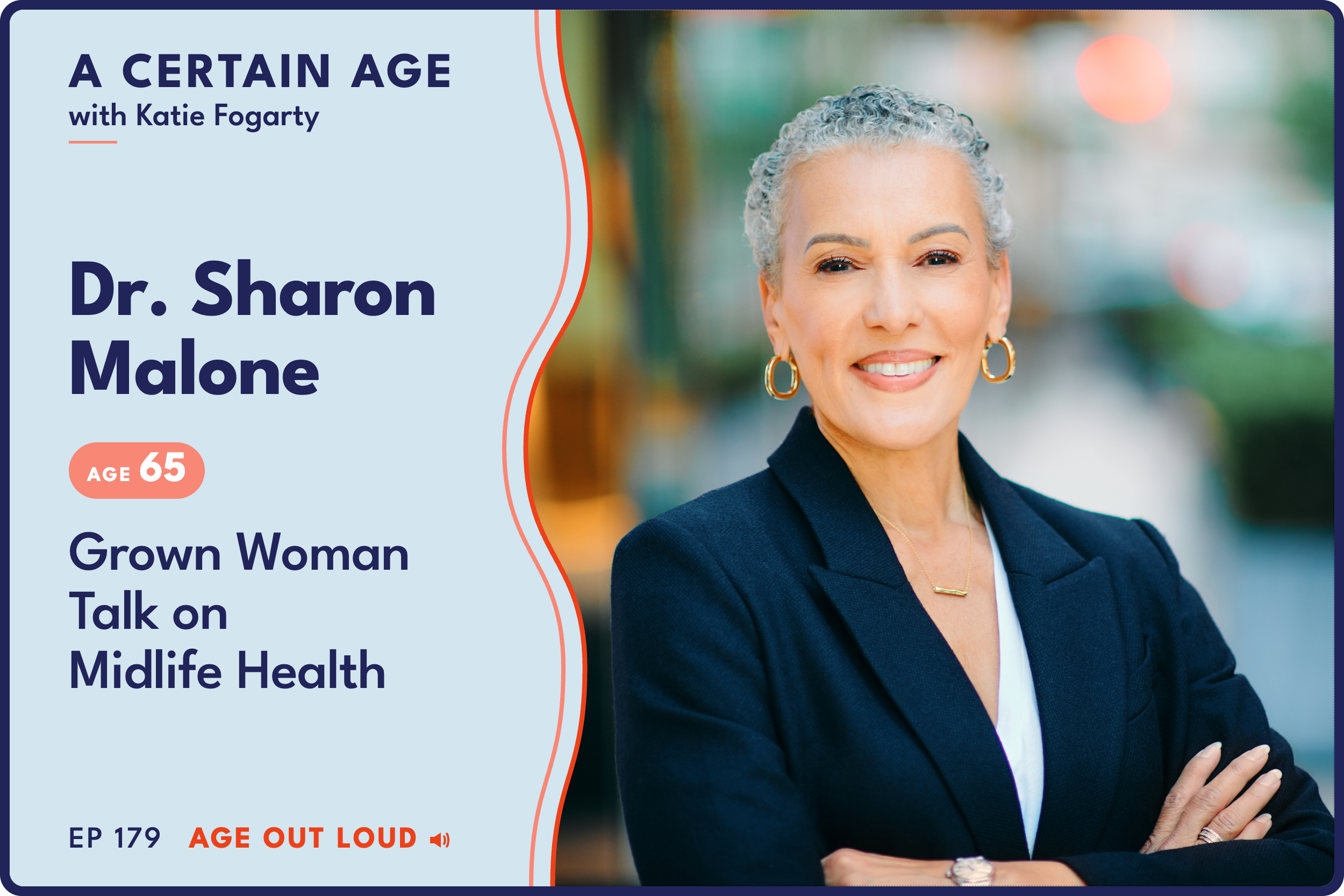
Grown Woman Talk on Getting and Staying Healthy at Midlife and Beyond with Dr. Sharon Malone
Show Snapshot:
Many of us walk out of a doctor's appointment more confused than when we walked in — and that's a systemic problem, not a personal failing. Dr. Sharon Malone, one of Michelle Obama's go-to doctors and author of the bestselling Grown Woman Talk, argues that midlife women need to become the primary architects of their own healthcare, not passive patients waiting to be told what's next. "No one is coming to save you," Dr. Malone says. So she wrote the playbook to help you do it yourself.
In this episode:
Why the healthcare system increasingly requires you to advocate for yourself
How race, economic status, and gender shape the quality of care you actually receive
Practical tools for pushing back when a doctor dismisses your concerns
What "getting and staying healthy" really means once you're past 40
About Dr. Sharon Malone: Dr. Sharon Malone is Chief Medical Advisor at Alloy Health, host of The Second Opinion podcast, and New York Times best-selling author of Grown Woman Talk. A veteran OB/GYN and Forbes 50 Over 50 honoree, she's a leading national voice on menopause care and policy reform.
Show Links:
Follow Dr. Malone:
Follow Alloy:
Dr. Malone’s book:
Grown Woman Talk: Your Essential Companion for Healthy Living
Dr. Malone’s podcast:
Learn more about Alloy on other episodes of A Certain Age.
We have featured Allyo co-founders Anne Fulenwider and Monica Molenaar:
Quotable:
“I have been the informal health advisor for most people in my family and a good portion of my friends, simply because I'm the only doctor in the group. And I am surprised by…how little they know, not just about their health in general, but about the logistics of how to navigate this crazy, unnecessarily complex system that we're all trying to live in.”
Transcript:
Dr. Sharon Malone0:00
No matter how many degrees a person has, no matter how many residencies they've done, you are the expert on you — remember that. Don't let anybody tell you that you're okay if you feel you're not. Then move on.
Katie Fogarty 0:18
Welcome to A Certain Age, a show for women who are unafraid to age out loud. Beauties, I'm a college grad, I have a master's degree, and I've had multiple careers — working as a teacher, in corporate America, and in newsrooms. I've even worked on Capitol Hill, where I helped manage legislative policy for a U.S. senator. So I feel like I know a thing or two, but I still find managing matters like my taxes and healthcare to be overwhelming. I mean, these systems are crazy, confusing, complex, and difficult to navigate. Today, I am thrilled to welcome to the show a visionary woman who is going to help us get our healthcare trains on the tracks. Dr. Sharon Malone is a DC-based OB/GYN and certified menopause practitioner. She is the chief medical advisor at Alloy Women's Health, a telehealth company that focuses on women over 40. She is on Michelle Obama's speed dial for all things health, and she is the author of the new book, Grown Woman Talk: Your Guide to Getting and Staying Healthy. This book is going to change how you think about managing your health. You are going to want to press this book into the hands of every woman you know — I'm telling you, it's packed with actionable, user-friendly, smart ideas and lots of wisdom. We need to make this book required reading. If you feel overwhelmed by our healthcare system, if you're standing at the intersection of aging and health, anxious and wanting ideas, or if you simply want to hang around with a super-smart and inspiring woman — stick around, this show is for you. Welcome, Dr. Malone.
Dr. Sharon Malone 2:03
Thank you so much, Katie, for having me. That was a great introduction — I'm going to take you on the road with me.
Katie Fogarty 2:09
Well, I would be thrilled, because I love hearing you talk. I've been dying to get you on A Certain Age ever since I saw you speak at some of the New York menopause events. I heard you a couple of weeks ago at South by Southwest, and I know how you share all the smart, actionable info — but it wasn't until I read your book that I learned your interesting backstory: that you're the youngest of eight, and that you got started in women's healthcare for a very personal reason. As stage setting, I would love it if you could share a little bit of your own story and why you chose to focus on women's health as a career.
Dr. Sharon Malone 2:44
Yes, you know, I'm the youngest of eight, and when you're the youngest of eight, you get to see a lot of things — you get to see how people age, what their health journeys have been. But I think it really started for me when I was just a little girl. Unfortunately, I lost my mother when I was 12, and I remember thinking at the time, having no medical background, that this wasn't really how it was supposed to be — not just the course of her illness, which was very brief (she only lived six months after being diagnosed with colon cancer), but just the quality of the interaction that my family and she had with the medical personnel. At that point, it left me wanting. And even though I was probably already thinking about being a doctor, that interaction really changed what kind of doctor I wanted to be. I never wanted to put a patient or a family in a position where they felt unheard and unseen.
Katie Fogarty 3:47
And this notion of being unheard and unseen, I think, is so important. Your book talks about how hard it can be for people to be seen and taken seriously by the healthcare industry — people of color, women, people from certain socioeconomic backgrounds, people from rural America — who are not often given the same kind of access, or seen as the same type of patients as other people. Does this play any role in your advocacy? How does it inform the writing in your book?
Dr. Sharon Malone 4:21
Absolutely — I think it is really the bedrock of the writing in my book, simply because when I wrote this book, you have to decide — since this is my first and only book — what kind of book you want to write. My guiding principle has always been: if you don't have something to say, don't write a book. Books can sometimes be vanity projects.
Katie Fogarty 4:48
That's a pretty good starting point, right? Have a point of view.
Dr. Sharon Malone 4:51
Sometimes you write a book because you think you're interesting, and I personally think everybody has a very interesting backstory. But what was important for me was: how does my backstory and my experience inform or help someone else? That's really how I got to this book. I have been the informal health advisor for most people in my family, and a good portion of my friends, simply because I'm the only doctor in the group. And I was surprised — I'm talking about very educated women who have access — by how little they knew, not just about their health in general, but about the logistics of how to navigate this crazy, unnecessarily complex system we're all trying to live in. And let me say this: if you are a woman, we know from past experience that women's complaints are always minimized — there is always that sort of patriarchal nature to doctor-patient relationships. So you've got that piece, and then you've got the real-life experience of how you show up in that world. If you're a Black woman, if you're a Hispanic woman, if you're economically disadvantaged — all of these things weigh heavily into the quality of your experience with healthcare professionals. We don't have enough cultural sensitivity, we don't have enough gender sensitivity in these interactions to make it really worthwhile. So I felt that women, in particular, needed a guidebook to tell them: all right, someone's going to say X, but here's what I want you to ask. That is really where my book comes from.
Katie Fogarty 6:49
Your book does that so beautifully. I said at the beginning of the show that I think it should be required reading, and I truly, truly mean that. I had my own eyes opened to ways I could be a better advocate for myself, and ways I can encourage people in my life to be better advocates for themselves. I love the stage-setting you open with — that given the state of our current healthcare system, you really need to be your own best advocate. I think that I, at least, grew up thinking the doctors were in charge. You very much make the case in the first chapter of your book that its purpose is for readers to become their own best primary caregiver. I wrote down something you say later in the book: "In the changing medical landscape, it's every woman for herself. No one is coming to save us." And you add — I mean this in the best possible way, I mean it to motivate you, not discourage you — you must take full charge of your health and your healthcare. I noted this language down because it really spoke to me. Just this past weekend, I was talking to a friend of mine who said, "Wait a minute — why wouldn't my doctor have suggested that I go on HRT?" She was waiting for the doctor to be in charge, and I hear this again and again. So before we dive into some of your concrete recommendations for getting and staying healthy, which we're definitely going to get to, I'd love it if you could share with our listeners why our past, current, and future healthcare systems truly require us to get in the driver's seat.
Dr. Sharon Malone 8:26
I'll give you an example of what my career was like. I practiced medicine for over 30 years before I took a little detour and decided to work in telehealth and write this book, and I could see the changes coming. When I started, way back in 1992, in my private practice, I joined a practice that had been in existence for 30-plus years before I got there — a very well-established practice. Patients had been there through generations, and I had the luxury of practicing in one place with families who'd been with us forever. I watched young women go through high school, college, have children, and go through perimenopause. So there was a great deal of context and relationship built up. My patients trusted me not just because I walked in and they looked at my degree on the wall — no, they trusted me because they knew me and I knew them. That experience, for most people today, is no longer a viable option. The nature of medical practice has changed, and the self-contained, independent doctor's offices you may have had in the past are going away. More and more doctors' practices are being bought up by either hospital groups or venture capital groups forming these large conglomerates, and your doctor is now an employee — not an owner of their practice. And as an employee, they're no longer as loyal to that particular practice, because it's not theirs. You may move, and you'll find there's a good bit of doctor churn. You'll find that even the way the insurance market works — you may change jobs, you may move, you can stay with the same insurance, and all of a sudden your doctors are being dropped by your insurance carrier. This puts you in the unfortunate position of having to constantly re-explain yourself to a new group of healthcare providers. So the continuity is really compromised, and that's unfortunate, because it means the only constant in this ever-changing environment is going to be you. That's why I say this is an opportunity — not just the bad side of it, but an opportunity for you to realize that you are in control of your story: how it's told, how your care is managed — in a way we may not have been in the past, because we assumed, well, my doctor knows me, he or she will make the best decision for me. No — they don't know you, and that's the message I want to drive home. If they don't know you, don't expect that they're necessarily going to make good choices for you.
Katie Fogarty 11:29
Thank you so much for that explanation. That chapter of the book was really riveting to me, because you spelled out things I hadn't considered. As I was reading your words, I realized that's been my own experience with my care, and it hadn't been crystallized for me in that way before. I think it's a really important chapter for any woman listening to the show to truly understand what the current landscape is like, and why it's so important to take action. We're heading into a quick break, but when we come back, I want to talk about the many chapters in your book that focus on the key pillars of health, and some of your more concrete recommendations for becoming our own primary care doctor and putting ourselves firmly in the driver's seat. We'll be right back.
[ AD BREAK ]
Katie Fogarty 11:29 (cont'd)
We're back. Before the break, you did some great stage-setting — you let us know why it's really incumbent on us to be in the driver's seat of our own healthcare. Your book has chapters on all the key pillars of health: lifestyle choices, cardiac health, brain health, and, of course, reproductive, peri-, and menopause health. I'd love to touch on as many as we can, but let's start with peri- and menopause, because in some ways menopause marks an end — the end of reproduction — but it's also a beginning: the beginning of a new set of health challenges that impact every aspect of the body. I love what you say in the book: menopause is like parenting — once you're in it, you're in it for life. What do you want every woman on this journey to know about taking care of their menopausal health?
Dr. Sharon Malone 13:04
What I really want them to know is, first off, what it is. I want them to understand that menopause is way more than just hot flashes, and I think we tend to minimize the symptoms and the suffering that women go through — not just at menopause. For listeners who may not know what I'm talking about: there are really two phases. There's perimenopause, the menopausal transition, which happens anywhere from four to ten years before your last menstrual period. Then, once you've had your last period, how do you know it was the last one? It's confirmed after twelve months without another one, and that's when you're officially menopausal. The term I really don't like is "postmenopausal," because it implies you're over it — and you're never over it. The menopausal journey is the rest of your life; that's the hormone state you'll be in forever, unless we intervene. That's the important thing women need to understand: it's not one-and-done. Once your hot flashes go away, it's not, "okay, I'm done with menopause." No — it has a profound impact on your bone health, your cardiovascular health, and even your sexual function from now on. So understand that it's something that needs to be tended to and paid attention to, not just during that transition, but forever.
Katie Fogarty 14:38
Yeah, absolutely — menopause is like parenting, right? It never ends. My listeners tend to be 45 to 65, so they're either approaching menopause, in perimenopause, or firmly postmenopausal. I know, from having other doctors on the show and from hearing you speak, that sometimes the symptoms of menopause don't present themselves for decades — you might wake up and realize you've broken a hip because your bone health was compromised. So for women who think they're skating through menopause because they didn't have a lot of hot flashes, and feel like they're done with the whole thing — what do women need to know today to look down the road and invest in steps that will protect their longer-term health?
Dr. Sharon Malone 15:27
Okay, number one: women have to guard and protect their cardiovascular health. Even though we spend an inordinate amount of time on breast cancer — and we should, it's important — I think the impact we've had, over the past 30 or 40 years, on increasing the breast cancer cure rate really has to do with awareness first, and early intervention; that's probably the bulk of the advances we've made. We've also made some advances in treatment. But to give you some perspective: cardiovascular disease kills more women each year than all cancers combined, not just breast cancer — and yet, for reasons I think are largely about awareness, we're more afraid of breast cancer than of having a heart attack or stroke, or even some of the more debilitating chronic conditions related to cardiovascular disease. So I want women to understand the root of this cardiovascular epidemic: a lot of it is lifestyle, far less genetic than people think — things we actually do have control over. I want women to understand that these outcomes are not inevitable, and it really starts around the time of perimenopause and menopause. Here's an example: when women are in perimenopause and premenopause — in their 40s, usually into their 50s — they have about half the risk of heart disease that men do. Great, wonderful. But what happens after menopause? In the ten years after menopause, when estrogen levels are low and the ovaries are no longer producing, the rate of cardiac disease in women approaches that of men — within ten years, you're nearly at parity. And unfortunately, not only do we reach parity, but women with heart disease do worse: more women die in the first year after a heart attack than men do, and more women have strokes as a result of cardiovascular disease. So, in relatively rapid order — and ten years is rapid, to me, these days — things that weren't as problematic when we were younger become problematic as we age. What's the difference? It happens in those ten years after menopause. That's why I don't want women to think, 'I'm done, on to something else.' No — this is also when osteoporosis becomes an issue, because for women at risk for fractures — and you may not know if you are — it has to do with the size of your bones. If you're small-framed, you don't weigh a lot; but even if you weigh a lot and have small bones, that's the key. I think there's a misperception that just because you're heavy, you're not at risk for osteoporosis. Not true — it's the size of your bones, not necessarily the size of your body. That's a very significant risk factor as we age — not just death from hip fractures, but the loss of mobility and independence. And again, these are things you can intervene on early and turn the train around; you don't have to keep going in that direction. So if I had to name the two big things I want women to understand: you're not out of the woods. I use my book to explain the basic lifestyle changes you can make. You can't stop it forever, but you can certainly minimize your risk.
Katie Fogarty 19:47
Yeah, and that's one of the things I think the book does so beautifully — it provides an optimistic framework. Everyone wants a sense of agency over their own life, and it feels empowering to know these are choices we can make, that we can put ourselves into action. We're going to dive into your lifestyle recommendations in just a minute, but I'd love to ask you a little about the role of HRT — both in managing symptoms like hot flashes and mood swings, and in some of these bigger lifestyle impacts, like cardiac health and bone health — and then we can hear your lifestyle recommendations as well.
Dr. Sharon Malone 20:33
Sure — hormone replacement therapy, or menopausal hormone therapy; we get a new name every other year, it seems. You know, I said I'm old, and I—
Katie Fogarty 20:43
We get new names, but not enough research, right? We're just getting rebrands — repackaging, but not necessarily new. It's all sizzle, no steak. We want some steak.
Dr. Sharon Malone 20:54
Here's what I want women to know: hormone therapy for the symptoms of menopause is not new. Premarin, the first commercially available hormone therapy, was patented in 1942. It's hard to think of another medication that's been on the market in its original form for as long — we're almost coming up on 80 years now. So we pretty much know the landscape of hormones, and we know they treat the symptoms of menopause. Where we are now — fearful of hormones — is because of a study that came out 21 years ago that put in women's minds: not only is it not helping your heart, it's increasing your risk of breast cancer. That was a double whammy that came out in full force. There was a whole press conference announcing this, and women who'd been successfully taking hormones for years, and doing quite well, dropped it like it was hot, saying, "Oh my goodness, doctor, you're going to kill me with these hormones." That's the message we've been trying to undo for the past 20 years, because it turns out we've gone around the world and back again, and guess what — hormone therapy does decrease the risk of heart disease if it's taken within a certain window. The earlier you take it in menopause, the more benefit you achieve. If you take it before age 60, or within ten years of menopause — and even those numbers aren't hard and fast, they just give you a framework — the earlier, the better. If you're trying to do a prevention study, which they were trying to do with the Women's Health Initiative, they allowed women in the study to be anywhere from 50 to 79. Now, I think we can all agree that if you're trying to prevent heart disease, starting at 79 is probably a little too late — and that was the flaw in the study. It cemented this notion, in women's minds and doctors' minds, for a generation, that hormones are dangerous — that if you must take them, take a little for a short period, just until you get over the hot flashes. That mindset has stuck. I want women to understand: there is nothing more effective for treating hot flashes than hormone therapy — not herbal concoctions, not whatever you're getting from your herbalist or your hairdresser. Women are trying all these things because they're suffering and want someone to help them, and we spend a lot of time and money on things that are far less effective.
Katie Fogarty 24:09
Right — and it's interesting that people rely on things like herbal supplements, things that aren't even third-party tested.
Dr. Sharon Malone 24:17
Right.
Katie Fogarty 24:17
And they're fearful of something that has decades of testing and data behind it.
Dr. Sharon Malone 24:21
Exactly, exactly. You don't even know what's in it, much less whether it's effective, because in the supplement market, all a company really has to prove when introducing a supplement is safety — that it won't kill you. It doesn't have to work. There's no—
Katie Fogarty 24:41
That sounds like a pretty low bar. Well, maybe that's a high bar — we don't want it to kill us — but in terms of efficacy, it's a pretty low bar.
Dr. Sharon Malone 24:47
"But you know how they find out if it's going to kill you? You take it, and someone has to report it and say, "Oh yeah, it did kill you." There's no a priori evidence that it won't. A lot of it depends on the supplement, depends on the source — some have contaminants, and a lot of them, when you pull them off the shelf, don't even have what they say is in them, in the amounts they claim. So that's what I'll say about the supplement market. But the point is, women have been searching, in these 20 years while hormone therapy was in the doghouse — do you think women stopped suffering? They did not. But they kept looking for other sources, and I think women have been the victims of a lot of chicanery, a lot of people selling them things that don't work. So that was my number one: if you're symptomatic, there's nothing that works better than hormone therapy.
Katie Fogarty 25:51
Yeah, absolutely. I love how you flag the fact that not every doctor knows this, because — going back to the beginning of our conversation — many people, including me, ironically, feel better educated about their health by becoming a podcaster than by walking into a doctor's office for years. I've learned that I need to be working with a doctor, and now I am — with someone who's a certified menopause specialist, double board-certified in both OB/GYN and integrative health, who really cares about hormonal health and has prioritized it in her practice. But women who are simply relying on their doctor may not be getting the up-to-date science they need. You should be looking for certified menopause specialists, which you can find at menopause.org — that's NAMS, the North American Menopause Society. I'm on the board of Let's Talk Menopause; they also offer resources for finding doctors in your area. I'd love for you to tell us a little about Alloy Health and the telehealth options available, because not every woman is physically near a doctor who's trained in this.
Dr. Sharon Malone 27:05
We have to deal with the reality in this country right now: this demographic of women over 50 is the largest-growing demographic. When we talk about OB/GYNs, there are a little more than 20,000 in the entire United States for 55 million women. Fifty percent of the counties in the United States do not have a practicing OB/GYN — that's horrifying. And given the current political environment, there will probably be even more counties, in more states, without one. So it's important — given how spotty our coverage is, and how few doctors are trained in menopause — that we use a different model. I think if there's anything COVID taught us, it's that telehealth is a viable alternative for delivering care for certain things, and menopausal care certainly falls into that category. The main thing about menopause is that when you have questions, it requires education up front — education about what it is, then education about your choices — and that's where telehealth really comes in. You can do this without having to take a half day off work, spend a lot of money on parking, get frustrated, and go into an appointment where the doctor tells you, 'Oh no, dear, that couldn't be menopause,' or 'No, you can't have that.' That happens more than you'd think — we have doctors who haven't kept up and won't prescribe because they don't think it's a good idea. These are probably doctors who came of age in the 20 years after the Women's Health Initiative, when hormone therapy got a black eye — but that's not true. If you can't find a certified menopause practitioner, telehealth is the way to go — that's why I joined Alloy, because I realized there's only so much I can do in a day. No matter how much I try to explain to women, I really only have about five minutes of their fifteen-minute appointment to cover everything, and it's just not possible. That's why I'm a big fan of telehealth, particularly for things like this, where you can spend time on your own, at your own pace, reading, looking at your options, and then making decisions for yourself — because this, my book, and Alloy Women's Health are all about agency. That's the point I want to make: we want democratized access, and we want to give you agency, because I don't think it's a doctor's place to tell you what you can and cannot have, or to deny you care you feel you need because of what they think. That's all I ask. I say this a lot, because my job in this new world is: I want to tell you something, I'm not trying to sell you something. My role as medical advisor for Alloy Women's Health is to educate women. I'm not a salesperson; I want you to know your options. My mantra is: I'm trying to tell you something, not sell you something. And I think if you get good information, women can make good choices for themselves — you don't need me to gatekeep, you don't need me to tell you what you can and cannot have. That's your decision, and that empowerment model is behind all of it — behind my book. I want women to go out there, to know things, so they can ask good questions and get good answers. And if doctors put you off, or are annoyed by your questions, then you need to find a new doctor, because that's not a person who's going to serve you well in the long run.
Katie Fogarty 31:29
Yeah, that's such great advice. I've had multiple medical providers on the show, including doctors — I think of Dr. Angelish Kumar, a urologist I interviewed, who said women walk through her door after seeing six specialists and suffering for ten years. Or a founder I spoke with who helps women with hair loss, who said patients are usually on their fifth, sixth, seventh practitioner before they walk through the door. Women have to be persistent to get the healthcare they need. And your book is a wonderful starting point — anyone who reads it is going to feel smarter about what they need to be asking for. So I'm thrilled to have you with us. I have two more things I want to ask you about before our time is up. I was really fascinated by your chapter on brain health and Alzheimer's, in particular — this touches so many people, it's beginning to touch my own life — and in that chapter, which was really illuminating, you introduced me to a concept I'd never heard of, called weathering: this notion of accelerated aging. I'd love it if you could share with our listeners what this concept is and how we might mitigate against it.
Dr. Sharon Malone 32:39
Sure — this concept was really popularized by Dr. Arline Geronimus. I believe she's at the University of Michigan, and she talks about lived experience — particularly when you look at communities that are economically disadvantaged, communities of Black people, Native American communities: the harshness of your life, the chronic stress you find yourself in — these things, believe it or not, are not imprinted in your DNA, but they do wear you down. They damage your DNA, causing this sort of weathering, or accelerated aging. I think it's something you already know, but you needed someone to really explain it. Here's a good picture: think of a smoker — you've seen those before-and-after pictures. Someone who's been smoking two packs a day looks different on the outside, and they are different on the inside. All of these environmental things age you — not only your body, but your brain. So we have to really look at marginalized communities, chief among them African American communities, and ask: why do African American women have twice the rate of Alzheimer's as white women? Why do women have twice the rate of Alzheimer's as men? These observations aren't new. What's perplexing to me is that we've described it, but nobody's said, 'Huh, wonder why that is — let's do some research.' I'll give credit to the great Dr. Lisa Mosconi, who's just written a book called The Menopause Brain. She's one of the few neuroscientists who's done more than just observe what happens — she's actually looking for places where we can intervene. It turns out the same things we need to do to preserve our heart are the things we need to do to preserve our brain health, and women carry a disproportionate share of the burden of Alzheimer's and cognitive decline — not just because of different lived experiences and different hormonal experiences, but because women's brains age faster due to the rapid shift in hormones at, you guessed it, menopause. I say this not to be gloom and doom — these are opportunities, because once we know what those things are, we have the chance to intervene. A lot of bad outcomes in health are not inevitable, and they're not just because of race. When we talk about racial disparities — yes, they exist, but it's not being Black that's the problem, it's being Black in a system that doesn't see you, living in poor environments without access to clean water, clean air, healthy food. Those are what we call the social determinants of health, and they'll determine how you age. And when I tell you it's not just race — look at poor people in Appalachia, white people — you'll see the same patterns. So we know what those factors are, and I think what's been lacking is research aimed at making interventions.
Katie Fogarty 36:40
Absolutely, it's astonishing when you spell it all out, because it's such an intertwined system — everything impacts where you're raised, the stress you're under—
Dr. Sharon Malone 36:54
—the—
Katie Fogarty 36:54
—the level of access you have to care, the corrosive nature of constantly feeling under threat on your health. It makes so much sense. So we need a multi-pronged response to manage this and shift the needle. For listeners thinking, 'Well, some of that doesn't apply to me' — the modern ills of modern life, the stress, the corrosive nature of that on ourselves — that's one thing we can intervene on. What would be others? Because you said what's good for the brain and good for the heart are the same thing. What can we put in our listeners' hands, not just for themselves, but maybe to bring into their communities and civic life, so that other people have access to these things as well?
Dr. Sharon Malone 37:43
You know, I think if I had to name the lifestyle things that have the most impact on your health generally — and you know them, but you don't do them —
Katie Fogarty 37:53
Tell us, because every time I hear it I get a little more inspired to be better. This is like ripping off the prescription pad — hand us this prescription. We want to be better.
Dr. Sharon Malone 38:06
Okay, number one: don't smoke, and limit alcohol intake. I think people used to believe red wine was good for your heart — well, too much red wine isn't good for your health, and alcohol generally isn't either. So limit the amount you drink; less is more here. Certainly less than one drink a day, or seven a week — and if you can do less than that, great. And let's not forget exercise — it's key to heart health and brain health. The current recommendation is 30 minutes a day, five days a week; I say do as much as you like, more is more here. The one thing I keep telling women about exercise is that it's good for your mood, your heart, your brain — it is not good for losing weight. If your only motivation for exercising is weight loss, it's not going to work out great for you. Exercise helps with everything else, certainly, but as a weight-loss program, no. So I try to give as many reasons as I can for why exercise matters: mood, heart, brain, and bone health too. So exercise is key. And if you find yourself already hypertensive or diabetic, understand these are manageable — do the first three things, and if you're still there, take your medication. This is not something to skimp on, because controlling your blood pressure and blood sugar is key to maintaining your cardiovascular and brain health. Just having diabetes alone markedly increases your risk for Alzheimer's and heart disease. And the last thing I'll say is sleep — the importance of sleep. We're just starting to focus on this, because sleep disturbances really come up in midlife, in perimenopause and menopause. That's why I'd encourage women — if you're having sleep issues, particularly due to hot flashes, get your hot flashes treated, because disrupted sleep, night after night, year after year, is also a big risk factor for aging your heart and your brain, and for feeling lousy and unproductive during the day. If you mind those things, that's your best shot — and you'd be surprised, you wouldn't just decrease your heart disease and Alzheimer's risk, but — and we didn't even talk about this — you'd also decrease your cancer risk. Huge.
Katie Fogarty 41:03
So important to have these great reminders. I just rounded up three episodes I did on sleep with two sleep doctors and a sleep coach, which I shared last month for National Sleep Month. I'd encourage all listeners to go check those out if you're really struggling. One of the doctors, Dr. Shelby Harris, said — to echo Dr. Malone — if you walk into a doctor's office and they don't take your sleep seriously, find a new doctor, because—
Dr. Sharon Malone 41:28
—this is—
Katie Fogarty 41:28
—foundational. Thank you for reminding us about that. We're heading into our speed round in just a minute, because our time is nearing an end. But before we do, I want to ask you one last question. You've been doing this work for years, and I know you have a daughter — I have one too, mine is 23. For listeners who have young women in their lives, looking to the future — if you feel like whipping out your crystal ball, where do you think we're heading in terms of care? Are we at the tipping point we need to be? What's the future of our daughters' healthcare and menopause care in this country?
Dr. Sharon Malone 42:05
I think we're starting to see it already, particularly in young women. More of their care is going to be delivered via algorithm. As I said, they're not going to have long-term relationships with doctors — they may see a different one every visit — and that's why the empowerment piece is so important: they have to educate themselves so they know how to interact with doctors. And doctors don't know everything — let me just say that, a lot of them think they do, but we don't. I think this next generation is not going to be shy about just saying, 'Well, that's what the doctor said' — no, I think they're going to be much more proactive in their care, and they should be, because no matter how many degrees a person has, no matter how many residencies they've done — you are the expert on you, and remember that. Don't let anybody tell you that you're okay if you feel you're not. Then move on.
Katie Fogarty 43:11
Great advice. I said at the beginning of the show that every woman needs to give this to their girlfriends — it's the perfect hostess present — but it sounds like it's also the perfect gift for your daughter. Put this in their hands. This is for grown women and growing women, so let's get it into young women's hands too, so they can be in the driver's seat of their healthcare. All right, our time is nearly up — we're moving into the speed round. High energy, so we can cover a little more ground before we say goodbye. One- or two-word answers. Let's do it. Writing Grown Woman Talk was liberating.
Dr. Sharon Malone 43:51
Yes. I could talk about this women's health topic again and again: menopause.
Katie Fogarty 43:52
Menopause — nice, me too. I wish every woman would talk to a certified menopause specialist about getting this particular tool into their menopause health toolbox.
Dr. Sharon Malone 44:04
Hormone therapy.
Katie Fogarty 44:05
Nice. Even doctors need to work on their health — what is a lifestyle hack that keeps your own healthcare train on the tracks?
Dr. Sharon Malone 44:13
The community of friends — we didn't even get to that part, but—
Katie Fogarty 44:17
Nice.
Dr. Sharon Malone 44:18
—it's important. Community.
Katie Fogarty 44:20
Yeah, absolutely. Loneliness is a new epidemic, so get yourself girlfriends and keep them close. You're an author, an advocate, a medical advisor, a wife, and a mom — you've got a lot of balls in the air. Is there a lifestyle choice that helps fuel your inner peace?
Dr. Sharon Malone 44:38
I love music. It's the thing I turn to when I want to decompress — it immediately makes me feel good. It's always music.
Katie Fogarty 44:47
Love it. And for listeners — we didn't even talk about this, but Dr. Malone's book is threaded through with musical references. There's so much great medical information in it, but it's also part memoir — lots of stories of real women, just like you, going through very real experiences — and Dr. Malone references songs throughout that inspire her at different points in the book. It's a super fun read; I really encourage you to put it in your cart. So, finally, your one-word answer to complete the sentence: As I age, I feel—
Dr. Sharon Malone 45:22
Fearless.
Katie Fogarty 45:23
Nice. You know, I've asked 170-plus women this question, and I don't think anyone's used that word yet — love it, love it, love it. Before we say goodbye, how can our listeners keep following you, your work, and get access to your book?
Dr. Sharon Malone 45:38
Absolutely — you can go to my website, drsharonmalone.com. The book is available wherever you buy books — Amazon, Barnes & Noble, Walmart, all of the above. And for those who want to know where I am on my book tour, follow me on Instagram at @smalonemd — I'll constantly update my tour dates, so hopefully I'll be in a city near you and get to meet you in person.
Katie Fogarty 46:11
Yeah, put that on your list, listeners, because Dr. Malone is really amazing and inspiring to hear in person. Check out that Instagram and follow the book tour. Thank you so much, Dr. Malone.
Dr. Sharon Malone 46:23
Thank you, Katie.
Katie Fogarty 46:24
This wraps A Certain Age — a show for women who are aging without apology. Before I say goodbye, two quick favors. First, can you please forward this episode to a friend? Sharing the show helps it grow — you can even drop it into your girlfriend group text, you know, the one you've got going with all the grown women in your life. Second, we would love a five-star podcast review. Did you learn something on today's show? Do you have some easy ideas you're going to start using immediately? If so, please take five minutes to write a short review on Apple Podcasts or Spotify — every review helps the show grow. Special thanks to Michael Mancini, who composed and produced our theme music. See you next time, and until then — age boldly, beauties.
