
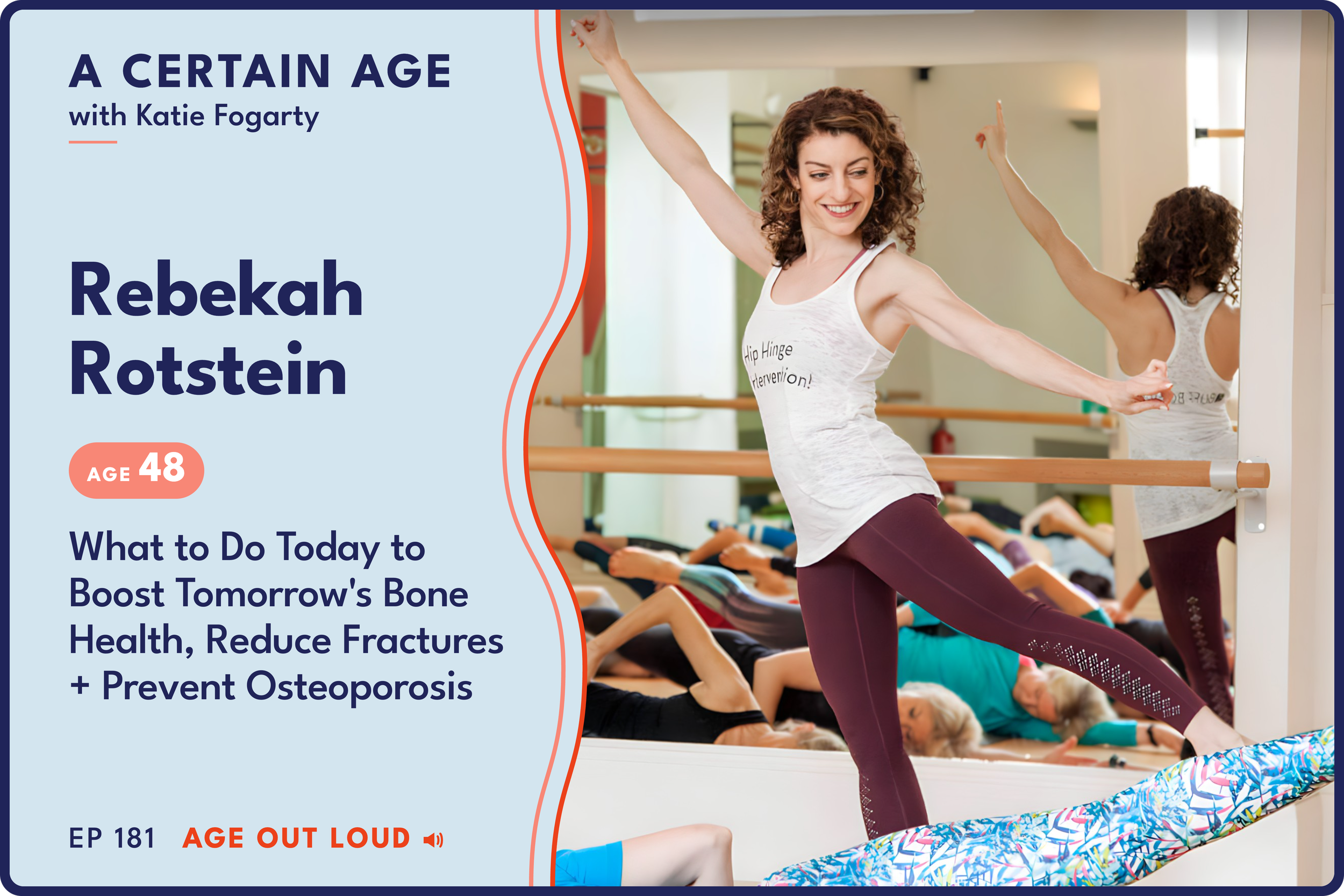
What to Do Today to Boost Tomorrow’s Bone Health, Reduce Fractures + Prevent Osteoporosis with Rebekah Rotstein
Show Snapshot:
Diagnosed with osteoporosis at 28, Rebekah Rotstein turned a personal bone health crisis into a career built around helping other women avoid the same one. She founded Buff Bones®, a bone and joint health exercise system now taught by trained instructors in more than 30 countries. Her work includes professional courses at institutions like Johns Hopkins Rehabilitation Network, and she sits on the Ambassador Leadership Council for the Bone Health and Osteoporosis Foundation.
In this episode:
The pillars of a real bone health formula, beyond "take calcium"
Tests worth knowing about beyond the standard DEXA scan
Simple exercises for strength, balance, and mobility anyone can start
Practical movement mechanics to help you carry groceries, travel, and scoop up a future grandchild for decades to come
About Rebekah Rotstein: Rebekah Rotstein, NCPT, CPT, is the founder of Buff Bones®, a bone and joint health exercise system taught by trained instructors in more than 30 countries, with professional courses at institutions including Johns Hopkins Rehabilitation Network. Diagnosed with osteoporosis at 28, she serves on the Ambassador Leadership Council for the Bone Health and Osteoporosis Foundation.
Quotable:
We do start to feel these changes in balance happening around midlifethings that we took for granted in our 20s and 30s. For sure. And so balance is key not only for fall prevention but also for fracture prevention.
Transcript:
Rebekah Rotstein (00:00)
We do start to feel these changes in balance happening around midlife — things that we took for granted in our twenties and thirties, for sure. And so balance is key not only for fall prevention, but also for fracture prevention.
Katie Fogarty (00:19)
Welcome to A Certain Age, a show for women who are unafraid to age out loud. Beauties, I wish we were hanging out in person so we could make a bet. Because here's my bet: I bet that in a year, five years, ten years, twenty years, you will be delighted that you listened to today's show — like, really over the top, over the moon delighted. Because today you're going to meet a woman who's going to help you radically rethink your bone health. A woman who can share information, exercises, and inspiration for midlife women like me and you to protect our bones, tackle osteoporosis, and develop a strong, resilient body for midlife and beyond.
Rebekah Rotstein is a bone health and movement specialist and the creator of Buff Bones, a system of exercises and education that protects, preserves, and improves your bone health — because most of us don't think about our bone health until it's way, way too late. Welcome, Rebekah.
Rebekah Rotstein (01:17)
Thanks, Katie. I'm excited to be here with you.
Katie Fogarty (01:20)
I'm so excited as well, because this took a while to get into action. We had this scheduled, it got canceled, it got moved, and I am so excited to finally have this conversation. The information, resources, and tools that you offer are so needed. I know so many people in my own life who are struggling with bone health issues, ranging from osteopenia to more severe fractures. So this is an important conversation, and I'm delighted we're having it.
I always love to start with a backstory, and I know your work in advocacy and bone health is rooted in the personal. Can you open by having listeners understand why you got started on your bone health journey?
Rebekah Rotstein (02:03)
Sure. Well, I was already an exercise professional when I decided to get my own bone density tested. It was because of some additional coursework I had taken, where I learned that you build the majority of your bone density — anywhere from 85 to 90 percent, typically — by the end of your teenage years.
And I realized that I was at risk, especially because I hadn't been menstruating for much of that time during my years as a ballet dancer. So I decided to just get a baseline for later in life. And lo and behold, I was told, "Guess what? You have osteoporosis."
Katie Fogarty (02:50)
And how old were you at that time, Rebekah?
Rebekah Rotstein (02:53)
I was twenty-eight years old.
Katie Fogarty (02:55)
Twenty-eight, wow. So what came next?
Rebekah Rotstein (02:59)
Well, initially it was a big bout of depression — and that's not uncommon, actually, for people to dive into a really low point after a diagnosis, because there's a lot of fear and anxiety that surrounds it. But then I started doing some research, and I reached out to colleagues to see what would be the best course of action and who I should speak with. I met with an endocrinologist.
I then started working with different professionals, including a personal trainer, learning more on the nutrition side, and really diving into the research on what was being shown to benefit bones from an exercise perspective.
Katie Fogarty (03:45)
Yeah, that must have been such a shock at such a young age. We think of osteoporosis as a condition of people who are older. I know it set you off on this journey, which is pretty incredible. So for our listeners who are thinking, "Okay, Rebekah went and did that test to discover her bone density" — can you do a little level-setting? Is bone density the gold standard, the barometer for bone health? Or are there more factors we need to know about?
Rebekah Rotstein (04:12)
Well, basically about sixty to seventy percent of your bone strength is accounted for by bone mineral density. But again, that's only sixty to seventy percent, which is what people mostly think about. Bone density is important, and the gold standard way to test it is with the DEXA scan, a bone density test. It has very low radiation exposure, it's simple, and it's totally painless — you're wearing your clothes, and the technician stays in the room with you, unlike a typical X-ray.
But there are newer ways emerging to detect not just your bone density, but your bone quality. There are factors beyond bone density that matter — it's important to recognize that you could have low bone density, but that doesn't necessarily mean the quality of your bones, in other words the structural integrity, is poor.
So there are other tests now that can be added on, or even used in place of a DEXA, to give you more qualitative information. Because we do care about bone density, but it's not the entire picture. In fact, more fractures occur in those with osteopenia, the precursor to osteoporosis, than in osteoporosis itself. So bone density is important, but it's not everything.
Katie Fogarty (05:43)
So why is that? Why are more fractures occurring in osteopenia than in osteoporosis, which is the full-blown condition?
Rebekah Rotstein (05:51)
There are a number of reasons. One is that there are simply more people with osteopenia than osteoporosis, so if you look at the pure numbers and statistics, that makes sense. But there are also limitations to bone density testing and to the DEXA — which, as I mentioned, is the gold standard. Some of those limitations include, for instance, if you have osteophytes or osteoarthritis, you can get a misreading that indicates your bone density is higher than it actually is. It's not measuring quality, but it may give you a false impression that your bones are stronger than they are.
Another factor: if you're small-boned, like myself, you're automatically at a disadvantage, because you naturally have less bone mass than someone who is larger. So you may come across as having lower bone density, even though your bones aren't necessarily weaker. You can also get different readings depending on the machine — different calibration or different technicians can produce different results.
Katie Fogarty (07:21)
That's fascinating — sort of like measuring your weight on different scales, where you could get a slightly different reading depending on the scale. So fascinating. We're going to get into all the things you recommend, the system you've put together, because we want to make sure our bones are healthy. I know from spending time on your website that you talk about a bone health formula. What does that formula look like?
Rebekah Rotstein (07:45)
It involves both exercise and other lifestyle interventions. So we're talking about diet, sleep, stress level, and then there's the exercise side as well. The exercise side has a lot of nuance, but it doesn't have to be complex. So when it comes—
Katie Fogarty (08:11)
By the way, Rebekah, I have to hop in — I'm like, make it simple, please! It's like that big red "Easy" button from Staples — let me hit it. We have a lot going on in our lives; modern life is busy. We've got jobs and fitness and kids and family and pets. So I'm delighted that you had me at "easy." Keep going.
Rebekah Rotstein (08:31)
Absolutely. I think that's part of the key — things sound like they have to be very complicated when they really don't. But nuance does matter at the same time. When it comes to exercise, we want to target the areas of the body that are most susceptible to fracture as we age, and especially with osteoporosis. Specifically, those are the spine, the hip, and the wrist. We call this "site-specific." At the same time, while we want to target those areas, we also want to incorporate the entire body and look not just at strength, but also at function. So when it comes to how you want to exercise, there are several areas we really want to focus on, and I can come back to those.
But we want to be getting in weight-bearing exercise, we want to be getting in resistance training, and we also want to be getting in impact — because those are the three elements that we know bone density relies upon.
Katie Fogarty (09:49)
Okay, phenomenal. So we're heading into a quick break, but when we come back, let's explore those three areas we can focus on.
[ AD BREAK ]
Katie Fogarty (10:01)
Rebekah, we're back from a break. When we went into it, you identified that there are three body parts we need to focus on: the spine, the hip, the wrist. You said there are three broad categories of exercise we could focus on, which are weights, resistance, and impact. I'd love to talk a little about each of these. So what would be first? It doesn't have to be in order of priority — or maybe it could be.
Rebekah Rotstein (10:28)
Well, I'm going to first back up — it's not specifically "weights," but "weight-bearing" that I'd say. Weight-bearing means literally bearing your weight against gravity. So when you're standing upright, walking, jumping, or running — any of those are weight-bearing activities. But we also need weight-bearing for our wrists, so anything on your hands and knees, or hands and feet — like planks — is weight-bearing for the wrists.
Katie Fogarty (10:34)
Okay, good.
Rebekah Rotstein (10:56)
But those are three different elements of what you need to strengthen your bones. Now, since we're talking about the magic number of three, I want to bring in an even broader set — three different elements you should incorporate into any kind of exercise program that goes beyond just strengthening your bones. It's also about protecting your bones.
So those are the three skills I consider foundational: strength, balance, and mobility. Those are the three things you want as part of any bone health protection program.
Katie Fogarty (11:45)
Okay, great. By the way, I love that this is "three" for everything, because it makes it easier for me to pay attention to and remember. So where do you want to start — strength, balance, or mobility? I'd love to explore each.
Rebekah Rotstein (11:57)
I want to start with strength. It's certainly the most obvious, because everybody knows they want to get stronger, and we want strong bones. But I'm talking about strength not just in terms of your bones, but your entire body in general. You hear a lot about strength training, and strength training involves progressively increasing the challenge so that your muscles and bones adapt and don't get lazy.
Both your skeletal system and your muscular system adapt to different loads. In other words, whether you're lifting a five-pound weight or a fifty-pound weight, if you do the same exercise over a certain amount of time, you'll acclimate to that load and it will become easier. So you need to continuously stimulate your bones and challenge your muscular system.
Progression is important. Strength is also important because of something called sarcopenia — the loss of muscle mass and power as we get older. So we want to make sure we can maintain lean muscle mass, as well as the bone density we have.
Katie Fogarty (13:20)
Okay, great — that was such a clear and wonderful explanation. So when we're thinking about strength training, we're thinking about building in a progressive load so we can continually challenge our muscles and bones. I know we could pick up weights — as you said, a five-pound weight or a fifty-pound weight. What might be an exercise you'd recommend to a listener who wants to get started, or wants to challenge herself, but maybe isn't into weights? Or do you recommend definitely starting with weights?
Rebekah Rotstein (13:50)
I do not recommend starting with weights, actually. I recommend starting with what I call "body organization" — addressing the different movement patterns you have and identifying what's known as pathomechanics, or poor movement mechanics, and compensatory patterns and strategies you may have developed over the years. Say you sprained your ankle, or injured your shoulder at some point — as a result, you developed strategies to work around that funky feeling in your ankle or that tweak in your shoulder. You start forming habits that might not be ideal, and over time those can lead to injuries, especially once you start adding load.
So I like to start with a solid foundation — addressing the body and really mastering the key movements, whether from poor movement habits you've developed in the past, or other strategies you've picked up throughout your life — mastering the movements from the get-go.
Katie Fogarty (15:08)
And are some of these movements things like squats or lunges? What are you referring to when you say "movements"?
Rebekah Rotstein (15:15)
They are — they involve squats and lunges, but often I like to offload the body from the start. So doing things on the ground before you're even weight-bearing, to remove the element of gravity and also address the fascia — something I know you're familiar with, the connective tissue of the body that serves both as a wrapping around, and running through, all our different tissues and organs.
When you feel stiff in the morning, for instance, that's often the fascia you're feeling restricted in. So we try to address that and alleviate those restrictions so your joints can move in an optimal manner.
Katie Fogarty (16:03)
Okay, I love that — and thank you for reminding me. I did a wonderful show with Anna Rahe from GST Body, who gives such a beautiful explanation of the fascia — why it's so important, how to care for it. I'll link out to that in the show notes. Thank you, Rebekah. And I do want to say that Rebekah has her own exercise platform called Buff Bones. I'd love for her to share her website — you can see a lot of the images of the exercises she's recommending, and there are opportunities for video tutorials and classes. So if you want to incorporate these exercises into your own life, Rebekah's Buff Bones is a great resource.
Okay, let's move on to balance. Talk us through balance, because I understand from having Dr. Vonda Wright on the show — I know you know her; she's one of the leading voices on musculoskeletal systems for women and the impact of menopause on those systems — that balance begins to deteriorate at a pretty surprisingly young age.
Rebekah Rotstein (17:05)
Yes, it's really interesting, because now that I'm in midlife, I'm starting to experience some of these things I've been talking about for the past fifteen, twenty years.
Katie Fogarty (17:15)
Welcome to the club, Rebekah.
Rebekah Rotstein (17:19)
And it was always fascinating to me, when I was teaching this program and teaching classes and workouts with midlife clients — when I was in my thirties, I didn't really have much trouble with balance. Again, I was also a dancer, a ballet dancer specifically — balance was my jam, right? So when we'd get into the standing portion of a workout, that's when balance would really be revealed as a challenge for people. Some people would think, "I'm doing fine, none of this is very hard," and then all of a sudden it was like a slap in the face when they'd realize, "Whoa, wait, I'm confronting some challenges here." It's fascinating for me to experience a bit more of that personally now, as I notice some of the changes I'm working to combat.
We do start to feel these changes in balance happening around midlife — things we took for granted in our twenties and thirties. Balance is key not only for fall prevention, but also for fracture prevention, because the majority of fractures occur from falls. And even though in midlife we might not be so concerned about our balance, or about hip fractures — because in reality, the majority of those occur more in the senior years — the greatest site of fracture in midlife is actually the distal forearm, known as a Colles' fracture, your wrist. If you think about it, you probably know a lot of people who've accidentally tripped on something and reached their arm out to break the fall, unconsciously protecting their head — and as a result, the wrist fractures. That's the most common site of fracture in midlife.
So this does relate to balance. One of the things we can do is improve and challenge our balance every single day, in a variety of ways. And it's not only standing on one leg, which is known as static balance — the research really points to dynamic balance as pivotal for fall prevention. Dynamic balance means how you're able to maintain yourself over your center of gravity while in motion. Say you stand on one leg, but then reach for an object in front of you, or move your arms while standing on that leg, or transfer from one leg to another — very rapidly, or maybe very slowly — how are you able to maintain your uprightness and not fall with motion?
Katie Fogarty (20:15)
It's so interesting you mention dynamic balance. I took a Pilates class for the first time in my 54 years about a month ago — it was taught by my niece, and I absolutely loved it. We were on the reformer, and that's no joke — for anyone who's never done Pilates, you're standing on one portion of the machine while your foot is moving on another. I was like, "This is not easy." It doesn't look that hard when she's demonstrating it, and then you try it and think, "This is challenging." Most of us don't have reformers in our homes, and many of us aren't going to a Pilates studio — do you recommend balance boards, or just simple exercises at home on the floor, but as you shared, maybe doing a lunge while reaching for something? What are some ways we can start incorporating simple balancing exercises into our daily routine?
Rebekah Rotstein (21:04)
If you have a balance board, that's great, but it's not necessary — it's not required. We have three different systems of balance — since we're on this magic number of three, why don't I keep going.
Katie Fogarty (21:15)
Let's do it. I love it. It makes life easy. You know we love easy, Rebekah.
Rebekah Rotstein (21:20)
So we have our visual system. You're probably familiar with this — if you're trying to balance on one leg and you close your eyes, it suddenly becomes harder. When you reduce your reliance on the visual system, you discover that the other systems step up to the plate. The other systems include the vestibular system — again, you're probably familiar with it if you've ever experienced vertigo. The inner ears are key to this element of balance. So, for instance, can you turn your head while performing a balance task? And the third system of balance is called the somatosensory, or proprioceptive, system — especially relevant when we're talking about balance while standing upright.
This relates to the receptors in your feet. So if you're standing on an uneven surface, or walking on an even surface — or, as we New Yorkers know very well, standing in the subway car and not holding onto the pole, doing that sort of "subway surfing" to maintain your balance — that's working your somatosensory, or proprioceptive, system. Now, I don't recommend doing that if you're not steady, because I've known people who have fractured because they weren't holding onto something, say, on a bus. But that is one way you can challenge your balance.
So we have these three different systems, and there are so many different tasks and drills you can do — everything from what you mentioned: stepping into a forward lunge, a side lunge, a back lunge; standing on one leg and tossing a ball; standing on one leg and moving your arms out to the sides or shaking your arms. You could stand with one foot directly in front of the other, as if on a tightrope — known as tandem stance — and close your eyes, even holding that position. You could try walking on a tightrope, turning your head, or walking on a tightrope set on pillows to get extra sensory input through your feet. It becomes almost limitless, the number of tasks and drills you could go through.
Katie Fogarty (24:03)
I love all of these ideas. I take Bikram yoga regularly, and one of our teachers always encourages us to close our eyes during tree pose, because — real talk — it really ups the difficulty level. And I've found that I definitely balance better on one side than the other. It's really remarkable how much we rely on our eyes just to keep ourselves upright. Okay, so this is great — tell me—
Rebekah Rotstein (24:28)
I just want to say, I love that you pointed out something really important — the difference from side to side. Most of us are not completely even, and most of us favor one side, whether it's for strength, for balance, or the next element I'm going to talk about, mobility. So it's really important that we do things on both sides, and not judge, but just be aware, so we recognize what we have to work on — it gives us goals to keep practicing toward.
Katie Fogarty (25:01)
I love that. Rebekah, you're jogging a really funny memory — I went to an event in New York about a year ago, and Amanda Thebe, who's been a guest on my show and written a wonderful book called Menopocalypse — she's a big menopause advocate out of Canada and a fitness expert as well — walked us through a quick stretch during the session to break things up. She said, "Okay, I want everyone to stand up on one leg." And we all did. Then she said, "Okay, put that leg down and stand on the other, because I know you all picked your favorite leg." She automatically made us do it harder. I thought, that's smart — she's obviously a mom, like, "I've seen your tricks, I know my way around them." So, we're going to work on the sides that are hard, because we can do hard things.
So talk to us about mobility. We want to make sure we retain the ability to do simple things, like carry our groceries and get in and out of chairs as we age, and then do fun things, like travel the world and pick up our grandkids. How do we retain mobility as our bodies begin to age?
Rebekah Rotstein (26:09)
Well, first of all, especially in midlife, we're all probably familiar with newer aches and pains that can be a little mysterious, that we hadn't experienced previously. Sometimes this is a result of declining estrogen, and sometimes it's just a result of different issues that have built up in the body and are manifesting more now, at this point in life. Or sometimes it's an issue where we've ignored something for years, and now finally have a bit more time to pay attention to it — and with everything else changing in our bodies, we're more aware of these mysterious aches and pains.
So one of the things I think we really need to focus on when it comes to mobility isn't just stiffness, but the act of restriction. Do you tend to do something less because it doesn't feel good? I'll give you an example — this has nothing to do with midlife, but many years ago I injured my knee, I think in a step-aerobics class, and then re-injured it at another point when I was reaching for something. As a result, over the years, I would avoid deep knee flexion — kneeling down on that knee, squatting on it. And as a result, I created some compensations, some other patterns, and some weakness. So by avoiding certain activities because of a past injury, you may not only become weaker, but you might lose range in that joint.
So this is something for us to be aware of — what are we avoiding, and doing less of? I like taking people through various mobility drills, but also through different exercises and movements that make you aware of sensation — "I feel restricted there," or "I feel a really good stretch there that's been lacking." Part of this really comes back to embodiment — your sense of sensation and awareness in your body.
When we talk about mobility and aging, it also becomes apparent when you watch certain elderly people walk. If you think about what comes to mind when you picture a senior person shuffling — what's really happening is they're lacking full motion and range of motion at the ankle, and especially at the hip joint. There might also be some rotation missing through the trunk. You might not be aware of that, but what you're really identifying in that shuffling pattern is a lack of motion through the foot, ankle, and hip-knee complexes. So we want to make sure we can retain, and perhaps even restore, range of motion through all of our joints, so we have the ability to do everything we're doing now for years to come — whether it's carrying your groceries, reaching for objects on the top shelf or the bottom shelf, taking something out of the oven, getting up and down from the ground, or playing with your children, grandchildren, or pets.
All of these things — part of our daily activities — are things we often take for granted, but they really involve mobility. On top of this, mobility is key for strength and balance as well. It's something we don't necessarily think about, but if you want to be able to do a full squat, or an overhead press where you lift weights overhead, that involves range of motion in your joints. If you're restricted there and start adding load, you're potentially risking injury.
Katie Fogarty (30:27)
Yeah, I love that you use such real-world examples, because when I hear the word "squat," I think, "No, thank you." But when I think about squatting down so my three-year-old niece can run into my arms for a hug, I'm all in, right? So those are the things we want to be doing. You also shared a vivid example — seeing a much more senior person kind of shuffling, and you mentioned the ankle, feet, and knee trio again — we're back to three. What are some exercises we might do for that example you shared?
Rebekah Rotstein (31:09)
Sure. For instance, calf stretches — something everyone's aware of, I think, to some extent. Say you're facing a wall, standing close to it, hands up against the wall, and you reach one foot back so your front knee is bent and your back knee is straight, toes facing forward, stretching the calf of that back leg. You could hold that statically, or you could push through the ground to lift the heel and slowly lower it, finding a rhythm — lifting and lowering the heel about ten times, working through part of the range of motion in that ankle.
Another simple mobility exercise: say you're sitting in your chair right now — I'll probably do this as I talk to you. We're sitting in our chairs, and we lift our arms up overhead, shrug our shoulders, then slowly lower them, shrug again, and lower again. And now we can do it—
Katie Fogarty (32:33)
It feels amazing. It totally feels amazing.
Rebekah Rotstein (32:37)
It doesn't have to be complicated — you're just mobilizing the shoulder girdle there. Now bring your hands straight out in front of you, interlace your fingers, and reach forward, which stretches your back — you're not rounding your back, just letting your shoulders pull forward. Now pull your shoulders and hands back, then reach forward again. That's shoulder protraction and retraction — pulling your shoulders back.
So I'm giving you a very simple, basic exercise, but something anyone can do — it doesn't require any equipment. And the key to all of this, especially with anything you're doing, whether it's strength training, balance, or mobility, is that it always has to integrate the breath. Breathing is really the basis of all developmental movement patterns — the basis of all movement. Think about it: the moment a baby is born, it knows how to breathe. Nobody has to teach it. We know how to breathe, but often we develop strange patterns or tension patterns. If you've been through trauma, or had an injury and every time you lift your arms it hurts your shoulder, you're more likely to hold your breath. So how can we integrate breathing into our different exercises, which also relates to everything within your core control system?
I think a simple thing to keep in mind isn't whether you're breathing correctly or incorrectly — just to think about how you can integrate the breath: Am I breathing? Am I holding my breath? Am I allowing the breath to flow through my body as I move? Just bringing in that awareness will make a big difference.
Katie Fogarty (34:37)
Yeah, that's such a great point, and it's been brought up before by different guests. If people are curious about learning more about this, I had Dr. Anne Duch on, a pelvic floor therapist who walked us through some wonderful exercises and breathing exercises for the pelvic canister. And I started the year with another fitness expert, Megan Dahlman, who also walked us through some breathing exercises. So thank you for that wonderful reminder.
Rebekah, I want to go back to something you said earlier — how you realized you were favoring your knee, that you had overcompensated or avoided certain things because of your history with pain. I think this is a great topic to explore a bit further before we wrap: what are the things that get in the way of our bone health? Is it pain? Is it the fact that we might be overweight, or have an illness? When clients walk in your door and aren't yet prioritizing their bone health, what are some of the themes you've identified that stop people from doing the things they need to do?
Rebekah Rotstein (35:46)
So glad you bring this up, because I think this is really the big discussion that needs to be had. It's not just about what you should do, but what's stopping you from doing the things you either should do, or really want to be doing. One thing is joint pain — menopause joint pain is very, very real, and arthralgia is usually the term for it. It's one of the big obstacles: if someone is in pain, especially feeling stiffness, they're less likely to move, because it hurts.
Another thing can be fear of movement, or kinesiophobia. This can occur especially in people who are afraid of having a fracture, or who've had one before — I work with both. That fear of movement can be debilitating, and I see it quite frequently in people after a diagnosis — exactly the experience I had myself. There's a lot of anxiety after being diagnosed with osteoporosis, or even just osteopenia. I like to say to them: what's the difference between now — this fear of moving, afraid you're going to fracture just walking down the street — and a week ago, before your diagnosis, when you were fearless? Your bone density is probably no different right now than it was then. So that fear can be very prohibitive.
I also think there's a sense of concern some people have about doing something wrong and injuring themselves — that's another one I hear very frequently. "How do I know if I'm doing this right? How do I know I won't hurt myself?" — whether that's based on previous injuries, or some other fear of getting hurt. So those things have to be addressed.
And I also think we have to acknowledge — this isn't a scientific statistic, but many, many people in our midlife community have comorbidities, meaning other conditions or things going on in their bodies. Unfortunately, a lot of research tends to exclude people with comorbidities from its inclusion criteria — when you're conducting a study, you exclude certain people to keep your cohort specific, so other factors don't confound the data. But that means people with comorbidities are often excluded from the research, and as a result, they often feel left out of the conversation.
When it comes to heavy lifting, which is important for bone density, and which ideally we do want to work toward as one of the three elements of strength, not everybody is going to be able to do that, for a variety of reasons — maybe because of comorbidities or other issues going on in their body, or because of accessibility or financial obstacles. But we want to at least acknowledge: what can everybody do? What are the options that allow as many people as possible to engage in these three areas, so we can protect our bones and really improve our longevity — so we can remain resilient, independent, and active for as many years as possible.
Katie Fogarty (39:41)
This might be a great last question before we move to our speed round. For people who have some of these challenges, or for anyone who wants to be smarter about the exercises, resources, and tools available to help them protect, preserve, and maintain their bone health — where would you direct them? I know that in addition to running your own company, you're an ambassador for the Bone Health and Osteoporosis Foundation, and you work with the American Bone Health organization. You're active in a number of other women's health groups. Where would you direct listeners for more resources?
Rebekah Rotstein (40:19)
The Bone Health and Osteoporosis Foundation is a great resource for learning more about bone health and understanding what it means to have osteoporosis, and the different actions you can take. You can also look at the International Osteoporosis Foundation — they have terrific resources and information as well. I should clarify that American Bone Health is now under the umbrella of the Bone Health and Osteoporosis Foundation — that happened just last year. So really, we have one major organization within the United States. In the UK, there's the Royal Osteoporosis Society, another terrific resource, depending on what country you're in.
Katie Fogarty (41:08)
Okay, phenomenal. I'll link to those in the show notes when I post this conversation. Rebekah, we're near the end of our time — we're going to do a quick speed round to close. Are you ready?
Rebekah Rotstein (41:20)
I think so.
Katie Fogarty (41:22)
You're totally ready — this is your stuff, right in your wheelhouse. Okay: I could talk about this bone health topic again and again.
Rebekah Rotstein (41:30)
Embodiment — something I don't think you hear enough about within the bone health world, because it doesn't fit into the neat little paradigm. But if you consider it, it's about body appreciation. And the more we can appreciate our bodies and understand them, the more we're able to direct them well, and let them serve us for years to come.
Katie Fogarty (41:58)
Okay, nice. This bone-health exercise is one of my favorites.
Rebekah Rotstein (42:03)
Squats.
Katie Fogarty (42:05)
Everybody! All right, all right, all right — I may try them! Okay: no one wants to fall and break a hip — what's an action we can take today to make sure that's not in our future?
All right, now you're really — okay, you're doubling down, I'm going to do this. Okay: this bone-healthy food is always in my grocery cart.
Rebekah Rotstein (42:26)
Hmm — what's always in my grocery cart that's a bone-healthy food? Arugula and kale.
Katie Fogarty (42:34)
Ooh, I was going to say spinach — we go through tubs and tubs of that at my house, I've finally gotten my kids to eat it. Okay: even fitness pros need to work on their well-being. What lifestyle choice or hack helps fuel your inner peace?
Rebekah Rotstein (42:47)
Meditation.
Katie Fogarty (42:49)
Finally: your one-word answer to complete this sentence — "As I age, I feel ___."
Rebekah Rotstein (42:55)
Calmer.
Katie Fogarty (42:56)
Nice. Rebekah, thank you for coming on — I'm so glad we kept rescheduling, retrying, and made this happen. I know listeners will be so excited down the road, once they've taken care of their bone health with the tips you shared today, that they'll be grateful they tuned in. Thank you for your time. Before we say goodbye — how can our listeners keep following you, your work, and learn about Buff Bones?
Rebekah Rotstein (43:20)
Well, thank you so much, Katie. You can go to our website, which is buff-bones.com — in other words, "buff" hyphen "bones" dot com. And on Instagram, we're @gotbuffbones.
Katie Fogarty (43:38)
Everybody needs to hop over to Instagram and see all of Rebekah's phenomenal exercises in action, visually. Thank you so much, Rebekah. This wraps A Certain Age, a show for women who are aging without apology. And before I say goodbye — a quick favor: did you learn something on today's show? Do you feel smarter, more informed, more supported? If so, please take five minutes to write a short review over on Apple Podcasts or Spotify, and please forward this fabulous show on to a friend.
We need to spread the word to all the women we love about how to keep our bones healthy. Friends do not let friends break their hips. Special thanks to Michael Mancini, who composed and produced our theme music. See you next time, and until then: age boldly, beauties.
