
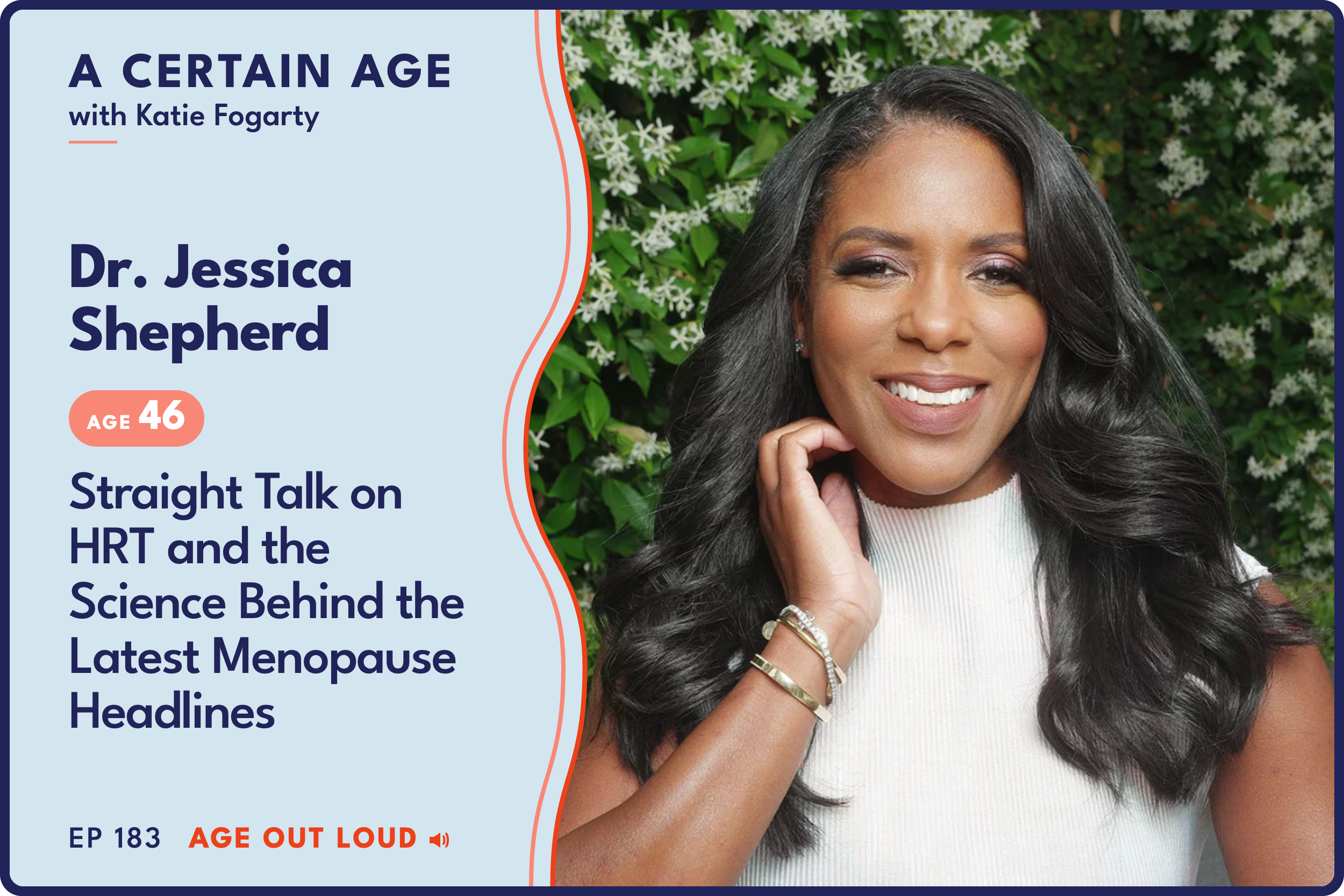
Straight Talk on HRT and the Science Behind the Latest Menopause Headlines with Dr. Jessica Shepherd
Show Snapshot:
A new study just made headlines: HRT's health benefits outweigh the risks. But headlines don't tell you how to use that information to make decisons about your hormonal health. Dr. Jessica Shepherd, board-certified OB-GYN, Chief Medical Officer at Hers, and a familiar face from Good Morning America and The Today Show, breaks it down so you can make a real decision, not just react to a news cycle.
In this episode:
What HRT is, how it works, and when it's most likely to help
Common hormone myths, debunked
Who's a good candidate for HRT, and who isn't
Options beyond HRT for building a broader menopause care toolkit
About Dr. Jessica Shepherd: Dr. Jessica Shepherd, MD, MBA, FACOG, is a board-certified OB-GYN and Chief Medical Officer at Hers. She's the author of Generation M and founder of Sanctum Med + Wellness, and appears regularly as a health expert on Good Morning America and The Today Show.
Show Links:
Follow Dr. Shepherd:
Dr. Shepherd’s Book:
Generation M: Living Well in Perimenopause and Menopause
Quotable:
I want women to understand that we have estrogen receptors all over the body. And we really have typecast it to just the pelvis. It's in the brain, the bone, the heart, in the breast tissue. It's all over. When you understand that it's all over the body, you can really see how it benefits vitality and longevity because it really impacts every part of our body.
Transcript:
[00:00] Dr. Jessica Shepherd
I think once you know the fundamental building blocks of estrogen and how it helps the body, I think you see it in a different light. When we look at the ability for us to have better bone health as we get older — if we think about it in terms of cardiovascular and cardioprotective effects and benefits — then we can ask, how do I want my heart health to be later in life? And what is the number one killer of women across the world? Cardiovascular disease.
[00:30] Katie Fogarty
Welcome to A Certain Age, a show for women who are unafraid to age out loud. Beauties, you are seeing the buzzy headlines and the news stories: a new study shows the benefits of hormone therapy for the treatment of menopause symptoms outweigh the risks. That's the conclusion of a new study published in the Journal of the American Medical Association. Here's why this is exciting — the new analysis is based on two decades of follow-up data from the Women's Health Initiative study, which in the early 2000s generated a faulty interpretation that scared women away from HRT for a generation. So what does this new study mean for you? Today on the show, we are unpacking HRT — what it is, how it works, and at what age and stage you can best benefit from it. We're also going to get into other options beyond HRT for those of you who can't or don't want to use it. And we're doing it with a total pro. I'm joined by Dr. Jessica Shepherd, a menopause expert and board-certified OB-GYN who is a leader in women's health. You may have seen her on the Today Show, Good Morning America, CNN, or in Vogue. You might be following her on social media or her menopause community, Modern Méno. You also may be eagerly awaiting her debut book, Generation M, which is coming this October for World Menopause Month. She joins me today to help us make sense of the science and demystify HRT and what it means for our health today and for our longevity tomorrow. Welcome, Dr. Shepherd.
[02:16] Dr. Jessica Shepherd
Thank you so much for having me today.
[02:19] Katie Fogarty
I'm really excited because you are joining me during an exciting time for women's menopausal health. What does this new study mean for women in perimenopause and menopause?
[02:29] Dr. Jessica Shepherd
I think that this is a groundbreaking time for women, for practitioners, and for doctors, because for so long there's been this message of cannot, will not, and should not. And now we're really pushing away those words in order to, like you said, let women live out loud and feel free to understand the true benefits of hormone replacement therapy. I think there was almost like a cloak placed over it — it was the land of no return. And now we're really seeing and allowing the space and safe place for women to explore HRT.
[03:08] Katie Fogarty
It really is a pivotal point in women's health care. So what are some of the benefits of HRT? We've explored it on the show in the past, but I would love to hear your perspective on what difference this course of treatment can make for women in midlife and beyond.
[03:24] Dr. Jessica Shepherd
Well, if we had the whole hour to discuss the benefits —
[03:29] Katie Fogarty
Great, we can probably spend a long time on this, right?
[03:34] Dr. Jessica Shepherd
It would sound similar to Forrest Gump when we're talking about shrimp, and all the different types of shrimp on the boat. But I'll condense it and make it really applicable for those who are listening. I really look at estrogen — and when we think of hormone replacement therapy, I'm really combining all of them: estrogen, progesterone, and testosterone. But I think the most pivotal, or you could say striking, hormone that women think of is estrogen, and estrogen to me means vitality and longevity. The reason I like to state it that way is because it really touches so many different parts of our lives — I don't like to pigeonhole it. I also want women to understand that we have estrogen receptors all over the body. We've kind of typecast it to just the pelvis, and I want people to understand it's in the brain, it's in the bone, it's in the heart, it's in the breast tissue — it's all over. So when you understand that it's all over the body, you can really see how the concept of benefit means vitality and longevity, because it impacts every part of our body. When we think of brain health, heart health, libido and vitality, how our skin looks — all of those different things, I think you can really tie it back to estrogen.
[04:56] Katie Fogarty
That's such an important distinction, because I do think a lot of women think of estrogen as something we use for our reproductive systems. And we're no longer in our reproductive years, so we feel like maybe we don't need this any longer. Obviously we want it to manage our symptoms like hot flashes, but once we get beyond those, I sometimes hear women saying, you know, I'm through all that stuff, I'm on the other side.
[05:21] Dr. Jessica Shepherd
If you think about how women have been placed in society — we live a highlight reel in our reproductive years. That's when we're visualized as looking our best, that's when we're expected to have children if we have children, and then after that we're just kind of cast to the wayside. So that's where 'estrogen? Oh, I don't need it, I'm not important, I'm not of any use' comes from. That happens to a lot of the psyche, but it's also what's been shown to women over the course of their careers, over sexuality, over attractiveness — we're not useful anymore, so why would we need estrogen?
[06:01] Katie Fogarty
Right. And we need it for our cardiac health, for our bone health, and for our brain health — that's something we've explored on this show. I'm so happy that women now have new science they can access. You could pick up almost any newspaper in America, you could Google this study, the Journal of the American Medical Association, and read the stories for yourself. But we're really unpacking this for the total pros. The science has now come out saying that the benefits outweigh the risks for most women under the age of 60. So where does that leave women over the age of 60? Do we need to stop taking our hormones once we get there, or are we able to begin hormone therapy after 60 if we haven't taken it yet?
[06:46] Dr. Jessica Shepherd
I'll lay it out in two different scenarios. One, the study really was there to underscore that the benefit clearly outweighs the risk, and that allows women in general to say, I can take HRT and I don't have to hold on to all these hang-ups I heard, or who told me not to take it and why I shouldn't. We're really looking at it more as a beneficial package. Now, on the other side of that is the age factor — and that was one of the reasons the WHI was grossly flawed, because the women it studied were already older and had a lot of disease progression going on. So it wasn't as helpful to start it in women over 60. This study is really looking at how we can start it in younger women, so it can be more preventative for chronic disease — restoring estrogen, progesterone, and testosterone earlier on, rather than when they're fully depleted. So going back to your initial question — can you start it after age 60? I think if you talk to a lot of menopause experts, we're completely comfortable starting women over the age of 60. But this study, in my opinion, wasn't clear on giving us the ability to say we should start women after 60. When we look at what it's preventing, you're not going to see as many preventative measures after a start age of 60. But again — longevity and vitality, what can I still offer women over 60 as they age? That's where I give the green light to women who may have started earlier than 60 and want to continue after 60 — I say go right ahead. It really comes down to what the starting age is, what diseases they already have, and making a good decision with a doctor who truly understands HRT and when to start and continue.
[08:34] Katie Fogarty
That makes a lot of sense. You mentioned that everyone needs to work with their own medical provider to do their own risk assessment — if you have certain diseases, those might be contraindications for the medicine. So maybe this is a good time to segue into who is not a good candidate for HRT, because I think there are a lot of myths around this.
[08:54] Dr. Jessica Shepherd
Yeah, there are a lot of myths, and that obviously started with the messaging that came out — 'estrogen causes breast cancer' — which was really the tagline you heard a lot back in the early 2000s with the WHI study. So it's important — usually I start with my patients by looking at who is not a candidate, because outside of that bucket, everyone in some way does become a candidate. Looking at who is not a candidate: women who have a hormone-sensitive personal history of breast cancer, and women who have a really high predilection for blood clotting — meaning they have a diagnosis of a disorder or disease that makes them clot a lot, which we could maybe tie to estrogen, but that requires a further conversation. Now comes the tricky part: women who have a family history of breast cancer. Again, breast cancer was the one thing people aligned with HRT and causing it, so it doesn't necessarily mean that woman cannot take HRT — that's where a thoughtful conversation comes in about what type of cancer it was, and how it aligns with that specific person's personal history based on the family history. It's not a definitive no — if you have a family history of breast cancer, it just needs to be discussed in detail.
[10:24] Katie Fogarty
That's such an important distinction, because I've been in a number of rooms lately where hormone replacement therapy has been discussed, and I've heard audience members ask, 'I have a family history — does this mean I'm not a candidate?' It's great to hear doctors saying that's not necessarily the case, it really needs to be explored further, because that messaging hasn't reached enough women. Unless you have that personal history — unless it's you, the patient — you may still be a candidate even if you've had a family history. So thank you for re-emphasizing that, Dr. Shepherd. We're heading to a quick break.
— AD BREAK —
[10:24] Katie Fogarty
When we come back, I want to explore a little more the different forms of HRT, and then get into what options exist beyond HRT, because I know you have a lot of great information to share on that topic. Dr. Shepherd, we're back from the break. When we headed into it, we talked about how HRT is more available to more women than they think, based on what they've been reading in the news, or hearing through the old game of telephone — the word had spread that if you wanted to avoid breast cancer, you needed to avoid HRT. But the latest science shows that's not true — many more women than realize are candidates for this therapy. So let's do a little HRT 101. For somebody who is in the beginning stages of their journey, thinking about whether this is something they want to incorporate into their longevity and wellness routine — what do they need to know?
[12:02] Dr. Jessica Shepherd
What they need to know is what does estrogen do. Once you know the fundamental building blocks of estrogen and how it helps the body, I think you see it in a different light. When we look at the ability to have better bone health as we get older — if we think about cardiovascular and cardioprotective effects and benefits — we can ask, how do I want my heart health to be later in life? What is the number one killer of women across the world? Cardiovascular disease. And then also brain — we have such amazing links between estrogen and brain health, in the sense of neurodegenerative diseases such as dementia, which are directly correlated with estrogen loss. So I always ask, how do you want to show up later in life, in your seventh and eighth decades? Do you want to be vivacious? Do you want to be able to do daily activities — carrying your groceries, going up the stairs, bending down to pick something up? That all comes with body mechanics, how your body is able to function and move, and that comes with vitality. When you put it in that scope, I think women can really take a step back and say, you know what, I do want to live like that.
[13:14] Katie Fogarty
I want all of those things — every single one of those things you just outlined.
[13:19] Dr. Jessica Shepherd
Exactly, and that's how I usually open the conversation. Again, because we think estrogen is just for reproduction, or maybe libido, that it just has to do with the pelvis and sexuality — but there's so much more to it.
[13:33] Katie Fogarty
I love that you spelled all those things out, because every single thing you mentioned is on my radar. I want to be able to scoop up future grandchildren, I want to be able to continue to play racquet sports and age with vitality, and make my older years golden years. So for women who are like, yes, I'm all in — obviously everybody needs to work with their own medical provider, and if you find a doctor who is not open to this, know that other doctors are out there who are menopause-trained specialists. I sit on the board of the nonprofit Let's Talk Menopause, and they provide access to providers in every state. There are other great organizations, like the National Association of Menopause Specialists — I believe they're now called Living Menopause, or they may have rebranded as the Menopause Society — but there are doctors out there who are able to help you. When you finally do get a doctor who gets it, what are the different options? Is it oral, is it a cream — what are the different solutions and formats women can avail themselves of?
[14:38] Dr. Jessica Shepherd
I put it into buckets. It can sometimes be very overwhelming, so the first visit I have with a woman is really just to find out where she is, what her journey looks like — I want to meet her where she is, give her the information, let her sit with it, and then have her come back for another visit if she chooses. So I put it into buckets: estrogen, progesterone, and testosterone, and each of them comes in different dosages and modalities for how you can take them. Estrogen — because it's, I guess you could say, the main character in the movie — has a lot more options for how it can be delivered: it can be a pill, a patch, a cream, a gel, or a pellet you can insert. Progesterone can come in a cream — though I don't love the way it's absorbed, you get better absorption through a pill — and then a troche, which dissolves sublingually in your mouth. And then testosterone, which can come in the form of a gel or cream, an injection (which has to be monitored closely because it has to be done weekly), and also in the form of a pellet. So I present it to everyone to see what questions they have, what they think might fit them, and I say, this is a menu — what do you think is going to work for you, and how do you want to take it? The only caveat is: if someone has a uterus and is on estrogen therapy, they must take progesterone. That's non-negotiable.
[16:10] Katie Fogarty
That's non-negotiable, right? Like, during this buffet of choices, that's the one thing you must put on your plate. Exactly — all right, I love that. So that was very clear about all the different options out there. I would love to ask you — I don't want to go too much into my own personal experience, but when I began HRT I had to make some modifications, try some new things, and let it evolve until I started to feel great. The reason I want to bring this up is, I've had conversations with women who said, 'Oh, that wasn't for me, I didn't feel great' — sometimes I think we give up on things too quickly. I'd love to hear your perspective: how long does it take, and what if you begin one treatment and don't feel great, maybe feel crampy at the beginning — what might you expect, and how long should it take to start feeling good again, for the medicine to start working for you rather than against you?
[17:06] Dr. Jessica Shepherd
This is where I really want to hear their expression of how they feel, and really learn body awareness. You have to understand that their entry point into hormones could be very different — it could be someone in their 40s in the perimenopausal phase who has a lot more hormone supply in her body than someone who is postmenopausal and has a very low level of all the hormones. So the entry point is going to be different, and I want to know where they were at baseline when we started. I also want them to have skin in the game, because the idea with hormone replacement therapy is I don't want you on it for three months and then coming off — the goal is I really want you on this for a certain number of years. Some women refuse to come off, and that's fine, I put them in that category. Once we know the entry point, I want women to understand this is for you to feel better in the areas where you weren't as well — that's symptom resolution. I look at it in two buckets: you're coming here because you have a specific symptom we're trying to resolve, and we're also trying to give you fuel for longevity and vitality. For symptom resolution, it's easy — how are you feeling, has this resolved, do we need to increase it or decrease it? And I tell them this needs to be at least a six-to-nine-month beginning phase until we figure out your sweet spot. Once we figure that out, we can move along and progress year to year.
[18:39] Katie Fogarty
I love that you shared that, because in all the conversations I've had about HRT, I haven't heard many people talk about the fact that it sometimes takes a while to get the recipe right — and that was my own experience. I was committed to sticking with it because I care about the long-term impacts. I worry about my bone health, because we have a family history of osteoporosis and I have low bone density, and I care about other things too, so I was willing to put the time in. But we live in a society of immediate gratification, and I think it's worth flagging for people that sometimes it takes a bit of time to start delivering the results you want. So thank you for sharing that. I'd love to switch gears now — I know from following you on Instagram, and everyone needs to click over and follow Dr. Shepherd — she's got a big, healthy community, she shares a lot of great information, she has a blog, and she's at work on a book, her forthcoming book Generation M, which focuses on the small steps we can all take to become the CEO of our own health. I had the pleasure of seeing Dr. Shepherd on a panel with Dr. Sharon Malone, who was a guest on the show a few weeks ago, when I was out in Austin for South by Southwest, and you both talked about the importance of being in the driver's seat of your own health. I'd love to talk about what we can do for our midlife health and manage our menopausal symptoms with lifestyle choices, because I know this is a big area of interest for you. Where should we begin? I know, we need another hour.
[20:19] Dr. Jessica Shepherd
Where do we begin? I really believe that perimenopause and menopause is this perfect storm of challenges that present in the form of hormonal, but also nutritional and physiologic challenges the cells are going through because of the depletion of hormones. So I really look at nutrition and exercise and movement as the pillars that substantiate the experience one chooses to have. This is where the choice comes in — how do you want to experience this transition in your life, and how do you want to show up later? We know there have to be significant diet changes — and when I say diet, I don't mean diet as in restriction, I mean how we choose to fuel our body and which food types and choices we plug into. And then with movement — because our body is starting to decrease in flexibility and joint response, and our muscles take a big hit as we go through this transition and start to decline in lean muscle mass — how do we build all these things together? I would never expect anyone to do it overnight, or even over the course of a month. That's why I always say menopause is a marathon, not a sprint, and we have to take into account all the subtle changes that need to occur. If you're invested, this is an investment, and I want people to know that their investment is going to determine what that outcome looks like later in life.
[21:47] Katie Fogarty
I love it. First of all, we're all invested, so I'm hanging on the edge of my seat because I'm dying to know — let's start with nutrition, because I feel like that's the builder, that's the first thing we do — well, not always for some of us, but we get up in the morning and that's one of the first things I do, start thinking about breakfast. So let's walk through some nutrition. You said this isn't about restriction, it's about making different choices that our midlife bodies require as we age. What kind of changes are we talking about?
[22:15] Dr. Jessica Shepherd
I look at it as an addition. Protein, to me, is one of those things that fundamentally has to be at the top of the list for how we fuel our body, because of that decrease in muscle mass. I don't think society did a good job placing importance on protein for women — people think, 'oh, I don't want to bulk up, so if anything's going to increase my muscles, I'm not doing it,' but protein really fuels our muscle mass. Increasing your protein intake isn't easy, but over time it can be done — that can be through meat, or if you choose not to get protein through meat, through powders, or through legumes and beans, which is a great way to do it. Moving into nutrients and supplements — I think, one, don't overdo it. A lot of people take twelve supplements a day; some can do that, but most can't, because it's not sustainable. So I always say, let's pick three for this moment in your life, and we may substitute some along the way. Vitamin D and omega-3 fatty acids are very important, and also your B vitamins — those are the three I think are imperative to start with, because a lot of that has to do with our gut health and how our gut changes, since there are estrogen receptors in the gut that help us absorb things like the amino acids from protein. And we see a lot of the B vitamins, particularly B2, B6, and B12, start to decrease.
[23:52] Katie Fogarty
I had that experience myself with B12 — I've been taking supplements, and it's made a difference in my energy, I honestly feel a difference now that that's being handled. So many women just continue to eat exactly the way they always have. But things change — you start to hang on to weight in places it didn't exist before, or you start to feel more uncomfortable, more bloated. So I'm following your lead, I'm going to continue to add more protein to my diet and make that a priority. But if we're doing what we've always done, why does it feel different in our bodies?
[24:32] Dr. Jessica Shepherd
Our bodies are going through the aging process. Menopause and aging are kind of two different categories, but they have so much overlap. In general, men and women go through an aging process, and our bodies don't quite do the things they used to as easily — that's where it's craving for help, like, 'please help me.' When I think of joints and gut health, they really need extra TLC to continue functioning the way they have, whether that's digestion — not feeling bloated, absorbing and digesting things as easily as we used to. And a lot of food sensitivities start to pop up later in life, because the gut microbiome also starts to change as estrogen decreases. So there are a lot of environmental and structural changes in the body, and this is where we have to pitch in, because what you're going to have issues with — whether it's the gut, joints, or whatever it is — is going to be different than the woman next to you. So you have to fine-tune it yourself, and that's where body awareness comes into play. For example, my sister's joints were probably the one thing she experienced through the menopausal transition, which was relieved with HRT. For me, it was brain fog — my ability to stay on task, remember things, multitask, executive functioning — that was my thing. So we had different things show up, and we had to address those differently. For me, testosterone was probably the key thing that helped with my brain fog. So being able to identify what your issue is will help determine what the resolution should be.
[26:20] Katie Fogarty
That's such an important point to make for all of our listeners — your menopause is going to look very different from your next-door neighbor's, your girlfriends', your sisters'. What works for them isn't necessarily going to be what works for you. It's important to share information, and I think it's important to remove some of the secrecy and shame, and let people know what's going on with you — but know that you may have to chart your own course to your own solutions. Thank you for sharing that, I love that. Talk to me a little about muscle building and exercise — you mentioned we need to be adding protein, that it's harder to build muscle as we age. I think at this stage of our lives we all know we need to be prioritizing fitness. But for women who think to themselves, 'I'm not a candidate for HRT' — maybe because they have active breast cancer, or for whatever reason they're just not willing — I know there's a sense of vulnerability where they feel left out of the story on bone health and cardiac health. But that's not entirely true — we can improve our bone health and cardiac health through fitness. What would you say to a woman who's thinking, 'I don't want to be left out of this,' and who does have active breast cancer?
[27:33] Dr. Jessica Shepherd
For my patients who have active breast cancer, one, I always let them know that when it comes to vaginal health and vaginal dryness or atrophy, they're actually still able to use estrogen cream. I really double down on that because everyone lumps HRT together and assumes 'estrogen is bad.' For people who've had breast cancer and still want some kind of access to the HRT toolkit, they can use estrogen vaginal cream for vaginal dryness. Beyond that, there are some medications that have been developed within the last year or so for hot flashes and night sweats, which I think is phenomenal, because they're non-hormonal — they work on a specific receptor in the brain that correlates with the thermoregulatory zone that controls hot and cold, and hot flashes and night sweats, and can adjust that without hormones.
[28:15] Katie Fogarty
And what are those, Dr. Shepherd?
[28:18] Dr. Jessica Shepherd
Yeah, so Veozah is the name of the medication. It targets a specific receptor in the brain — it's an NK3 receptor antagonist — and works with that part of the brain, which is how it can offset some of the hot flashes and night sweats. It's non-hormonal, which I think is fascinating — that women are able to have access to that, and that they made a drug specifically for menopausal women. We're crying out for these things, and finally we have something.
[29:01] Katie Fogarty
Nice — it took a while, it took too long, but it's here, and we're grateful. And for women who are looking for — it's not even just for women who don't want to use HRT — let's talk about, before we head into our speed round, I want to hear a little more about your philosophy on exercise, and why it's important. It's on your prescription pad, right — you're ripping this off and handing people a prescription for getting out there and moving their bodies. Why does it matter so much in midlife to finally begin prioritizing different types of fitness?
[29:35] Dr. Jessica Shepherd
Moving your body doesn't just have to do with being able to bend down and pick things up and walk — it actually has to do with your brain. It helps decrease your risk of dementia — when we look at neurodegenerative disease, exercise helps prevent it. And when we look at cardiovascular health, we know the more we move and make our muscles work, the more they acclimatize and adjust. If we don't use them, they won't be able to do that. We want our heart to be able to give us what we need — oxygen and blood — for the rest of our lives, so we have to work it to stay in tune. And when we think about muscles — their ability to take in and utilize glucose — because when glucose sits and doesn't go anywhere, it turns into fat. Muscle is the biggest utilizer of glucose uptake. So if we're not moving our muscles, glucose sits, and that contributes to heart health, increased risk of diabetes, and adiposity, or fat tissue. Your body is like a car assembly, or an orchestra — everything needs to help the other to sound like that wonderful symphony you want to hear. And when we don't pay attention to it, you get instruments that are out of tune.
[31:02] Katie Fogarty
Trombone — I have three children, Dr. Shepherd, I have sat through a lot of violin recitals, I know exactly what it sounds like when things aren't working together. I love this idea of making beautiful music — everything has to work together. We can't just do crunches and hope we're solving things — we're an integrative system, our own universe, and we need all the different pieces to create this amazing symphony. Before we move into our speed round, I want a quick sneak peek into Generation M — I know you're working on this book. Where are you? It's coming out in October, and I personally cannot wait — I've got a very big bookshelf of menopause books, and I'm excited to put this one on it. What can readers expect from this book?
[31:48] Dr. Jessica Shepherd
This book is really geared to the lifestyle of menopause. My tagline — I love to use it — is 'evidence-based, lifestyle-approved,' because it's the guide to what we know about menopause, what you should know about it, but also how you can empower your approach to thriving through it. And the ability to do that is obviously with evidence-based medicine and evidence-based studies, but also the tips and tools you need to take every day to achieve and accomplish what you want, and how you want to show up later in life.
[32:25] Katie Fogarty
I love how you're translating the science into a blueprint we can access and implement in our lives — I'm personally very excited. Thank you so much for your time — we're moving into our speed round because 30 minutes goes so quickly on the show, I'm always amazed. We end with speed rounds so we can end on a high-energy note and get a little more from you before we say goodbye. Are you ready?
[32:50] Dr. Jessica Shepherd
I'm ready, let's do it.
[32:52] Katie Fogarty
Okay — all menopausal women will benefit from this menopause care choice: gut health.
[33:01] Dr. Jessica Shepherd
The ability for us to tune our gut means we're paying attention to our digestive tract, and also our brain, because they connect.
[33:09] Katie Fogarty
Nice. This lifestyle choice is in my personal menopause care toolkit.
[33:14] Dr. Jessica Shepherd
Definitely strength training and lifting heavy weight. I always like to say, you've got to lift heavy shit.
[33:23] Katie Fogarty
You do — indeed you do. Okay, my favorite form of exercise is — and you may have already said it, but if it's weightlifting — what is another?
[33:31] Dr. Jessica Shepherd
Another one is actually yoga. I think the mind-body connection is something that actually happens throughout the perimenopausal phase — we lose that mind-body connection, and this helps restore it.
[33:42] Katie Fogarty
I am such a yoga fan — it helps me process and offload my stress, it centers me, makes me feel sane, I love it. Okay — this nutrition choice or food is a longevity superhero.
[33:56] Dr. Jessica Shepherd
I think a great longevity superhero food is the ability to use protein in different forms — that's what I've had to navigate in my own space, because I wasn't protein-heavy either, but finding different things that give you the protein you need is almost like a jigsaw puzzle, and you just keep finding the pieces.
[34:13] Katie Fogarty
What's a new favorite protein you've added lately?
[34:17] Dr. Jessica Shepherd
Definitely in the bean category — I think I've tried every bean at this point in my life, and I find ways to put it into different recipes. That's kind of become my protein go-to.
[34:29] Katie Fogarty
I love that. Okay, even doctors need to work on their health — what is something you're really trying to prioritize these days, besides beans?
[34:37] Dr. Jessica Shepherd
In my health — this is a good one, good quickfire — I'd definitely say mindfulness. How we actually utilize our mind, the ability to quiet it. Who would ever think that when we say we want to use our mind, we always think of speeding it up and putting more RAM into the computer, but actually giving it a rest — the ability for the mind to rest — is what I've really focused on through meditation. It's not as easy as you think.
[35:03] Katie Fogarty
No, it sounds very hard — I'm a failed meditator. Although, I did a wonderful show a few weeks ago with an author named Deborah Huber, who wrote a book called Today I Noticed — it's a little book of mindfulness, and it encourages you to look for micro-moments of mindfulness throughout your day. You might notice how much you enjoy your coffee, or that you got to see a leaf fall off a tree right in front of you, or a bird fly by — it's just a way of being really present, and I love it.
[35:32] Dr. Jessica Shepherd
We definitely need that. It's adorable.
[35:34] Katie Fogarty
It's really cute — I think it's the perfect gift, it's a wonderful, sweet little book, and it's accompanied by illustrations, so put it on your radar. Okay, finally — your one-word answer to complete this sentence: as I age, I feel ___.
[35:56] Dr. Jessica Shepherd
Empowered.
[35:58] Katie Fogarty
Nice — me too. And I feel very empowered after having this smart, thoughtful, informative conversation with you. Thank you so much, Dr. Jessica Shepherd. Before we say goodbye, how can our listeners keep following you and your work?
[36:02] Dr. Jessica Shepherd
Yes, please follow me — you can find me on Instagram at Jessica Shepherd MD, spelled S-H-E-P-H-E-R-D, MD. And for all my menopause tips and tools, and to see what I think is really important, follow me at Modern Méno — M-E-N-O — on Instagram as well, which is focused specifically on perimenopause and menopause.
[36:21] Katie Fogarty
Modern Méno and Dr. Jessica Shepherd are all going into the show notes — check them out, beauties, you will not be disappointed, so much great information. Thank you again.
[36:32] Dr. Jessica Shepherd
I loved being here, thank you so much.
[36:35] Katie Fogarty
Beauties, do not go anywhere, because we are taking a listener question to wrap the show, and this one comes in from Roberta T. Roberta asks, 'Are you ever going to do live events?' And the answer is yes, Roberta, we are — I am planning some live shows in New York City this coming fall. We're celebrating a lot of big milestones in September, and we'll be doing it with live events. So get on our mailing list by signing up for our newsletter — head to acertainagepod.com, hit subscribe, and be the first to know when those tickets get posted. Thanks for your question, Roberta, I'm excited, I hope I'll see you in New York. This wraps A Certain Age, a show for women who are aging without apology. And before I say goodbye, a quick favor — this was such an informative, fascinating show, please consider sharing it with the women in your life. We need to get the word out about the changing face of menopause care, and spreading the word about A Certain Age Pod helps the show grow. Have a listener question of your own? You can email me at katie@acertainagepod.com, or come find me on Instagram, where I hang out at @acertainagepod, and DM me your questions there. Special thanks to Michael Mancini, who composed and produced our theme music. See you next time — until then, age boldly, beauties.
