
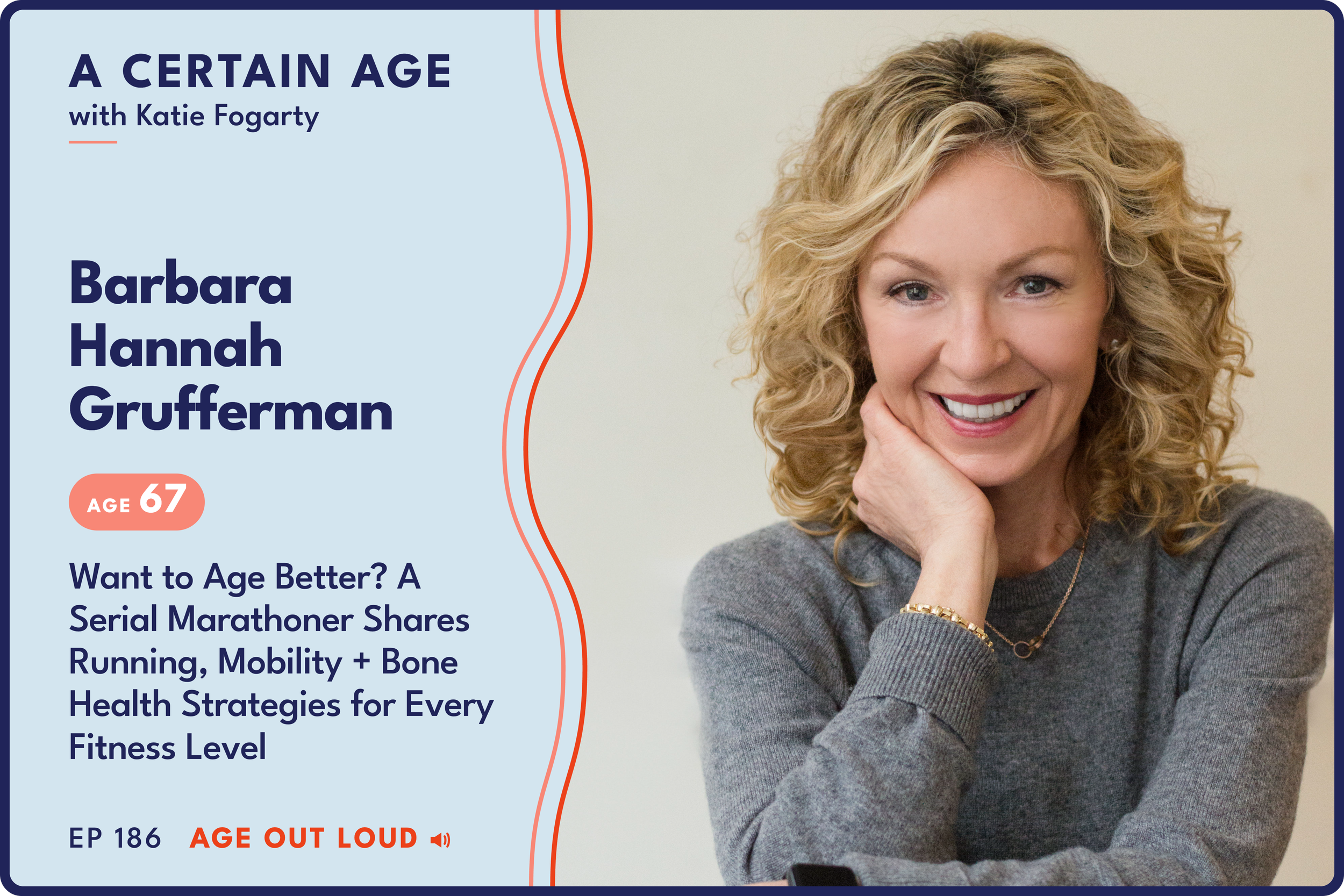
Want to Age Better? Serial Marathoner Barbara Hannah Grufferman Shares Running, Mobility + Bone Health Strategies for Every Fitness Level
Show Snapshot:
Barbara Hannah Grufferman ran her first marathon at 50. At 67, she's training for her 18th. Once the kid who dreaded gym class, she's since become a healthy aging advocate, podcaster, and author, with a decade on the Board of Trustees of the Bone Health & Osteoporosis Foundation informing everything she teaches about staying strong for the long run.
In this episode:
The run-walk-run program that took Barbara from newbie to finish line
Strength training and exercises for injury-free running at any level, with bone health in mind
All about ChiRunning, a running method influenced by tai chi
The real link between fitness, bone strength, and reinvention
About Barbara Hannah Grufferman: Barbara Hannah Grufferman is the host of the podcast “Age Better with Barbara Hannah Grufferman” and a longtime AARP contributor who writes the "Fix Your Body" column for AARP The Magazine. She's the author of Love Your Age, winner of a Gold IPPY Book Award, and served for a decade on the Board of Trustees of the Bone Health & Osteoporosis Foundation.
Quotable:
Let’s talk about the benefits of running. Not only does running keep your bones dense because its weight bearing, it's also a cardio workout. It helps your heart, helps your mood, can help you to maintain your ideal weight once you get there, whatever that weight is, it has so many benefits, but it also is so meditative.
Transcript:
Barbara Hannah Grufferman 00:00
You can run at any age, any ability, any shape, any size — whether you've never run a marathon, whether you've never run at all — and stay injury-free.
Katie Fogarty 00:14
Welcome to A Certain Age, a show for women who are unafraid to age out loud. Beauties, I'm going to be honest with you — I know you've heard me say countless times, you are never too old to try that thing, to try something new, to choose a new adventure. But truthfully, I've always thought I would get around to running a marathon, and lately I began to think maybe that ship has sailed. I'm 54, and the last time I ran, it was a mad dash through Grand Central Station to make a train. So I am excited to hang today with a guest who is both running and reinvention goals: Barbara Hannah Grufferman is an author, pro-aging advocate, and the host of the popular podcast Age Better. Like many of us, Barbara turned 50 and realized that what it takes to be fit, feel fabulous, and be healthy looks way different than it did in our 30s and 40s. She turned to running to stay in shape and is now training for her 18th marathon. Running changed her life and career in countless surprising ways that we are going to get into on the show today. If you are curious about the intersection of fitness and reinvention, if marathons or a running practice are on your bucket list, or if you want ideas on aging well from a top-ranked health podcaster, stick around — this show is for you. Welcome, Barbara.
Barbara Hannah Grufferman 01:35
Hi, Katie, thanks so much for having me on. I'm so excited to talk about one of my favorite topics.
Katie Fogarty 01:43
As well am I. I'm really thrilled to have you here. I've been a guest on your show, and I know you've written two award-winning books on aging and life after 50. You really are an OG in the positive aging space, and we have so much to explore. But I do want to start by hearing how you got going with running. Seventeen marathons is an incredible accomplishment, but you aren't done yet, right? You're training for your 18th. What made you take up running at 50?
Barbara Hannah Grufferman 02:07
I am, I am. And normally I do the New York City Marathon, because I live in New York City, but this year, in the fall, I'm going to be running the Chicago Marathon for the first time, and that will be number 18. I'm really, really excited about this because I have two daughters, both in their 20s — both are runners. The younger one is a little more serious about her running than the older one. Elizabeth, my younger one, is going to Chicago and running it with me. Now, “with me” is said very loosely — she is so fast, she qualified for the Boston Marathon by running the New York City Marathon. So we're going to Chicago together, and then we will separate.
Katie Fogarty 02:52
Oh my gosh, you guys are starting together but you may not be finishing together.
Barbara Hannah Grufferman 02:57
Exactly right. And I'm a slow runner — I do run, I love running, I have a certain way of running which I'll get into, but I would never say I'm a speedy runner. For me, though, I'm speedy — that's totally cool. I just want to say one thing, Katie, about what you said in your intro, about the last time you were running for the train in Grand Central Station — I hated running. Like so many of us, I absolutely hated running. In fact, I used to joke that I used to run after the Good Humor truck when I was a kid, and I would be the one in gym class when they were choosing people for the volleyball team — my mantra was, “Don't make eye contact, don't make eye contact, they won't choose you.” You don't want to be chosen. That was me — I was that kid, and that was me, really, throughout my whole adult life. I dabbled in a few things — I did Jane Fonda when she came out, for like a hot second — and then, you know how life is. I had a very booming career in magazine publishing, and I eventually got married, eventually had two children, and was traveling around the world for my business — no time for me. That's very typical of women, as we know — you've had so many women on your show who share that same narrative. So fast forward: I was 49, about to turn 50, and I'm gaining weight, and I'm saying, “What the heck is going on?” And then I turn 50, and I take a walk with my dog in New York City, and I fall — not too fast, not too far, not too hard — and I broke my arm. I was like, wait a minute, why in the world did that happen? Why in the world did I break my arm just from walking? I don't even know what I tripped on, Katie — it was bizarre. So I went and got my first bone density test, and I realized I had low bone density. Now, this is 17 years ago — let's create the context — nobody was talking about menopause. It was still very much swept under the rug. We weren't talking about what happens to a woman's body when she goes through menopause — what happens to her bones, her midline, her weight, and everything else that we now know to be true as a woman goes through menopause. So that was the context — I was confused, thinking, what the heck is going on with my body, is this what 50 is all about? And then, I have to tell you, where I live in New York City, my apartment is literally at mile 17-and-a-half of the New York City Marathon course. We always know somebody running the marathon — either a teacher or a friend. This particular year — I want to say it was around 2008 — one of my daughter's teachers was running in the marathon, so we're all standing on the corner: neighbors, my husband, my two daughters. My younger daughter at that point was about nine, and we're just watching. I'm watching all these people go by, Katie, thinking, wait a minute, how can they run 26.2 miles? Are they crazy to do this? Or — why would anyone want to do this — that was an even bigger question. But then I noticed, for the first time, they were all different sizes and shapes and ages and abilities — fast ones, slow ones, walkers. And I thought, wow, a lot of different kinds of people are running marathons. And then, all of a sudden, out of the blue, my youngest daughter, Elizabeth — the speedy one in the family — turns to me and says, “Hey Mom, I want to hold up a sign that says GO MOM GO,” because she was holding up a sign for her teacher. And then everybody looked at me — my husband smirked — and I said, “I don't know how, and I don't know when, but yes, I am going to do this.” That was, literally, my life-changing moment.
Katie Fogarty 07:37
I love that, I love that. First of all, I love that you were nudged into this by a family member, and that you were inspired watching. I think the reason I've been kicking around the idea of doing this myself is that I, too, at one point lived near the race route in the park, and my husband and I would go out and watch people coming through around hour six — right, they're running in full firefighter gear, or running it on crutches, or with one leg — and the race, along the track of a marathon, is some of the most inspirational landscape you can imagine, because you're watching people just putting themselves out there, at every level. I love that you shared that — you ran your own race. So walk us through how it happened. Your daughter held up a sign, and eighteen marathons later — how did you go from being on the sidelines to being in action?
Barbara Hannah Grufferman 08:30
Really, in the very thick of it. I'm such an active participant in the running community — I've built a team for the Bone Health and Osteoporosis Foundation, where I've been a trustee, a board member, for 10 years, and a few years ago started the Bone Strong New York City Marathon team. So we have a team, and I'm the team manager. I'm very proud of this, and I get a lot of people motivated to run on behalf of bone health. I mentioned that I broke my arm, and that's been a very big part of my own story as well — bone health is super important to me. My own mother fell in 2018 and broke her hip. She never returned home — she was confined to a wheelchair, her health spiraled downward, and then in 2021 she passed away. So bone health is critically important to all of us, especially postmenopausal women, and it's very important to me. But how did it get started? Getting back to that one pivotal moment — and I joke with my daughter about this all the time — she said that to me, and I said, “Yes, I will do it. I don't know how I'm going to do it, but I will do it.” Literally, Katie, the next day — it was a Monday, because the article had run in the Sunday paper — there was an in-depth Q&A in the Wall Street Journal with Jeff Galloway. Now, Jeff Galloway, for those who don't know him, is an Olympian. He's a man in his 70s at this point, and while he could have taken a path toward a pro racing and sprinting career — he's really an endurance runner — instead he pivoted. He took a pivot, Katie, your favorite word. This was back in the late ’70s — he decided, “I'm going to help people get off the couch and move their bodies more. That is my mission in life.” So there was a whole article about him and his program. For those of you who aren't familiar with him, I encourage you to go to his website, JeffGalloway.com — it's a run-walk-run program. Some people have their own method of doing it, their own way of doing run-walk, but he has a very planned-out way of creating your own ratio between running and walking that works best for you, so that you can run at any age, any ability, any shape, any size — whether you've never run a marathon, whether you've never run at all — and stay injury-free, which is a very critical component of his program, and that's really important to me, because who wants to get injured? You don't want to get injured.
Katie Fogarty 11:30
Absolutely. We are going to be heading into a quick commercial break. Barbara, when we come back, I want to pick this up.
— AD BREAK —
Katie Fogarty 11:30 (cont.)
Barbara, we're back from the break. Before we headed into it, you told us about the Jeff Galloway run-walk-run program. I am definitely going to go check out his website — you had me at injury-free, and you had me at getting off the sofa, right? Because you make it sound easy — he's helping train people who are total beginners. So I'm assuming you did this program, and that put you in action. Do you train all year long? If you're doing 18 marathons, I'm assuming running is part of your daily life — is that true? Or do you take periods for rest and recovery? What does it look like for you?
Barbara Hannah Grufferman 13:27
Oh, that's a great question, Katie. I'm always in a state of training — I mentioned the 17 marathons I've done to date, but I've done countless others; I truly don't know how many — half marathons, 10Ks, 5Ks, four-milers, fill in the blank, lots of different races. So I'm always training for something, because I live in New York City, and there are always races happening in Central Park or around the city — Queens, Brooklyn, the Bronx — and I sign up for all of them and try to make all of them. So I'm always in a state of training, and for me that's a really big motivator to stay in that state. By the time I start serious training for a marathon — you want to start training five or six months before, and build up your mileage to race day — my foundation is already there. My fitness foundation is solid because I'm always in a state of training. Now, everyone who's thinking about a marathon — first of all, as Katie pointed out, with this program really anybody can do it. Do not let age, ability, size, or shape deter you from checking this out. I know so many people who are part of, for example, the New York City Galloway group. There are groups all over the country, all over the world, and people call themselves “Jeffers.” I've met Jeffers in Edinburgh, Scotland, while running the marathon there, because my daughter — the same younger daughter, she's a big part of this whole story — went to the University of St. Andrews, and so together we decided to run the Edinburgh Marathon.
Katie Fogarty 15:26
I love that. And for listeners who don't know, that's where my daughter Grace went — it's a wonderful school on a beautiful stretch of Scottish coastline. Barbara and I shared that. I have not done the Edinburgh Marathon, so maybe that should be my goal.
Barbara Hannah Grufferman 15:43
I have to tell you, Katie, you really should. I highly recommend it to everyone, because it's flat — a little hill in the beginning, I believe, but it's basically flat and along the coast. It's absolutely beautiful. It's really lovely.
Katie Fogarty 15:59
I remember — you've done so many. I love that you did this in Scotland. I learned in prepping for this show that there are marathons all over the world, but there are six that are considered “the biggies” — London, New York, Boston, Berlin, Chicago, Tokyo. Which have you completed? I did my homework. Do you have a favorite, or is there one you haven't done yet? Is that why you're training for Chicago?
Barbara Hannah Grufferman 16:26
I have friends — this is really funny — I have friends in my running group who decided to make running all 50 states their mission, and they've done it; some are still on their way and have a few states left. And I have one friend who set out to do all of this — what they call the six majors, the ones you just mentioned, as well as one on each continent. He's done all of it — think about that, that's crazy, right?
Katie Fogarty 17:00
I'm trying to work my way up to just — yeah, I'm pretty knocked out just hearing that. But he just finished?
Barbara Hannah Grufferman 17:04
He did the Boston Marathon, and that was his last one to complete the set. But anyway, I digress. So the answer is no — I primarily run the New York City Marathon. During COVID, I ran two virtual marathons, which — oh my gosh, everyone, if you ever want to really put your mental abilities, stamina, and endurance to the test, do a virtual marathon, because you are alone.
Katie Fogarty 17:35
Are you on a treadmill?
Barbara Hannah Grufferman 17:39
Not a treadmill person. Okay — let's talk about the benefits of running for a second, let's shift gears. Running has so many benefits — not only does it keep your bones dense, because it's weight-bearing, it's also a cardio workout, it helps your heart, it helps your mood, it can help you maintain your ideal weight once you get there, whatever that weight is. It has so many benefits, but it's also so meditative. When I do my long training runs — as I mentioned, when you're training for a marathon you have to build up your mileage, so the typical program, whether it's Galloway or another program, looks something like this: you do three to four shorter runs during the week, and those should always include speed work, hill repeats, so that your body gets used to running up and down hills, because the New York City Marathon is loaded with them.
Katie Fogarty 18:40
All those bridges — bridges add up to serious hills.
Barbara Hannah Grufferman 18:44
Hills, and people hear that and go, “What, another hill, are you kidding me?” It's really wild. So: speed work, hill repeats, and things like that, and then just a normal five- or six-mile run, and then once a week you need that long endurance run, which is usually run a little slower.
Katie Fogarty 19:07
And when you say—
Barbara Hannah Grufferman 19:10
Okay, sure, you want to know this, everyone. So if you were to follow Jeff Galloway's program, which I really encourage everyone to do, because it's gotten me through 17 marathons and counting after 50 — mind you, all after 50 — you start with a base of five miles sometime in May. Let's just assume it's the New York City Marathon, which is November 3rd. So, in May, five miles, and the next week it'll be six miles, and you keep going up — not more than about 5% — and eventually you'll get to 12 miles, then 15 miles, and then 18 miles. Now, there are some programs that stop at 18 miles — I personally don't get that, and Jeff Galloway doesn't either. He believes — are you ready for this? — your last long run, which I do—
Katie Fogarty 20:11
I think I know what's coming.
Barbara Hannah Grufferman 20:15
You know what's coming, because it's so crazy, but I do it: your last long run before a marathon, religiously, should be three weeks before — no closer, and really no further. Three weeks is the sweet spot for your last long training run. Jeff Galloway believes that last long training run should be 30 miles.
Katie Fogarty 20:39
Wait — okay, I did not see that coming. I thought you'd top out around the marathon distance. He wants you to go beyond?
Barbara Hannah Grufferman 20:48
He wants you to go beyond. He says your body will then be so ready for the marathon.
Katie Fogarty 20:54
And you believe it feels shorter when you actually run it?
Barbara Hannah Grufferman 20:56
It's a mental thing as well as a physical thing. So, in effect, I've run many more marathons than my official marathon count.
Katie Fogarty 21:07
Oh my gosh — Jeff sounds like he's got a tough program.
Barbara Hannah Grufferman 21:15
You don't have to do 30 — however, the New York City Galloway program, and really all the other programs around the country as far as I know, their last long training run — I usually go a little further myself, to hit 30, after I leave the group, and sometimes somebody joins me; every once in a while one of the members will continue on with me — but the group goes up to about 25 miles. Twenty-five, with survivors.
Katie Fogarty 21:42
So — everyone's got their own personal way they operate in the world — but do you think it's helpful to have running partners, accountability buddies, groups? Or, since you said it's meditative, do you prefer to do these runs solo?
Barbara Hannah Grufferman 21:56
Great question. During the week, my runs are always alone — sometimes I listen to music, but I'm alone, extremely meditative. Truly, that's when I meditate. People say, “Oh, do you meditate?” I'll do micro-meditation sometimes, like five minutes, do my Oms and deep breathing — I'm a big believer in the deep breathing protocol to calm myself down and get more focused. But real deep meditation happens when I'm running. Those long runs, though — I encourage everyone to find a running group. If it's Galloway, great; if not, there are so many running groups out there, every community has one. And then you have your group — you talk about movies and restaurants and what's happening in your life, blah blah blah, always something to talk about. Our mantra in our running group is: bring some information to the group, every long run, contribute.
Katie Fogarty 23:04
Yeah, I love that — the community piece. You're reminding me that my good friend from high school, Brooke, moved to London — her husband's job got her transferred there — and she found a running community. It's literally women who haven't yet run marathons banding together to train together. Such a great way to be in community with somebody, and I think there are a lot of groups out there truly geared for beginners, for anyone who wants to get into this. So let's talk a little about nutrition and the exercises you're doing beyond running to prepare, because I imagine there's more to it than simply running to be ready for a marathon.
Barbara Hannah Grufferman 23:45
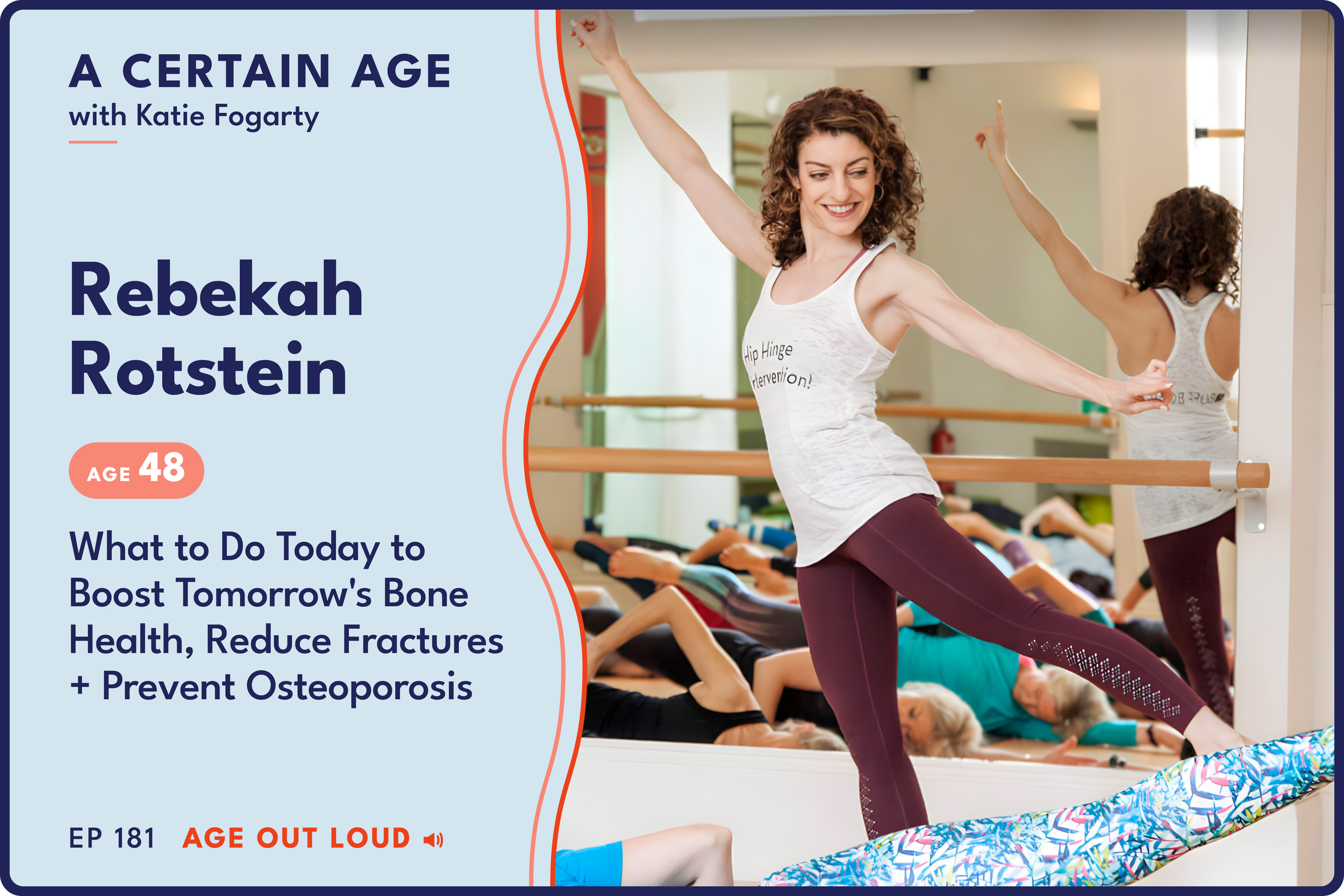
Couldn't agree more, and thank you for bringing that up. When I first started running, around age 50, it was just about running — that was the only thing we were told to do, even with the Jeff Galloway program, and there was very little focus on the other important component, which is strength training. But that's evolved, luckily. First of all, you should be strength training no matter what — even if you never run, if you decide running's not for you, you must be doing strength training. It's an important part of keeping your bones strong. We also know strength training helps with brain health. We also know — you and I have both had Rebecca Rothstein on our shows talking about strength training and progressive overload, and how, according to science, new studies show you can actually build back bone density. In the past, all studies showed the only way to do that was with medication — and now we see that's no longer the case. That's just an aside. So I really want to encourage everyone: two or three days a week of strength training is super important. And then there are specific exercises geared to running that help you become a stronger, more powerful, more efficient runner, which also helps keep you injury-free — and most of those focus on your core, your hamstrings, and—
Katie Fogarty 25:28
Glutes? What are we talking — squats, lunges?
Barbara Hannah Grufferman 25:31
Exactly — all of those, which you want to be doing anyway.
Katie Fogarty 25:35
Everybody's been beating the squat drum with me, and I have to confess—
Barbara Hannah Grufferman 25:38
I know, I heard — I listened. She was like, “You must be doing squats.”
Katie Fogarty 25:41
And I haven't added those, I'm going to confess. But this is a good reminder — I have been doing a lot of dynamic stability moves that she recommended, where you're standing on one leg, bending forward, picking things up, looking side to side — incorporating those types of things, probably because they're more fun than squats. But you're motivating me, I'm going to give it a try. So are you doing this two to three times a week? Is this a daily activity? What's—
Barbara Hannah Grufferman 26:07
It was in my mind at that time because, as I said, strength training really wasn't part of the training program for running back then, but I was doing it anyway because, as I mentioned, I broke my arm. And then my daughter said, “Oh, I want to see you running the marathon,” and I said, “Okay, I signed up for it,” and I wanted to pull it all together. Katie, at that point I said, “I need a book — I need a book that's going to guide me on how to really be a great 50-plus-year-old.” What should I be eating now, how should I be working out now, is my hair too long — all these big questions, because I wanted to be a great 50-year-old. And that book, at that time, believe it or not, did not exist. It was all about anti-aging — every magazine article was anti-aging. And I said, “Well, that's not what I'm looking for, I'm looking for positive aging — to be the best you can be at whatever age you are.” And then I said, “I'm going to write the book.” And that's when I wrote my first book.
Katie Fogarty 27:27
I love — The Best of Everything—
Barbara Hannah Grufferman 27:28
Is that crazy? No, it's not crazy to me — that's how it happens. I was in the shower one day, and my other daughter, Sarah, who hasn't been part of this story yet, happened to be walking by as I came out of the shower, and I said, “Sarah, I just had an idea for a book, because I can't find the book I need — I need a guide to this next stage in my life.” And so I said, “I'm going to write that book.”
Katie Fogarty 27:51
Well, tell us — you've written two books, so tell us the names of both of them, Barbara.
Barbara Hannah Grufferman 27:56
I'm writing my third book right now. The first one was called The Best of Everything After 50, and it covered everything — the subtitle is The Experts' Guide to Style, Health, Money, and More. I literally went to every great expert and said, “Okay, here I am, what should I do?” And then I did it, and if it worked, it made it into the book. So Jeff Galloway was in it for moving the body. And then I had a guy named David Kirsch, a top-tier fitness expert in Manhattan, who told me about the three moves I still do every single day. Katie, you need to do these three moves every day — it will not take you—
Katie Fogarty 28:48
Barbara, keep going—
Barbara Hannah Grufferman 28:51
You already know one of them: squats. There are two different ways to do them — with your feet out, like a plié, or straight — but your butt has to go back as far as it can as you're lowering down, because that's what really works your glutes. So: squats, push-ups, and the plank. Those three basic ones will give you a full-body workout. And that's what I did, and I never broke another thing. I even fell again at some point after I'd embarked on all this healthy living to be a great 50-plus-year-old, and I never broke a single bone. And in fact — I never went on hormone therapy. It's a bit of a regret, and I've said that publicly on my own show many times — I never went on hormone therapy, so my bone health was at great risk. I do have osteopenia, but 17 years later, Katie, it still hasn't progressed, because of all the things I started doing at 50.
Katie Fogarty 30:05
That's such a great testament — you're bringing this up, and it's really come up on the show before. I've recently had a number of doctors on, like Dr. Sharon Malone, who wrote Grown Woman Talk, and Dr. Jessica Shepherd, who came on to help demystify some of the recent headlines around the benefits of HRT — and while both of those doctors are proponents of HRT and really encourage women to fully explore whether they can make that happen, because more women can use it than not, they both said that lifestyle choices around fitness and nutrition are key players in bone, brain, and cardiac health as well. We have more control than we think, and I love that 17 years later you're going for marathon 18 because you invested in all these choices that truly make a difference in your bone health. So thank you for sharing that with us. Let's segue into your show, Age Better, because you have a wonderful podcast that I've had the pleasure of being on — you explore with a lot of great health professionals how we can be making choices to age better. You talk to caregivers and a whole host of people — I really recommend Barbara's podcast, Age Better. But I did want to ask — I noticed you recently had Joyce Shulman on the show, and for listeners who don't know who Joyce is, she's a walking evangelist. She's written a book on walking, and she's got a company that encourages people to walk. I'd love to hear about your conversation with her and your takeaways, because for listeners right now who are thinking, “Barbara's inspiring, but I'm still not going to run a marathon” — even though you make it seem fun and relatively easy — walking is such a low-barrier entry point. It's available to anyone, it's super fun, it can be super social. Tell us about that conversation and your biggest takeaway.
Barbara Hannah Grufferman 32:09
Right. And in fact, everyone should follow Joyce Shulman — she is just fantastic, I'm a huge fan of hers. She was on my show — she's been lifting weights since she was 18 years old, and she's a lawyer by trade, but then she started this company, 99 Walks. You can find her on Instagram and Facebook, and on her website for more info. But she was recently diagnosed as having, like me, low bone density, and she was in a state of shock, because she does everything right.
Katie Fogarty 32:45
Really — her whole life, her career, has been about movement.
Barbara Hannah Grufferman 32:49
Yeah, but hopefully she'll be able to, as I have, keep it in the osteopenia range and not let it progress to full-blown osteoporosis. But that's where she is now. The biggest takeaway I always get from Joyce — she's been on the show twice, and we talk sporadically offline — is that moving is essential to everyone's health and fitness. You do not have to run, you do not have to run a marathon — even if you like to run, you don't have to run any races — but moving throughout the day matters. I have so many experts on my show talking about that exact thing, and I keep bringing people on to repeat that message so it penetrates: you just need to move. Look at the Blue Zones groups around the world that Dan Buettner from National Geographic has studied for so many years — they have so many things in common, and that's why they live so long and so healthfully: they move throughout the day. They don't run, they don't go to a gym — they do squats, Katie, but not on purpose. They do it because it's part of their daily life — they squat down to pick something up.
Katie Fogarty 34:09
Barbara, we're coming out of the holiday weekend — my husband and I did seven hours of gardening each day, and I'm telling you, talk about squats, I am sore just from doing a fun activity I love. I love your point — you don't have to be at the gym, you could be out there gardening, that is a workout. I was ripping out vines of ivy — that's upper body, I was going at it toe to toe with my ivy.
Barbara Hannah Grufferman 34:34
I could picture you doing that — and you were squatting, Katie, yes you were, don't deny it.
Katie Fogarty 34:39
Believe me, when I got out of bed I was like, “Ow, okay, all righty.”
Barbara Hannah Grufferman 34:44
Right, but you see the point — that's really what Joyce says: keep moving. And she says something really interesting — a nice little twist I like — that if you're waiting to be motivated to get up and run, or take that 30-minute walk, you'll be waiting forever. Even though I love running now, I'd be lying if I said I'd rather get up at 6 a.m. and go for an 18-mile run than sleep in or cuddle with my husband. I'm not always motivated to do this — her whole point is that motivation comes once you start moving. And it's true — once I'm actually doing it, whether it's running, walking, or strength training, I'm motivated to keep going; I don't have any motivation to stop. Every once in a while I do, that's just human nature — but that's a really important point. So don't feel like, “Oh my gosh, I'm not motivated, so I'm not doing this.”
Katie Fogarty 35:59
Motivation follows the action, and enjoyment follows too. That totally makes sense to me. All right, wait — before we move off of that—
Barbara Hannah Grufferman 36:07
So this is important — 99 Walks, it's like a membership thing, you can join in, and we already talked about the importance of community. She's created this nationwide community of walkers, and she has a weekly podcast — a walk-and-talk — very clever. I really encourage everyone to check that out. However, all studies now show that walking alone is not enough — even Joyce knows this — you need to do strength training too. Before we move off this, I just want to point out three components to overall fitness: cardio — running, walking, swimming, biking, whatever your choice is — strength training, and, really important for all of us especially at this stage of our lives, balance practice. I do that throughout the day. Someone asked me — I was just interviewed for a New York Times article coming out soon — how do you do that? I said, it's easy, you do it throughout the day. Just this morning I was talking to my husband, having a cup of coffee, and I was standing on one—
Katie Fogarty 37:23
Foot, yes, I do that too. And the dynamic balance work that Rebecca — I'm going to link back out to Rebecca's episode — she talked a lot about balance and dynamic stability and different exercises. I think Joyce Shulman's podcast is super fun, I was a guest on her show too for the walk-and-talk, it was such a fun way to spend time, and I think it's a great show for listeners to pop into their AirPods — listen to Barbara's Age Better, listen to Joyce's show, 99 Walks, or Walk and Talk, and get really inspired. Okay, let's switch gears — I want to talk about something that might interest some of the more advanced listeners who've already been doing a running practice and are looking to amp it up. I saw you recently did a show — and I hope I'm pronouncing this correctly — on chi running, which incorporates tai chi and breathwork, so foundational to that form of exercise, and intersects it with running. Walk us through what this looks like.
Barbara Hannah Grufferman 38:28
I had Danny Dreyer, the founder of chi running — you said it correctly, Katie — on the show about a year ago, and he walked me through the whole method of focusing on your breathing as you're running or walking, whatever your activity is, which turns your workout into even more of a meditative practice than you originally intended. The focus on breathing is so important, especially when you're running — you adjust your effort level based on how you're breathing. The whole goal is that as you get fitter, you can put greater effort into your activity and your breathing won't be labored. It's all about nose breathing. And that makes me want to segue to another guest I had on my show who I just love — his name is Patrick McKeown, and he wrote a book about breathing called The Breathing Cure. He's from Ireland, and I had him on the show because during my discussion with Danny Dreyer about chi running, Danny said, “You've got to have Patrick McKeown on your show, because so much of what I propose in chi running is based on Patrick's whole premise around proper and improper breathing.” Patrick believes there's a proper way to breathe and an improper way to breathe, and the number one most improper way to breathe is through your mouth. He said sleep apnea can be cured — and by the way, sleep apnea is a very big issue, which might surprise some people listening.
Katie Fogarty 40:19
In menopausal women? Yes — I learned that from Dr. Shelby Harris, who was on the show. It's funny, menopause often gets — as Dr. Shepherd said — typecast to the pelvis. We tend to think menopause only affects reproductive health, but it affects so many things, including, oh my gosh, a greater incidence of sleep apnea. This is a good reminder that I actually want to do a show on that, because I know so many women suffer. I've also learned from my Bikram yoga practice, which is all nose breathing — you do one quick breathing exercise, and then you're not allowed to open your mouth for an hour. It's all nose breathing, and it's challenging, definitely challenging. So is that the correct way — nose breathing? How are you nose breathing when you're running?
Barbara Hannah Grufferman 41:09
Same thing, exactly. It is a challenge, so I've trained myself to slow my pace down if I find I can't breathe in and out through my nose any longer — that's the adjustment you have to make. It's all about focus, about focusing on what you're doing, being truly present in the moment. Because if you're not present, you're not really concentrating on what you're doing, and it won't be as effective. And how can you pay attention to how you're breathing if you're not focused?
Katie Fogarty 41:47
And does it have physiological benefits beyond the meditative qualities?
Barbara Hannah Grufferman 41:52
Yes, yes it does, absolutely — there's a whole scientific explanation that Patrick gave in our conversation on my podcast, and in his book The Breathing Cure, about what happens to your red blood cells, your oxygen levels, your VO2 max, which is another important lens through which to look at your overall health and wellness. I don't want to go too deep into the weeds, but the answer is yes — it affects you psychologically as well as physiologically.
Katie Fogarty 42:36
I'm going to link out to that episode in the show notes so people can go listen. You have so many fascinating podcast guests — I encourage anyone who wants to know more about running, or just health in general, to check out Barbara's show. We're moving into our speed round because our time together is coming to an end. But I do want to say one last thing about marathoning — doing the research for this show, I learned that the world's oldest marathon runner ran a marathon at the age of 100. I think his name is Fauja Singh — I hope I'm pronouncing that correctly.
Barbara Hannah Grufferman 43:11
I have seen him on the course of the New York City Marathon.
Katie Fogarty 43:15
You might know this fun fact — not only is he the oldest person to complete a marathon, at age 100, he ran his very first marathon at 81. I mean, talk about goals, right? So I guess I shouldn't count myself out. Listeners, do not count yourself out — if you've ever thought, “I don't know, maybe I'm too old,” let Fauja Singh be your guide. Eighty-one — that's pretty incredible. All right, let's do this speed round — this should be easy for you, because even though you're a “slow runner,” I know you've worked up some endurance and speed, and I know you're going to tackle this round like a boss. Okay — one or two word answers. Last time you ran?
Barbara Hannah Grufferman 44:03
Yesterday.
Katie Fogarty 44:04
Nice. Favorite running route in New York City?
Barbara Hannah Grufferman 44:06
Central Park.
Katie Fogarty 44:07
This running destination is on my bucket list — Tokyo. Do you have a favorite warm-up stretch?
Barbara Hannah Grufferman 44:12
Oh, definitely — it's called the monster walk, a lateral monster walk with an exercise band. Everyone can Google it. It's really, really good, before and after.
Katie Fogarty 44:25
I'm on to a favorite cool-down stretch.
Barbara Hannah Grufferman 44:27
Lying on my back and pulling my knees to my chest — very yoga-ish — knees to chest, then one knee to chest with the other leg straight, and then I swap. I love that stretch too — it's great for the lower back.
Katie Fogarty 44:50
Stability or balance exercise that helps keep you free of injuries?
Barbara Hannah Grufferman 44:53
Well, like I said, anything with the core, anything to build your core, is going to help your balance and stability. So really, the number one thing by far: the plank.
Katie Fogarty 45:06
Okay great. Absolutely. You are at work on a third book — you mentioned it — can we get a sneak peek of what it will cover? What's the topic?
Barbara Hannah Grufferman 45:14
Probably one of the hottest topics around — menopause.
Katie Fogarty 45:21
Ooh, okay great, well I'm here for that one. Okay, finally — your one-word answer to complete this sentence: As I age, I feel ___?
Barbara Hannah Grufferman 45:30
Ready. Ready, ready, ready, ready.
Katie Fogarty 45:34
I love it, I love it, I love it. Barbara, thank you so much, this has been a total blast. I'm not sure I'm going to run a marathon, but I'm definitely going to go check out the Galloway program and see if I can at least get myself out there for my town's turkey trot, which I usually walk. Turkey trots are great. Okay, so before we say goodbye, how can our listeners find you and your work and keep up with what you're up to?
Barbara Hannah Grufferman 45:56
Thank you. BarbaraHannahGrufferman.com, and also on all social media — I'm Barbara Hannah Grufferman. Thank you.
Katie Fogarty 46:03
Thank you, Barbara.
Barbara Hannah Grufferman 46:04
You can find me on all of those things. Thank you, Katie, this was so much fun.
Katie Fogarty 46:08
It was fun, thank you Barbara. Beauties, do not go anywhere — we are taking listener questions. This one came in via DM on Instagram: someone asked, “Do you have any book recommendations for the summer?” And I do — I'm super excited to get my hands on Summer Romance, the third book from Annabel Monaghan. Annabel was a guest on the podcast in the past — she came on to talk about her debut novel, Nora Goes Off Script, which was so wonderful, fun, and charming. I'm excited to hit the beach with Summer Romance in hand. I'm also planning on finally reading Andrew McCarthy's memoir, Brat: An '80s Story. This was a New York Times bestseller a couple of years ago, and I want to get around to reading it before the documentary starts streaming this summer. Andrew McCarthy produced Brats — it's going to be streaming on Hulu on June 13th, and it features clips and interviews from all the Brat Packers — Rob Lowe, Demi Moore, Molly Ringwald, Ally Sheedy, Emilio Estevez. I loved each and every one of these actors, I watched all their films when I was young, and I'm super excited for this walk down memory lane. If you have book recommendations for me, send them my way — you can email me at katie@acertainagepod.com, or DM me on Instagram. I would love to hear what you're reading this summer. This wraps A Certain Age, a show for women who are aging without apology. Special thanks to Michael Mancini, who composed and produced our theme music. See you next time, and until then — age boldly, beauties.
