
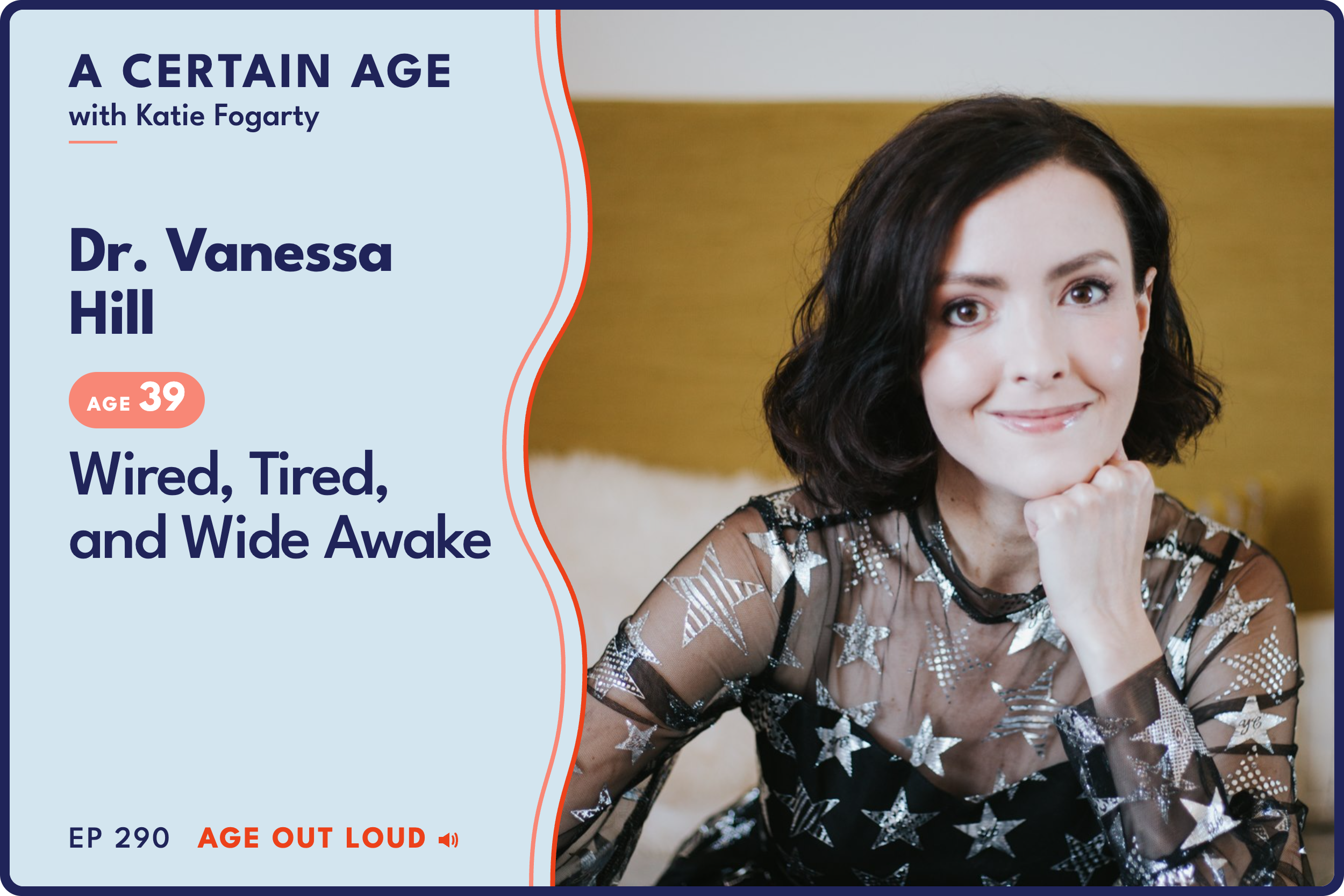
Wired, Tired, and Wide Awake: Sleep Scientist Dr. Vanessa Hill Explains Why
This episode is brought to you by Alloy Health — get $20 OFF your first order of M4 Skincare at MyAlloy.com with code KATIE.
Show Snapshot:
You're running on empty all day, then wide awake the second your head hits the pillow. Dr. Vanessa Hill, behavioral sleep scientist and creator of PBS/YouTube's Braincraft, says nearly half of women in perimenopause deal with real hormonal sleep disruption, hot flashes, 3am wake-ups, but some of what's keeping you up has nothing to do with hormones at all.
In this episode:
The 3 types of bedtime procrastination, and which one might be yours
How to tell hormonal sleep disruption apart from self-sabotage
Why your late-night Instagram habit isn't really a willpower problem
Sleep tech worth buying, and habits worth breaking for good
About Dr. Vanessa Hill: Dr. Vanessa Hill is a sleep scientist and public educator who studies bedtime procrastination and the impact of technology on sleep. She uses behavioral science to develop practical strategies that help people rest better, and is the creator and host of the science series BrainCraft on YouTube and PBS.
Show Links:
Follow Dr. Hill:
Quotable:
Bedtime procrastination is when we somewhat intentionally delay going to bed — doom scrolling, binge-watching, suddenly finding the energy for a to-do list we avoided all day, just to avoid starting the process of going to bed.
Want more? Find more ACA episodes on Sleep:
Transcript:
Katie Fogarty (00:03)
Welcome to A Certain Age, a show for women who are unafraid to age out loud. I'm your host, Katie Fogarty. Beauties, if you're craving a great night's sleep — or privately Googling "sleep divorce" at 1 a.m. — you need this episode. Nearly half of women in perimenopause report real sleep trouble: hot flashes, those middle-of-the-night wake-ups, the wired-but-tired feeling. That's biology. But some of what's keeping us up isn't hormones at all — it's us scrolling Instagram instead of clocking better Zzz's, and then beating ourselves up about it in the morning.
My guest today knows the science behind a great night's sleep, and she has the data to back it up. Dr. Vanessa Hill is a behavioral sleep scientist, science communicator, and creator of the YouTube and PBS series Braincraft. Her peer-reviewed research on bedtime procrastination has been published everywhere, from academic journals to Samsung's Wellness Council, where she advises on sleep tech.
Today we're getting into it: the three types of bedtime procrastinators, and which one shows up most in women 40-plus. How to actually tell if it's hormonal disruption or self-sabotage. Why roughly a third of couples are now sleeping in separate beds, and whether that's TMI or genius. And a full nightstand audit — what tech earns a spot by your bed, and what needs to go tonight.
Dr. Hill's mission is simple: help tired people rest. This tired person is here for it. Welcome to A Certain Age, Dr. Hill.
Dr. Vanessa Hill (01:20 approx.)
Thanks for having me, Katie.
Katie Fogarty (01:24 approx.)
I am very excited about this because this is a topic that resonates so deeply. I can't tell you how many text threads I'm in, how many conversations I have with listeners and women in my life who lament how exhausted, tired, and sleep-deprived we feel. Your research puts a name to something millions of us do but never really had language for. Walk us through your definition of bedtime procrastination, and how it shows up in our sleep for so many of us.
Dr. Vanessa Hill (02:06)
So bedtime procrastination is when we somewhat intentionally delay going to bed. And I want to come back and unpack this "somewhat," because I think there's a lot of nuance and context here that people deserve more information on. This could look like doom-scrolling on our phone, binge-watching a Netflix series, or suddenly getting through a to-do list we didn't have the energy for during the day — just because we want a reason not to have to start that process of going to bed.
Katie Fogarty (02:40)
So your research is into bedtime procrastination, and you've identified and named three patterns: the autopilot procrastinator, the revenge procrastinator, and the avoidance procrastinator. Walk us through your definition of each of these patterns, and then I'd be curious to know which shows up most for women 40-plus.
Dr. Vanessa Hill (02:59)
So when we're thinking about these different types of procrastinators, I want people to imagine it as a way to understand their behavior more — not as a definitive type or profile, like a personality test where you get one result and that's you for the rest of your life. Some people rotate through these different reasons for procrastination; on any given night, though, one of these will probably show up the most in your behavior if you're procrastinating your bedtime.
The autopilot procrastinator I find fascinating. This is when you're procrastinating your bedtime purely out of habit. In psychology research, we define a habit as something you do without consciously realizing it — a behavior you've repeated so many times that it happens automatically. One example: you pick up your phone to order groceries, click on Instagram, and suddenly think, "Wait, how did I end up watching 20 Instagram stories?" That's a classic habitual behavior — you were on autopilot, and the motion of picking up your phone and clicking the app happened entirely beneath your level of conscious awareness.
So that's the autopilot procrastinator: someone with such a strong habit of switching something on or scrolling that they never consciously deliberate about it. You haven't sat down and said, "I'm really tired, I want to do something low-effort, I'm going to grab my phone and watch 20 Instagram stories." That wasn't a conscious choice. And this often happens even after you've made a conscious choice to do something else — maybe you decided, "I'll just reply to three emails," and suddenly you've been on Pinterest for an hour with no idea how you got there or where that pinboard came from. You have this "come-to" moment where you think, "Wait, what is happening?" That's just habit taking over, and it happens more in the evening than in the morning — we rely on a lot of these habitual behaviors at night, when our brains are tired and we don't want to make conscious decisions anymore, because we've been making them all day and we're exhausted. We just take the path of least resistance. That's what autopilot procrastination looks like.
The revenge procrastinator is someone who just needs some "me time" — time to decompress. It's called revenge bedtime procrastination because you're taking revenge on something in your day that stole that time from you. It could be your employer, your children, or your parents, if you're in that sandwich generation caring for both parents and kids at once. Basically, you're getting revenge on the day, because bedtime is the only time you have autonomy — there's silence, and you can finally do whatever you want without being interrupted.
The avoidance procrastinator is avoiding going to bed altogether. It could be because you don't want to face the next day — maybe it's Sunday night, and you know you have to set an alarm and get up early for work Monday morning, and you don't quite want to do that. Or you could be avoiding bed because you know you'll wake up at 2 a.m. sweating, uncomfortable, and unable to fall back asleep. There are a number of different reasons you might avoid going to bed, but avoidance is really what's driving the behavior.
Katie Fogarty (06:49)
I'm sure my listeners can identify themselves in all three of these forms of procrastination, because I feel like we all cycle through them — I've certainly done each one at different points in my life. But many of my listeners are 40, 50, 60, and going through hormonal transitions — perimenopause, menopause — which disrupt sleep hormonally: progesterone declines, hot flashes happen, real wake-ups occur. If a midlife woman is up at midnight, how does she really untangle "my hormones did this" from "I did this to myself"?
Dr. Vanessa Hill (07:23)
I want to reframe this question — or at least reframe the way of thinking about it.
Katie Fogarty (07:30)
Yes, please.
Dr. Vanessa Hill (07:30)
I don't like to think that bedtime procrastination is something we're guilty of, that we've done to ourselves, and should feel bad about. Even if it's not bedtime procrastination but some other habit, there are genuine reasons why we do these things, and they're not something to blame ourselves for. Even if we're revenge-procrastinating our bedtime — some of my research suggests that personal autonomy is a psychological need we all have. Decompressing before bed is a way people de-stress; it's a genuine psychological need. So there are real needs driving these behaviors, and I really don't want people to feel guilty about delaying their bedtime, because there are all these other needs alongside sleep that could be driving the behavior.
Katie Fogarty (08:32)
Yeah, that's such a generous reframe — recognizing there's a psychological need behind why we might be practicing some of these patterns, to create an escape for ourselves or a release valve that, honestly, modern life requires. And I think you've outlined all the reasons women might be up: thinking about caregiving for their parents, their children, their careers, their spouses, themselves. It's a lot. So when you're working with someone who comes to you and says, "I want to achieve better sleep, but I also want to be generous with myself in how I approach habit change" — what are some of the ways you suggest they tackle each of these patterns?
Dr. Vanessa Hill (09:19)
Sure. Something I like to remind people of is that our brains genuinely operate differently at night than in the morning, and there's been so much research showing this — dating back to the late 1800s, which I find really impressive. Some of the first psychological experiments using the scientific method looked at how brains operate differently across the day. At night, our executive function is impaired, our ability to regulate emotions is impaired, and we learn more slowly in the evening compared to the morning. Our brains run more on habit and autopilot processes at night than they do in the morning — they're naturally less logical in the evening.
One thing I encourage people to do is think about how much "me time" they need in the evening to reclaim that sense of personal autonomy, to decompress and de-stress before bed. And I encourage people to make that call in the evening, not the morning. If you're listening to this podcast on your commute, or at 8 a.m., or on your lunch break, you're coming from a place of rationality and logical thinking that may not show up in your brain at 10 p.m., when you're deciding whether to watch another Netflix episode or scroll your phone. So make that call at 10 p.m.: how much me-time do you actually need in that moment? Decide in the moment you'll actually be in every day, rather than in the morning, when your logical brain is planning your ideal day.
Say you decide you need 60 minutes of decompression time after you've put your kids to bed, answered your emails, done your chores — whatever shows up in your life. Think about an activity that genuinely gives you that personal time to decompress, and let's not put value judgments around it. If you genuinely want to watch YouTube videos for 30 minutes, or create — I was going to say create a Pinterest board, I don't want that to sound demeaning, I genuinely do that. I've been doing home renovations, and sometimes I just want to spend 45 minutes on Pinterest looking at tile.
Katie Fogarty (11:59)
Exactly. Everyone has something like that — something that feels like a delicious treat. I think we all have our own version of a Pinterest board in some form.
Dr. Vanessa Hill (12:07)
Exactly, exactly. Pick that thing, set aside time for it, and then one of the most important things is to think about how you finish doing it. Because what can happen is our autopilot brains take over, and we end up doing it for a lot longer than we intended, which can negatively impact our sleep. So I encourage people to use an external cue to remind themselves it's time to start their bedtime routine. Bedtime routines don't need to be complicated — you can simply brush your teeth and go to bed. If you're into skincare, that's a good way to decompress and switch from whatever activity you were doing into getting into bed.
Katie Fogarty (12:54)
It's so important to have these cues. You were talking about skincare — washing your face, applying your serums — it signals to your brain that it's time to get ready for bed. I feel like when we build these habits and cues, it's so much easier, because I know this about myself: when I do wind-down yoga, I'm going to have a great night's sleep. But when I tumble into bed with my phone, fifty-five minutes pass, and I'm watching pantry-organizing videos, wondering, "What happened?"
Dr. Vanessa Hill (13:19)
Right — it only gets easier to do these things as the habits get stronger. The more you repeat them night after night, the less you have to deliberate. If you're trying to start a new bedtime habit, you might be lying on the couch at 11 p.m. and it feels so effortful — you have to peel yourself up, walk up the stairs, do all these things, get into bed, and try to fall asleep. It can feel really difficult, but the more times you do it, the easier it becomes.
When I talk about external cues to remind yourself it's time to think about bed, I mean things like having your smart lights go off at a certain time, or setting your phone to switch to grayscale at 10 or 10:30 p.m. — having these external things on a timer, so suddenly you're reminded: okay, my phone, my watch, my alarm just went off, reminding me it's time for bedtime. A lot of these external cues can really pull us out of the zone we get into — that extreme focus on looking at tiles online, or whatever it may be.
Katie Fogarty (14:33)
Yeah, technology is very seductive — it pulls you in and wants to keep you there. So it's smart to build those external cues right into the tech itself. Okay, we have to take a quick break, but when we come back, Vanessa is going to tell us what sleep tech is worth your hard-earned coins and what is just hype — including whether that white noise machine everyone swears by actually does anything. We'll be right back.
— AD BREAK —
Katie Fogarty (15:00 approx.)
Vanessa, we're back from the break. Before we went into it, we talked about something as simple as setting your phone to grayscale to say, "Hey, you're heading into sleep mode," or having an alert pop up that says, "Ten minutes till sleep mode." I find this so helpful, because it pops up right when I'm hanging out on Instagram in pantry-reorganizing mode. So I'd love to hear from you — you sit on the Samsung Wellness Council, you've done a lot of research into tech — let's get into the sleep aids, techniques, and tech that deserve a spot on our nightstand. You practice this in your own life: you have a phone-free bedroom, but you use an iPad loaded with meditations as a sleep aid, so you distinguish between passive and interactive tech. Let's explain to our listeners what that means, why defining these types of technology is a helpful starting point, and then get into some specific devices.
Dr. Vanessa Hill (15:51)
Sure. A lot of us feel really guilty about using technology before bed. There's a very simplistic narrative on social media that technology ruins our sleep, that blue light ruins our sleep — and like most things, it's actually nuanced. There have been a lot of studies showing that a small amount of phone or tech use before bed doesn't really move the needle on sleep metrics.
Something that can have a much bigger negative impact on our sleep is actually our ceiling lights. If you're in your bedroom with a bunch of downlights or really bright LEDs on full blast, that light is going to be a lot brighter than the light coming from an old tablet or your phone. So I'd like people to think about light holistically, rather than just demonizing the device in their hand.
My academic research has found that when we try something like a digital detox — taking away people's phones or tech before bed — a common response is, "Well, what do I actually do with that time?" What do I do with the hour before bed when I can't use technology? Some of us have found tech-free routines — knitting, crocheting, reading a physical book — and if you've built that into your schedule, that's great, keep doing it.
For a lot of us, though, tech has just become ingrained in our lives. People use technology as sleep aids — apps like Calm, crossword apps, meditations — and they can be really effective at helping us decompress and wind down. There's no reason to feel guilty about using those if you're still keeping a regular bedtime and bedtime routine. In my own life, I have an old tablet with a crossword app, audiobooks, and some meditations on it, and I keep that next to my bed, because I don't want my phone next to me — I don't want to get text messages or work emails, or have the urge to check them in the middle of the night. But when I do wake up in the middle of the night, which is frequent, I often just need to listen to something to help me fall back asleep.
When we're talking about the line between what stays and what goes, if you look at the research, there's a distinction between passive and interactive technology. Passive technology is what I mentioned — things we can think of as sleep aids: podcasts, audiobooks, meditations, things that distract our brains in a way that helps us fall asleep. I like to say I have a brain that needs to be distracted to sleep, or I'm just lying in bed staring at the ceiling, going over my mental to-do list for tomorrow. Interactive tech is what keeps us up more — things that are communication-based, like messaging friends, or playing an online game with a social component. Things that engage our brain, like scrolling through Instagram or Facebook and seeing photos of friends — that social nature can really keep us up. So when we're thinking about ways to use technology to decompress and wind down, I encourage people to think about what's passive for them — what really calms their brain in a way that helps them drift off, rather than keeping it engaged.
Katie Fogarty (19:25)
Yeah, it's such a wonderful distinction — what's going to quiet your monkey mind? You said you have a brain that keeps you up with a to-do list; my brain is hopping all over the place, thinking of a million things. I've learned over the years that yoga quiets my mind, whether I'm doing it in a studio or at home. When I do it at home, I do it with my laptop before bed. I'm curious about some of the technology I've seen you mention — you have a wonderful Instagram, by the way, and listeners should check it out. Why don't you share your Instagram handle now, since we're talking about it? Where can our listeners find you on Instagram?
Dr. Vanessa Hill (19:59)
Yeah, sure — it's Nessie Hill, N-E-S-S-Y-H-I-L-L.
Katie Fogarty (20:03)
At Nessie Hill — and there are a lot of wonderful, practical, actionable sleep tips you can quickly scroll through. Maybe not right before bed, but you'll come away with some good ideas. I saw you talking about white noise machines, and I've been intrigued — I have friends who swear by them, but I've never used one myself; they never seemed like something I wanted. I'm now living in Manhattan again, where I grew up, and it's noisy — we're going to hear a siren go by at some point during this recording, I'm sure. So I'd love to hear your thinking on them — what the data says, whether they're actually useful — just walk us through your thinking on ambient noise for sleep.
Dr. Vanessa Hill (20:46)
There's a popular narrative that you need a white noise machine to sleep, or that it's part of good sleep hygiene. What I find fascinating is that in the baby sleep market, white noise machines are now on at least a third of all baby registries — it's something people really believe is necessary and useful for sleep.
Katie Fogarty (21:09)
Parents are desperate — I have three kids. I would have thought parents would do anything; I completely understand.
Dr. Vanessa Hill (21:16)
And I will say that both my child and I sometimes sleep with a white noise machine — I can talk more about that. But what I find fascinating is that the scientific research is actually inconclusive on whether white noise helps sleep or not. It's one of those things some people swear by and some people find annoying — science doesn't really say one way or the other. There's a narrative that's probably been shaped by a lot of advertising and marketing. If we're honest, it's a product you can buy, there are a lot of ads for it, big companies behind a lot of these machines, and I think that's led to the idea that they're necessary. They're not necessary, but I personally like mine, because I live in a noisy area. I think what white noise excels at is drowning out street noise — I'm in a neighborhood with a lot of sirens and pedestrian noise late at night, so I find it useful for masking outside noise and creating a consistent background for sleep. A lot of the inconclusive studies I mentioned have looked at whether white noise can improve sleep, or change how you move through sleep stages overnight — what the research hasn't really looked at is whether it can simply stop sleep from getting worse.
Katie Fogarty (22:57)
Got it — so inconclusive data, but on a case-by-case basis it could be useful if you're in a noisy area. And I know you're very educated on sleep tech, part of the Samsung Wellness Council, and you do a lot of research on wearables — you have exposure to sleep technology that the average listener, including myself, isn't familiar with. So, what does the sleep data tell us about midlife women? When does tracking become genuinely useful for resetting personal habits, and when can it become more anxiety-inducing than useful?
Dr. Vanessa Hill (23:31)
It can be really useful for simply knowing how you slept. I know that sounds basic, but there's something called sleep state misperception, where you might wake up once during the night but have such a vivid recollection of it that you think your sleep was terrible — when actually you got seven hours of good-quality sleep and just had one half-hour window where you woke up. That's normal sleep by any definition, that's good sleep by any definition. But our perception of our sleep affects our behavior enormously — this has been studied scientifically. There are fascinating experiments where scientists woke people up after eight hours of great sleep, told them they'd had four hours of awful sleep, and those people performed worse on executive-function tasks afterward. So how we think about our sleep can actually affect how we go through our day.
I've experienced this a lot myself — I have young kids who wake me up overnight, and I'll think, "I had such a bad night's sleep, I got woken up, I had to use the bathroom, I was hot, all these disruptions." But when I actually look at the data from the watch I wear to sleep, I can see I got a good sleep score — enough sleep to get me through my day. That can be really reassuring. If you have perfectionistic tendencies, or are anxious about your health in any way, you can start to obsess over this data, which can backfire. A lot of sleep-tracking data isn't meant to be looked at every single day — you get more use out of it by looking at patterns over time. It's interesting to see how your sleep changes year to year. The thing about aging is that our sleep naturally changes as we get older — it's normal to sleep less as we age. Think about a two-year-old: they're probably sleeping 14 hours a day.
By the time you're in your sixties, it's normal to sleep around six hours a night. Over the course of a lifespan, we go from 14 or 15 hours a day as a young child to maybe six hours a night — and that doesn't happen all at once. You don't turn 65 and suddenly start sleeping five and a half or six hours; it happens gradually over your lifespan, and that's normal. There's no reason to feel awful if you're not getting seven or eight hours of sleep in your fifties, because that isn't realistic for a lot of people.
Katie Fogarty (26:22)
Yeah, that pattern recognition is so important. I've had multiple sleep experts on the show who've talked about the myth of a "perfect eight hours" of sleep, and how people feel inadequate if they haven't gotten that. What you just shared — that people's perception of their sleep affects how they feel, independent of the proven data on how they actually slept — is fascinating. I experienced that myself. I was a Fitbit user for many years — I'd wake up feeling amazing, then look at my Fitbit and it would tell me I'd had interrupted sleep, and suddenly I'd feel awful.
Dr. Vanessa Hill (26:54)
Right — it works in both directions. For some people, it's genuinely not good to look at it every morning.
Katie Fogarty (27:01)
And I had to break up with it. But this notion — which I've never heard anyone put quite this way — that you should look at this holistically over a week or several weeks to spot patterns, I think is a much smarter approach to using something like an Oura Ring, a Galaxy Watch, an Apple Watch, or a Fitbit: let it help you see patterns over time. I have a friend who shared that it was wonderful for her to see that after she'd had wine, she didn't sleep as well. We know that intellectually, we've heard doctors say it, but when she saw the proven data on her wearable, it really helped shape how she approached her alcohol consumption. So for those reasons, some of this wearable technology can be so useful.
Dr. Vanessa Hill (27:43)
Yeah, definitely.
Katie Fogarty (27:45)
If someone's interested in a wearable, is there something you recommend they start with? Where do you advise patients to start?
Dr. Vanessa Hill (27:53)
I don't think there's a need to get something incredibly fancy — you could spend $800 on a wearable if you wanted to, but if you just want a basic sleep tracker to look at patterns over time, the entry-level products use a lot of the same algorithms and sensors as the more expensive ones. So I'd start there. You can even start with something as simple as pen and paper — find a sleep diary; there are plenty of free ones available online. That's actually what we use a lot in research too — you just record the time you fell asleep and the time you woke up. If you just want a general sense of whether you're sleeping consistently, and what the pattern looks like, or if you want something you can set and forget without thinking about it, some of the entry-level options are certainly as good as the more expensive ones.
Katie Fogarty (28:49)
Great to hear — and free is good, by the way. That pen-and-paper system sounds like a wonderful starting point, because if you're not going to track consistently even that way, you're probably not going to use a more expensive wearable's data comprehensively either. Such smart advice. I want to ask about something I saw on your website, or maybe your Instagram — a stat that really caught my attention: roughly 35% of people sleep in a different bed than their partner. Sleep divorces, or sleep separations, are becoming a deliberate choice — a trend rather than a taboo. Many women who listen to the show navigate night sweats, restlessness, and partners' snoring — sometimes both partners snore. I did an episode on the onset of midlife sleep apnea in women with Dr. Shelby Harris, because that's common due to estrogen changes. Is it time to normalize separate beds as a legitimate midlife sleep strategy? What should a couple really consider before making that switch — because mattresses are expensive, this isn't like investing in pen and paper. What's your thinking on separate beds?
Dr. Vanessa Hill (30:00)
I think it's time to normalize having the option, or being able to make that choice. It's not necessary to always sleep in the same room as your partner — particularly if you've been together or married a long time and you're facing some of these new midlife challenges. There are products and technologies that can make it possible to share the same room: you can get beds that are essentially a king bed but built from two separate single beds, so you can have different mattresses, avoid being disturbed by your partner's movement, and use white noise machines that can help drown out snoring. If you have space constraints — say you're in Manhattan and don't have a spare bedroom — there are ways to make sharing a room more comfortable.
There is research showing that sleeping in the same room, or same bed, as your partner can lead to more restorative sleep — some of us feel more comfortable and safe sleeping next to our partner, and that shouldn't be discounted; it may be good for the quality of the relationship. I think we should also have the option of a separate room to sleep in if we need to deal with snoring or night sweats. In terms of considerations: there are cooling mattresses that can help with menopause or perimenopause symptoms, and cooling pods you can get to go over your mattress. There are a lot of new technologies that can help if you're sleeping hot, and that might not be for everyone — it might work for you and not your partner, which could be a reason to set up a spare bedroom.
Katie Fogarty (31:00 approx.)
Sleep is so personal, and there's such a wide variety of factors that help you identify how, where, and who you want to be sharing your bed with — thank you for walking us through some of that. We've mentioned a lot of sleep technology: noise machines, wearables like watches and rings, optimizing your mattress. Is there a piece of sleep tech I haven't asked you about that you think should be on our radar?
Dr. Vanessa Hill (31:25 approx.)
Going back to what I mentioned earlier — that I really rely on podcasts, meditations, and audiobooks to fall asleep, particularly when I wake up in the middle of the night — I'm a minimalist. I don't love buying new tech, or having drawers full of boxes and products; I don't have that much space. So I just use a normal earbud, which isn't a perfect system. I'm a sleep scientist, I advise people on this, but most mornings I wake up with a random earbud somewhere in my bed, underneath my pillow, because I listened to something...
Katie Fogarty (33:06)
...hidden in your sheets somewhere.
Dr. Vanessa Hill (33:07)
Yes — and it's fallen out of my ear. It's been through the wash in the sheets, it's not perfect. There are certain earbuds designed to fit cleanly and comfortably in your ear for sleep. There are speakers you can get that go under your pillow, and headbands with Bluetooth headphones built in. There are a lot of specialty products you can wear if you want to listen to meditations, music, or audiobooks to help you fall asleep.
Katie Fogarty (33:41)
I'm off to Google all of that — they sound like wonderful tools. When we're looking at our bedside table, if we're adding a few new devices, you've suggested some — but what should we be subtracting? What doesn't belong on our bedside table when it comes to tech, or any other tools, when we're thinking about better sleep optimization?
Dr. Vanessa Hill (34:00)
I really love this way of thinking, because when we struggle with sleep — and this goes for other areas of health too — our default mode is to think about what we can buy, what we can add that might help. But in a lot of cases, it's actually about what we can subtract, what we can do less of. We don't always need to buy something new to improve our health or sleep; in many cases, it's about taking things away. Our phones are just attached to us so closely — I think subtracting your phone from your bedside table is a really solid way to reduce disruptions while you're falling asleep and overnight. I like to leave my phone in the kitchen, in a different room. That's meant — even though I just made this whole speech about buying and doing less — that I've had to buy an alarm clock, since a lot of us use our phones as an alarm, and without that, you need another way to wake up in the morning. So I've added an alarm clock, but for me, that's been a really good switch, and it can be a powerful switch for a lot of us who want to disconnect from work, the news cycle, or doom-scrolling, before bed or overnight.
Katie Fogarty (35:21)
Vanessa, I love that piece of advice, because I'm firmly Gen X — I grew up waking up with an alarm clock my whole life, and it's great that we can be lo-fi and low-tech to upgrade our sleep. We don't have to use our phones; we can go back to something as simple as a physical, manual alarm clock ringing to get us out of bed.
Dr. Vanessa Hill (35:39)
And you know what? Alarm clocks are so much nicer now than when you were a teenager — you can get ones with ocean-wave sounds, birds chirping, even a simulated sunrise. It's not the blaring alarm of our childhoods.
Katie Fogarty (35:56)
Absolutely — I've seen beautiful alarm clocks that slowly light up and create almost a sunrise effect. What role do those play in our ability to wake up better? Do you think we should be getting light exposure as we get out of bed in the morning?
Dr. Vanessa Hill (36:12)
Oh, light exposure is wonderful — it's key to setting our circadian rhythm, improving mood in the morning, and giving us a general feeling of alertness. Sunrise alarm clocks can be really great for feeling less groggy in the morning; if you're in a deeper stage of sleep and a blaring alarm wakes you up, that can really jolt you awake and leave you groggy. Whereas with a 30-minute sunrise window, you can wake up at whatever point your body naturally wants to within that window, and start your day more calmly and with more energy than waking up randomly. So I quite like them — though I actually sleep with a sleep mask, because I have too many windows in my bedroom, so I can't personally use a sunrise alarm clock. But in theory, I think they're really great.
Katie Fogarty (37:11)
I'm a sleep-mask addict over here. If I could find a sleep-mask sponsor for this podcast, they'd be delighted, because I never shut up about my sleep masks and how much I love them.
Dr. Vanessa Hill (37:23)
Same — and the other thing I'd add to a bedside table is a lamp. I mentioned earlier in the episode how the brightness of ceiling lights can really affect people's sleep — when they're too bright, they can suppress our melatonin production. A lot of research has shown this, with people wearing portable light meters around their homes and finding that ceiling lights are just way too bright. So having a lamp — maybe in a warmer, orange or red tone, not necessarily right on your bedside table — and dimming the lights, switching to lamplight in the evening, can really help you wind down for sleep.
Katie Fogarty (38:00)
Another great, inexpensive, easy fix — simply swapping out your light so that when you're reading in bed, you're getting the kind of light that helps you hit the hay and sleep better. I love that actionable advice. So, we're nearing the end of our time together — you've shared so many great ideas. In a minute I'll have you share where listeners can keep following you and find your work, thinking, and research. But first, I want to leave them with one last idea: if a listener is going to do just one thing tonight based on this conversation — not a big five-step plan, just one thing — what's the highest-leverage move she can make before she gets into bed?
Dr. Vanessa Hill (38:37)
Think about the most powerful way you can truly decompress and de-stress before bed. If you had 30 minutes to do anything that would set your mind at ease, relax your body, and get you ready to fall asleep, what would that be for you? It looks a little different for everyone, and that's okay — we're all unique, beautiful people. Think about what that is, and then think about how you can build it into a routine you do every day — not a new five-step plan, just leveraging whatever it is you're already doing to decompress before bed.
Katie Fogarty (39:19)
Vanessa, thank you so much for your time today. I so enjoyed hanging out with you and learning more about your work, your research, all things sleep and sleep tech. Where can our listeners find you and keep following what you're up to?
Dr. Vanessa Hill (39:32)
If you want to follow me on Instagram, my handle is at Nessie Hill. On Substack, it's nessiehill.substack.com.
Katie Fogarty (39:46)
Phenomenal — I'll put those all in the show notes. Beauties, if this episode has you rethinking your nightstand, go back and listen to my conversation with Dr. Shelby Harris on midlife sleep apnea — we get into why snoring and disruptive breathing spike for women in perimenopause and menopause, and what to do about it. Sleep is one of those things we come back to again and again on this show, because it touches everything: your mood, your memory, your relationships, your energy, your sense of self. We want to get a great night's sleep, wake up, and feel awesome and ready to tackle our day. Thank you so much again for your time today, Vanessa.
This wraps A Certain Age — a show for women who are aging without apology. Special thanks to Michael Mancini, who composed and produced our theme music. See you next time, and until then — age boldly, beauties.
